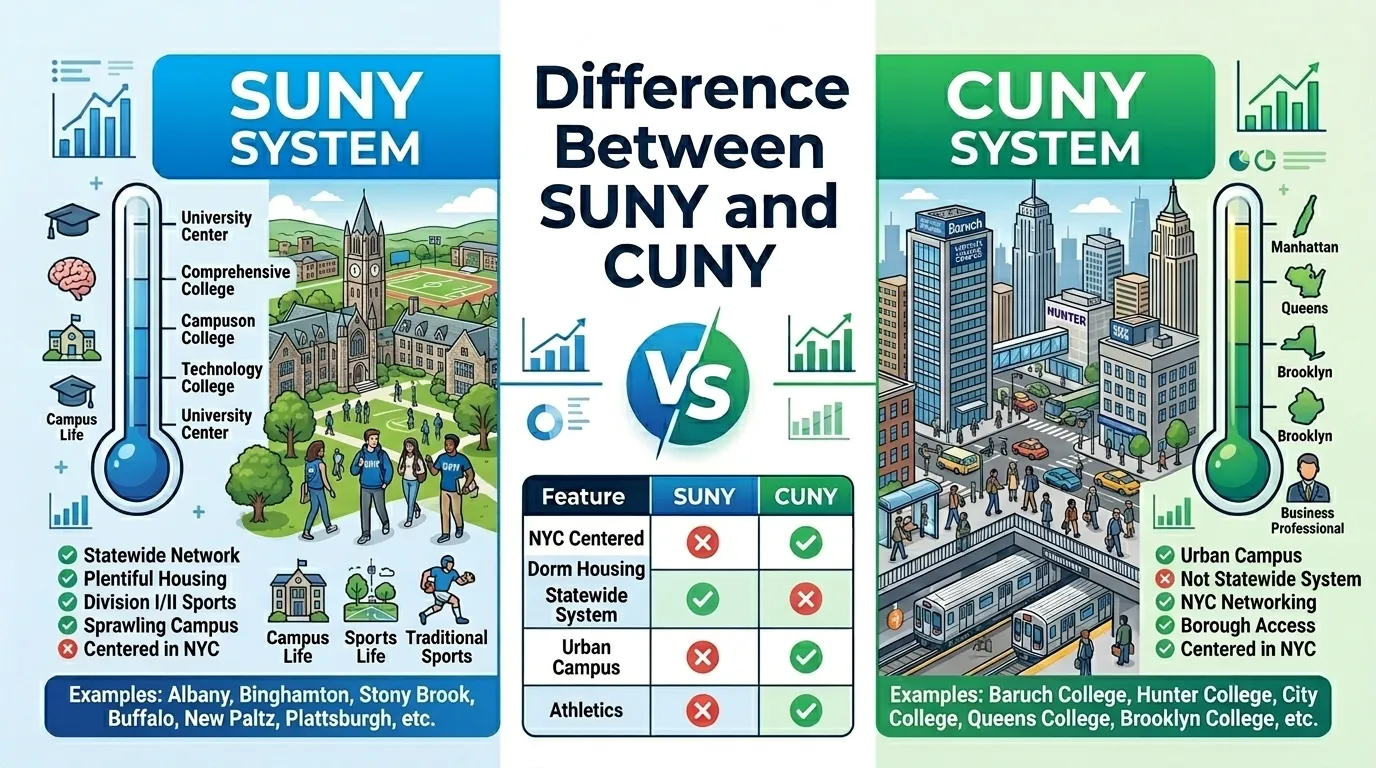
Many students get confused when comparing the difference between SUNY and CUNY because both are large public university systems in New York. At first glance, they may seem similar, but there are important distinctions in location, campus experience, tuition costs, academic offerings, and student demographics.
If you’re searching for the difference between SUNY and CUNY, you’re likely trying to decide which system fits your educational goals. Understanding the difference between SUNY and CUNY can help you make a smarter college decision and avoid costly mistakes.
In this guide, you’ll learn what SUNY and CUNY are, how they compare, their similarities, admissions requirements, costs, career opportunities, and which option may be best for different types of students.
Quick Answer: Difference Between SUNY and CUNY
The main difference between SUNY and CUNY is location and campus structure.
- SUNY (State University of New York) operates campuses throughout New York State and includes large residential universities.
- CUNY (City University of New York) primarily serves students within New York City and focuses more on commuter education.
For example, a student wanting a traditional college experience with dorms may prefer SUNY, while someone living in New York City who wants affordable education close to home may choose CUNY.
Definition of SUNY and CUNY
- SUNY (State University of New York): A statewide public university system consisting of universities, colleges, and community colleges across New York State.
- CUNY (City University of New York): A public university system serving New York City with colleges located across the city’s five boroughs.
Example: A student attending college in Buffalo may choose SUNY, while a student studying in Brooklyn may attend CUNY.
Pronunciation of Both Systems
| Institution | US Pronunciation | UK Pronunciation |
|---|---|---|
| SUNY | Soo-nee | Soo-nee |
| CUNY | Cue-nee | Cue-nee |
Now that you know what each system is called and how to pronounce them, let’s understand the key differences that matter to students.
Difference Between SUNY and CUNY: Comparison Table
| Feature | SUNY | CUNY |
|---|---|---|
| Full Name | State University of New York | City University of New York |
| Coverage Area | Entire New York State | New York City only |
| Campus Count | Large statewide network | Campuses within NYC boroughs |
| Student Lifestyle | Residential and commuter | Mostly commuter-focused |
| Campus Environment | Urban, suburban, and rural | Primarily urban |
| Dormitories | Widely available | Limited compared to SUNY |
| Tuition | Affordable public rates | Often lower for NYC residents |
| Program Variety | Extensive statewide offerings | Strong urban-focused programs |
| Research Opportunities | Large research universities | Strong research at selected campuses |
| Student Population | Diverse statewide students | Highly diverse city population |
Key Differences Explained Between SUNY and CUNY
1. Geographic Reach
SUNY campuses are spread throughout New York State. Students can study in rural towns, suburbs, or major cities.
CUNY campuses are concentrated entirely within New York City.
Real-life example: A student wanting to leave the city may choose SUNY, while one wanting to remain in Manhattan or Brooklyn may choose CUNY.
2. Campus Experience
Many SUNY schools offer a traditional residential college experience with dormitories, athletic programs, and campus communities.
CUNY institutions often serve commuting students who travel from home.
3. Size of University System
SUNY is one of the largest public university systems in the United States.
CUNY is also large but focuses specifically on serving New York City’s educational needs.
4. Academic Diversity
SUNY includes specialized institutions for technology, agriculture, medicine, and research.
CUNY excels in urban studies, public service, business, education, and community-focused programs.
5. Student Demographics
SUNY attracts students from across New York, other states, and international locations.
CUNY has a particularly diverse student population representing many cultures and languages found in New York City.
6. Housing Options
Many SUNY campuses provide extensive student housing.
CUNY students are more likely to commute, though some campuses offer residence halls.
7. College Environment
SUNY provides rural, suburban, and urban choices.
CUNY offers a distinctly city-centered educational experience.
8. Career Networking Opportunities
CUNY students benefit from direct access to businesses, nonprofits, media organizations, and corporations located in New York City.
SUNY students often gain opportunities through regional partnerships across the state.
What Is SUNY and How Does It Work?
SUNY was created to provide affordable public higher education throughout New York State.
The system includes:
- Community colleges
- Comprehensive colleges
- Research universities
- Professional schools
Students can choose from hundreds of academic programs ranging from engineering to healthcare and education.
One advantage is flexibility. Students can experience different living environments while earning a respected degree.
What Is CUNY and How Does It Work?
CUNY was established to provide accessible higher education for residents of New York City.
Its institutions are located across:
- Manhattan
- Brooklyn
- Queens
- Bronx
- Staten Island
Many students attend classes while working part-time or full-time jobs.
This practical structure makes CUNY especially attractive for working adults and first-generation college students.
Why Does the Difference Between SUNY and CUNY Exist?
Many users ask, “Why are SUNY and CUNY separate systems?”
The answer lies in history and administration.
SUNY was designed to serve the entire state.
CUNY was created specifically to meet the educational needs of New York City’s large population.
Because their missions differ, each system developed unique strengths and educational models.
Difference Between SUNY and CUNY in Tuition and Costs
Cost is often a deciding factor.
SUNY
- Affordable public tuition
- Housing costs may increase total expenses
- Financial aid widely available
CUNY
- Generally among the most affordable urban university options
- Lower living expenses for students already residing in NYC
- Strong financial aid programs
In practical use, commuting from home can significantly reduce overall educational costs.
Difference Between SUNY and CUNY for Academic Programs
SUNY Strengths
- Engineering
- Agriculture
- Healthcare
- Environmental sciences
- Research programs
CUNY Strengths
- Business
- Public administration
- Education
- Journalism
- Urban studies
Most beginners assume one system is academically superior. In reality, the better choice depends on the student’s major and career goals.
Difference and Similarity Between SUNY and CUNY
| Feature | SUNY | CUNY | Similarity |
|---|---|---|---|
| Purpose | Statewide education | NYC-focused education | Both provide public higher education |
| Funding | Publicly funded | Publicly funded | Supported by government funding |
| Degrees | Associate to doctoral | Associate to doctoral | Offer accredited degrees |
| Student Diversity | Statewide diversity | Global city diversity | Both welcome diverse students |
| Affordability | Low public tuition | Low public tuition | Affordable compared to private universities |
| Financial Aid | Available | Available | Students can receive aid |
| Career Services | Strong support | Strong support | Both help with employment preparation |
| Academic Quality | High-quality programs | High-quality programs | Recognized educational institutions |
This table clearly shows the difference and similarity between SUNY and CUNY for quick understanding.
Which Is Better: SUNY or CUNY?
A common search query is:
“Which is better, SUNY or CUNY?”
The truth is that neither system is universally better.
Choose SUNY if you want:
- Traditional campus life
- Dormitory experience
- Rural or suburban environment
- Large research universities
Choose CUNY if you want:
- Urban learning
- Commuting convenience
- Lower living costs
- Direct access to NYC industries
The best choice depends on personal goals, budget, and lifestyle preferences.
Common Mistakes with SUNY and CUNY
Mistake 1: Assuming They Are the Same
Many students think both systems operate identically.
Correction: Their missions and campus experiences differ significantly.
Mistake 2: Choosing Based Only on Tuition
Students often overlook housing and transportation costs.
Correction: Compare total educational expenses.
Mistake 3: Ignoring Location Preferences
Some students thrive in city environments while others prefer quieter campuses.
Correction: Consider your ideal learning environment.
Mistake 4: Focusing Only on Rankings
Rankings don’t always reflect program quality for your major.
Correction: Evaluate department strengths.
Mistake 5: Not Visiting Campuses
Campus culture can greatly influence satisfaction.
Correction: Attend tours or virtual visits whenever possible.
Real-Life Examples with SUNY and CUNY
Scenario 1: Traditional College Student
A student from upstate New York wants dorm life, athletics, and campus events.
Best fit: SUNY.
Scenario 2: Working Professional
A New York City resident works during the day and attends classes at night.
Best fit: CUNY.
Scenario 3: Engineering Student
A student seeks advanced research opportunities and specialized facilities.
Best fit: Many SUNY institutions.
Scenario 4: Future Journalist
A student wants internships with major media companies.
Best fit: CUNY’s proximity to NYC media organizations.
Scenario 5: Budget-Conscious Student
A student can live at home and commute.
Best fit: Often CUNY.
When to Use Each: Choosing the Right University System
Choose SUNY When:
- You want campus housing.
- You enjoy traditional college culture.
- You prefer suburban or rural settings.
- You need specialized statewide programs.
Choose CUNY When:
- You live in New York City.
- You plan to commute.
- You want strong urban networking opportunities.
- You need flexibility for work and study.
Why People Get Confused About the Difference Between SUNY and CUNY
Several factors create confusion:
Similar Naming Structure
Both names end with “University of New York.”
Public Funding
Both systems are publicly funded.
Degree Options
Both offer similar degree levels.
Shared State Connection
People assume SUNY and CUNY are branches of the same organization.
However, they operate independently with different administrative structures and educational goals.
Expert Insight
From an educational advising perspective, the most successful students do not choose between SUNY and CUNY based solely on reputation.
In real scenarios, academic fit, campus environment, financial considerations, and career goals matter far more than brand recognition.
Most beginners focus on tuition. Experienced counselors usually evaluate:
- Program quality
- Internship opportunities
- Graduation outcomes
- Campus culture
- Long-term career alignment
The strongest choice is the one that supports your personal and professional goals.
Frequently Asked Questions (FAQ)
Is SUNY better than CUNY?
Neither is universally better. The right choice depends on your academic goals, budget, and preferred campus experience.
What does SUNY stand for?
SUNY stands for State University of New York.
What does CUNY stand for?
CUNY stands for City University of New York.
Is CUNY only in New York City?
Yes. All CUNY campuses are located within New York City’s boroughs.
Does SUNY have dormitories?
Yes. Many SUNY campuses provide extensive student housing.
Is CUNY cheaper than SUNY?
For many NYC residents who can commute, CUNY may result in lower overall costs.
Which system has more campuses?
SUNY generally has a larger statewide network of campuses.
Can international students attend SUNY and CUNY?
Yes. Both systems welcome international students.
Which is better for engineering?
Many SUNY institutions are particularly known for engineering and technical programs.
Which is better for working adults?
CUNY is often attractive for working adults because of its commuter-friendly structure.
Conclusion
Understanding the difference between SUNY and CUNY is essential for making an informed college decision. While both systems provide affordable, high-quality public education, they serve different purposes and student populations.
SUNY offers a statewide network with traditional residential campuses, broader geographic choices, and extensive research opportunities. CUNY focuses on serving New York City students through urban campuses, commuter flexibility, and strong connections to one of the world’s largest economic centers.
When evaluating the difference between SUNY and CUNY, consider more than tuition alone. Think about your preferred learning environment, career goals, housing needs, transportation options, and academic interests. A future engineer may find a SUNY campus ideal, while a student seeking internships in finance, media, or public service may benefit from CUNY’s location advantages.

Sarfraz Ahmad is language researcher and content writer who specializes in explaining the difference between commonly confused English words. Through WordClearify, learners understand subtle word distinctions in a simple, structured, and practical way. My writing focuses on clarity, real-life examples, and easy comparisons for students, bloggers, and professionals worldwide.