Many writers, students, and professionals struggle to understand the difference between semicolon and comma. At first glance, both punctuation marks seem similar because they create pauses within a sentence. However, they serve different purposes and affect sentence structure in unique ways.
Understanding the difference between semicolon and comma is important for clear writing, whether you’re drafting emails, academic papers, blog posts, social media captions, or business reports. Many users search for terms like what is a semicolon, what is a comma, how to use a semicolon, and semicolon vs comma because incorrect punctuation can change meaning and reduce readability.
In this complete guide, you’ll learn the difference between semicolon and comma, when to use each one, common mistakes, practical examples, pronunciation, similarities, and expert writing insights. By the end, you won’t need another article on this topic.
Quick Answer: Difference Between Semicolon and Comma
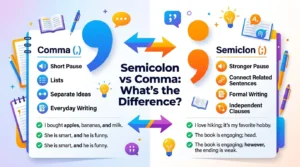
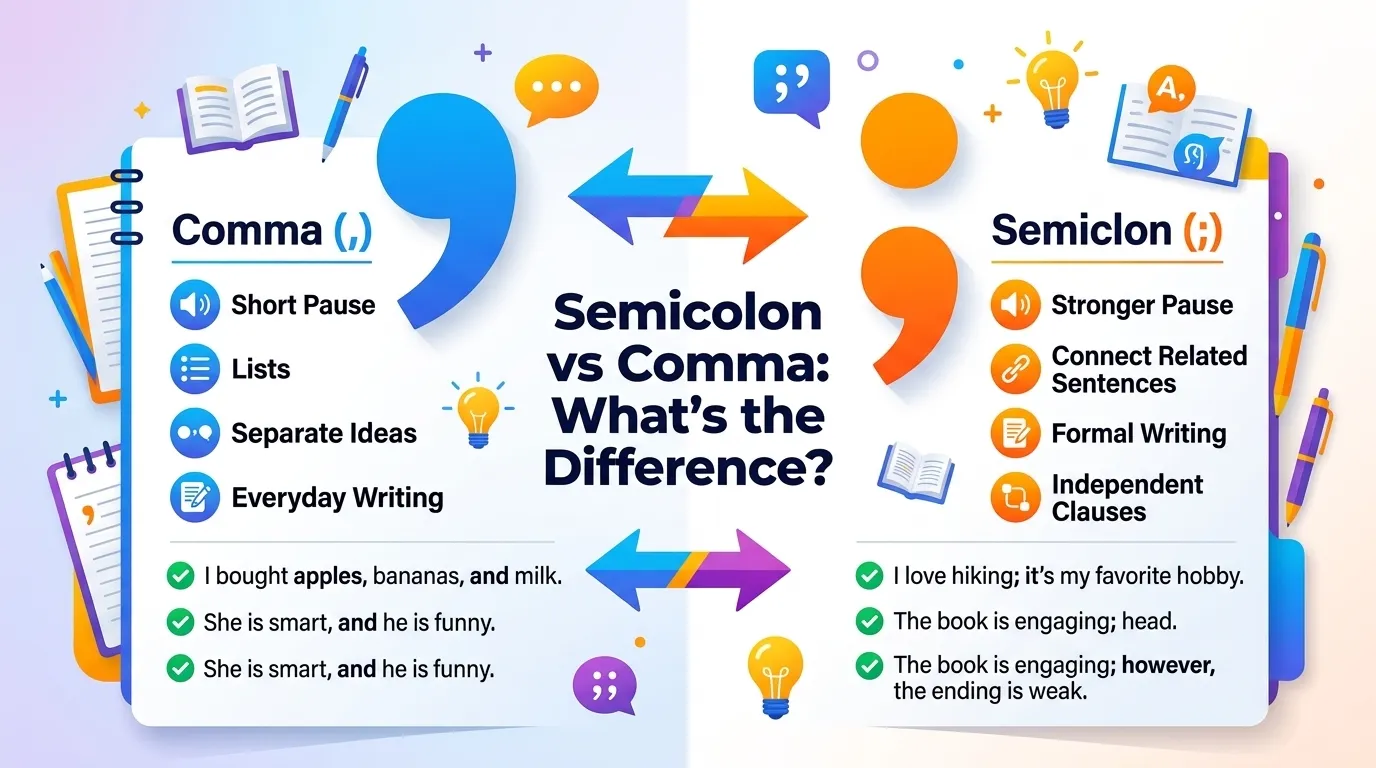
A comma (,) separates items, phrases, or clauses and creates a short pause.
A semicolon (;) connects two closely related independent clauses without using a conjunction.
Example
Comma: I bought apples, oranges, and bananas.
Semicolon: I bought apples; they were on sale today.
In simple words, a comma creates separation, while a semicolon creates a stronger connection between complete ideas.
Definition of Semicolon and Comma
- Comma (,): A punctuation mark used to separate words, phrases, items in a list, or clauses within a sentence.
- Semicolon (;): A punctuation mark used to connect two related independent clauses or separate complex list items.
Quick Example
- Comma: She likes coffee, tea, and juice.
- Semicolon: She likes coffee; her brother prefers tea.
Pronunciation of Both (US & UK)
| Punctuation Mark | US Pronunciation | UK Pronunciation |
|---|---|---|
| Comma | KOM-uh | KOM-uh |
| Semicolon | SEM-ee-koh-luhn | SEM-ee-koh-luhn |
Now that you know how both punctuation marks are pronounced, let’s understand how they function in real writing situations and why so many people confuse them.
Difference Between Semicolon and Comma: Comparison Table
| Feature | Comma (,) | Semicolon (;) |
|---|---|---|
| Purpose | Separates parts of a sentence | Connects related complete thoughts |
| Pause Length | Short pause | Longer pause |
| Independent Clauses | Usually needs conjunction | Often works without conjunction |
| Lists | Commonly used in lists | Used in complex lists |
| Formal Writing | Very common | Common in academic and professional writing |
| Sentence Strength | Weaker separation | Stronger connection |
| Readability | Simplifies sentence flow | Links related ideas smoothly |
| Frequency of Use | Used daily | Used less often |
Example
Comma: I wanted to go outside, but it was raining.
Semicolon: I wanted to go outside; it was raining heavily.
Key Differences Explained Between Semicolon and Comma
1. Strength of Separation
A comma creates a light pause.
A semicolon creates a stronger pause while keeping ideas connected.
Example:
- Comma: She arrived early, and she found a good seat.
- Semicolon: She arrived early; she found a good seat.
2. Independent Clauses
A semicolon can connect two complete sentences.
A comma usually cannot do this alone.
Example:
Incorrect: I love writing, I write every day.
Correct: I love writing; I write every day.
3. Use in Lists
Commas separate simple list items.
Semicolons separate complex list items that already contain commas.
4. Formality Level
Semicolons often appear in academic reports, business documents, and professional writing.
Commas appear everywhere.
5. Reader Experience
A comma keeps writing moving quickly.
A semicolon encourages readers to pause and consider the relationship between ideas.
6. Grammar Function
Semicolons join related thoughts.
Commas organize sentence elements.
7. Error Prevention
Many grammar mistakes involve commas joining complete sentences incorrectly.
Semicolons often solve this problem.
What Is a Comma and Why Does It Exist?
A comma exists to make writing easier to read and understand.
Without commas, sentences can become confusing.
Example
Without comma:
Let’s eat Grandma.
With comma:
Let’s eat, Grandma.
One small punctuation mark completely changes the meaning.
In modern platforms such as Google Docs, Microsoft Word, Gmail, and Meta-owned apps like Instagram and Facebook, commas help improve readability and communication.
Common Uses of Commas
- Lists
- Introductory phrases
- Coordinating conjunctions
- Parenthetical information
- Direct address
What Is a Semicolon and Why Does It Exist?
The semicolon fills the gap between a comma and a period.
It allows writers to connect ideas that are closely related without fully separating them.
Example
The project was finished; the team celebrated.
These are two complete sentences, but they share a strong relationship.
In academic writing, journalism, and professional communication, semicolons help create sophisticated sentence flow.
How Does a Semicolon Work in Real Writing?
A semicolon connects independent clauses.
Formula
Independent Clause + Semicolon + Independent Clause
Example
The meeting ended early; everyone appreciated the extra time.
The second clause explains or expands the first.
Many professional writers use semicolons to avoid repetitive sentence structures.
How Does a Comma Work in Real Writing?
Commas organize information.
Example Types
Lists
We purchased laptops, monitors, keyboards, and printers.
Introductory Elements
After lunch, we returned to work.
Compound Sentences
She studied hard, and she passed the exam.
Commas help readers process information naturally.
Difference Between Semicolon and Comma in Academic Writing
In academic writing, punctuation affects clarity and credibility.
Comma Usage
- Citations
- Lists
- Explanatory phrases
Semicolon Usage
- Linking research findings
- Connecting analytical ideas
- Separating complex data points
Researchers often prefer semicolons when discussing related concepts because they improve flow without creating overly short sentences.
Difference Between Semicolon and Comma in Business Communication
In professional settings, punctuation influences how messages are perceived.
Business Email Example
Comma:
The report is complete, and it is ready for review.
Semicolon:
The report is complete; it is ready for review.
The semicolon version feels more concise and polished.
In practical use, executives, editors, and content strategists frequently use semicolons to improve readability.
Difference and Similarity Table Between Semicolon and Comma
| Feature | Comma | Semicolon | Similarity |
|---|---|---|---|
| Meaning | Separates sentence elements | Connects related complete thoughts | Both improve clarity |
| Function | Organizes information | Links ideas | Both guide readers |
| Pause | Short | Medium | Both create pauses |
| Lists | Simple lists | Complex lists | Both can organize lists |
| Formality | General writing | More formal writing | Both appear in professional content |
| Grammar Role | Separator | Connector | Both are punctuation marks |
| Readability | Enhances flow | Enhances relationships between ideas | Both improve comprehension |
| Usage Frequency | Very common | Less common | Both are essential tools |
This table clearly shows the difference and similarity between difference between semicolon and comma for quick understanding.
Common Mistakes with Difference Between Semicolon and Comma
Mistake 1: Comma Splice
Incorrect:
I love books, I read every night.
Correct:
I love books; I read every night.
Mistake 2: Using Semicolon Before a Fragment
Incorrect:
I enjoy sports; especially football.
Correct:
I enjoy sports, especially football.
Mistake 3: Overusing Semicolons
Too many semicolons can make writing feel unnatural.
Mistake 4: Forgetting Conjunction Rules
Incorrect:
She arrived early; and she prepared the room.
Correct:
She arrived early, and she prepared the room.
Mistake 5: Using Commas in Complex Lists
Use semicolons when list items already contain commas.
Real Life Examples with Difference Between Semicolon and Comma
Personal Use
Comma:
I need milk, eggs, and bread.
Semicolon:
I need groceries; the refrigerator is empty.
Student Writing
Comma:
The lecture ended, and students left.
Semicolon:
The lecture ended; students immediately started discussing the exam.
Business Communication
Comma:
The proposal is ready, and the client approved it.
Semicolon:
The proposal is ready; the client approved it yesterday.
Content Marketing
Writers creating articles for Google Search often use both punctuation marks to improve readability and engagement.
Social Media
On Instagram and Facebook, commas help readability, while semicolons occasionally appear in longer educational content.
When to Use Each
Use a Comma When:
- Writing lists
- Adding introductory phrases
- Joining clauses with conjunctions
- Clarifying sentence structure
Use a Semicolon When:
- Joining related independent clauses
- Creating smoother transitions
- Separating complex list items
- Improving formal writing flow
Quick Decision Rule
If both sides can stand alone as complete sentences, consider a semicolon.
If you’re simply separating sentence parts, use a comma.
Why People Get Confused in Difference Between Semicolon and Comma
Several reasons explain this confusion:
Similar Appearance
Both create pauses.
School-Level Teaching
Many students learn commas extensively but receive limited instruction on semicolons.
Digital Communication
Short-form platforms like Instagram, YouTube comments, and messaging apps encourage simpler punctuation.
Misleading Examples
Online examples sometimes blur the distinction between complete clauses and sentence fragments.
Expert Insight
From an editorial perspective, the biggest mistake beginners make is treating semicolons as decorative punctuation.
In real scenarios, punctuation should always serve readability.
Professional editors generally recommend using commas whenever simple separation is needed and reserving semicolons for situations where two complete ideas share a strong connection.
A useful test is this:
Replace the semicolon with a period.
If both parts still make sense independently, the semicolon is probably appropriate.
This practical method works for students, bloggers, marketers, and business professionals alike.
Frequently Asked Questions (FAQ)
What is the main difference between semicolon and comma?
A comma separates sentence elements, while a semicolon connects related independent clauses.
Can a semicolon replace a comma?
Sometimes, but only when connecting complete thoughts.
Is a semicolon stronger than a comma?
Yes. A semicolon creates a stronger pause and connection.
When should I use a semicolon instead of a period?
Use a semicolon when two complete sentences are closely related.
Can I use a semicolon in a list?
Yes, especially when list items already contain commas.
Why do writers use semicolons?
To connect related ideas smoothly without creating separate sentences.
Are semicolons common in modern writing?
Yes, especially in academic, journalistic, and professional writing.
Is a comma splice a grammar mistake?
Yes. A comma splice occurs when two complete sentences are joined with only a comma.
Which punctuation mark is used more often?
The comma is used much more frequently than the semicolon.
Do search engines care about punctuation?
Indirectly, yes. Clear punctuation improves readability and user experience, which supports better content performance.
Conclusion
Understanding the difference between semicolon and comma is essential for anyone who wants to write clearly and confidently. While both punctuation marks create pauses, they perform very different jobs. A comma separates words, phrases, and clauses to improve readability, whereas a semicolon connects closely related independent clauses without requiring a conjunction.
In practical writing, commas are far more common because they organize information and keep sentences flowing naturally. Semicolons, however, provide a valuable tool for linking complete ideas and creating a more sophisticated writing style. Most beginners struggle because both marks create pauses, but the key distinction is grammatical function rather than pause length.

Sarfraz Ahmad is language researcher and content writer who specializes in explaining the difference between commonly confused English words. Through WordClearify, learners understand subtle word distinctions in a simple, structured, and practical way. My writing focuses on clarity, real-life examples, and easy comparisons for students, bloggers, and professionals worldwide.