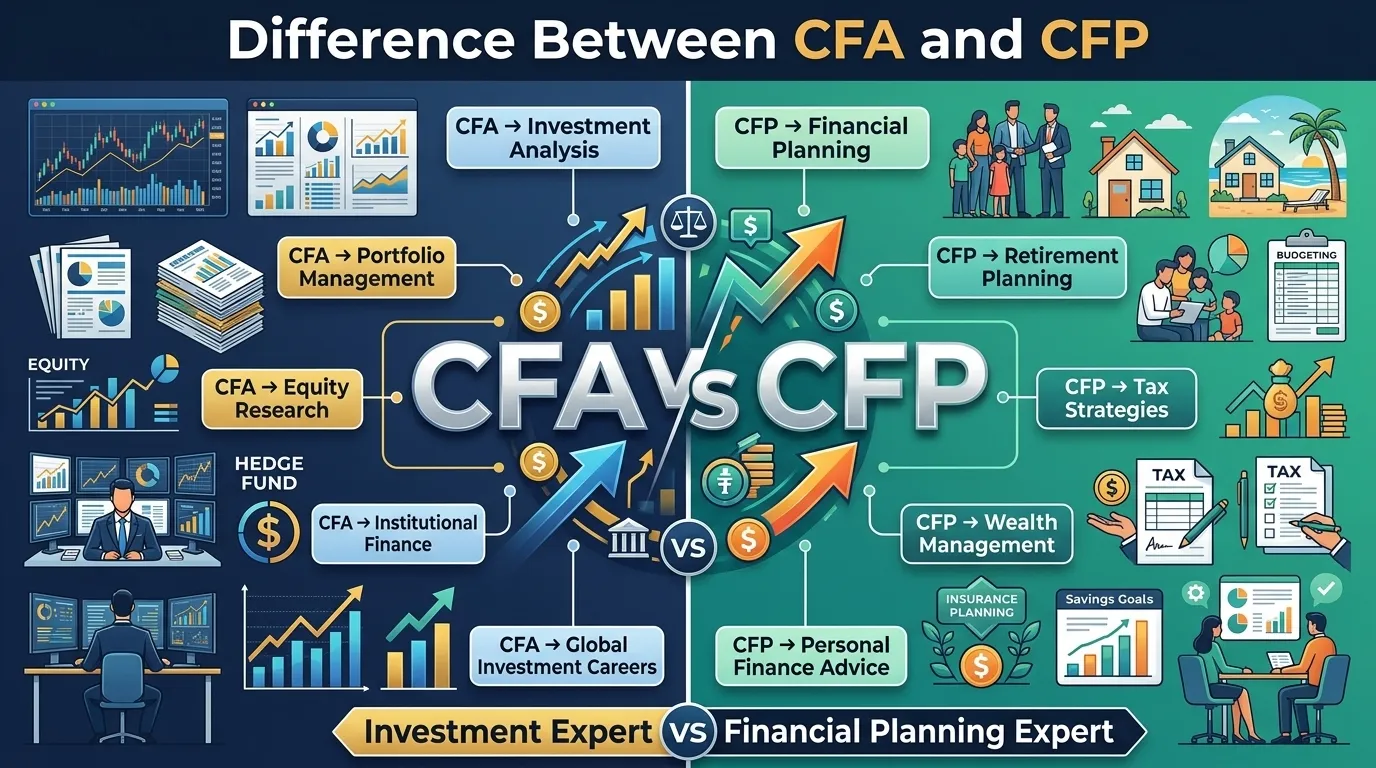
Many people get confused when comparing the difference between CFA and CFP because both are highly respected financial certifications. At first glance, they seem similar, but they prepare professionals for very different career paths.
The difference between CFA and CFP mainly comes down to focus. A CFA specializes in investment analysis, portfolio management, and institutional finance, while a CFP focuses on personal financial planning, retirement strategies, tax planning, and wealth management for individual clients.
If you are researching the difference between CFA and CFP, choosing between these credentials, or wondering which certification offers better career opportunities, this guide covers everything you need to know. We’ll explain definitions, salaries, exam difficulty, career paths, similarities, and real-world applications in a simple and practical way.
Quick Answer: Difference Between CFA and CFP
The CFA (Chartered Financial Analyst) credential focuses on investment management, financial analysis, and institutional investing.
The CFP (Certified Financial Planner) credential focuses on helping individuals manage their finances, retirement plans, taxes, insurance, and wealth.
Example: A CFA might manage a multi-million-dollar investment fund, while a CFP helps a family plan for retirement and college savings.
Definition of CFA and CFP
- CFA (Chartered Financial Analyst): A globally recognized professional designation focused on investment analysis, portfolio management, equity research, and financial markets.
- CFP (Certified Financial Planner): A professional certification focused on personal financial planning, retirement planning, tax strategies, insurance planning, and wealth management.
Simple Example:
CFA = Investment Expert
CFP = Personal Finance Expert
Pronunciation of Both (US & UK)
| Certification | US Pronunciation | UK Pronunciation |
|---|---|---|
| CFA | See-Eff-Ay | See-Eff-Ay |
| CFP | See-Eff-Pee | See-Eff-Pee |
Now that the definitions are clear, let’s understand the key differences that influence careers, salaries, and professional opportunities.
CFA vs CFP: Comparison Table
| Feature | CFA | CFP |
|---|---|---|
| Full Form | Chartered Financial Analyst | Certified Financial Planner |
| Primary Focus | Investments and Portfolio Management | Personal Financial Planning |
| Target Clients | Institutions, Funds, Corporations | Individuals and Families |
| Investment Analysis | Extensive | Basic to Moderate |
| Retirement Planning | Limited | Core Focus |
| Tax Planning | Limited | Major Component |
| Wealth Management | Moderate | Extensive |
| Global Recognition | Extremely High | High |
| Exam Structure | Three Levels | Single Certification Process |
| Difficulty | Very Difficult | Moderately Difficult |
What This Means in Real Life
A professional working at investment firms, hedge funds, or asset management companies often benefits more from a CFA designation.
Someone working directly with families and individual investors usually gains greater value from a CFP certification.
Key Differences Explained Between CFA and CFP
1. Career Focus
The biggest difference between CFA and CFP is specialization.
- CFA focuses on investment management.
- CFP focuses on financial planning.
Example:
A CFA analyzes stocks and bonds.
A CFP creates retirement plans for clients.
2. Client Type
CFAs typically work with:
- Pension funds
- Investment firms
- Asset managers
- Institutional investors
CFPs generally work with:
- Families
- Business owners
- Retirees
- Individual investors
3. Exam Difficulty
The CFA program is widely considered one of the toughest finance certifications globally.
Many candidates spend over 900 hours preparing across three exam levels.
CFP exams are challenging but generally less demanding than CFA exams.
4. Financial Knowledge Depth
CFA curriculum dives deeply into:
- Equity valuation
- Fixed income
- Derivatives
- Alternative investments
- Portfolio management
CFP focuses on:
- Retirement planning
- Estate planning
- Insurance
- Tax strategies
- Client financial goals
5. Income Potential
Both credentials can lead to high earnings.
However:
- Top CFA charterholders working in investment management often earn higher compensation.
- Successful CFP professionals can build profitable advisory businesses serving affluent clients.
6. Work Environment
A CFA often works behind the scenes analyzing investments.
A CFP spends more time meeting clients and providing financial advice.
7. Global Recognition
The CFA designation enjoys exceptional recognition worldwide.
CFP certification is also respected internationally but is particularly strong in personal financial planning and wealth advisory services.
What Is the Main Difference Between CFA and CFP?
The easiest way to understand the difference between CFA and CFP is this:
CFA = Investment Specialist
Focuses on:
- Security analysis
- Asset allocation
- Risk management
- Portfolio performance
CFP = Financial Planning Specialist
Focuses on:
- Retirement planning
- Budgeting
- Insurance
- Tax-efficient wealth strategies
Think of a CFA as helping money grow through investments, while a CFP helps people organize their entire financial life.
Why Do CFA and CFP Certifications Exist?
Financial services have become increasingly specialized.
Investors need professionals who understand:
- Complex markets
- Risk management
- Wealth preservation
- Retirement planning
That’s why separate credentials were created.
The CFA program serves the investment industry, while CFP certification serves personal financial planning needs.
This specialization helps consumers and employers identify professionals with verified expertise.
How Does the CFA Program Work?
The CFA program includes:
Level I
Focuses on investment tools and ethics.
Level II
Emphasizes asset valuation and analysis.
Level III
Concentrates on portfolio management.
Candidates must also meet professional experience requirements before earning the charter.
How Does the CFP Certification Work?
CFP certification typically involves:
Education
Completing approved financial planning coursework.
Examination
Passing the CFP certification exam.
Experience
Meeting professional experience requirements.
Ethics
Agreeing to professional ethical standards.
The process ensures financial planners can competently advise clients.
Difference Between CFA and CFP Salary Potential
| Role | Typical Credential | Salary Potential |
|---|---|---|
| Portfolio Manager | CFA | Very High |
| Equity Research Analyst | CFA | Very High |
| Investment Banker | CFA | High |
| Financial Advisor | CFP | High |
| Wealth Manager | CFP | High |
| Retirement Planner | CFP | Moderate to High |
In practical use, income depends heavily on location, employer, expertise, and client base rather than certification alone.
Difference and Similarity Table Between CFA and CFP
| Feature | CFA | CFP | Similarity |
|---|---|---|---|
| Meaning | Investment-focused credential | Financial planning credential | Both are finance certifications |
| Purpose | Analyze investments | Advise individuals financially | Improve financial expertise |
| Audience | Institutional investors | Personal clients | Serve financial decision-making |
| Ethics Standards | Strong ethics requirements | Strong ethics requirements | Professional conduct required |
| Career Path | Asset management | Financial advisory | Finance industry careers |
| Recognition | Global investment industry | Global planning profession | Highly respected credentials |
| Education | Advanced investment knowledge | Comprehensive planning knowledge | Require extensive learning |
| Professional Value | Investment specialization | Planning specialization | Enhance credibility |
This table clearly shows the difference and similarity between CFA and CFP for quick understanding.
Which Is Better: CFA or CFP?
The answer depends entirely on your goals.
Choose CFA If You Want To:
- Become a portfolio manager
- Work in investment research
- Analyze stocks and markets
- Enter asset management
- Work with institutional investors
Choose CFP If You Want To:
- Become a financial advisor
- Build a wealth management practice
- Help families achieve financial goals
- Focus on retirement and estate planning
- Work directly with clients
There is no universally “better” certification.
The best choice depends on the career you want.
Common Mistakes With CFA and CFP
Mistake 1: Assuming They Are the Same
Many beginners think both credentials cover identical material.
Correction: They serve different financial specialties.
Mistake 2: Choosing Based Only on Salary
Higher salary potential should not be the only factor.
Correction: Match the certification to your interests.
Mistake 3: Ignoring Client Interaction Preferences
Some people dislike constant client meetings.
Correction: CFP requires more client-facing work.
Mistake 4: Underestimating CFA Difficulty
Many candidates underestimate the time commitment.
Correction: Expect years of study and preparation.
Mistake 5: Focusing Only on Prestige
Prestige matters less than career alignment.
Correction: Choose the credential that supports your long-term goals.
Real-Life Examples With CFA and CFP
Scenario 1: Personal Investor
A family wants retirement guidance.
Best Fit: CFP
Scenario 2: Mutual Fund Manager
An investment firm needs portfolio analysis.
Best Fit: CFA
Scenario 3: Wealth Advisory Firm
A business serves high-net-worth clients.
Best Fit: CFP
Scenario 4: Hedge Fund Analyst
Researching investment opportunities daily.
Best Fit: CFA
Scenario 5: Financial Planning Practice
Helping clients create long-term financial plans.
Best Fit: CFP
When to Use Each Certification
Use CFA When:
- Investment expertise is required.
- Security valuation matters.
- Portfolio construction is a priority.
- Institutional finance is involved.
Use CFP When:
- Financial planning is needed.
- Retirement advice is required.
- Estate planning matters.
- Personal wealth management is the goal.
Why People Get Confused About CFA and CFP
Several factors cause confusion:
Similar Industry
Both operate in financial services.
Similar Acronyms
The abbreviations look alike.
Overlapping Topics
Both discuss investments and wealth.
Media Representation
Financial experts on platforms like Google, YouTube, and Meta often use both designations, making distinctions less obvious to beginners.
Career Overlap
Some wealth managers hold both credentials.
Expert Insight
From a financial career perspective, the decision is rarely about prestige alone.
In real scenarios, professionals who enjoy investment analysis, market research, and portfolio construction often thrive with the CFA designation.
Meanwhile, professionals who enjoy building relationships and helping clients make life-changing financial decisions typically find greater satisfaction pursuing CFP certification.
Many experienced wealth managers eventually earn both credentials because investment expertise and financial planning complement each other exceptionally well.
Frequently Asked Questions (FAQs)
Is CFA harder than CFP?
Yes. Most finance professionals consider the CFA program significantly more difficult due to its depth, breadth, and three-level examination structure.
Can I get both CFA and CFP?
Yes. Many financial professionals earn both credentials to expand expertise in investing and financial planning.
Which pays more, CFA or CFP?
On average, CFA charterholders in investment management often have higher earning potential, but successful CFP professionals can also achieve substantial incomes.
Is CFA good for financial advisors?
Yes, especially advisors focused on investment management and portfolio construction.
Is CFP worth it for wealth management?
Absolutely. CFP is one of the most respected credentials in personal financial planning and wealth advisory services.
Which credential is better for beginners?
It depends on career goals. Future investment analysts often choose CFA, while aspiring financial planners usually choose CFP.
How long does CFA take?
Most candidates spend several years completing all three CFA levels.
How long does CFP take?
The CFP process is typically shorter than CFA, depending on education and experience requirements.
Can a CFP manage investments?
Yes. Many CFP professionals provide investment advice alongside comprehensive financial planning.
Is CFA recognized internationally?
Yes. CFA is widely regarded as one of the most globally recognized finance credentials.
Conclusion
Understanding the difference between CFA and CFP is essential before investing time, money, and effort into a professional certification. Although both credentials belong to the financial services industry, they serve very different purposes.
The CFA designation focuses on investment analysis, portfolio management, asset valuation, and institutional finance. It is often the preferred path for professionals pursuing careers in asset management, equity research, hedge funds, and investment banking.
The CFP certification focuses on helping individuals and families make smarter financial decisions. Retirement planning, tax strategies, estate planning, insurance analysis, and wealth management form the core of the CFP profession.
Ultimately, the difference between CFA and CFP comes down to specialization. Neither credential is universally superior. The best option is the one that aligns with your career objectives, strengths, and long-term professional vision. Understanding this distinction helps you make a confident and informed decision for your future in finance.

David Anderson
I am David Anderson, a USA-based content writer and digital author. I create clear, engaging, and well-structured articles focused on delivering valuable and well-researched information. I specialize in blog writing and digital content that helps websites grow visibility and build strong online authority.