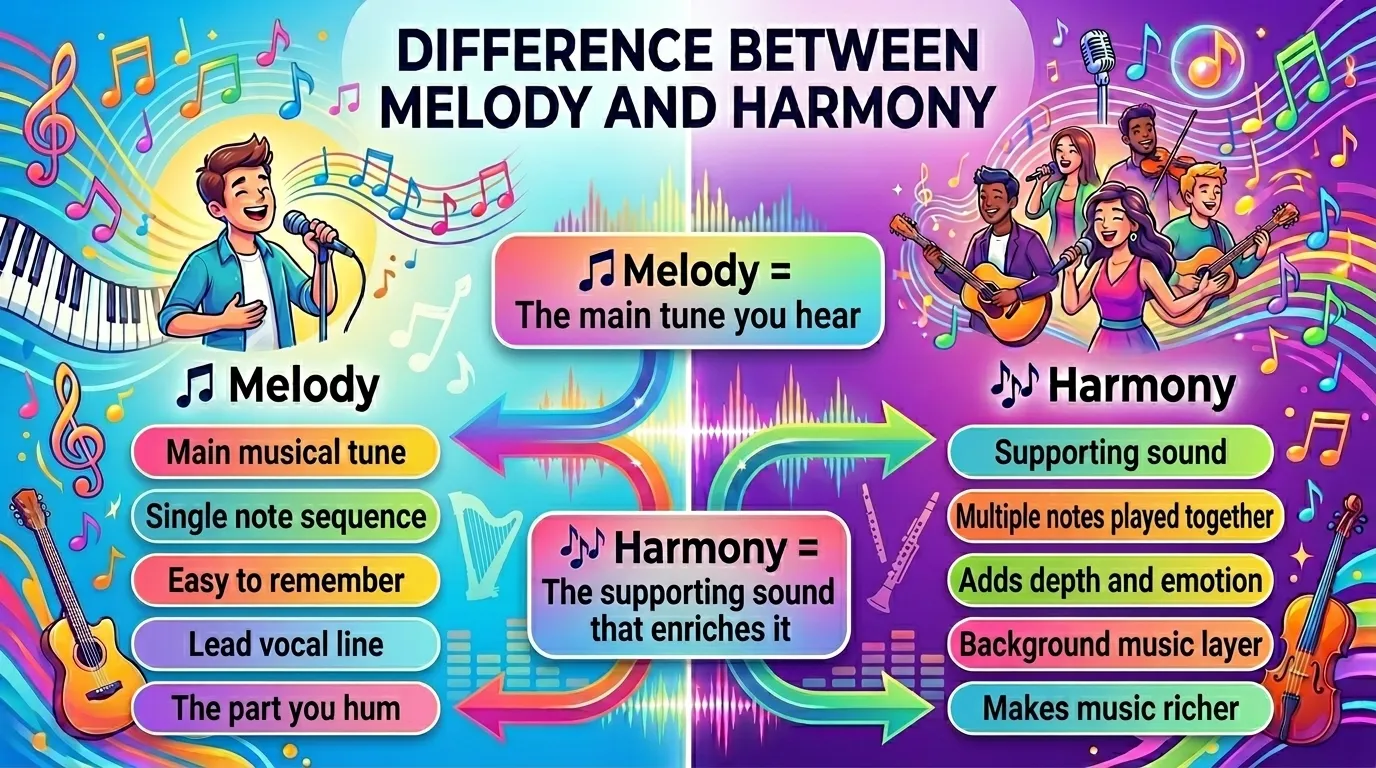
If you’ve ever listened to a song and wondered why the tune stays in your head while the background sounds make it feel rich and emotional, you’re already thinking about the difference between melody and harmony.
Many users get confused because melody and harmony work together in almost every piece of music. However, they serve very different purposes. Understanding the difference between both helps musicians, singers, songwriters, students, and even casual music listeners appreciate music on a deeper level.
In simple words, melody is the main tune you can hum, while harmony is the supporting combination of notes that adds depth and emotion to that tune. Whether you’re listening on platforms like YouTube, watching performances on Instagram, or creating music with modern software, understanding melody and harmony is essential.
In this guide, you’ll learn what melody and harmony are, how they work, why they matter, and the key differences between them through practical examples and expert insights.
Quick Answer: Difference Between Melody and Harmony
A melody is the main sequence of musical notes that forms a recognizable tune.
A harmony is the combination of additional notes played alongside the melody to support and enrich it.
Example:
In the song “Happy Birthday,” the tune everyone sings is the melody. If a piano adds chords underneath while people sing, those supporting chords create the harmony.
Definition of Melody and Harmony
- Melody: A sequence of musical notes arranged in a way that creates a memorable tune or musical phrase.
- Harmony: The combination of two or more notes played simultaneously to support and enhance a melody.
Simple Example:
- Melody = The song you hum.
- Harmony = The musical background that makes the song sound fuller.
Pronunciation of Both Terms (US & UK)
| Term | US Pronunciation | UK Pronunciation |
|---|---|---|
| Melody | MEL-uh-dee | MEL-uh-dee |
| Harmony | HAR-muh-nee | HAH-muh-nee |
Now that you know what these terms mean and how to pronounce them, let’s understand how they work together in real music.
Melody vs Harmony Comparison Table
| Feature | Melody | Harmony | Explanation |
|---|---|---|---|
| Definition | Main tune of a song | Supporting notes or chords | Both work together to create music |
| Function | Carries the musical idea | Adds depth and emotion | Each has a unique role |
| Number of Notes | Usually one note at a time | Multiple notes together | Creates different textures |
| Recognition | Easy to remember | Often less noticeable | Supports the melody |
| Focus | Primary musical line | Background support | Both are important |
| Singing | Usually sung by lead vocalist | Sung by backing vocalists | Common in choirs |
| Listening Experience | What people hum later | What creates richness | Combined effect sounds complete |
| Composition Role | Starts many songs | Enhances existing melody | Songwriters use both |
Key Differences Explained Between Melody and Harmony
1. Melody Is the Main Tune
The melody is usually the part listeners remember.
Example: The tune of a national anthem.
2. Harmony Supports the Melody
Harmony acts like a musical foundation.
Example: Piano chords supporting a singer.
3. Melody Can Stand Alone
A melody often sounds complete by itself.
Example: Whistling a song.
4. Harmony Usually Needs a Melody
Harmony is most effective when supporting another musical line.
5. Melody Moves Horizontally
It progresses note by note through time.
6. Harmony Works Vertically
Multiple notes sound together at the same moment.
7. Melody Grabs Attention
Listeners naturally focus on the melody first.
8. Harmony Creates Emotion
Harmony influences whether music feels happy, sad, dramatic, or peaceful.
What Is Melody in Music?
Melody is often called the “voice” of music.
It is the sequence of notes that listeners identify as the song itself. When people sing along to music, they are usually singing the melody.
Characteristics of Melody
- Easy to remember
- Follows a musical pattern
- Has a beginning and ending
- Creates musical identity
Real-World Example
The theme songs used in movies, commercials, and viral content on platforms like YouTube often rely on strong melodies because memorable tunes help audiences remember the content.
What Is Harmony in Music?
Harmony occurs when multiple notes are played together to support the melody.
Without harmony, music may sound empty or unfinished.
Characteristics of Harmony
- Creates emotional depth
- Builds musical texture
- Uses chords and chord progressions
- Enhances the melody
Real-World Example
Choirs often use harmony by having different singers perform different notes at the same time, creating a richer sound.
How Do Melody and Harmony Work Together?
Think of a melody as the main character in a movie.
Harmony is the supporting cast that helps tell the story.
A beautiful melody may sound good alone, but harmony can transform it into something emotionally powerful.
Example
Imagine a singer performing alone.
Now imagine adding:
- Piano chords
- Background vocals
- String instruments
The melody remains the same, but harmony creates a fuller musical experience.
Why Does Harmony Exist?
Many beginners ask why harmony is necessary if melody already sounds good.
The answer lies in emotional expression.
Harmony helps:
- Create tension
- Build excitement
- Add warmth
- Establish mood
- Guide listener emotions
In practical use, harmony is one of the biggest reasons why professional recordings sound richer than simple vocal performances.
Difference Between Melody and Harmony in Songwriting
Songwriters often begin with either a melody or a chord progression.
Melody-First Approach
The songwriter creates the tune first and adds harmony later.
Harmony-First Approach
The songwriter starts with chords and builds a melody on top.
Modern music creators using software from companies like Apple, Google, and digital audio workstations frequently use both approaches depending on the project.
Difference Between Both in Singing
Singing provides one of the easiest ways to understand this concept.
Melody Singing
The lead vocalist usually performs the melody.
Harmony Singing
Backup singers perform complementary notes.
Example
A solo singer performing a song sings the melody.
A choir singing in multiple parts creates harmony.
This is common in gospel music, pop music, classical music, and contemporary worship songs.
Difference and Similarity Between Melody and Harmony
| Feature | Melody | Harmony | Similarity |
|---|---|---|---|
| Purpose | Main tune | Musical support | Both create music |
| Structure | Single note line | Multiple notes together | Both use notes |
| Recognition | Easy to identify | Less obvious | Both affect listeners |
| Emotional Impact | Directly memorable | Adds emotional color | Both influence mood |
| Composition | Musical centerpiece | Musical enhancement | Both require creativity |
| Performance | Lead role | Supporting role | Both are performed |
| Learning Difficulty | Easier for beginners | More advanced | Both can be studied |
| Musical Value | Essential | Essential | Neither replaces the other |
This table clearly shows the difference and similarity between them for quick understanding.
Common Mistakes with Both
Mistake 1: Thinking They Are the Same Thing
Correction: Melody is the tune; harmony supports it.
Mistake 2: Believing Harmony Is Less Important
Correction: Harmony significantly impacts emotional depth.
Mistake 3: Confusing Chords with Melody
Correction: Chords usually belong to harmony.
Mistake 4: Assuming Every Song Has Complex Harmony
Correction: Some songs use very simple harmonic structures.
Mistake 5: Ignoring Harmony When Learning Music
Correction: Understanding harmony improves musicianship.
Real-Life Examples with Both
Personal Use
A person humming a favorite song is using melody.
School Choir
Students singing different vocal parts create harmony.
Church Worship
Lead vocals perform melody while the choir provides harmony.
Music Production
Producers add harmonies to make songs sound fuller.
Film Industry
Movie soundtracks use harmony to create emotional scenes.
Commercial Advertising
Brands often use memorable melodies with supporting harmonies to improve recall.
When to Use Each
Use Melody When
- Creating a memorable tune
- Singing solo
- Writing song hooks
- Composing themes
Use Harmony When
- Adding emotional depth
- Supporting singers
- Building musical texture
- Creating richer arrangements
Best Results
Most successful music combines both melody and harmony effectively.
Why People Get Confused About Melody and Harmony
Several factors contribute to confusion.
They Always Appear Together
Most songs include both elements.
Beginner Music Lessons
Many lessons focus on melodies first.
Modern Music Production
Advanced arrangements can blur the distinction.
Media Influence
Music content on platforms like Instagram and YouTube often discusses chords and melodies without clearly separating the concepts.
Expert Insight
From a music education perspective, the most effective way to understand the difference between melody and harmony is through active listening.
In real scenarios, most beginners identify melodies quickly because melodies are easier to remember. Harmony takes longer to recognize because it operates in the background.
Professional musicians often describe melody as the story and harmony as the emotional atmosphere surrounding that story.
Understanding both concepts is one of the foundations of music theory, songwriting, arranging, and music production.
Frequently Asked Questions (FAQs)
Is melody more important than harmony?
Not necessarily. Melody attracts attention, but harmony creates depth and emotional impact.
Can a song have melody without harmony?
Yes. A solo singer can perform only a melody.
Can harmony exist without melody?
Technically yes, but harmony is usually more meaningful when supporting a melody.
What comes first, melody or harmony?
Songwriters use both approaches. Some begin with melody, others start with chords.
Is harmony the same as chords?
Harmony often uses chords, but harmony is a broader concept that includes how notes interact.
Why is melody easier to remember?
Because it forms the primary musical line that listeners focus on.
Do all genres use melody and harmony?
Most genres use both, though the complexity varies.
How can beginners learn harmony?
Start by learning basic chords and listening to how they support melodies.
What is an example of melody and harmony together?
A singer performing a tune while a piano plays chords underneath is a classic example.
Why should musicians understand both?
Because strong music depends on the balance between memorable melodies and effective harmonies.
Conclusion
Understanding the difference between melody and harmony is one of the most important steps in learning how music works. Melody is the tune that listeners remember, sing, and recognize instantly. Harmony is the collection of supporting notes and chords that adds emotion, color, and depth to that tune.
In practical use, melody helps a song become memorable, while harmony helps it become emotionally powerful. Whether you are a casual listener, a singer, a songwriter, or a music student, understanding the difference between both allows you to appreciate music on a deeper level and communicate musical ideas more effectively.
The simplest way to remember it is this: melody is the tune you hum, and harmony is the sound that makes that tune come alive.

Sarfraz Ahmad is language researcher and content writer who specializes in explaining the difference between commonly confused English words. Through WordClearify, learners understand subtle word distinctions in a simple, structured, and practical way. My writing focuses on clarity, real-life examples, and easy comparisons for students, bloggers, and professionals worldwide.