Many people get confused when comparing construction equipment, especially when looking at the difference between backhoe and excavator. At first glance, both machines dig trenches, move soil, and handle excavation tasks, which makes them seem almost identical. However, the difference between backhoe and excavator becomes clear when you examine their design, mobility, digging power, and job-site applications.
Understanding the difference between backhoe and excavator is important for contractors, landscapers, farmers, construction managers, and even homeowners planning major projects. Choosing the wrong machine can increase costs, reduce productivity, and slow project completion.
In this guide, you’ll learn what each machine is, how they work, their key differences, similarities, practical uses, expert insights, and how to choose the right equipment for your project.
Quick Answer: Difference Between Backhoe and Excavator
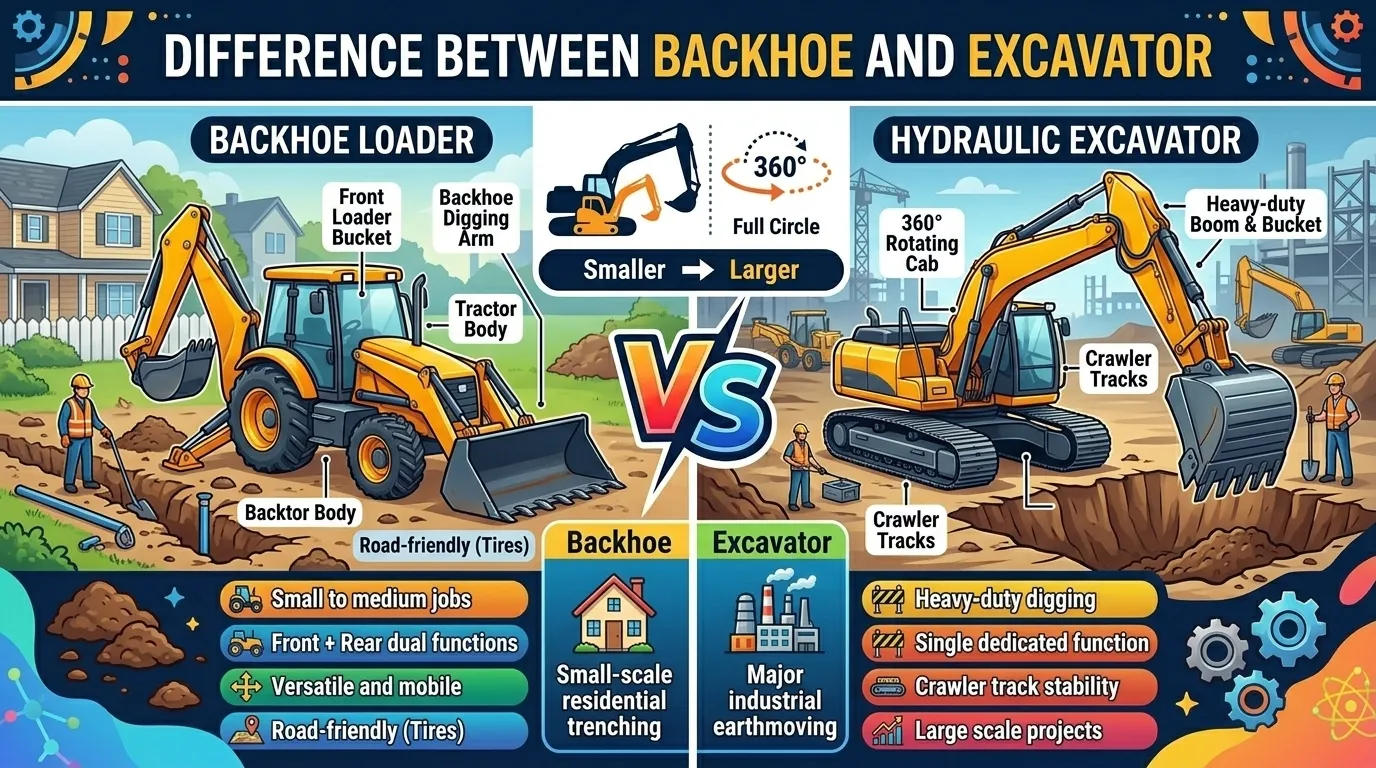
A backhoe is a versatile machine that combines a front loader bucket and a rear digging arm, making it ideal for small-to-medium construction jobs and utility work.
An excavator is a dedicated digging machine with a rotating cab and powerful hydraulic arm designed for heavy excavation, demolition, mining, and large-scale construction projects.
Example: A contractor digging a backyard drainage trench may use a backhoe, while a company excavating foundations for a large commercial building would typically use an excavator.
Definition of Backhoe and Excavator
- Backhoe: A multipurpose construction machine with a front loader bucket and a rear excavating arm mounted on a tractor-like body.
- Excavator: A heavy-duty hydraulic machine featuring a rotating cab and boom-arm system primarily designed for digging and earthmoving operations.
Simple Example
A backhoe is like a multitool that can dig and load materials, while an excavator is a specialized power tool built mainly for digging and heavy excavation.
Pronunciation of Both Terms
| Term | US Pronunciation | UK Pronunciation |
|---|---|---|
| Backhoe | BAK-hoh | BAK-hoh |
| Excavator | EK-skuh-vay-ter | EK-skuh-vay-tuh |
Now that you know what each machine is and how to pronounce them, let’s understand their differences in detail.
Backhoe vs Excavator Comparison Table
| Feature | Backhoe | Excavator |
|---|---|---|
| Primary Purpose | Digging and loading | Heavy excavation |
| Mobility | Drives on roads easily | Usually transported by trailer |
| Rotation | Limited arm movement | Full 360-degree rotation |
| Size | Smaller and compact | Larger and more powerful |
| Digging Depth | Moderate | Deep excavation capability |
| Versatility | Very versatile | Specialized for excavation |
| Cost | Generally lower | Usually higher |
| Best For | Utilities, farms, landscaping | Large construction projects |
| Travel Speed | Faster movement between sites | Slower site-to-site travel |
| Attachments | Multiple attachments available | Extensive attachment options |
Key Differences Explained Between Difference Between Backhoe and Excavator
1. Machine Design
A backhoe combines a loader and digging arm into one machine.
An excavator focuses almost entirely on excavation performance.
Real-world example: Municipal utility crews often prefer backhoes because they can dig and transport materials without switching equipment.
2. Rotation Capability
The excavator’s cab rotates a full 360 degrees.
A backhoe’s rear arm has limited swing movement.
Why it matters: Excavators can work efficiently in confined spaces without repositioning the machine repeatedly.
3. Digging Power
Excavators deliver significantly greater hydraulic force.
Backhoes are suitable for lighter digging operations.
4. Site Mobility
Backhoes travel on roads more easily.
Excavators typically require transportation equipment for relocation.
5. Operating Cost
Backhoes generally cost less to purchase and maintain.
Excavators require larger investments but offer higher productivity.
6. Project Scale
Backhoes excel in small and medium projects.
Excavators dominate large infrastructure developments.
7. Attachment Flexibility
Both support attachments, but excavators often accommodate heavier specialized tools.
8. Operator Efficiency
Excavators reduce repositioning time thanks to their rotating upper structure.
Why Does the Difference Between Backhoe and Excavator Matter?
The distinction matters because every project has unique requirements.
If you choose an excavator for a small residential job, you may spend more money than necessary. Conversely, using a backhoe for large-scale earthmoving can increase labor hours and reduce efficiency.
The right machine improves:
- Productivity
- Fuel efficiency
- Project speed
- Safety
- Return on investment
How Does a Backhoe Work?
A backhoe uses hydraulic systems to power:
- Front loader bucket
- Rear digging arm
- Stabilizer legs
The front bucket loads materials such as gravel, sand, and soil.
The rear arm performs digging operations.
Common Backhoe Tasks
- Utility trenching
- Landscaping
- Farm work
- Small construction projects
- Road maintenance
Many municipalities rely on backhoes because one machine can perform multiple tasks throughout the day.
How Does an Excavator Work?
An excavator operates using powerful hydraulic cylinders attached to:
- Boom
- Stick
- Bucket
The cab sits on tracks or wheels and rotates completely around its base.
Common Excavator Tasks
- Foundation excavation
- Demolition
- Mining
- Heavy trenching
- River dredging
- Land clearing
Large contractors often choose excavators because they can move enormous amounts of material quickly.
Which Machine Is Better for Construction Projects?
The answer depends on project requirements.
Choose a Backhoe If:
- You need one machine for multiple tasks.
- Budget is limited.
- The project is small or medium-sized.
- Frequent travel between sites is required.
Choose an Excavator If:
- Deep digging is necessary.
- Heavy material handling is involved.
- Large-scale excavation is planned.
- Maximum productivity is the priority.
Mini Excavators
A growing trend in 2026 is the use of mini excavators for residential construction. These machines provide many excavator advantages while fitting into tighter spaces.
Difference Between Backhoe and Excavator for Trenching
Trenching is one of the most searched comparisons.
Backhoe Trenching
Best for:
- Utility lines
- Residential drainage
- Small pipelines
Excavator Trenching
Best for:
- Deep sewer systems
- Industrial pipelines
- Major infrastructure projects
In practical use, deeper trenches typically favor excavators because of their reach and hydraulic strength.
Difference Between Backhoe and Excavator for Landscaping
Landscaping companies often debate which machine offers the best value.
Backhoe Advantages
- Can transport soil.
- Can load trucks.
- Easier road travel.
Excavator Advantages
- Precise digging.
- Better reach.
- Superior grading capability.
For most residential landscaping projects, a backhoe often delivers greater versatility.
Difference Between Backhoe and Excavator in Operating Costs
Cost is a major factor for equipment buyers.
Backhoe Costs
- Lower purchase price
- Lower maintenance costs
- Reduced transportation expenses
Excavator Costs
- Higher upfront investment
- Increased fuel consumption
- More transportation requirements
However, excavators may generate higher productivity on large projects, offsetting the increased cost.
Difference and Similarity Table Between Backhoe and Excavator
| Feature | Backhoe | Excavator | Similarity |
|---|---|---|---|
| Main Function | Digging and loading | Heavy excavation | Both move earth efficiently |
| Hydraulic System | Yes | Yes | Both use hydraulics |
| Construction Use | Small to medium jobs | Large projects | Used in construction |
| Trenching Ability | Moderate depth | Greater depth | Both dig trenches |
| Operator Cab | Fixed orientation | Rotating cab | Controlled by operator |
| Attachments | Various attachments | Extensive attachments | Highly adaptable |
| Mobility | Road-friendly | Trailer transport often needed | Can move between sites |
| Material Handling | Good | Excellent | Both handle soil and debris |
This table clearly shows the difference and similarity between difference between backhoe and excavator for quick understanding.
Common Mistakes with Difference Between Backhoe and Excavator
Mistake 1: Assuming They Are the Same Machine
Many beginners think both machines perform identical functions.
Correction: Understand their different strengths before renting or buying.
Mistake 2: Choosing Only Based on Price
Cheaper isn’t always better.
Correction: Consider productivity and project scope.
Mistake 3: Ignoring Job Site Space
Large excavators may not fit residential areas.
Correction: Measure site access first.
Mistake 4: Overlooking Transportation Costs
Excavators often require trailers.
Correction: Include transport expenses in budgeting.
Mistake 5: Not Considering Attachments
Different attachments dramatically affect performance.
Correction: Match attachments to project goals.
Real Life Examples with Difference Between Backhoe and Excavator
Example 1: Homeowner Project
A homeowner installs a drainage system.
Best choice: Backhoe.
Example 2: Commercial Building Foundation
A contractor excavates deep foundations.
Best choice: Excavator.
Example 3: Farm Operations
A farmer digs irrigation trenches and moves soil.
Best choice: Backhoe.
Example 4: Highway Expansion
A road construction company removes massive amounts of earth.
Best choice: Excavator.
Example 5: Utility Company
A crew repairs underground water lines.
Best choice: Backhoe.
When to Use Each
Use a Backhoe When
- Versatility matters most.
- Multiple tasks are required.
- Working on farms or utility projects.
- Frequent movement between locations is needed.
Use an Excavator When
- Maximum digging power is required.
- Working on large commercial projects.
- Deep excavation is necessary.
- Heavy demolition work is involved.
Why People Get Confused in Difference Between Backhoe and Excavator
Several reasons contribute to confusion:
Similar Appearance
Both feature hydraulic digging arms.
Shared Job Functions
Both dig trenches and move soil.
Media Representation
Construction videos on platforms like YouTube often show both machines performing similar tasks.
Equipment Rental Listings
Rental companies sometimes group excavation equipment together, making distinctions less obvious.
Industry Terminology
Many non-professionals use “excavator” as a generic term for any digging machine.
Expert Insight
From an equipment management perspective, the best machine is rarely the biggest machine.
In real scenarios, experienced contractors evaluate:
- Job size
- Soil conditions
- Transportation logistics
- Operator availability
- Equipment utilization rates
Most beginners focus only on digging power. Professionals focus on total project efficiency.
A backhoe often delivers greater value when multiple tasks must be completed with one machine. An excavator becomes the superior option when excavation productivity directly impacts project timelines.
That practical distinction is often more important than raw specifications.
Frequently Asked Questions
Is a backhoe the same as an excavator?
No. A backhoe is a multipurpose machine, while an excavator is designed primarily for excavation work.
Which is better, a backhoe or an excavator?
Neither is universally better. The right choice depends on project size and requirements.
Can a backhoe dig as deep as an excavator?
Generally, no. Excavators usually offer greater digging depth and reach.
Why do excavators rotate 360 degrees?
The rotating cab improves efficiency and reduces repositioning time.
Are backhoes cheaper than excavators?
In most cases, yes. Backhoes usually have lower purchase and operating costs.
What is a mini excavator?
A compact excavator designed for small spaces and residential projects.
Which machine is best for trenching?
For shallow utility trenches, backhoes work well. For deep trenches, excavators are usually preferred.
Can excavators load trucks?
Yes. Excavators frequently load trucks with soil, gravel, and debris.
Do both machines use hydraulic systems?
Yes. Hydraulics power the digging and lifting functions of both machines.
Which machine is easier for beginners?
Many operators find backhoes easier to learn because of their versatility and familiar tractor-style layout.
Conclusion
Understanding the difference between backhoe and excavator is essential before renting, buying, or operating construction equipment. While both machines perform excavation tasks, they are designed for different priorities. A backhoe emphasizes versatility by combining digging and loading capabilities in a single machine. An excavator focuses on maximum digging performance, deeper reach, stronger hydraulics, and greater efficiency on large-scale projects.
For homeowners, farmers, utility crews, and small contractors, a backhoe often provides the best balance of flexibility and cost-effectiveness. For commercial construction firms, mining operations, demolition contractors, and infrastructure projects, an excavator usually delivers superior productivity and excavation power.

David Anderson
I am David Anderson, a USA-based content writer and digital author. I create clear, engaging, and well-structured articles focused on delivering valuable and well-researched information. I specialize in blog writing and digital content that helps websites grow visibility and build strong online authority.