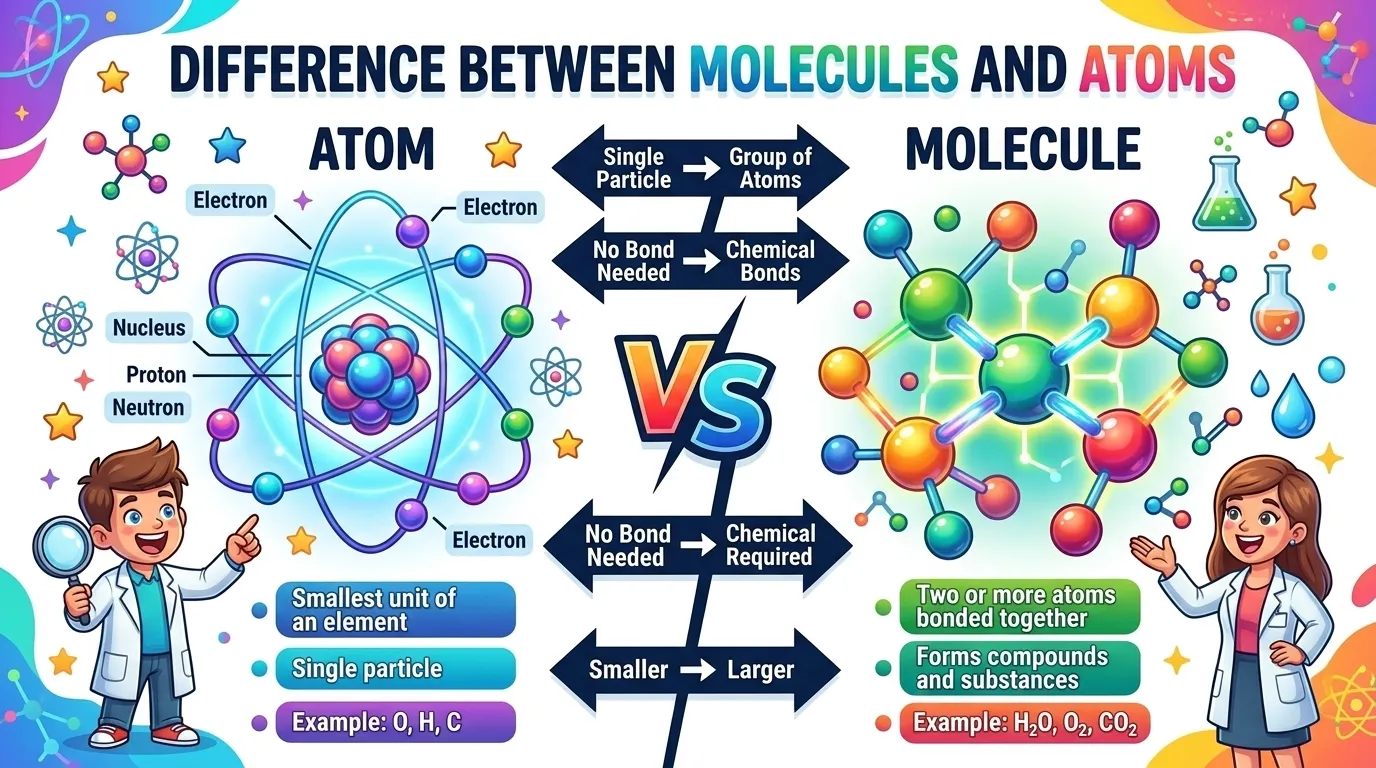
Many students and even adults get confused about the difference between molecules and atoms because both are tiny building blocks of matter. In simple words, an atom is the smallest unit of an element, while a molecule is formed when two or more atoms join together through chemical bonds.
Understanding the difference between molecules and atoms is important in chemistry, biology, medicine, technology, and even everyday life. Whether you are learning about water, oxygen, medicines, or modern materials, atoms and molecules are everywhere.
In this guide, you’ll learn the difference between molecules and atoms, how they are related, why they exist, how they work, real-life examples, similarities, common mistakes, and practical applications. By the end, you will have a complete understanding without needing another article.
Quick Answer: Difference Between Molecules and Atoms
An atom is the smallest particle of an element that retains its chemical properties.
A molecule is a group of two or more atoms chemically bonded together.
Example
- A single oxygen atom = Atom (O)
- Two oxygen atoms joined together = Molecule (O₂)
So, atoms are the basic units, while molecules are combinations of atoms.
Definition of Molecules and Atoms
- Atom: The smallest unit of a chemical element that cannot be broken down by ordinary chemical reactions.
- Molecule: A group of two or more atoms chemically bonded together acting as a single unit.
Simple Example
Water (H₂O) is a molecule because it contains two hydrogen atoms and one oxygen atom bonded together.
Pronunciation of Both Terms
| Term | US Pronunciation | UK Pronunciation |
|---|---|---|
| Atom | AT-um | AT-uhm |
| Molecule | MOL-uh-kyool | MOL-i-kyool |
Now that you know what atoms and molecules are, let’s explore their differences in greater detail.
Molecules vs Atoms Comparison Table
| Feature | Atom | Molecule |
|---|---|---|
| Definition | Smallest unit of an element | Group of bonded atoms |
| Composition | Contains one type of particle | Contains two or more atoms |
| Independent Existence | May exist alone | Exists as bonded units |
| Chemical Bond | Not required | Required |
| Representation | H, O, C, Na | H₂O, O₂, CO₂ |
| Size | Smaller | Larger |
| Structure | Single particle | Multiple particles |
| Formation | Naturally exists as elemental unit | Forms through chemical bonding |
| Examples | Helium atom, Carbon atom | Water, Oxygen gas |
| Complexity | Simpler | More complex |
Key Differences Explained Between Molecules and Atoms
1. Basic Structure
An atom consists of protons, neutrons, and electrons.
A molecule consists of multiple atoms bonded together.
Example: Hydrogen atom (H) versus hydrogen molecule (H₂).
2. Size
Atoms are generally smaller than molecules.
Example: A water molecule contains three atoms, making it larger than a single hydrogen atom.
3. Chemical Bonds
Atoms do not always require chemical bonds.
Molecules always require chemical bonds.
4. Stability
Many atoms become more stable after forming molecules.
Example: Oxygen prefers existing as O₂ rather than as individual oxygen atoms.
5. Chemical Behavior
Atoms participate in reactions.
Molecules often determine the observable properties of substances.
6. Representation
Atoms are shown with element symbols.
Molecules are shown with chemical formulas.
Examples:
- Atom = C
- Molecule = CO₂
7. Complexity
Atoms are simpler structures.
Molecules can become highly complex.
Example: DNA molecules contain millions of atoms.
What Is an Atom and Why Does It Exist?
An atom is the fundamental building block of matter.
Everything around us—including air, water, plants, smartphones, and even our bodies—is made of atoms.
Atoms exist because matter needs a basic structural unit. Scientists discovered that elements such as hydrogen, oxygen, carbon, and gold are made of unique atoms.
Main Parts of an Atom
- Protons
- Neutrons
- Electrons
These particles determine the atom’s properties and behavior.
Real-World Example
The silicon chips used in computers and devices from companies like Google and Meta rely on the behavior of silicon atoms.
What Is a Molecule and How Does It Form?
A molecule forms when atoms share or exchange electrons and become chemically bonded.
This bonding helps atoms achieve greater stability.
Common Molecules
- Water (H₂O)
- Oxygen (O₂)
- Carbon Dioxide (CO₂)
- Methane (CH₄)
Why Molecules Matter
Molecules determine the properties of most substances we use daily.
For example:
- Water molecules make drinking water possible.
- Oxygen molecules support breathing.
- Protein molecules help build muscles.
How Does Chemical Bonding Connect Atoms and Molecules?
Chemical bonding is the bridge between atoms and molecules.
Atoms join together because their outer electrons seek stability.
Major Types of Bonds
Covalent Bonds
Atoms share electrons.
Example: Water (H₂O)
Ionic Bonds
Atoms transfer electrons.
Example: Sodium chloride (table salt)
Metallic Bonds
Common in metals like copper and aluminum.
Without bonding, molecules could not exist.
Why Is the Difference Between Molecules and Atoms Important in Science?
Understanding the difference between molecules and atoms helps explain:
- Chemical reactions
- Biological systems
- Medical treatments
- Material science
- Environmental processes
In Medicine
Drug molecules interact with body cells to create desired effects.
In Biology
DNA molecules store genetic information.
In Technology
Semiconductor atoms power computers and smartphones.
Difference Between Both in Everyday Life
Many people think atoms and molecules only exist in laboratories. In reality, they are everywhere.
Water
Every glass of water contains trillions of H₂O molecules.
Air
The air we breathe contains oxygen molecules and nitrogen molecules.
Food
Proteins, fats, and carbohydrates are made from complex molecules.
Electronics
Devices used to access platforms like YouTube, Instagram, and Google rely on materials built from carefully arranged atoms.
Are Atoms and Molecules the Same Thing?
No.
Although closely related, they are not identical.
Similarities
- Both are components of matter.
- Both are microscopic.
- Both participate in chemical processes.
- Both influence physical properties.
Important Difference
Atoms are the building blocks.
Molecules are structures built from those blocks.
Think of atoms as individual letters and molecules as complete words.
Difference and Similarity Between Both
| Feature | Atom | Molecule | Similarity |
|---|---|---|---|
| Meaning | Smallest unit of an element | Group of bonded atoms | Both make up matter |
| Structure | Single unit | Multiple units | Both have defined structures |
| Size | Smaller | Larger | Both are microscopic |
| Role | Building block | Functional combination | Both participate in reactions |
| Representation | Element symbol | Chemical formula | Both use scientific notation |
| Composition | One atom | Multiple atoms | Both contain particles |
| Existence | May exist independently | Usually bonded | Both occur naturally |
| Scientific Importance | Fundamental unit | Functional unit | Both are essential in chemistry |
This table clearly shows the difference and similarity between both for quick understanding.
Common Mistakes with Difference Between Molecules and Atoms
Mistake 1: Thinking They Mean the Same Thing
Correction: Molecules contain atoms.
Mistake 2: Assuming Every Atom Is a Molecule
Correction: A single atom is not automatically a molecule.
Mistake 3: Ignoring Chemical Bonds
Correction: Molecules require chemical bonds.
Mistake 4: Confusing Elements with Molecules
Correction: Elements are made of atoms, while molecules can contain one or multiple elements.
Mistake 5: Believing Molecules Are Always Large
Correction: Some molecules contain only two atoms, such as O₂.
Real-Life Examples with Difference Between Both
Example 1: Drinking Water
Water consists of H₂O molecules formed from hydrogen and oxygen atoms.
Example 2: Breathing
Oxygen enters the lungs as O₂ molecules.
Example 3: Medical Industry
Drug molecules are designed to interact with specific cells.
Example 4: Manufacturing
Factories create materials by controlling atomic structures.
Example 5: Space Science
Scientists study atoms and molecules in distant planets and stars.
Example 6: Artificial Intelligence Hardware
Advanced processors used by companies like Google and Meta depend on precise arrangements of silicon atoms.
When to Use Each
Use “Atom” When:
- Discussing chemical elements
- Studying atomic structure
- Explaining periodic table concepts
- Understanding nuclear science
Use “Molecule” When:
- Discussing compounds
- Explaining chemical reactions
- Studying biology
- Describing substances like water and oxygen
Why People Get Confused in Difference Between Both
Several reasons create confusion:
Similar Terminology
Both belong to chemistry.
Tiny Size
Neither can be seen with the naked eye.
Education Level
Many introductory lessons simplify concepts too much.
Media Representation
Movies and advertisements often use the terms interchangeably.
Scientific Complexity
The transition from atomic structure to molecular chemistry can seem overwhelming for beginners.
Expert Insight
From a chemistry education perspective, the easiest way to understand the difference is to think of atoms as individual building blocks and molecules as completed structures built from those blocks.
In practical teaching scenarios, most beginners understand the concept much faster when visual examples are used. Once students realize that a water molecule contains multiple atoms working together, the relationship becomes much clearer.
Scientists, researchers, engineers, and medical professionals all rely on understanding atoms and molecules because nearly every material and biological process depends on them.
Frequently Asked Questions (FAQs)
What is the main difference between molecules and atoms?
An atom is the smallest unit of an element, while a molecule consists of two or more atoms chemically bonded together.
Can a molecule contain only one atom?
No. A molecule requires at least two atoms bonded together.
Is water an atom or a molecule?
Water (H₂O) is a molecule made from hydrogen and oxygen atoms.
Are all molecules compounds?
No. Oxygen (O₂) is a molecule but not a compound because it contains only one element.
Which is smaller, an atom or a molecule?
An atom is generally smaller than a molecule.
Can atoms exist alone?
Yes. Some atoms, such as helium atoms, can exist independently.
Why do atoms form molecules?
Atoms form molecules to achieve greater stability through chemical bonding.
Is oxygen an atom or a molecule?
It can be both. A single oxygen particle is an atom, while O₂ is a molecule.
Conclusion
Understanding the difference between molecules and atoms is one of the most important foundations of chemistry. An atom is the smallest unit of an element, while a molecule is a group of two or more atoms joined together through chemical bonds. Although they are closely connected, they serve different roles in the structure of matter.
In real-world situations, atoms act as the building blocks, while molecules create the substances we interact with every day. Water, oxygen, medicines, plastics, foods, and even the materials inside computers all depend on the relationship between atoms and molecules.
For beginners, the simplest way to remember the concept is this: atoms are like individual bricks, and molecules are the structures built from those bricks. Once this idea becomes clear, understanding chemical reactions, biological processes, and material science becomes much easier.

Sarfraz Ahmad is language researcher and content writer who specializes in explaining the difference between commonly confused English words. Through WordClearify, learners understand subtle word distinctions in a simple, structured, and practical way. My writing focuses on clarity, real-life examples, and easy comparisons for students, bloggers, and professionals worldwide.