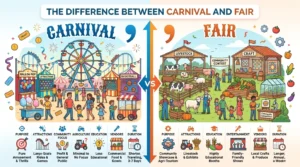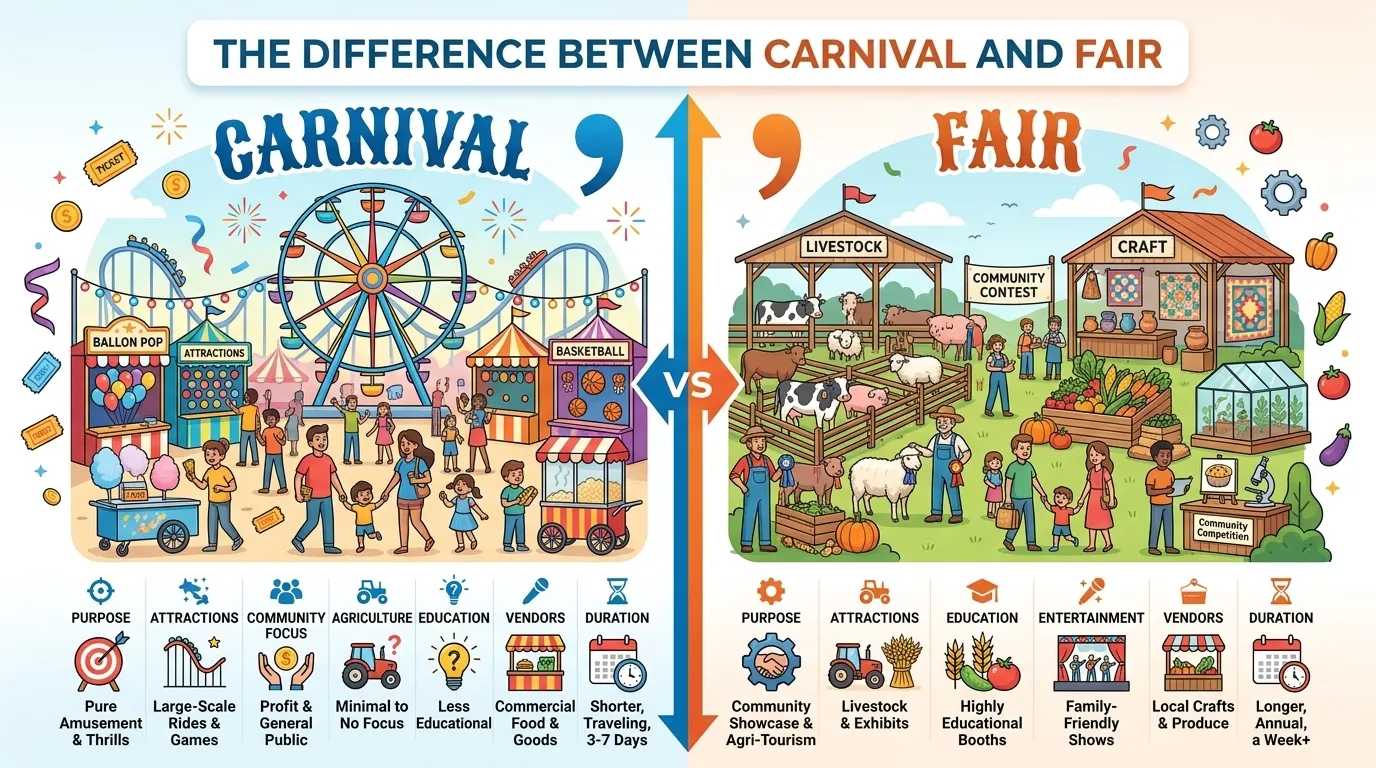
Many people search for the difference between carnival and fair because the two events look very similar at first glance. Both offer entertainment, food, games, rides, and community gatherings. However, the difference between carnival and fair becomes clear when you understand their purpose, history, attractions, and overall experience.
If you have ever wondered whether a traveling amusement event is a carnival or if a local community celebration is a fair, you are not alone. Many users get confused by these terms because they are often used interchangeably in everyday conversation.
In this guide, you’ll learn the exact difference between carnival and fair, their definitions, pronunciation, similarities, real-life examples, common mistakes, and practical situations where each term is used. By the end, you will have a complete understanding without needing another article.
Quick Answer: Difference Between Carnival and Fair
A carnival is mainly focused on entertainment, amusement rides, games, and festive attractions.
A fair is usually a larger community or agricultural event that combines entertainment with exhibitions, competitions, education, culture, or commerce.
Example:
A traveling event with Ferris wheels and game booths is usually a carnival, while a county event featuring livestock competitions, local vendors, concerts, and rides is typically a fair.
Definition of Carnival and Fair
- Carnival: A festive event focused mainly on amusement rides, games, food stalls, and entertainment activities.
- Fair: A public gathering that combines entertainment with exhibitions, trade, agriculture, culture, education, or community activities.
Simple Example:
- Carnival = Fun rides and games.
- Fair = Community showcase plus fun attractions.
Pronunciation of Both Terms
| Word | US Pronunciation | UK Pronunciation |
|---|---|---|
| Carnival | KAR-nuh-vuhl | KAH-nuh-vuhl |
| Fair | Fair | Fair |
Now that you know what these terms mean and how they are pronounced, let’s understand the real differences in detail.
Carnival vs Fair: Comparison Table
| Feature | Carnival | Fair |
|---|---|---|
| Main Purpose | Entertainment and amusement | Community gathering and exhibitions |
| Attractions | Rides, games, food stalls | Exhibits, competitions, vendors, rides |
| Duration | Usually shorter | Often lasts several days or weeks |
| Educational Element | Rare | Common |
| Agricultural Activities | Usually absent | Often included |
| Commercial Activity | Limited | Frequently present |
| Community Focus | Entertainment-focused | Community-focused |
| Traveling Nature | Often mobile | Usually tied to a location |
| Historical Roots | Festivals and celebrations | Markets and trade gatherings |
| Audience Experience | Thrill and excitement | Learning, shopping, and entertainment |
Key Differences Explained Between Carnival and Fair
1. Purpose
A carnival exists mainly to entertain visitors through rides and games.
A fair serves broader purposes, including education, business promotion, agriculture, and community celebration.
Example: A carnival may focus entirely on fun attractions, while a state fair may feature livestock competitions and educational exhibits.
2. Attractions
Carnivals prioritize amusement rides, game booths, and festive entertainment.
Fairs include rides but also showcase exhibitions, competitions, and local products.
3. Community Involvement
Fairs often highlight local businesses, schools, farmers, and organizations.
Carnivals generally focus less on community representation and more on entertainment.
4. Educational Value
Many fairs include educational programs, workshops, and demonstrations.
Carnivals rarely emphasize learning opportunities.
5. Agricultural Connection
Agricultural displays are common at fairs.
Carnivals typically do not feature livestock or farming exhibits.
6. Economic Purpose
Historically, fairs were places where merchants and producers sold goods.
Carnivals focus more on recreational spending.
7. Event Scale
A county or state fair may cover a large area with multiple activities.
Carnivals are often smaller and concentrated around rides and attractions.
What Is a Carnival and Why Does It Exist?
A carnival is designed to create excitement, social interaction, and entertainment.
Historically, carnivals evolved from celebrations that allowed communities to gather before significant religious or cultural periods. Over time, they became associated with amusement rides, colorful attractions, and traveling entertainment companies.
Modern carnivals often include:
- Ferris wheels
- Roller coasters
- Food trucks
- Game booths
- Live performances
- Family attractions
The primary goal is fun and excitement.
What Is a Fair and Why Does It Exist?
A fair traditionally served as a gathering place where people exchanged goods, shared knowledge, and celebrated community achievements.
Today, fairs continue to serve multiple purposes:
- Agricultural exhibitions
- Business promotion
- Cultural celebrations
- Educational programs
- Local competitions
- Entertainment activities
Unlike carnivals, fairs balance entertainment with information and community engagement.
How Does the Difference Between Carnival and Fair Affect Visitors?
For visitors, the choice often depends on their goals.
Visit a Carnival If You Want:
- Thrilling rides
- Fast-paced entertainment
- Festival atmosphere
- Arcade-style games
- Family amusement
Visit a Fair If You Want:
- Community experiences
- Local food vendors
- Agricultural displays
- Educational exhibits
- Shopping opportunities
- Live competitions
In practical use, families often choose fairs for a full-day experience, while younger visitors may prefer carnivals for excitement and rides.
Why Are Carnivals and Fairs Often Used Interchangeably?
Many people use both terms interchangeably because modern fairs often include carnival sections.
For example:
A state fair may contain:
- Carnival rides
- Food stalls
- Games
- Exhibitions
- Competitions
Visitors see the carnival attractions and assume the entire event is a carnival.
In reality, the carnival is often just one component of the larger fair.
Difference Between Carnival and Fair in Modern Events
Today’s events frequently blend both concepts.
A modern fair might include:
- Amusement rides
- Concerts
- Vendor booths
- Agricultural exhibitions
- Community showcases
Similarly, some carnivals add concerts and cultural performances.
Because of this overlap, understanding the event’s primary purpose helps identify whether it is a carnival or a fair.
Carnival vs Fair: Historical Origins
Origins of Carnivals
Carnivals originated from festive celebrations and public festivities that encouraged social gathering and entertainment.
Many famous carnivals around the world focus on parades, costumes, music, and celebration.
Examples include:
- Rio Carnival
- Venice Carnival
Origins of Fairs
Fairs developed from trade markets where merchants, farmers, and artisans gathered to sell products and exchange ideas.
Over centuries, fairs expanded into cultural and community-centered events.
Difference and Similarity Between Carnival and Fair
| Feature | Carnival | Fair | Similarity |
|---|---|---|---|
| Meaning | Entertainment-focused event | Community and exhibition event | Both attract large crowds |
| Purpose | Fun and amusement | Education, commerce, and fun | Both provide entertainment |
| Rides | Major attraction | Secondary attraction | Both may include rides |
| Food | Festival foods | Local foods and vendors | Both offer food options |
| Competitions | Rare | Common | Both may host contests |
| Vendors | Limited | Extensive | Both may include sellers |
| Audience | Entertainment seekers | Families and communities | Both welcome all ages |
| Duration | Shorter events | Longer events | Both are temporary gatherings |
This table clearly shows the difference and similarity between carnival and fair for quick understanding.
Common Mistakes With Carnival and Fair
Mistake 1: Thinking They Mean Exactly the Same Thing
Correction: A carnival focuses on entertainment, while a fair serves broader community purposes.
Mistake 2: Assuming Every Fair Is Agricultural
Correction: Some fairs focus on culture, business, or education rather than farming.
Mistake 3: Calling Every Ride Event a Fair
Correction: Events centered mostly on rides are usually carnivals.
Mistake 4: Ignoring Historical Context
Correction: Fairs originated from trade and community gatherings.
Mistake 5: Believing Carnivals Are Always Traveling
Correction: Many are traveling, but some are permanent annual events.
Real-Life Examples With Carnival and Fair
Personal Example
A family visits a local carnival to enjoy rides and win prizes.
Community Example
Residents attend a county fair to support local farmers and businesses.
Educational Example
Students visit a fair to learn about agriculture and technology exhibits.
Business Example
Local companies showcase products during regional fairs.
Tourism Example
Travelers attend the famous Rio Carnival for cultural celebrations and entertainment.
When to Use Each
Use “Carnival” When:
- Talking about rides and games.
- Referring to traveling amusement events.
- Discussing festive entertainment.
Use “Fair” When:
- Referring to community gatherings.
- Discussing agricultural exhibitions.
- Talking about trade, education, or cultural showcases.
Why People Get Confused About Carnival and Fair
Several factors contribute to confusion:
Overlapping Attractions
Both events often feature rides and food stalls.
Regional Language Differences
Different regions use the terms differently.
Media Influence
Television, social media, and marketing often use the terms loosely.
Event Evolution
Modern fairs frequently incorporate carnival attractions.
Cultural Variations
The meaning of carnival changes across countries and traditions.
Expert Insight
From an event management perspective, the biggest distinction is purpose.
In real-world scenarios, professionals usually classify an event based on its primary objective rather than its attractions.
If the event’s core goal is entertainment through rides and games, it is generally considered a carnival.
If the event exists to promote community engagement, education, commerce, agriculture, or culture while also providing entertainment, it is more accurately described as a fair.
This practical classification method is commonly used by organizers, tourism boards, and local governments.
Frequently Asked Questions (FAQs)
Is a carnival the same as a fair?
No. A carnival mainly focuses on entertainment, while a fair combines entertainment with community, educational, cultural, or commercial activities.
What is the biggest difference between carnival and fair?
The biggest difference is purpose. Carnivals prioritize fun and rides, whereas fairs serve broader community functions.
Can a fair have a carnival?
Yes. Many fairs include a carnival section with rides and games.
Are carnivals usually traveling events?
Many are, but not all. Some carnivals occur annually in fixed locations.
Why do fairs have livestock exhibits?
Fairs often have agricultural roots and showcase farming achievements.
Which is larger, a carnival or a fair?
Fairs are generally larger because they include multiple types of activities.
Are state fairs different from county fairs?
State fairs are usually larger and attract visitors from wider regions.
What activities are common at carnivals?
Rides, games, food stalls, live entertainment, and family attractions.
Why are people confused between fairs and carnivals?
Because modern fairs often contain carnival rides and similar attractions.
Which is better for families?
Both can be enjoyable, but fairs often offer a wider range of activities for different age groups.
Conclusion
Understanding the difference between carnival and fair is easier once you focus on each event’s purpose. A carnival is primarily an entertainment-driven gathering filled with rides, games, festive attractions, and excitement. A fair, on the other hand, is a broader community event that may include entertainment while also featuring exhibitions, competitions, agriculture, education, culture, and commerce.
Although modern events often blend elements of both, the core distinction remains clear. If the main attraction is amusement and fun, it is likely a carnival. If the event showcases community achievements, local businesses, educational exhibits, or agricultural displays alongside entertainment, it is generally a fair.

David Anderson
I am David Anderson, a USA-based content writer and digital author. I create clear, engaging, and well-structured articles focused on delivering valuable and well-researched information. I specialize in blog writing and digital content that helps websites grow visibility and build strong online authority.