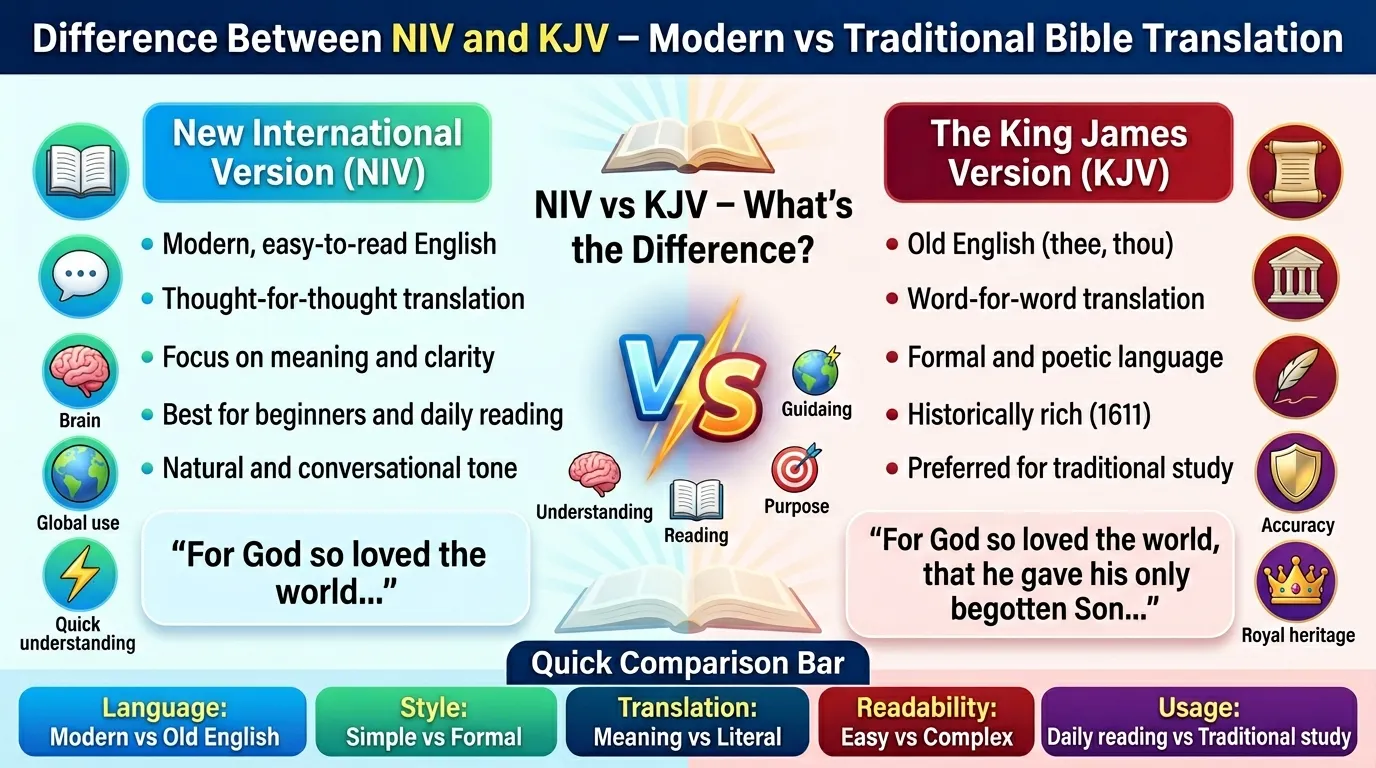
If you’ve ever picked up a Bible, you’ve probably noticed that there are many different versions available. Among the most popular are the New International Version (NIV) and the King James Version (KJV). While both communicate the same core message, the difference between NIV and KJV lies in their language style, translation approach, readability, and historical background.
For many readers, choosing between these two versions can be confusing. Some prefer the traditional and poetic language of the KJV, while others appreciate the modern and easy-to-understand wording of the NIV.
In this detailed guide, you’ll learn:
- What NIV and KJV are
- Their features and purposes
- 15 key differences (with examples)
- When to use each version
- Advantages and disadvantages
What Is NIV? (New International Version)
The New International Version (NIV) is a modern English Bible translation first published in 1978. It was created by a team of scholars aiming to make the Bible clear, accurate, and easy to understand for contemporary readers.
Key Features of NIV:
- Uses modern English language
- Focuses on clarity and readability
- Uses dynamic equivalence (thought-for-thought translation)
- Widely used in churches and study groups
Example (John 3:16 – NIV):
“For God so loved the world that he gave his one and only Son…”
Simple idea: NIV = clear, modern, easy to read
What Is KJV? (King James Version)
The King James Version (KJV) is one of the oldest and most influential English Bible translations, first published in 1611. It is known for its formal, poetic, and traditional language style.
Key Features of KJV:
- Uses Old English style (thee, thou, thy)
- Follows word-for-word translation (formal equivalence)
- Highly literary and poetic
- Historically significant
Example (John 3:16 – KJV):
“For God so loved the world, that he gave his only begotten Son…”
Simple idea: KJV = traditional, poetic, formal
Is NIV Better Than KJV?
There is no absolute answer—it depends on your purpose.
- NIV is better for understanding and daily reading
- KJV is preferred for traditional study and literary value
Important: Both convey the same core message, just in different styles.
Quick Comparison Table
| Feature | NIV | KJV |
| Language | Modern English | Old English |
| Year Published | 1978 | 1611 |
| Translation Style | Thought-for-thought | Word-for-word |
| Readability | Easy | Difficult |
| Tone | Simple | Formal |
| Usage | Modern readers | Traditional readers |
| Accuracy Style | Dynamic | Literal |
| Popularity | Very high | Historically strong |
15 Key Differences Between NIV and KJV with Examples
1. Language Style
The New International Version (NIV) uses modern, everyday English, making it easier for contemporary readers to understand. In contrast, the King James Version (KJV) uses archaic Old English, including words and sentence structures that are no longer commonly used today.
Example:
NIV: “You”
KJV: “Thou”
Explanation:
While “thou” was once common, today it can confuse readers unfamiliar with older English forms.
2. Historical Background
The KJV was first published in 1611, making it over 400 years old and deeply rooted in history. The NIV, however, was published in 1978 and revised later to reflect modern scholarship and language updates.
Example:
The KJV reflects the English style of Shakespeare’s era, while NIV reflects present-day communication.
3. Translation Method
The NIV follows a thought-for-thought (dynamic equivalence) approach, meaning it focuses on conveying the intended meaning of the text. The KJV uses a word-for-word (formal equivalence) approach, aiming to preserve the exact wording and structure of the original languages.
Example:
NIV simplifies phrases for clarity, while KJV keeps original phrasing even if complex.
4. Readability
NIV is designed for easy reading, making it suitable for beginners, students, and general audiences. KJV, due to its older language, can feel difficult and formal, especially for new readers.
Example:
A teenager reading NIV may understand it easily, while KJV may require explanation or guidance.
5. Purpose
The NIV’s main goal is clarity and accessibility, helping readers quickly grasp meaning. The KJV’s purpose is to maintain accuracy, tradition, and literary beauty, even if that reduces ease of understanding.
Example:
NIV is often used in modern churches, while KJV is used in traditional settings.
6. Tone and Style
KJV has a poetic, formal, and majestic tone, often appreciated for its literary beauty. NIV uses a simple, conversational tone that feels more natural in everyday language.
Example:
KJV sounds like classical literature, while NIV sounds like modern speech.
7. Understanding Level
NIV is suitable for all levels of readers, including beginners. KJV often requires higher reading comprehension and familiarity with older English.
Example:
Children and new readers usually prefer NIV because it’s easier to follow.
8. Word Choice
KJV uses outdated vocabulary, while NIV replaces these with modern equivalents that are easier to understand.
Example:
KJV: “Begotten”
NIV: “One and only”
Explanation:
NIV translates complex or old terms into simpler language without changing the core meaning.
9. Cultural Influence
KJV has had a massive impact on English literature, culture, and language, influencing writers and poets for centuries. NIV reflects modern linguistic and cultural context, making it more relatable today.
Example:
Many famous quotes and sayings come from KJV wording.
10. Interpretation Approach
NIV sometimes interprets phrases to make them clearer, while KJV tries to preserve original sentence structure, even if it’s harder to understand.
Example:
NIV explains meaning clearly, while KJV leaves interpretation more open.
11. Manuscript Sources
NIV is based on more recent and diverse manuscript discoveries, benefiting from modern biblical scholarship. KJV relies on older manuscripts, such as the Textus Receptus.
Example:
NIV may reflect updated research, while KJV reflects historical textual tradition.
12. Study Use
NIV is ideal for general reading, teaching, and group study due to its clarity. KJV is often preferred for in-depth study, especially when analyzing exact wording.
Example:
Bible study groups often use NIV, while scholars may reference KJV.
13. Spoken Language
NIV sounds natural when read aloud, making it suitable for sermons and discussions. KJV sounds formal and traditional, which may feel less natural in everyday speech.
Example:
NIV fits modern conversations, while KJV feels ceremonial.
14. Global Usage
NIV is widely used around the world today, especially among modern churches and readers. KJV remains popular in traditional and conservative communities.
Example:
NIV is common in international churches, while KJV is often used in heritage-focused groups.
15. Overall Nature
The overall difference can be summarized as:
- NIV = Modern, clear, accessible, reader-friendly
- KJV = Traditional, literal, poetic, historically rich
Example:
If you want quick understanding → NIV
If you want traditional depth → KJV
The Translation Spectrum
To fully understand the difference between NIV and KJV, it helps to see where they fall on the translation spectrum, which ranges from word-for-word (formal equivalence) to thought-for-thought (dynamic equivalence).
- The King James Version (KJV) sits closer to the word-for-word end of the spectrum. This means it tries to preserve the exact wording, sentence structure, and style of the original texts, even if it makes the language more complex.
- The New International Version (NIV) falls toward the thought-for-thought side. Instead of translating each word literally, it focuses on delivering the intended meaning in clear and natural English.
Example to Understand the Spectrum:
KJV (Literal Style):
“For God so loved the world, that he gave his only begotten Son…”
NIV (Meaning-Based Style):
“For God so loved the world that he gave his one and only Son…”
Why This Matters:
- A word-for-word translation (like KJV) is useful for deep study and accuracy
- A thought-for-thought translation (like NIV) is better for easy understanding and daily reading
Simple Summary:
- KJV → Focus on original wording
- NIV → Focus on clear meaning
When to Use NIV vs KJV
Use NIV when:
- You want easy understanding
- You are a beginner
- You prefer modern language
Use KJV when:
- You prefer traditional style
- You are studying deeply
- You appreciate poetic language
Advantages and Disadvantages
NIV
✔ Easy to understand
✔ Modern language
✔ Great for daily reading
❌ Less literal translation
❌ May simplify complex phrases
KJV
✔ Historically rich
✔ Very accurate wording
✔ Beautiful poetic style
❌ Difficult for beginners
❌ Uses outdated language
Conclusion
The difference between NIV and KJV lies in modern clarity vs traditional accuracy. While NIV makes the Bible accessible to today’s readers, KJV preserves its classic and historical essence.
Final takeaway:
- NIV = Easy, modern, reader-friendly
- KJV = Traditional, poetic, and formal
FAQs
1. Is NIV more accurate than KJV?
Both are accurate, but they use different translation styles.
2. Which Bible is easiest to read?
NIV is easier due to modern language.
3. Why is KJV still popular?
Because of its tradition and literary beauty.
4. Can I use both NIV and KJV?
Yes, many people use both for better understanding.
5. Which version is best for beginners?
NIV is best for beginners.

Sarfraz Ahmad is language researcher and content writer who specializes in explaining the difference between commonly confused English words. Through WordClearify, learners understand subtle word distinctions in a simple, structured, and practical way. My writing focuses on clarity, real-life examples, and easy comparisons for students, bloggers, and professionals worldwide.