Many people search for the difference between zebra and horse because, at first glance, both animals look surprisingly similar. They belong to the same animal family, have four legs, a mane, and a horse-like body shape. However, the difference between zebra and horse goes far beyond their appearance. Their behavior, habitat, domestication history, physical traits, and survival instincts are very different.
If you have ever wondered why zebras cannot be ridden like horses or why horses became one of humanity’s most useful animals while zebras remained wild, this guide will answer those questions.
In this complete comparison, you’ll learn the major differences, similarities, real-life examples, scientific facts, and expert insights about the difference between zebra and horse in a simple and easy-to-understand way.
Quick Answer: Difference Between Zebra and Horse
The main difference between a zebra and a horse is that zebras are wild African animals with distinctive black-and-white stripes, while horses are domesticated animals bred by humans for transportation, farming, sports, and companionship.
For example, a horse can be trained to carry a rider, but a zebra is much harder to domesticate due to its aggressive and unpredictable behavior.
Definition of Zebra and Horse
- Zebra: A wild African mammal belonging to the Equidae family, recognized by its unique black-and-white striped coat.
- Horse: A domesticated hoofed mammal from the Equidae family that has been bred and trained by humans for thousands of years.
Example: Both animals are relatives, but one lives mostly in the wild while the other commonly lives alongside humans.
Pronunciation of Both Animals (US & UK)
| Animal | US Pronunciation | UK Pronunciation |
| Zebra | ZEE-bruh | ZEB-ruh |
| Horse | HORS | HORS |
Now that you know what each animal is and how to pronounce their names, let’s understand the major differences in detail.
Zebra vs Horse Comparison Table
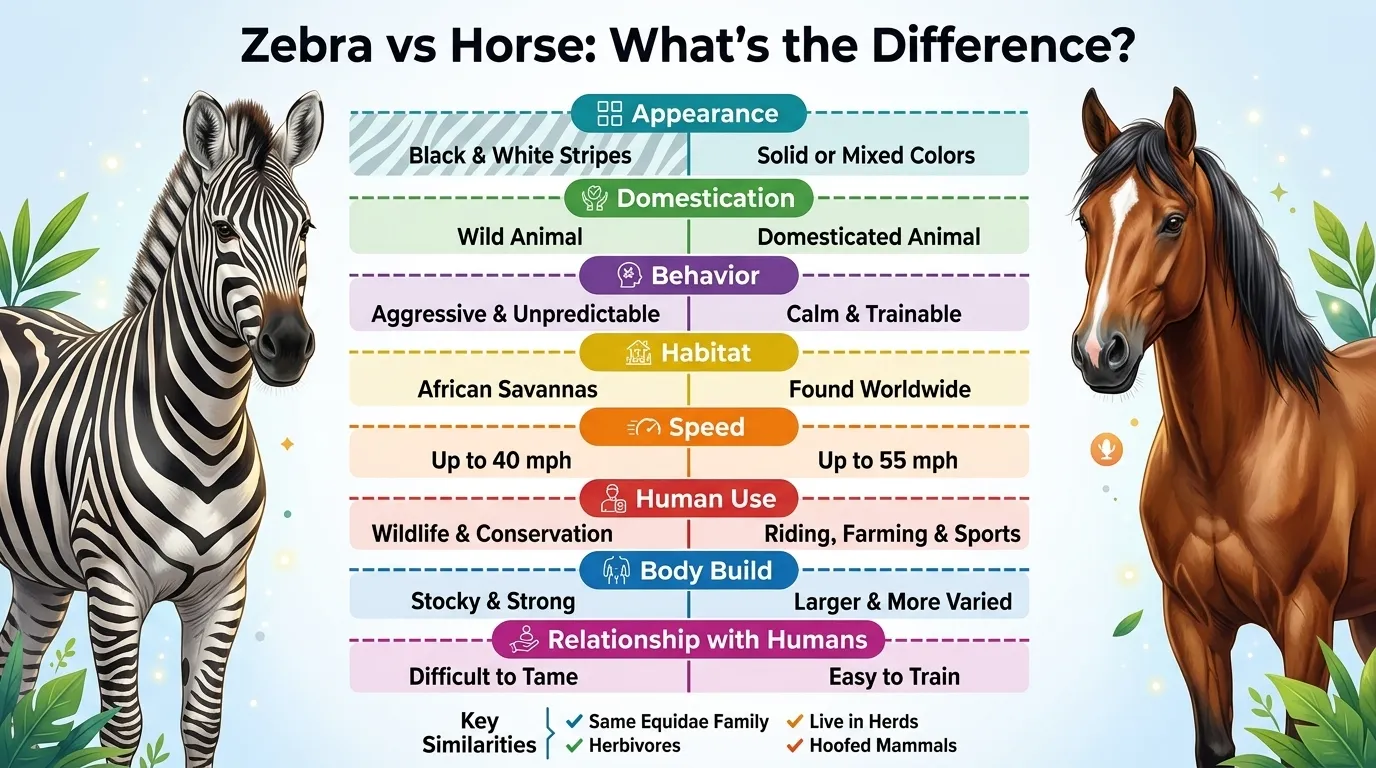
| Feature | Zebra | Horse |
| Classification | Wild animal | Domesticated animal |
| Coat Pattern | Black and white stripes | Solid or mixed colors |
| Habitat | African grasslands and savannas | Worldwide |
| Temperament | Aggressive and unpredictable | Generally trainable |
| Domestication | Never fully domesticated | Domesticated for thousands of years |
| Speed | Around 40 mph | Around 55 mph |
| Social Structure | Wild herds for protection | Herds and human-managed groups |
| Human Use | Wildlife conservation and tourism | Riding, farming, racing, therapy |
| Build | Shorter and stockier | Larger and more varied |
| Lifespan | 20–30 years | 25–30 years |
Key Differences Explained Between Difference Between Zebra and Horse
1. Domestication
The biggest difference is domestication. Horses have worked with humans for over 5,000 years, while zebras remain wild.
Real-life example: Farmers use horses for riding and work, but zebras are rarely used for practical transportation.
2. Coat Appearance
Every zebra has a unique stripe pattern, similar to a human fingerprint. Horses come in many colors but lack stripes.
3. Behavior
Zebras are known for being defensive and aggressive. Horses are generally calmer and easier to train.
4. Habitat
Zebras naturally live in African savannas. Horses can live almost anywhere humans care for them.
5. Speed and Endurance
Although horses are usually faster, zebras have exceptional agility and quick defensive movements.
6. Relationship with Humans
Humans depend on horses for sports, recreation, therapy, and transportation. Zebras are mainly observed in wildlife reserves and zoos.
7. Body Structure
Zebras have stronger necks and tougher bodies adapted for predator-rich environments.
8. Survival Instincts
Zebras evolved under constant threat from lions, hyenas, and other predators, making them highly alert and difficult to control.
Why Do Zebras Have Stripes While Horses Do Not?
Scientists believe zebra stripes evolved for several reasons:
- Predator confusion
- Insect deterrence
- Temperature regulation
- Individual identification
Research suggests that biting flies are less likely to land on striped coats. Horses never developed this adaptation because they evolved under different environmental pressures.
In simple words, zebra stripes are a survival tool rather than just a decorative pattern.
Why Can’t Zebras Be Domesticated Like Horses?
This is one of the most searched questions related to the difference between zebra and horse.
Several factors make domestication difficult:
- Strong flight response
- Aggressive temperament
- Powerful bite reflex
- Unpredictable behavior
- Lower tolerance for human handling
In practical use, even zoo professionals exercise caution when working closely with zebras.
Most beginners assume zebras are simply striped horses, but their behavior is dramatically different.
Difference Between Zebra and Horse in Physical Appearance
Although they share a similar body shape, several physical distinctions exist.
Zebra Characteristics
- Black-and-white stripes
- Smaller frame
- Upright mane
- Strong neck muscles
- Shorter body
Horse Characteristics
- Multiple coat colors
- Longer body
- Flowing mane
- Larger size range
- Greater breed diversity
A racehorse, draft horse, and pony can all look very different, while zebra species generally maintain a more consistent appearance.
Difference Between Zebra and Horse Habitat and Lifestyle
Zebra Habitat
Zebras are mainly found in:
- Kenya
- Tanzania
- Botswana
- Namibia
- South Africa
They live in grasslands, savannas, and open woodlands.
Horse Habitat
Horses live worldwide because humans care for them.
Common environments include:
- Farms
- Ranches
- Equestrian centers
- Riding schools
- Recreational facilities
This worldwide distribution is one reason horses have become one of the most influential animals in human history.
How Are Zebras and Horses Similar?
Despite many differences, they also share important similarities.
Similarities Table
| Feature | Zebra | Horse | Similarity |
| Family | Equidae | Equidae | Same biological family |
| Diet | Herbivore | Herbivore | Eat plant-based foods |
| Hooves | Single hoof per foot | Single hoof per foot | Similar foot structure |
| Social Life | Live in herds | Live in herds | Group-oriented animals |
| Reproduction | Give birth to foals | Give birth to foals | Similar reproduction |
| Body Shape | Horse-like frame | Horse-like frame | Related anatomy |
| Movement | Running animal | Running animal | Built for speed |
| Communication | Sounds and body language | Sounds and body language | Social communication |
This table clearly shows the difference and similarity between zebra and horse for quick understanding.
Difference Between Zebra and Horse in Human Society
Horses have shaped transportation, agriculture, military history, sports, and recreation.
Examples include:
- Horse racing
- Equestrian sports
- Therapeutic riding
- Ranch work
- Police patrol units
Zebras, on the other hand, contribute primarily through:
- Wildlife tourism
- Ecological balance
- Conservation programs
- Educational exhibits
In modern digital ecosystems such as Google Search, YouTube documentaries, Instagram wildlife pages, and Meta conservation campaigns, zebras often appear as symbols of African wildlife, while horses are commonly featured in sports, training, and lifestyle content.
Common Mistakes With Difference Between Zebra and Horse
Mistake 1: Thinking Zebras Are Just Wild Horses
Correction: Zebras and horses are related but are different species.
Mistake 2: Assuming Zebras Can Be Easily Trained
Correction: Zebras are significantly harder to domesticate.
Mistake 3: Believing All Zebras Look Identical
Correction: Every zebra has unique stripe patterns.
Mistake 4: Thinking Horses Naturally Live in the Wild Everywhere
Correction: Most horses today depend on human care.
Mistake 5: Assuming Zebras Are Faster Than Horses
Correction: Most horse breeds can run faster.
Real-Life Examples With Difference Between Zebra and Horse
Scenario 1: Personal Use
A family may own a horse for riding lessons and recreation. A zebra would not be a practical pet.
Scenario 2: Business Use
Horse ranches generate income through training, breeding, and tourism.
Scenario 3: Wildlife Industry
Safari parks attract visitors hoping to see zebras in their natural habitat.
Scenario 4: Sports Industry
Horses compete in racing, jumping, polo, and dressage events.
Scenario 5: Conservation Programs
Wildlife organizations focus on protecting zebra populations and habitats.
When to Use Each?
Choose Horses When:
- Riding is needed
- Transportation is required
- Farm work is involved
- Sports participation is desired
- Therapy programs are being used
Choose Zebras When:
- Studying wildlife
- Conservation research
- Educational programs
- Ecotourism activities
- Biodiversity protection
Why People Get Confused in Difference Between Zebra and Horse
Several reasons cause confusion:
- Similar body shape
- Same animal family
- Comparable size
- Similar grazing behavior
- Media portrayals
Movies, cartoons, and social media often simplify animal relationships, leading many people to think zebras are simply striped horses.
Expert Insight
From a zoological perspective, the most important distinction is not appearance but behavior. In real scenarios, domestication plays a far greater role than stripes or color patterns. Horses evolved alongside human civilization and adapted to cooperative work. Zebras evolved in predator-heavy ecosystems where caution and aggression increased survival.
This behavioral difference explains why horses became one of humanity’s most valuable companions while zebras remained symbols of the wild.
Frequently Asked Questions (FAQ)
Is a zebra stronger than a horse?
A zebra can be extremely strong and defensive, but overall strength depends on the horse breed being compared.
Can a zebra and horse mate?
Yes. They can produce a hybrid known as a zorse.
Which is faster, a zebra or a horse?
Most horses are faster than zebras.
Are zebras related to horses?
Yes. Both belong to the Equidae family.
Why are zebras difficult to tame?
They have stronger survival instincts, aggressive tendencies, and unpredictable behavior.
Do zebras and horses eat the same food?
Both are herbivores and mainly eat grasses and plants.
Are zebra stripes unique?
Yes. Every zebra has its own stripe pattern.
Which animal is more intelligent?
Both are intelligent in different ways, but zebras rely heavily on survival awareness.
Why do people compare zebras and horses?
Because they share similar anatomy and belong to the same animal family.
Conclusion
Understanding the difference between zebra and horse becomes much easier when you look beyond appearance. While both animals belong to the Equidae family and share several physical traits, their lifestyles, behavior, and relationship with humans are very different.
The horse is a domesticated animal that has supported transportation, farming, sports, and human development for thousands of years. The zebra remains a wild animal adapted for survival in Africa’s challenging ecosystems. Their stripes, behavior, habitat, and level of trainability highlight the biggest distinctions.
If someone asks for a simple answer about the difference between zebra and horse, remember this: a horse evolved to cooperate with humans, while a zebra evolved to survive predators in the wild.

Sarfraz Ahmad is language researcher and content writer who specializes in explaining the difference between commonly confused English words. Through WordClearify, learners understand subtle word distinctions in a simple, structured, and practical way. My writing focuses on clarity, real-life examples, and easy comparisons for students, bloggers, and professionals worldwide.