Have you ever looked up at the night sky and wondered whether those bright objects are stars or planets? Many people search for the difference between stars and planets because both appear as shining objects in space. However, they are very different in how they form, produce light, and behave in the universe.
Understanding the difference between stars and planets helps explain how our solar system works and why objects like the Sun, Earth, Mars, and Jupiter are classified differently. In simple words, stars create their own light and energy, while planets do not.
This guide will explain the difference between stars and planets in an easy-to-understand way, along with examples, comparisons, similarities, and expert insights. By the end of this article, you’ll know how to identify them, why they exist, and how astronomers study them today.
Quick Answer: Difference Between Stars and Planets
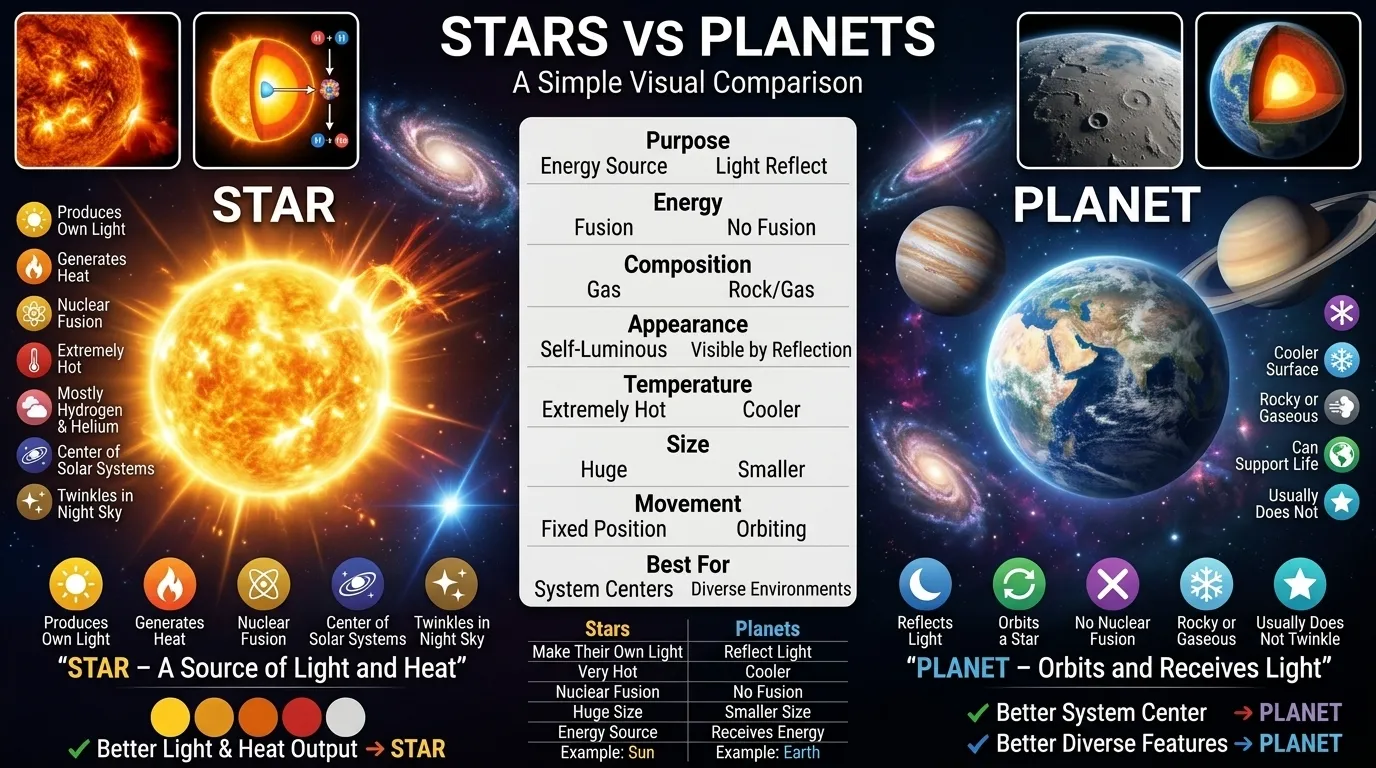
The main difference between stars and planets is that a star produces its own light and heat through nuclear fusion, while a planet does not create light and only reflects the light of a star.
Example: The Sun is a star because it generates energy. Earth is a planet because it revolves around the Sun and reflects sunlight.
Definition of Stars and Planets
- Star: A massive ball of hot gases, mainly hydrogen and helium, that produces its own light and heat through nuclear fusion.
- Planet: A large celestial body that orbits a star and reflects the star’s light instead of creating its own.
Example: The Sun is a star, while Earth and Mars are planets.
Pronunciation of Both Terms
| Term | US Pronunciation | UK Pronunciation |
|---|---|---|
| Star | /stɑːr/ | /stɑː/ |
| Planet | /ˈplænɪt/ | /ˈplænɪt/ |
Stars vs Planets Comparison Table
| Feature | Stars | Planets |
|---|---|---|
| Light Production | Produce their own light | Reflect light from stars |
| Energy Source | Nuclear fusion | No fusion process |
| Temperature | Extremely hot | Much cooler |
| Size | Usually much larger | Smaller than stars |
| Composition | Mostly hydrogen and helium | Rock, gas, ice, or metal |
| Motion | May have planets orbiting them | Orbit around stars |
| Twinkling Appearance | Usually twinkle | Usually shine steadily |
| Role in Solar System | Center of planetary systems | Orbit around stars |
| Lifespan | Millions to billions of years | Can survive as long as systems remain stable |
| Example | Sun, Sirius, Betelgeuse | Earth, Mars, Jupiter |
Key Differences Explained Between Stars and Planets
1. Stars Generate Light; Planets Reflect It
Stars shine because they create energy internally. Planets only appear bright because sunlight bounces off their surfaces or atmospheres.
Example: Venus often looks bright in the sky, but it is reflecting sunlight.
2. Stars Have Nuclear Fusion
Inside stars, hydrogen atoms combine to form helium, releasing enormous amounts of energy.
Planets lack the pressure and temperature needed for fusion.
3. Stars Are Much Hotter
The surface of the Sun is about 5,500°C, while Earth’s average surface temperature is far lower.
4. Planets Orbit Stars
Planets move around stars due to gravity.
For example, Earth takes approximately 365 days to orbit the Sun.
5. Stars Form Planetary Systems
Stars act as gravitational centers around which planets, moons, asteroids, and comets revolve.
6. Stars Are Visible Across Great Distances
Many stars visible from Earth are light-years away, while planets in our sky belong mainly to our solar system.
7. Planets Can Support Atmospheres
Some planets have atmospheres, oceans, and conditions that may support life.
Stars are too hot for life as we know it.
8. Stars and Planets Have Different Roles
Stars provide energy. Planets provide environments where geological and atmospheric processes occur.
What Is a Star and How Does It Work?
A star is a giant sphere of plasma held together by gravity. Deep inside, nuclear fusion converts hydrogen into helium.
This process releases:
- Light
- Heat
- Radiation
- Energy
Without stars, planets would receive no light or warmth.
The Sun powers Earth’s climate, weather, and life systems.
Why Stars Exist
Stars form when giant clouds of gas and dust collapse under gravity. As the material compresses, temperatures rise until nuclear fusion begins.
What Is a Planet and How Does It Work?
A planet is a celestial body that:
- Orbits a star
- Has enough gravity to become nearly spherical
- Has cleared its orbital path of debris
Planets come in different types:
Rocky Planets
Examples:
- Mercury
- Venus
- Earth
- Mars
Gas Giants
Examples:
- Jupiter
- Saturn
Ice Giants
Examples:
- Uranus
- Neptune
Unlike stars, planets cannot produce their own energy through fusion.
Why Do Stars Twinkle but Planets Usually Do Not?
Many beginners ask this question when learning the difference between both.
Stars Twinkle Because
Stars are extremely far away and appear as tiny points of light. Earth’s atmosphere bends their light repeatedly, creating a twinkling effect.
Planets Usually Do Not Twinkle Because
Planets appear as small disks rather than points of light. Their reflected light is spread out, making their brightness appear steadier.
This is one of the easiest ways to identify planets in the night sky.
Difference Between Both in Our Solar System
Our solar system provides a perfect real-world example.
The Star
- Sun
The Planets
- Mercury
- Venus
- Earth
- Mars
- Jupiter
- Saturn
- Uranus
- Neptune
Every planet in our solar system depends on the Sun’s energy.
Without the Sun, Earth would become a frozen world incapable of supporting life.
How Are Stars and Planets Formed?
Star Formation
- Gas cloud collapses.
- Gravity increases pressure.
- Temperature rises.
- Nuclear fusion begins.
- A new star is born.
Planet Formation
- Material remains around a young star.
- Dust particles collide.
- Larger bodies form.
- Gravity gathers more matter.
- Planets develop over millions of years.
This connection explains why planets are commonly found around stars.
Can a Planet Become a Star?
Generally, no.
For a planet to become a star, it would need enough mass to trigger nuclear fusion.
Even the largest planet in our solar system, Jupiter, is far too small.
Astronomers estimate Jupiter would need many times its current mass before fusion could begin.
Why Is the Difference Between Both Important?
Understanding the difference helps scientists:
- Search for habitable worlds
- Study galaxy formation
- Understand solar systems
- Explore the possibility of extraterrestrial life
- Analyze cosmic evolution
It also helps students and astronomy enthusiasts better understand the universe.
Difference and Similarity Between Stars and Planets
| Feature | Stars | Planets | Similarity |
|---|---|---|---|
| Definition | Produce their own energy | Orbit stars and reflect light | Both are celestial objects |
| Shape | Nearly spherical | Nearly spherical | Gravity shapes both |
| Gravity | Very strong | Strong but smaller | Both possess gravity |
| Location | Found in galaxies | Found around stars | Both exist in space |
| Formation | Form from collapsing gas clouds | Form from leftover material around stars | Both originate from cosmic matter |
| Motion | Move through galaxies | Orbit stars | Both are constantly moving |
| Observation | Visible in night sky | Visible in night sky | Both can be observed from Earth |
| Scientific Study | Studied by astronomers | Studied by astronomers | Both help us understand the universe |
This table clearly shows the difference and similarity between both for quick understanding.
Common Mistakes with Difference Between Both
Mistake 1: Thinking Every Bright Object Is a Star
Correction: Some bright objects are actually planets, especially Venus and Jupiter.
Mistake 2: Assuming Planets Produce Light
Correction: Planets reflect light from stars.
Mistake 3: Believing the Sun Is a Planet
Correction: The Sun is a star because it generates energy through fusion.
Mistake 4: Thinking Stars Orbit Planets
Correction: Planets orbit stars.
Mistake 5: Assuming All Planets Can Support Life
Correction: Most known planets have environments unsuitable for life.
Real-Life Examples with Difference Between Stars and Planets
Example 1: Looking at Venus
Many people mistake Venus for a star because of its brightness.
Example 2: School Astronomy Projects
Students compare Earth and the Sun to understand planetary systems.
Example 3: Telescope Observations
Amateur astronomers identify planets by their steady glow.
Example 4: Space Missions
Organizations like NASA study planets and stars to understand the universe.
Example 5: Exoplanet Discovery
Scientists search for planets around distant stars to find potentially habitable worlds.
When to Use Each Concept
When Discussing Stars
Use the term star when referring to:
- The Sun
- Stellar evolution
- Nuclear fusion
- Galaxies
- Energy-producing celestial bodies
When Discussing Planets
Use the term planet when referring to:
- Earth-like worlds
- Orbital systems
- Habitability
- Space exploration
- Solar system objects
Why People Get Confused in Difference Between Stars and Planets
Several factors cause confusion:
Similar Appearance
Both appear as bright points in the night sky.
Limited Visibility
Without telescopes, differences are not always obvious.
Media Representations
Movies and illustrations sometimes simplify astronomical objects.
Lack of Basic Astronomy Education
Many people never learn how stars and planets function differently.
Expert Insight
From an astronomy education perspective, the most important distinction is energy production.
In real scenarios, beginners often focus on appearance. However, astronomers classify stars and planets based on physics rather than brightness. If an object generates energy through nuclear fusion, it is a star. If it orbits a star and reflects light, it is a planet.
This single principle eliminates most confusion and provides a reliable scientific framework for classification.
Frequently Asked Questions (FAQs)
What is the main difference between stars and planets?
Stars produce their own light and energy, while planets reflect the light of stars.
Is the Sun a star or a planet?
The Sun is a star because it generates energy through nuclear fusion.
Why do planets shine at night?
They reflect sunlight toward Earth.
Can planets become stars?
Not under normal conditions because they lack sufficient mass for nuclear fusion.
Which is bigger, a star or a planet?
Stars are generally much larger than planets.
Why do stars twinkle?
Earth’s atmosphere bends their light, causing the twinkling effect.
Is Earth a star?
No. Earth is a planet that orbits the Sun.
Can life exist on stars?
No. Stars are far too hot for life as we know it.
How many planets orbit the Sun?
There are eight officially recognized planets in our solar system.
Conclusion
Understanding the difference between stars and planets is essential for anyone interested in astronomy, science, or the universe around us. While both are celestial objects found in space, they serve very different roles. Stars are powerful energy-producing bodies that create light and heat through nuclear fusion. Planets, on the other hand, orbit stars and reflect their light.
In simple terms, the Sun is a star because it generates energy, while Earth, Mars, and Jupiter are planets because they revolve around the Sun. This distinction helps scientists study solar systems, discover exoplanets, and search for conditions that may support life elsewhere in the universe.

David Anderson
I am David Anderson, a USA-based content writer and digital author. I create clear, engaging, and well-structured articles focused on delivering valuable and well-researched information. I specialize in blog writing and digital content that helps websites grow visibility and build strong online authority.