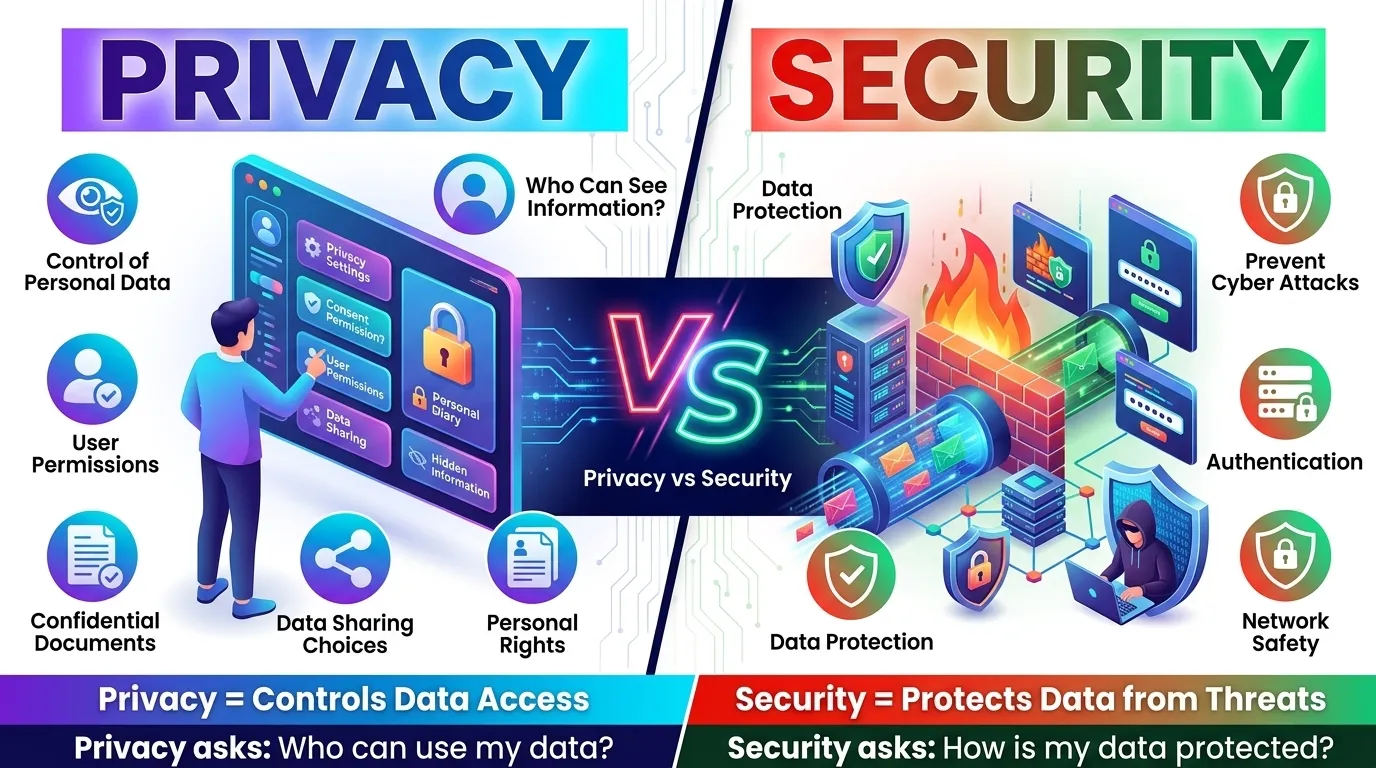
Many users get confused about the difference between privacy and security because both concepts are closely connected in the digital world. When you use online services, social media platforms, banking apps, or cloud storage, privacy and security work together, but they are not the same thing.
In simple words, privacy is about controlling who can access your personal information, while security is about protecting information from unauthorized access, attacks, or theft. Understanding the difference between both helps individuals and businesses make better decisions about data protection, cybersecurity, and online safety.
If you have ever wondered what privacy means, how security works, or why companies like Google, Meta, Instagram, and YouTube talk about both privacy policies and security measures, this guide will explain everything clearly.
Quick Answer: Difference Between Both
Privacy focuses on how personal information is collected, used, shared, and controlled.
Security focuses on protecting data, systems, and devices from unauthorized access, cyberattacks, and breaches.
Example: A social media account may have strong security through encryption and passwords, but if the platform shares user information without permission, privacy can still be compromised.
Definition of Both
- Privacy: The right and ability of individuals to control how their personal information is collected, used, stored, and shared.
- Security: The methods, technologies, and processes used to protect data, devices, networks, and systems from unauthorized access or damage.
Example: Keeping your medical records confidential relates to privacy, while protecting those records with passwords and encryption relates to security.
Pronunciation of Both Terms
| Term | US Pronunciation | UK Pronunciation |
|---|---|---|
| Privacy | /ˈpraɪ.və.si/ | /ˈprɪv.ə.si/ |
| Security | /sɪˈkjʊr.ə.t̬i/ | /sɪˈkjʊə.rə.ti/ |
Now that we understand the basic definitions, let’s explore the difference between both in greater detail.
Privacy vs Security: Comparison Table
| Feature | Privacy | Security |
|---|---|---|
| Main Focus | Control over personal information | Protection of data and systems |
| Purpose | Manage information usage | Prevent unauthorized access |
| Concern | Who can see data | How data is protected |
| User Control | High involvement from individuals | Mostly technical protection |
| Risk | Data misuse | Data theft or cyberattacks |
| Tools Used | Privacy settings, consent management | Firewalls, encryption, authentication |
| Goal | Confidentiality and personal control | Safety and protection |
| Example | Choosing who sees your posts | Preventing hackers from accessing your account |
Key Differences Explained Between Privacy and Security
1. Privacy Is About Control
Privacy allows people to decide who can access their information.
Example: Choosing whether your photos on Instagram are public or private.
2. Security Is About Protection
Security protects information from cybercriminals and unauthorized users.
Example: Two-factor authentication preventing hackers from logging into your account.
3. Privacy Involves Personal Rights
Privacy often relates to legal and ethical rights concerning personal data.
Example: Users requesting deletion of their personal information.
4. Security Uses Technical Measures
Security depends on technologies such as encryption, antivirus software, and firewalls.
5. Privacy Can Exist Without Strong Security
A company may respect privacy policies but still suffer a data breach due to weak security.
6. Security Does Not Automatically Guarantee Privacy
An organization can securely store data yet still collect excessive information from users.
7. Privacy Focuses on Data Usage
The key question is: “How is the information being used?”
8. Security Focuses on Threat Prevention
The key question is: “How is the information being protected?”
Why Does Privacy Exist?
Privacy exists because individuals need control over their personal lives, communications, identities, and information.
Without privacy:
- Personal information can be exploited.
- Identity theft becomes easier.
- User trust decreases.
- Personal freedoms may be restricted.
In practical use, privacy helps maintain dignity, autonomy, and personal choice.
Why Does Security Exist?
Security exists to protect systems, data, and networks from threats.
Modern security protects against:
- Malware
- Phishing attacks
- Ransomware
- Identity theft
- Data breaches
- Unauthorized access
As businesses increasingly rely on cloud computing and digital platforms, security has become a critical business requirement.
How Both Work Together
Many beginners assume privacy and security are separate. In reality, they depend on each other.
Think of a house:
- Privacy decides who should enter the house.
- Security locks the doors and windows.
Without security, privacy cannot be maintained.
Without privacy policies, security protects information that may still be misused.
This relationship explains why organizations invest heavily in both privacy compliance and cybersecurity programs.
Difference and Similarity Between Both
| Feature | Privacy | Security | Similarity |
|---|---|---|---|
| Purpose | Control information usage | Protect information | Both involve data protection |
| User Focus | Personal rights | System protection | Both affect users |
| Main Question | Who can access data? | How is data protected? | Both address data management |
| Technology Dependence | Moderate | High | Both use digital tools |
| Legal Importance | High | High | Both have regulations |
| Risk Reduction | Prevents misuse | Prevents attacks | Both reduce harm |
| Business Impact | Builds trust | Prevents breaches | Both support reputation |
| Digital Environment | User-centered | Infrastructure-centered | Essential for modern technology |
This table clearly shows the difference and similarity between both for quick understanding.
Difference Between Both in Social Media
Social media platforms provide excellent examples.
Privacy Example
On Instagram, users can decide:
- Public account
- Private account
- Story visibility
- Audience permissions
These are privacy controls.
Security Example
Instagram uses:
- Login authentication
- Suspicious login detection
- Password protection
- Encryption
These are security measures.
Many users mistakenly think changing privacy settings improves security. In reality, both require separate actions.
Difference Between Both in Business
Organizations handle enormous amounts of customer information.
Privacy Responsibilities
- Obtaining consent
- Transparent data collection
- Data retention policies
- Customer rights management
Security Responsibilities
- Endpoint protection
- Network monitoring
- Access control
- Incident response
A company can fail in either area independently.
For example, a business may have strong cybersecurity but collect more customer information than necessary, creating privacy concerns.
Real-Life Examples of Both
Personal Example
A smartphone password protects your phone through security.
Choosing which apps can access your location is privacy.
Healthcare Example
Hospitals protect patient records with cybersecurity tools.
Patients decide who can access their medical information.
Banking Example
Banks use encryption and fraud detection systems.
Customers control who can view financial details.
Workplace Example
Employees receive secure login credentials.
Organizations establish privacy rules for employee information.
Cloud Storage Example
Cloud providers secure files against hackers.
Users decide who can view shared documents.
When to Use Each
1. Focus on Privacy When:
- Managing personal information
- Setting sharing permissions
- Controlling data collection
- Reviewing consent agreements
2. Focus on Security When:
- Protecting accounts
- Preventing cyberattacks
- Securing networks
- Safeguarding devices
3. Focus on Both When:
- Running a business
- Managing customer data
- Using online services
- Storing sensitive information
Why People Get Confused Between Them
Several factors contribute to confusion.
Similar Goals
Both aim to protect information.
Marketing Language
Companies often use the terms interchangeably.
Technology Overlap
Privacy tools frequently include security features.
Media Coverage
News reports often combine privacy breaches and security incidents.
Shared Data Environment
Both operate within the same digital ecosystem.
As a result, many users mistakenly believe they are identical concepts.
Common Mistakes with Privacy and Security
Mistake 1: Thinking Security Automatically Provides Privacy
Correction: Strong security does not guarantee responsible data usage.
Mistake 2: Ignoring Privacy Settings
Correction: Review permissions regularly.
Mistake 3: Using Weak Passwords
Correction: Enable strong passwords and multi-factor authentication.
Mistake 4: Sharing Excessive Personal Information
Correction: Limit unnecessary data exposure.
Mistake 5: Trusting Every Secure Website
Correction: Security certificates do not guarantee ethical data practices.
Mistake 6: Assuming Privacy Is Only a Legal Issue
Correction: Privacy affects everyday digital behavior.
Frequently Asked Questions (FAQs)
What is the main difference between privacy and security?
Privacy concerns control over personal information, while security focuses on protecting that information from threats.
Can security exist without privacy?
Yes. Data can be securely stored but still collected or used in ways users do not approve.
Can privacy exist without security?
Not effectively. Weak security makes private information vulnerable.
Why are privacy and security important?
They protect personal information, maintain trust, and reduce risks such as identity theft and cybercrime.
Do businesses need both privacy and security programs?
Yes. Modern organizations require both to protect customer data and maintain compliance.
Conclusion
Understanding the difference between privacy and security is essential in today’s digital world. Although the two concepts are closely related, they serve different purposes. Privacy focuses on controlling how personal information is collected, shared, and used, while security focuses on protecting that information from unauthorized access, cyber threats, and data breaches.
In practical situations, privacy answers the question, “Who should have access to this information?” Security answers the question, “How do we protect this information?” Both are necessary for effective data protection. A secure system without privacy controls can still misuse information, while privacy policies without strong security can leave sensitive data exposed.

Sarfraz Ahmad is language researcher and content writer who specializes in explaining the difference between commonly confused English words. Through WordClearify, learners understand subtle word distinctions in a simple, structured, and practical way. My writing focuses on clarity, real-life examples, and easy comparisons for students, bloggers, and professionals worldwide.