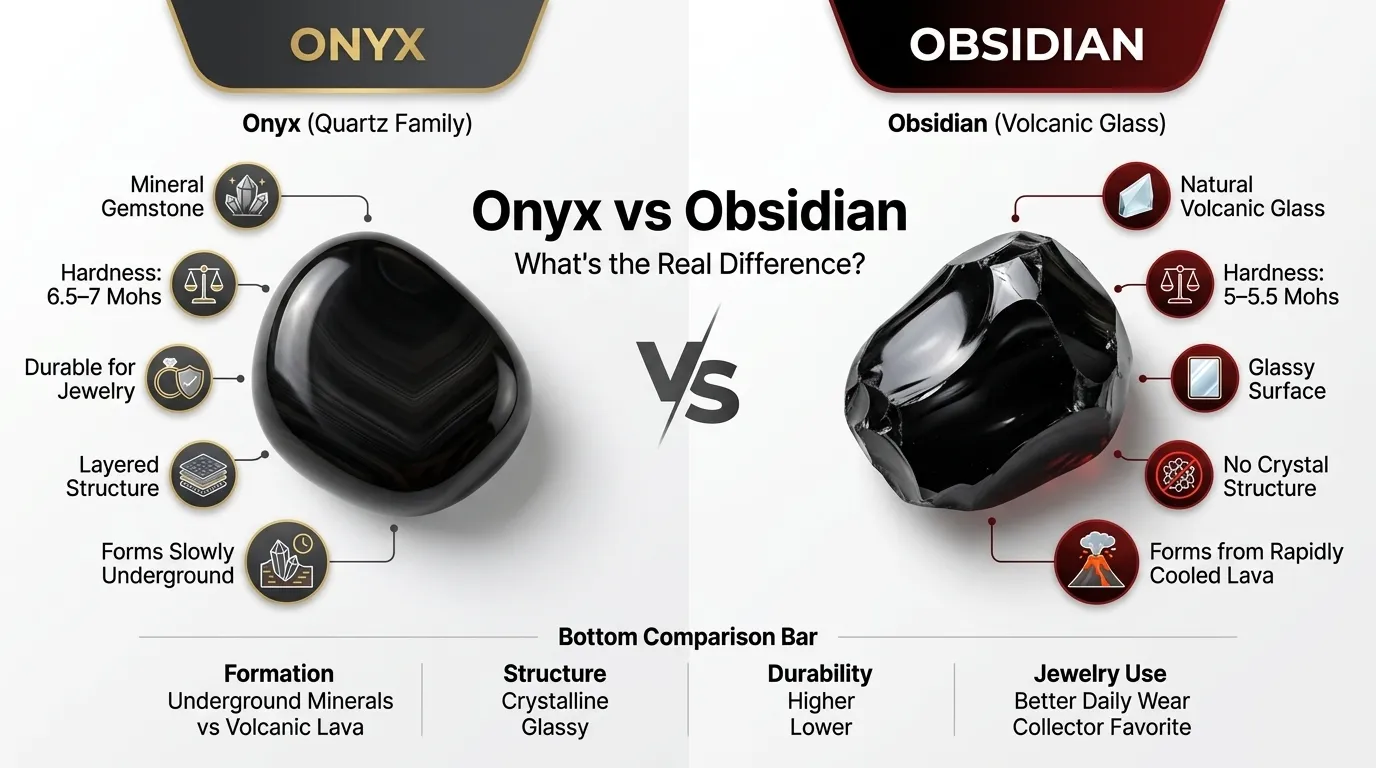
Many people searching for the difference between onyx and obsidian assume they are the same stone because both are typically black, polished, and widely used in jewelry and decorative objects. However, the difference between onyx and obsidian is much more significant than appearance alone.
In simple terms, onyx is a mineral gemstone made from layered chalcedony, while obsidian is a natural volcanic glass formed from rapidly cooled lava. Understanding the difference between onyx and obsidian helps buyers, collectors, jewelers, and crystal enthusiasts make better decisions.
If you’ve ever wondered what is onyx, what is obsidian, how they form, which is more valuable, or which stone is better for jewelry, this guide covers everything. By the end, you’ll have a complete understanding without needing another article.
Quick Answer: Difference Between Onyx and Obsidian
The main difference between onyx and obsidian is their origin and composition.
- Onyx is a banded variety of chalcedony, a mineral in the quartz family.
- Obsidian is natural volcanic glass created when lava cools extremely fast.
Example
A polished black ring may look identical from a distance, but if it’s made from onyx, it’s a mineral gemstone. If it’s made from obsidian, it’s volcanic glass created by geological activity.
Definition of Onyx and Obsidian
- Onyx: A gemstone composed of layered chalcedony (microcrystalline quartz), known for its bands and durability.
- Obsidian: A naturally occurring volcanic glass formed when molten lava cools rapidly with minimal crystal growth.
Simple Example
Think of onyx as a stone that slowly developed underground, while obsidian formed almost instantly during a volcanic eruption.
Pronunciation of Both Stones
| Stone | US Pronunciation | UK Pronunciation |
| Onyx | AH-niks | OH-niks |
| Obsidian | uhb-SID-ee-ən | ob-SID-ee-ən |
Now that we know what these stones are and how to pronounce them, let’s understand their real differences in depth.
Onyx vs Obsidian: Comparison Table
| Feature | Onyx | Obsidian |
| Formation | Forms slowly through mineral deposits | Forms rapidly from volcanic lava |
| Classification | Mineral gemstone | Natural volcanic glass |
| Composition | Chalcedony (Quartz family) | Silica-rich volcanic glass |
| Crystal Structure | Microcrystalline | No crystal structure |
| Hardness | 6.5–7 Mohs | 5–5.5 Mohs |
| Durability | More durable for jewelry | More prone to scratches |
| Appearance | Often banded | Usually uniform and glassy |
| Transparency | Mostly opaque | Can be slightly translucent |
| Geological Origin | Sedimentary environments | Volcanic regions |
| Common Use | Jewelry, carvings, décor | Jewelry, tools, collectibles |
Mini Summary
Onyx is a mineral gemstone with a crystalline structure, while obsidian is volcanic glass without crystals.
Key Differences Explained Between Onyx and Obsidian
1. Formation Process
Onyx develops gradually through mineral deposition over thousands of years.
Obsidian forms almost instantly when lava cools too quickly for crystals to grow.
2. Material Type
Onyx belongs to the quartz family.
Obsidian is technically glass, not a mineral.
3. Hardness
Onyx ranks higher on the Mohs hardness scale, making it more resistant to everyday wear.
4. Appearance
Many users get confused because both can appear black. However, onyx often contains subtle banding, while obsidian has a smooth glass-like shine.
5. Durability
For rings and bracelets exposed to daily use, onyx generally performs better.
6. Geological Origin
Onyx forms underground through mineral processes.
Obsidian forms near volcanoes.
7. Historical Use
Ancient civilizations used obsidian for cutting tools because of its razor-sharp edges.
Onyx was favored for carvings, seals, and ornamental objects.
8. Market Position
High-quality onyx is often marketed as a luxury gemstone, while obsidian is commonly sold as a collector’s stone or crystal.
What Is Onyx and How Does It Form?
Onyx is a variety of chalcedony, which belongs to the quartz family.
It forms when silica-rich water deposits microscopic quartz layers over long periods. These layers create the characteristic bands associated with traditional onyx.
Common Colors
- Black
- White
- Brown
- Red
- Green (often treated)
Real-World Uses
- Luxury jewelry
- Decorative sculptures
- Home décor
- Architectural accents
In practical use, onyx is valued because it combines beauty with relatively high durability.
What Is Obsidian and How Does It Form?
Obsidian is volcanic glass produced when lava cools rapidly after an eruption.
Because cooling occurs so quickly, crystals do not have time to develop.
Types of Obsidian
- Black Obsidian
- Snowflake Obsidian
- Rainbow Obsidian
- Mahogany Obsidian
- Gold Sheen Obsidian
Common Uses
- Jewelry
- Collectibles
- Decorative objects
- Historical cutting tools
In real scenarios, archaeologists frequently study obsidian artifacts to understand ancient trade networks.
Difference Between Onyx and Obsidian in Jewelry
When choosing jewelry, durability matters.
Why Jewelers Prefer Onyx
- Better scratch resistance
- More durable for daily wear
- Elegant appearance
- Suitable for rings and bracelets
Why Some Buyers Prefer Obsidian
- Unique volcanic origin
- Distinct glassy shine
- Popular in crystal communities
- Often more affordable
For everyday jewelry, onyx usually offers better longevity.
Which Is More Valuable: Onyx or Obsidian?
The answer depends on quality, rarity, craftsmanship, and market demand.
Onyx Value Factors
- Color consistency
- Natural banding
- Size
- Quality of cutting
Obsidian Value Factors
- Rare varieties
- Visual effects
- Origin location
- Collector demand
Generally, premium jewelry-grade onyx often commands higher prices than common black obsidian.
However, rare obsidian varieties can exceed standard onyx pricing.
How to Identify Onyx vs Obsidian
Many beginners struggle to tell them apart.
Look for Banding
Onyx may display layered patterns.
Examine the Surface
Obsidian often has a glass-like reflection.
Check Hardness
Onyx is harder and more scratch-resistant.
Observe Fractures
Obsidian breaks with sharp, curved fractures.
Professional Testing
Gemological testing remains the most reliable identification method.
Difference and Similarity Table: Difference Between Onyx and Obsidian
| Feature | Onyx | Obsidian | Similarity |
| Meaning | Quartz-based gemstone | Volcanic glass | Both are natural materials |
| Formation | Mineral deposition | Lava cooling | Geological origins |
| Structure | Crystalline | Non-crystalline | Used in jewelry |
| Hardness | Higher | Lower | Can be polished |
| Appearance | Banded or solid | Glassy surface | Often black |
| Uses | Jewelry and décor | Jewelry and collectibles | Decorative applications |
| Durability | Better daily wear | More fragile | Require care |
| Popularity | Luxury gemstone market | Crystal and collector market | Widely recognized stones |
This table clearly shows the difference and similarity between difference between onyx and obsidian for quick understanding.
Common Mistakes with Onyx and Obsidian
Mistake 1: Assuming Both Are Minerals
Correction: Obsidian is volcanic glass.
Mistake 2: Using Appearance Alone
Correction: Similar color does not mean identical composition.
Mistake 3: Ignoring Hardness
Correction: Onyx is harder and more durable.
Mistake 4: Believing All Black Stones Are Onyx
Correction: Many black gemstones exist.
Mistake 5: Confusing Crystal Healing Claims with Geology
Correction: Geological classification differs from spiritual beliefs.
Real Life Examples with Difference Between Onyx and Obsidian
Personal Use
Someone buying a daily-wear ring may choose onyx for durability.
Collector Use
A crystal enthusiast may collect rainbow obsidian due to its unique visual effects.
Business Use
Jewelry retailers often stock both because they appeal to different customer preferences.
Educational Use
Geology students study obsidian to understand volcanic activity.
Museum Use
Historical museums display obsidian tools from ancient civilizations.
When to Use Each Stone
Choose Onyx When
- You want durable jewelry.
- You prefer gemstone materials.
- You need scratch resistance.
Choose Obsidian When
- You appreciate volcanic history.
- You collect natural specimens.
- You enjoy glass-like aesthetics.
Why People Get Confused About Onyx and Obsidian
Several factors contribute to confusion.
Similar Color
Both are commonly black.
Jewelry Marketing
Some product listings emphasize appearance rather than geological classification.
Social Media Influence
Platforms such as Instagram,YouTube, and Facebook (Meta) often showcase polished stones without explaining material differences.
Limited Consumer Knowledge
Most buyers focus on looks rather than mineral composition.
Expert Insight
From a gemological perspective, the most important distinction is not color but structure.
Most beginners focus on appearance. Professionals focus on composition, formation, hardness, and intended use.
In practical use, onyx is often the better choice for everyday jewelry because of its durability. Obsidian, however, remains fascinating due to its volcanic origin and historical significance.
Understanding this distinction helps buyers make informed decisions rather than relying solely on visual appearance.
Frequently Asked Questions
Is onyx the same as obsidian?
No. Onyx is a quartz-based gemstone, while obsidian is volcanic glass.
Which is harder, onyx or obsidian?
Onyx is generally harder and more scratch-resistant.
Is obsidian considered a crystal?
Technically, obsidian lacks a crystal structure and is classified as volcanic glass.
Can obsidian be used in rings?
Yes, but it can scratch and chip more easily than onyx.
Why are both stones usually black?
Natural mineral content and geological formation contribute to their dark coloration.
Which stone is better for daily wear?
Onyx is typically the better option for everyday jewelry.
Is black onyx rare?
High-quality natural black onyx is less common than treated varieties.
Does obsidian occur near volcanoes?
Yes. Obsidian forms directly from volcanic activity.
Which is more expensive?
Premium onyx often costs more, although rare obsidian varieties can be valuable.
How can I identify real onyx?
Professional gemological testing provides the most accurate identification.
Conclusion
Understanding the difference between onyx and obsidian is easier once you focus on their origins rather than their appearance. Although both stones often look similar and are frequently black, they belong to completely different geological categories.
Onyx is a durable quartz-based gemstone formed through mineral deposition over long periods. Obsidian is natural volcanic glass created when lava cools rapidly. This distinction affects hardness, durability, value, appearance, and practical use.
For buyers seeking long-lasting jewelry, onyx is often the preferred option because it withstands daily wear better. For collectors, geology enthusiasts, and crystal lovers, obsidian offers a unique connection to volcanic processes and Earth’s natural history.

David Anderson
I am David Anderson, a USA-based content writer and digital author. I create clear, engaging, and well-structured articles focused on delivering valuable and well-researched information. I specialize in blog writing and digital content that helps websites grow visibility and build strong online authority.