The difference between beans and legumes is one of the most common food-related questions people ask. Many people use the words interchangeably, but they are not exactly the same thing. In fact, understanding the difference between both can help you make better choices when cooking, shopping, or learning about nutrition.
If you’ve ever wondered whether kidney beans, chickpeas, lentils, and peas belong to the same category, you’re not alone. The difference between both comes down to classification, plant families, and how these foods grow.
In this guide, you’ll learn what beans and legumes are, how they differ, their nutritional value, practical uses, and why so many people confuse them. By the end, you’ll have a clear answer without needing another article.
Quick Answer: Difference Between Beans and Legumes
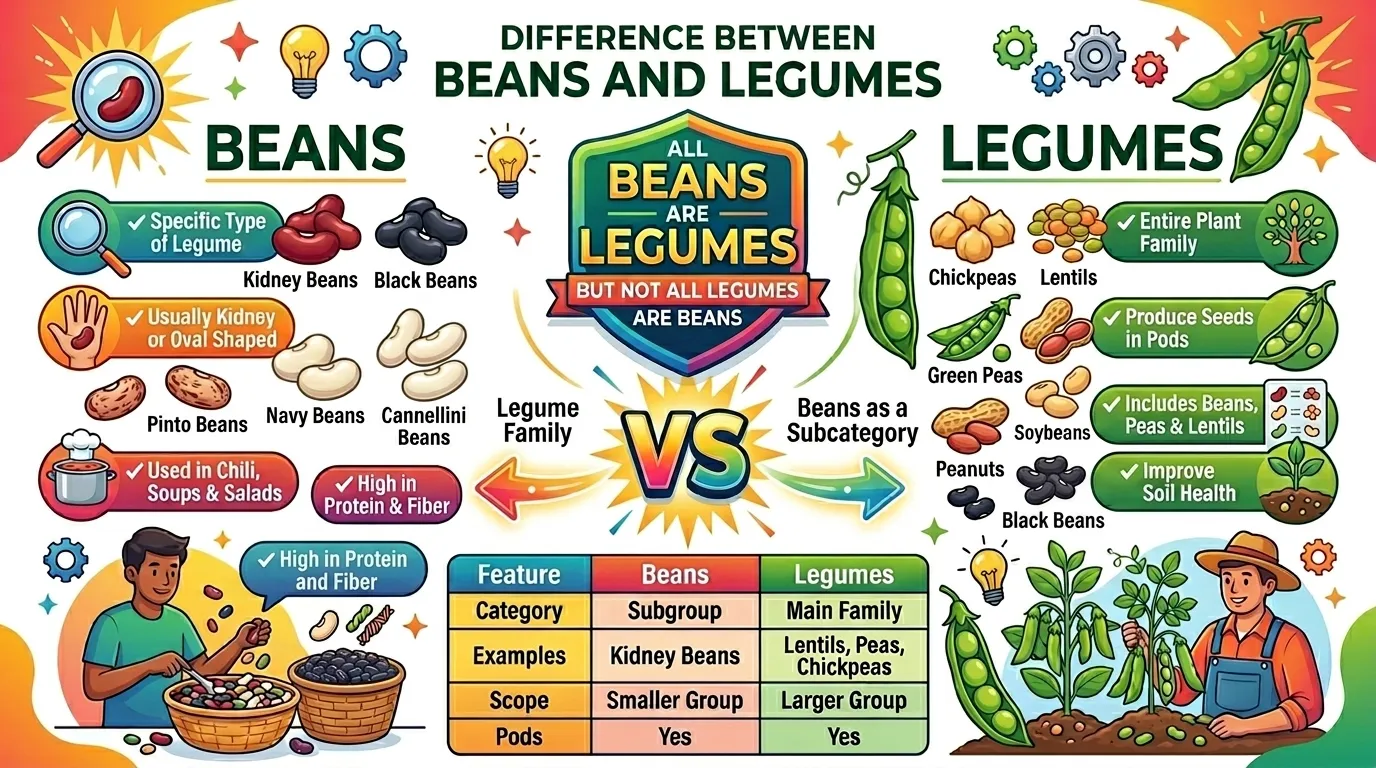
All beans are legumes, but not all legumes are beans.
A legume is a broad category of plants that produce seeds inside pods. Beans are one type of legume.
Example:
- Kidney beans = Bean + Legume
- Chickpeas = Legume but not technically a bean
- Lentils = Legume but not a bean
So, beans are a subset of the larger legume family.
Definition of Beans and Legumes
- Beans: Edible seeds from certain plants within the legume family, usually kidney-shaped, oval, or round.
- Legumes: Plants belonging to the Fabaceae family that produce seeds inside pods, including beans, peas, lentils, peanuts, and chickpeas.
Example: Every black bean is a legume, but not every legume is a bean.
Pronunciation of Both Terms
| Term | US Pronunciation | UK Pronunciation |
|---|---|---|
| Beans | /biːnz/ | /biːnz/ |
| Legumes | /ləˈɡuːmz/ | /ˈleɡ.juːmz/ |
Now that you know what these terms mean and how they are pronounced, let’s explore the key differences in detail.
Beans vs Legumes Comparison Table
| Feature | Beans | Legumes |
|---|---|---|
| Definition | Specific type of edible seed | Entire plant family |
| Category Size | Smaller group | Larger group |
| Scientific Scope | Subgroup of legumes | Fabaceae family |
| Includes | Kidney beans, black beans, pinto beans | Beans, peas, lentils, chickpeas, peanuts |
| Pod Production | Grow inside pods | Produce pods by definition |
| Plant Classification | Specific crops | Broad botanical category |
| Nutritional Profile | High in fiber and protein | Generally high in protein and nutrients |
| Common Use | Soups, salads, chili | Wide variety of dishes worldwide |
| Agricultural Role | Food crop | Food crop and soil enhancer |
| Examples | Navy beans, black beans | Lentils, peas, peanuts, beans |
Key Differences Explained Between Beans and Legumes
1. Scope of Classification
Legumes represent an entire plant family, while beans are only one group within that family.
Example: Lentils and peanuts are legumes but not beans.
2. Botanical Definition
Botanists classify legumes based on pod-producing plants. Beans are classified by their specific seed type.
3. Variety
The legume family contains thousands of species worldwide. Beans make up only a portion of them.
4. Physical Appearance
Most beans have a characteristic kidney, oval, or rounded shape. Legumes vary significantly in appearance.
5. Culinary Usage
Beans are commonly used in chili, soups, and salads. Legumes include many additional foods such as hummus made from chickpeas.
6. Agricultural Benefits
All legumes help enrich soil through nitrogen fixation, while beans contribute to this process as members of the legume family.
7. Consumer Understanding
Most people refer to all legumes as beans, creating confusion during shopping and meal planning.
8. Nutritional Diversity
Although most legumes are rich in protein and fiber, nutritional values differ among beans, lentils, peas, and peanuts.
What Are Legumes and Why Do They Exist?
Legumes are plants from the Fabaceae family that produce seeds inside pods.
One unique reason legumes are important is their ability to work with soil bacteria to convert atmospheric nitrogen into usable nutrients. This natural process improves soil fertility.
Examples include:
- Lentils
- Chickpeas
- Green peas
- Peanuts
- Soybeans
- Black beans
- Kidney beans
This ability makes legumes extremely valuable in modern agriculture and sustainable farming systems.
What Are Beans?
Beans are edible seeds harvested from certain legume plants.
They are popular worldwide because they are:
- Affordable
- High in protein
- Rich in fiber
- Easy to store
- Versatile in recipes
Common types include:
- Kidney beans
- Black beans
- Pinto beans
- Navy beans
- Great Northern beans
- Cannellini beans
Many nutrition experts recommend beans as part of a balanced diet because they provide plant-based protein and complex carbohydrates.
Why Are All Beans Legumes but Not All Legumes Beans?
This is where most beginners get confused.
Think of it like this:
- Legumes = The entire family
- Beans = One branch of that family
A simple comparison:
| Category | Example |
|---|---|
| Vehicle | Car |
| Legume | Bean |
Just as every car is a vehicle but not every vehicle is a car, every bean is a legume but not every legume is a bean.
This simple analogy helps clarify the relationship instantly.
Difference Between Beans and Legumes in Nutrition
Many users searching for the difference between beans and legumes are actually interested in nutrition.
Protein Content
Both beans and legumes are excellent plant protein sources.
Fiber
Most legumes provide significant dietary fiber that supports digestion.
Vitamins and Minerals
Common nutrients include:
- Iron
- Folate
- Magnesium
- Potassium
- Zinc
Calories
Calorie levels vary depending on the specific legume.
Healthy Diets
Legumes play important roles in:
- Mediterranean diets
- Vegetarian diets
- Vegan diets
- Heart-healthy meal plans
Organizations like World Health Organization and Food and Agriculture Organization frequently recognize legumes as valuable nutrient-rich foods.
Common Types of Legumes That Are Not Beans
Many people assume every legume is a bean.
Here are several legumes that are not beans:
| Legume | Bean? |
|---|---|
| Lentils | No |
| Chickpeas | No |
| Peanuts | No |
| Green Peas | No |
| Split Peas | No |
| Alfalfa | No |
These foods belong to the legume family but are not classified as beans.
Difference and Similarity Between Beans and Legumes
| Feature | Beans | Legumes | Similarity |
|---|---|---|---|
| Meaning | Specific edible seed group | Entire plant family | Both are plant foods |
| Botanical Level | Subcategory | Main category | Both belong to Fabaceae |
| Examples | Kidney beans, black beans | Lentils, peas, peanuts | Beans are part of legumes |
| Protein Content | High | Usually high | Both support plant-based diets |
| Fiber Content | Rich source | Rich source | Aid digestion |
| Growth Method | Grow in pods | Produce pods | Pod-based development |
| Agricultural Value | Useful crop | Improve soil fertility | Important for farming |
| Global Consumption | Widely consumed | Widely consumed | Popular worldwide |
This table clearly shows the difference and similarity between both for quick understanding.
How Are Both Are Used Around the World?
Different cultures use legumes in unique ways.
North America
- Chili with kidney beans
- Baked beans
- Bean soups
Middle East
- Hummus from chickpeas
- Falafel
South Asia
- Lentil curries
- Dal dishes
Mediterranean Region
- White bean salads
- Chickpea stews
Latin America
- Black beans with rice
- Pinto bean dishes
In practical use, legumes serve as affordable protein sources for millions of people worldwide.
Common Mistakes with Both
Mistake 1: Thinking They Mean Exactly the Same Thing
Correction: Beans are a type of legume.
Mistake 2: Calling Lentils Beans
Correction: Lentils are legumes but not beans.
Mistake 3: Assuming Peanuts Are Nuts
Correction: Peanuts are actually legumes.
Mistake 4: Ignoring Botanical Classification
Correction: Scientific classification explains the distinction.
Mistake 5: Believing Nutritional Values Are Identical
Correction: Different legumes contain varying nutrient levels.
Mistake 6: Using Food Labels as Scientific Definitions
Correction: Marketing terms do not always match botanical definitions.
Real-Life Examples with Difference Between Both
Scenario 1: Grocery Shopping
A shopper buys chickpeas thinking they are beans. Technically, they are legumes but not beans.
Scenario 2: Nutrition Planning
A vegan meal plan includes beans, lentils, and peas. All are legumes providing plant protein.
Scenario 3: Agricultural Education
Farmers rotate legume crops to improve soil health naturally.
Scenario 4: Food Manufacturing
Plant-based food companies use legumes to create protein-rich products.
Scenario 5: Restaurant Menus
Menus may list “beans and legumes” separately to indicate broader ingredient choices.
When to Use Each
Use the Word “Beans” When:
- Referring to kidney beans
- Referring to black beans
- Discussing bean recipes
- Talking about specific bean varieties
Use the Word “Legumes” When:
- Referring to the entire plant family
- Discussing nutrition broadly
- Talking about agricultural science
- Including peas, lentils, peanuts, and beans together
Why People Get Confused in Difference Between Them
Several factors cause confusion.
Everyday Language
Most people use the terms interchangeably.
Food Packaging
Packages often simplify terminology.
Nutrition Articles
Some articles prioritize readability over botanical accuracy.
Cultural Usage
Different countries may use broader or narrower definitions.
Educational Gaps
Many schools focus on nutrition rather than plant classification.
As a result, the distinction becomes blurred in everyday conversations.
Expert Insight
From a nutrition and food science perspective, the most important takeaway is that the distinction is primarily botanical rather than nutritional.
In real-world scenarios, most dietary recommendations focus on increasing legume consumption overall because legumes provide fiber, protein, vitamins, and minerals.
Most beginners spend too much time worrying about whether something is technically a bean or a legume. For healthy eating, the bigger goal is simply incorporating a variety of legumes into meals.
However, for education, agriculture, nutrition research, and food labeling, understanding the difference between both remains valuable.
Frequently Asked Questions (FAQs)
Are beans and legumes the same thing?
No. Beans are a type of legume, but legumes include many other foods such as lentils, peas, and peanuts.
Are chickpeas beans or legumes?
Chickpeas are legumes but are not technically classified as beans.
Are lentils considered beans?
No. Lentils belong to the legume family but are not beans.
Why are peanuts classified as legumes?
Peanuts grow in pods and belong to the Fabaceae family, making them legumes rather than true nuts.
Which is healthier: beans or legumes?
Beans are legumes, so the comparison is not direct. Both provide valuable nutrients and can support a healthy diet.
Are soybeans beans or legumes?
Soybeans are both. They are a bean variety within the larger legume family.
Do all legumes contain protein?
Most legumes are excellent protein sources, although amounts vary by type.
What is the biggest difference between beans and legumes?
The biggest difference is classification. Legumes are the broad family, while beans are one subgroup within that family.
Can legumes improve soil quality?
Yes. Many legumes naturally increase soil nitrogen levels through beneficial bacterial relationships.
Why do nutrition experts recommend legumes?
Because they are nutrient-dense, affordable, high in fiber, and rich in plant-based protein.
Conclusion
Understanding the difference between beans and legumes is much simpler once you know the basic rule: all beans are legumes, but not all legumes are beans. Beans represent a specific group within the larger legume family, while legumes include beans, lentils, chickpeas, peas, peanuts, and many other pod-producing plants.
If you’re comparing foods, planning a healthy diet, studying botany, or simply trying to understand food labels, remembering this relationship will give you instant clarity. The next time someone asks about the difference between both, you’ll know that beans are just one part of the much larger legume family.

Sarfraz Ahmad is language researcher and content writer who specializes in explaining the difference between commonly confused English words. Through WordClearify, learners understand subtle word distinctions in a simple, structured, and practical way. My writing focuses on clarity, real-life examples, and easy comparisons for students, bloggers, and professionals worldwide.