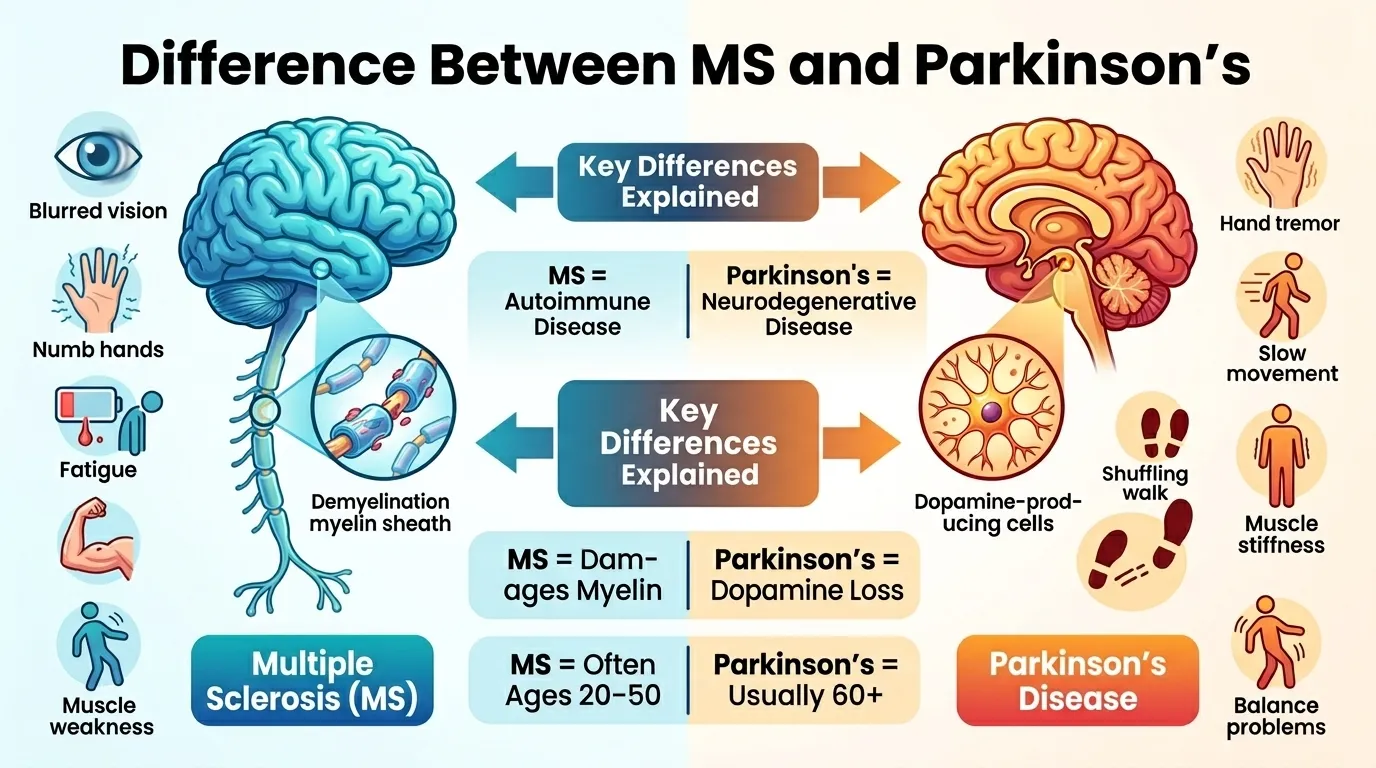
Many people search for the difference between MS and Parkinson’s because both conditions affect movement, balance, and daily activities. At first glance, they may seem similar, but they are actually very different neurological disorders.
Understanding the difference between both is important for patients, caregivers, and anyone looking for accurate health information. Multiple sclerosis (MS) affects the central nervous system through immune system attacks, while Parkinson’s disease mainly develops because of the loss of dopamine-producing brain cells.
In this guide, you’ll learn what these conditions are, how they differ, why symptoms can overlap, and how doctors diagnose and treat them. We will also explore real-life examples, common misconceptions, similarities, and expert insights to give you a complete understanding of the topic.
Quick Answer: Difference Between Both
The main difference between MS and Parkinson’s is that MS is an autoimmune disease that damages the protective covering of nerves, while Parkinson’s disease is a progressive brain disorder caused by the loss of dopamine-producing neurons.
For example, a person with MS may experience vision problems and numbness, whereas a person with Parkinson’s often develops tremors, slow movement, and muscle stiffness.
Definition of MS and Parkinson’s
- Multiple Sclerosis (MS): A chronic autoimmune disease in which the immune system attacks the protective myelin sheath surrounding nerve fibers in the brain and spinal cord.
- Parkinson’s Disease: A progressive neurological disorder caused by the gradual loss of dopamine-producing cells in a region of the brain called the substantia nigra.
Example: MS commonly affects communication between the brain and body, while Parkinson’s primarily affects movement control.
Pronunciation of Both Conditions
Multiple Sclerosis (MS)
US Pronunciation: MUL-tuh-pul skluh-ROH-sis
UK Pronunciation: MUL-ti-pul skluh-ROH-sis
Parkinson’s Disease
US Pronunciation: PAR-kin-sunz dih-ZEEZ
UK Pronunciation: PAA-kin-sunz dih-ZEEZ
Now that you know what each condition is and how to pronounce them, let’s understand the major differences that separate these two neurological disorders.
MS vs Parkinson’s: Comparison Table
| Feature | Multiple Sclerosis (MS) | Parkinson’s Disease |
|---|---|---|
| Disease Type | Autoimmune disorder | Neurodegenerative disorder |
| Main Cause | Immune system attacks myelin | Loss of dopamine-producing neurons |
| Typical Age | 20–50 years | Usually over 60 years |
| Tremors | Less common | Very common |
| Vision Problems | Common symptom | Rare |
| Muscle Stiffness | Can occur | Major symptom |
| Disease Progression | Relapsing or progressive | Gradually progressive |
| Brain Chemical Involvement | Nerve signal disruption | Dopamine deficiency |
| Cognitive Effects | May affect memory and thinking | Can affect cognition later |
| Cure Available | No cure yet | No cure yet |
This comparison highlights the difference between both in terms of causes, symptoms, and disease progression.
Key Differences Explained Between MS and Parkinson’s
1. Underlying Cause
MS occurs when the immune system mistakenly attacks healthy nerve tissue. Parkinson’s develops because dopamine-producing brain cells gradually die.
Real-life example: A young adult may suddenly experience MS symptoms after an immune response, while Parkinson’s often develops slowly over years.
2. Age of Onset
MS frequently appears in younger adults between ages 20 and 50.
Parkinson’s is more common after age 60.
3. Movement Symptoms
Many users get confused because both conditions affect movement.
However, Parkinson’s is primarily a movement disorder, while MS affects many neurological functions beyond movement.
4. Vision Problems
Blurred vision and optic neuritis are common in MS.
Vision changes are generally not early signs of Parkinson’s.
5. Tremors
Parkinson’s is famous for its resting tremor.
MS tremors can occur but are usually less predictable.
6. Disease Pattern
MS often has flare-ups and periods of remission.
Parkinson’s usually progresses steadily over time.
7. Immune System Involvement
MS is strongly linked to immune dysfunction.
Parkinson’s is not considered an autoimmune disease.
What Is Multiple Sclerosis (MS)?
Multiple sclerosis is a disease that damages myelin, the protective layer surrounding nerve fibers.
When myelin is damaged, communication between the brain and body becomes slower or disrupted. This can cause:
- Numbness
- Tingling
- Fatigue
- Vision loss
- Weakness
- Coordination problems
In simple words, MS affects how efficiently the nervous system sends messages throughout the body.
What Is Parkinson’s Disease?
Parkinson’s disease occurs when dopamine-producing neurons gradually die.
Dopamine helps coordinate smooth body movements. As dopamine levels decrease, symptoms develop such as:
- Tremors
- Slow movement (bradykinesia)
- Muscle rigidity
- Balance issues
- Reduced facial expression
The condition usually worsens gradually over time.
Why Do Both Diseases Share Similar Symptoms?
One reason people search for the difference between both is symptom overlap.
Both conditions affect the nervous system and can lead to:
- Walking difficulties
- Balance problems
- Muscle stiffness
- Fatigue
- Coordination challenges
The similarity exists because both disorders interfere with brain-to-body communication, though the underlying mechanisms differ significantly.
How Do Doctors Diagnose MS and Parkinson’s?
Accurate diagnosis is essential because treatment approaches are completely different.
Diagnosing MS
Doctors may use:
- MRI scans
- Neurological examinations
- Lumbar puncture
- Evoked potential tests
Diagnosing Parkinson’s
Doctors often rely on:
- Neurological examination
- Medical history
- Symptom assessment
- Response to dopamine-based medications
There is currently no single laboratory test that definitively confirms Parkinson’s disease.
Difference Between MS and Parkinson’s Symptoms
| Symptom | MS | Parkinson’s |
|---|---|---|
| Vision Problems | Common | Rare |
| Numbness | Common | Uncommon |
| Tremor | Possible | Very Common |
| Balance Issues | Common | Common |
| Muscle Rigidity | Sometimes | Very Common |
| Fatigue | Common | Common |
| Speech Problems | Possible | Common |
| Walking Difficulty | Common | Common |
Understanding symptom patterns helps healthcare professionals distinguish between the two conditions.
Difference and Similarity Table Between Both
| Feature | MS | Parkinson’s | Similarity |
|---|---|---|---|
| Meaning | Autoimmune neurological disease | Neurodegenerative movement disorder | Both affect the nervous system |
| Cause | Immune attack on myelin | Dopamine neuron loss | Both involve brain-related changes |
| Age Group | Younger adults | Older adults | Can affect quality of life |
| Symptoms | Numbness, vision issues | Tremors, stiffness | Balance problems possible |
| Disease Course | Relapsing or progressive | Progressive | Long-term conditions |
| Diagnosis | MRI-focused | Clinical assessment | Requires specialist evaluation |
| Treatment | Immune-modifying drugs | Dopamine therapy | No permanent cure |
| Daily Impact | Variable symptoms | Movement limitations | Ongoing management needed |
This table clearly shows the difference and similarity between difference between both for quick understanding.
Common Mistakes With Difference Between Both
Mistake 1: Assuming Both Are the Same Disease
Correction: They have completely different causes.
Mistake 2: Believing Tremors Mean MS
Correction: Tremors are much more strongly associated with Parkinson’s.
Mistake 3: Thinking Only Older Adults Get MS
Correction: MS commonly affects younger adults.
Mistake 4: Ignoring Vision Symptoms
Correction: Vision issues are important indicators of MS.
Real-Life Examples With Difference Between Both
Personal Scenario
A 32-year-old experiences blurred vision and leg numbness. MRI testing reveals MS.
Family Care Scenario
A 68-year-old develops hand tremors and slow walking. Neurological evaluation confirms Parkinson’s disease.
Workplace Scenario
An employee with MS may struggle with fatigue during flare-ups.
Healthcare Industry Scenario
Neurologists use imaging and symptom patterns to differentiate between the two disorders.
Rehabilitation Scenario
Physical therapy may help both conditions, but treatment goals differ.
When to Use Each Diagnosis Understanding
1. When MS Is More Likely
- Younger age
- Vision problems
- Numbness and tingling
- Relapsing symptoms
2. When Parkinson’s Is More Likely
- Older age
- Resting tremor
- Slow movement
- Muscle rigidity
Understanding these patterns can help patients seek appropriate medical evaluation sooner.
Why People Get Confused in Difference Between Both
Several factors contribute to confusion:
- Both affect movement.
- Both involve the nervous system.
- Media coverage often simplifies neurological diseases.
- Online discussions sometimes mix symptoms.
- Fatigue and balance issues occur in both disorders.
Most beginners focus on visible symptoms rather than underlying biological causes, which creates misunderstanding.
Expert Insight
From a neurological perspective, the most important distinction is the biological mechanism behind each condition.
MS damages the communication pathways of the nervous system through immune attacks on myelin. Parkinson’s disease mainly affects movement because dopamine-producing neurons gradually decline.
In practical clinical scenarios, symptom overlap can delay recognition. However, age of onset, vision involvement, MRI findings, and movement characteristics often provide strong diagnostic clues.
Healthcare professionals generally recommend early neurological assessment because earlier diagnosis can improve long-term management and quality of life.
Frequently Asked Questions
Is MS worse than Parkinson’s?
Neither condition is universally worse. Severity varies greatly from person to person.
Can MS turn into Parkinson’s?
No. MS does not transform into Parkinson’s disease.
Is tremor more common in MS or Parkinson’s?
Tremor is much more common in Parkinson’s disease.
Can someone have both MS and Parkinson’s?
Although rare, it is possible for a person to have both conditions.
What is the biggest difference between MS and Parkinson’s?
MS is autoimmune, while Parkinson’s is neurodegenerative.
Which disease progresses faster?
Progression varies, but Parkinson’s usually follows a steadily progressive pattern, while MS may have relapses and remissions.
Does MS affect memory?
Yes. Some individuals with MS experience cognitive changes.
Does Parkinson’s affect vision?
Vision problems are generally less prominent than in MS.
What tests confirm MS?
MRI scans are among the most important diagnostic tools.
Can lifestyle changes help both conditions?
Yes. Exercise, healthy nutrition, sleep, and rehabilitation therapies may support symptom management.
Conclusion
Understanding the difference between MS and Parkinson’s is essential because these conditions may appear similar but are fundamentally different disorders. MS is an autoimmune disease that damages the protective covering of nerve fibers, while Parkinson’s disease is a neurodegenerative condition linked to the loss of dopamine-producing brain cells.
The key differences involve causes, age of onset, symptoms, diagnosis methods, and treatment approaches. MS often presents with vision problems, numbness, and fluctuating symptoms, whereas Parkinson’s is more strongly associated with tremors, stiffness, and slow movement. Despite these differences, both conditions can significantly affect mobility, independence, and quality of life.

David Anderson
I am David Anderson, a USA-based content writer and digital author. I create clear, engaging, and well-structured articles focused on delivering valuable and well-researched information. I specialize in blog writing and digital content that helps websites grow visibility and build strong online authority.