Many users get confused when comparing 110V vs 120V because both terms are often used interchangeably in homes, appliances, and electrical discussions. If you’ve ever wondered whether 110V and 120V are the same, you’re not alone.
The short answer is that 110V and 120V refer to nearly the same residential electrical system in North America, but there are technical differences in naming, historical standards, and actual voltage delivery. Understanding 110V vs 120V helps you choose compatible appliances, avoid electrical issues, and better understand how household power works.
In this guide, you’ll learn the difference between 110V and 120V, how each system works, where they are used, safety considerations, real-life examples, and which voltage matters when buying electrical equipment.
Quick Answer: 110V vs 120V
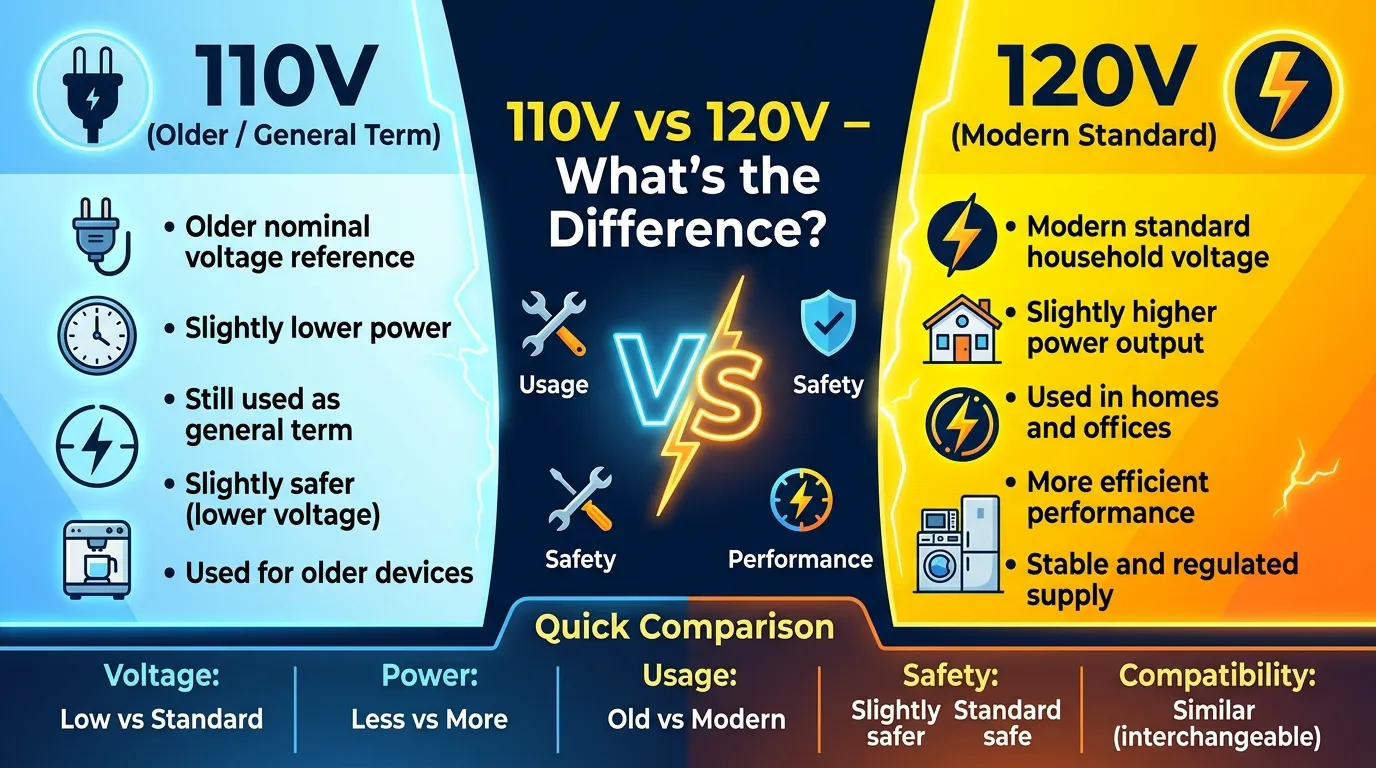
The difference between 110V and 120V is mostly historical rather than practical. Modern North American electrical systems are designed around 120 volts, but many people still say 110V out of habit.
For example, a toaster labeled for 110V will usually work perfectly on a modern 120V household outlet because electrical devices are designed with a voltage tolerance range.
Definition of 110V vs 120V
- 110V: An older residential voltage standard historically used in North America. Today, the term is often used informally to describe standard household outlets.
- 120V: The modern nominal voltage standard used in homes throughout the United States, Canada, and several other regions.
Example: A lamp marketed as a 110V appliance is generally designed to operate on today’s 120V outlets.
Pronunciation of Both Terms (US & UK)
| Term | US Pronunciation | UK Pronunciation |
|---|---|---|
| 110V | One Ten Volts | One Hundred and Ten Volts |
| 120V | One Twenty Volts | One Hundred and Twenty Volts |
Now that the terminology is clear, let’s understand why these two voltage ratings exist and why people continue to compare them.
110V vs 120V Comparison Table
| Feature | 110V | 120V |
|---|---|---|
| Meaning | Older voltage reference | Modern standard voltage |
| Current Use | Informal term today | Official residential standard |
| Typical Household Use | Commonly referenced | Actually supplied by utilities |
| Appliance Compatibility | Usually compatible | Designed target voltage |
| Electrical Performance | Slightly lower power output | Slightly higher power output |
| Regional Usage | Historical North America | Modern North America |
| Safety Difference | Minimal | Minimal |
| Industry Standard | Obsolete as official standard | Active electrical standard |
Deep Explanation of the Comparison
| Comparison Point | 110V | 120V | Real-World Impact |
|---|---|---|---|
| Historical Origin | Early electrical systems | Updated utility standard | Explains naming confusion |
| Voltage Output | Around 110 volts | Around 120 volts | Small practical difference |
| Appliance Design | Older references | Modern specifications | Most devices support both |
| Home Wiring | Similar systems | Same system today | No rewiring required |
| Energy Delivery | Slightly lower | Slightly higher | Minor efficiency difference |
| Labeling | Common in marketing | Common in technical documents | Both appear frequently |
| Outlet Design | Same outlet type | Same outlet type | No physical difference |
| Consumer Experience | Nearly identical | Nearly identical | Most users notice nothing |
Key Differences Explained Between 110V vs 120V
1. Historical Background
The biggest difference is historical. Early electrical grids often operated around 110 volts. Over time, utility companies standardized closer to 120 volts for improved efficiency.
Real-life example: Older homes may still contain manuals referencing 110V even though the outlets now deliver approximately 120V.
2. Modern Electrical Standard
Today, 120V is the recognized residential standard in North America.
User insight: When manufacturers publish technical specifications, they typically list 120V.
3. Appliance Labeling
Many appliance manufacturers still use 110V, 115V, or 120V labels interchangeably.
Example: Power tools often show 110V while household appliances display 120V.
4. Power Output
Higher voltage allows slightly more power delivery at the same current.
Example: A heating element may theoretically produce marginally more heat at 120V than at 110V.
5. Utility Voltage Fluctuations
Actual household voltage naturally fluctuates.
Most homes receive somewhere between approximately 114V and 126V during normal operation.
6. International Context
Countries using 220V–240V systems view both 110V and 120V as low-voltage household systems.
7. Compatibility
Most modern devices support voltage ranges that comfortably include both values.
Why Does the Difference Between 110V and 120V Exist?
Electrical standards evolve over time.
As utility infrastructure improved, power companies gradually increased nominal voltage from around 110V to 120V. This helped improve power transmission efficiency while remaining safe for residential use.
In simple words, the system changed but the old terminology remained.
That’s why millions of people still say “110V outlet” even though the outlet is technically 120V.
How Does a 120V Residential Electrical System Work?
A typical North American home receives power through a split-phase electrical system.
The utility transformer provides:
- 120V for standard outlets
- 240V for larger appliances
- Shared neutral connection
- Circuit breaker protection
Examples of 120V appliances include:
- TVs
- Computers
- Gaming consoles
- Chargers
- Kitchen appliances
- Smart home devices
Many modern devices from companies like Google, Meta, and devices used with platforms such as YouTube rely on equipment powered by standard 120V household outlets.
Is 110V the Same as 120V?
For most consumers, yes.
From a practical standpoint:
- Same outlet design
- Same household circuits
- Same appliance compatibility
- Same wiring system
However, engineers and electricians recognize 120V as the official modern standard.
Mini Summary
For everyday use:
110V ≈ 120V
For technical accuracy:
120V is the current standard.
Which Appliances Use 110V and 120V?
Common Household Devices
- Televisions
- Wi-Fi routers
- Desktop computers
- Phone chargers
- Coffee makers
- Air fryers
- Fans
- Vacuum cleaners
Professional Equipment
- Construction tools
- Commercial lighting
- Workshop equipment
- Test instruments
Most manufacturers design products to tolerate normal voltage variations.
Is 120V More Dangerous Than 110V?
Not significantly.
Both voltages can cause:
- Electric shock
- Burns
- Fire hazards
- Equipment damage
Safety depends more on:
- Current flow
- Exposure duration
- Grounding quality
- Circuit protection
Important Safety Tip
Never assume a lower voltage is safe to touch.
Even 110V can be dangerous under the right conditions.
Common Mistakes with 110V vs 120V
Mistake 1: Thinking They Are Completely Different Systems
Correction: They generally refer to the same residential electrical infrastructure.
Mistake 2: Assuming Appliances Will Fail
Correction: Most appliances handle both voltages easily.
Mistake 3: Believing One Is Significantly Safer
Correction: Both require proper electrical safety.
Mistake 4: Confusing 120V with 240V
Correction: 240V is a separate higher-voltage circuit.
Mistake 5: Ignoring Manufacturer Ratings
Correction: Always check the appliance nameplate before use.
Real-Life Examples with 110V vs 120V
Scenario 1: Personal Use
You buy a lamp labeled 110V.
It works normally in a 120V household outlet.
Scenario 2: Home Office
A computer setup with monitors and networking gear operates on standard 120V residential circuits.
Scenario 3: Small Business
A retail store uses dozens of devices rated for 110V without issues on modern 120V power.
Scenario 4: Construction Site
Power tools may be marketed as 110V equipment even when connected to systems delivering close to 120V.
Scenario 5: Industrial Environment
Facilities carefully monitor voltage tolerances for sensitive equipment.
When Should You Use Each?
Use Equipment Rated for 110V When:
- Manufacturer allows 110V–120V operation
- Household outlets provide standard residential power
- Consumer electronics are involved
Use Equipment Rated for 120V When:
- Following official electrical specifications
- Purchasing new appliances
- Reviewing technical documentation
Decision Rule
If a device is designed for North American household electricity, compatibility is rarely an issue.
Why People Get Confused About 110V vs 120V
Several factors contribute to confusion:
Historical Language
People continue using older terminology.
Marketing Practices
Manufacturers often mix voltage labels.
Regional Habits
Electricians, retailers, and consumers may use different terms.
Internet Content
Older articles and forum posts still reference 110V extensively.
Expert Insight
From an electrical engineering perspective, the practical distinction between 110V and 120V is often overstated.
In real scenarios, residential voltage fluctuates naturally throughout the day. Most modern appliances are engineered with acceptable operating ranges that accommodate these variations.
The more important consideration is not whether equipment says 110V or 120V, but whether the device matches the electrical standards of the country where it will be used.
For homeowners, contractors, and business owners, focusing on appliance compatibility, grounding, and circuit protection provides far greater value than worrying about a 10-volt labeling difference.
Frequently Asked Questions (FAQ)
Is 110V the same as 120V?
For most practical purposes, yes. Modern homes typically provide 120V power.
Can a 110V appliance run on 120V?
Most modern appliances can operate safely on 120V if designed for North American electrical standards.
Which is safer, 110V or 120V?
Neither offers a significant safety advantage. Both can be dangerous if mishandled.
Why do people still say 110V?
The term remains from older electrical standards and continues through common usage.
Are household outlets 110V or 120V?
Technically, modern North American outlets are 120V.
Can I plug a 120V device into a 110V outlet?
In most cases, yes, because both typically belong to the same residential power system.
Is there a difference in electricity cost?
Not specifically due to the label. Cost depends on power consumption.
Why do appliances show 115V, 110V, and 120V?
Manufacturers use different nominal voltage ratings while targeting the same residential market.
Does voltage fluctuate in homes?
Yes. Small voltage variations are normal.
Is 120V replacing 110V?
Technically, 120V is already the established standard, while 110V survives as a common term.
Conclusion
Understanding 110V vs 120V is much easier once you separate historical terminology from modern electrical standards. While many people still refer to household outlets as 110V, today’s North American residential power system is officially based on 120 volts. In practical use, the difference between 110V and 120V is usually minimal because modern appliances are built to operate within a voltage range rather than at one exact value.
If you’re buying appliances, troubleshooting electrical equipment, or comparing voltage standards, focus on compatibility and manufacturer specifications rather than the small difference between 110V and 120V. For nearly all residential applications, both terms point to the same everyday power system. Understanding this simple fact eliminates confusion and helps you make smarter electrical decisions with confidence.

Sarfraz Ahmad is language researcher and content writer who specializes in explaining the difference between commonly confused English words. Through WordClearify, learners understand subtle word distinctions in a simple, structured, and practical way. My writing focuses on clarity, real-life examples, and easy comparisons for students, bloggers, and professionals worldwide.