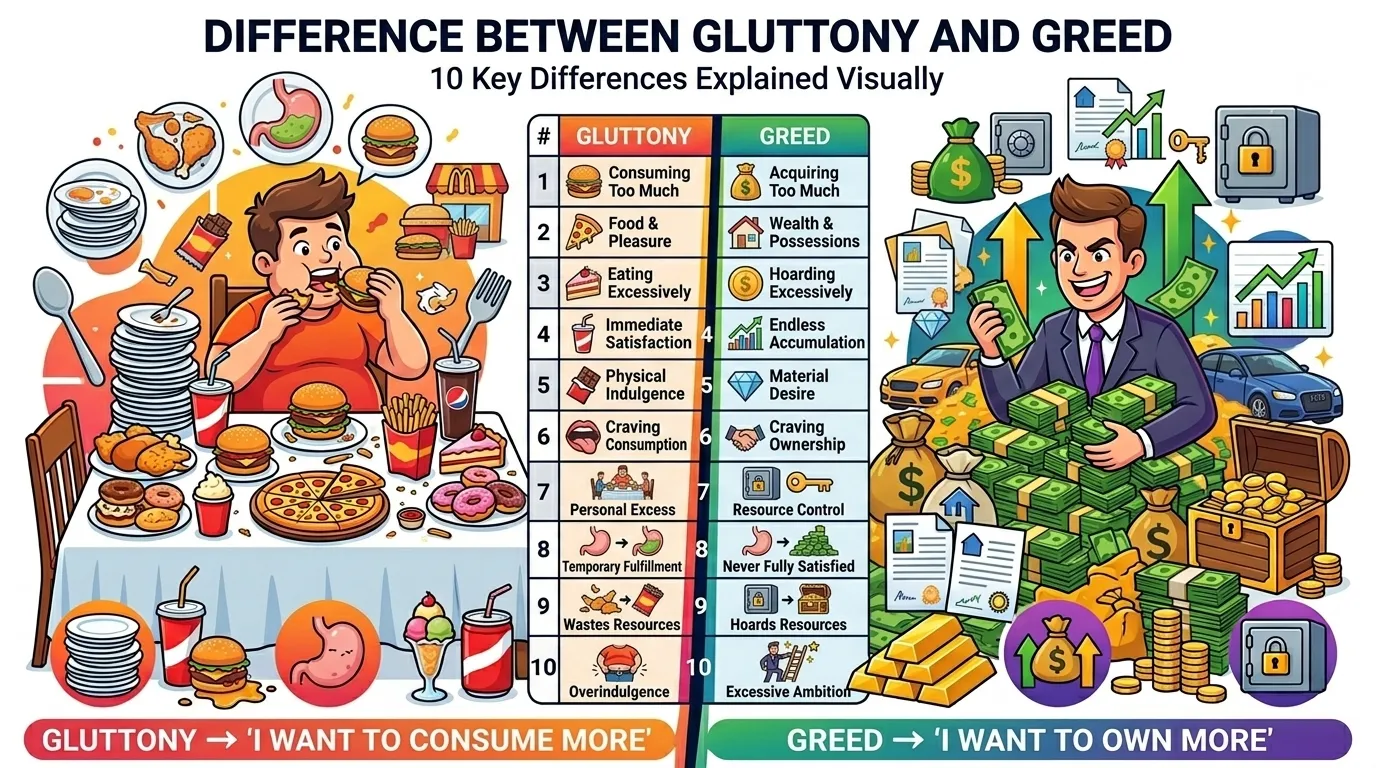
Many people use the words gluttony and greed as if they mean the same thing. However, understanding the difference between gluttony and greed is important because these terms describe different behaviors and motivations. While both involve excessive desire, they focus on different things.
The difference between gluttony and greed lies mainly in what a person craves. Gluttony usually relates to overconsumption of food, drink, or physical pleasures, whereas greed refers to an excessive desire for wealth, possessions, power, or resources. Many users search for the difference between gluttony and greed to better understand moral teachings, religious concepts, literature, and everyday behavior.
In this guide, you’ll learn clear definitions, pronunciation, comparison tables, real-life examples, similarities, key differences, common mistakes, and expert insights so you won’t need another article on this topic.
Quick Answer: Difference Between Gluttony and Greed
Gluttony is the excessive consumption of food, drink, or physical pleasures beyond what is needed.
Greed is an excessive desire to acquire more money, possessions, power, or resources than necessary.
Example:
A person eating five large meals despite being full shows gluttony. A billionaire constantly seeking more wealth despite already having enough demonstrates greed.
Definition of Gluttony and Greed
- Gluttony: Excessive indulgence in food, drink, or physical pleasures beyond reasonable limits.
- Greed: An intense and selfish desire for wealth, possessions, status, power, or resources.
Simple Example:
Eating too much cake is gluttony. Wanting all the cake so nobody else can have any reflects greed.
Pronunciation of Both Terms
| Word | US Pronunciation | UK Pronunciation |
| Gluttony | GLUHT-uh-nee | GLUHT-uh-nee |
| Greed | GREED | GREED |
Now that you know how to pronounce these words, let’s understand how they differ in meaning, behavior, motivation, and real-world impact.
Gluttony vs Greed Comparison Table
| Feature | Gluttony | Greed |
| Main Focus | Overconsumption | Over-acquisition |
| Related To | Food, drink, pleasure | Wealth, possessions, power |
| Motivation | Immediate satisfaction | Continuous accumulation |
| Resource Use | Consuming too much | Collecting too much |
| Impact | Physical and personal harm | Social and economic harm |
| Time Frame | Often short-term | Usually long-term |
| Common Example | Excessive eating | Hoarding money |
| Traditional Classification | Deadly sin of excess consumption | Deadly sin of excessive desire |
Deep Explanation of Key Comparison Points
| Comparison Point | Gluttony | Greed |
| Object of Desire | Food and pleasures | Wealth and possessions |
| Satisfaction Level | Temporary satisfaction | Rarely satisfied |
| Typical Behavior | Overeating or overindulging | Hoarding or exploiting |
| Emotional Driver | Craving enjoyment | Craving ownership |
| Visible Signs | Excessive consumption | Excessive accumulation |
| Effect on Others | Usually indirect | Often directly affects others |
| Psychological Pattern | Lack of self-control | Lack of contentment |
| Moral Interpretation | Abuse of consumption | Abuse of acquisition |
Key Differences Explained Between Difference Between Gluttony and Greed
1. What Is Desired?
Gluttony focuses on consuming.
Greed focuses on possessing.
Example: A person eating three dinners displays gluttony. Someone buying unnecessary properties simply to own more shows greed.
2. Consumption vs Accumulation
Gluttony involves taking in too much.
Greed involves collecting too much.
This is perhaps the biggest distinction many people miss.
3. Short-Term vs Long-Term Satisfaction
Gluttony usually seeks immediate pleasure.
Greed often seeks long-term control, security, or status.
4. Physical vs Material Focus
Gluttony commonly affects physical needs and pleasures.
Greed often targets material wealth and resources.
5. Impact on Society
Greed frequently affects communities, businesses, and economies.
Gluttony mainly affects the individual, though it can influence families and relationships.
6. Psychological Motivation
Gluttony often comes from cravings.
Greed usually comes from a desire for more ownership and control.
7. Resource Handling
Gluttony wastes resources through overuse.
Greed restricts resources by hoarding them.
What Is Gluttony and Why Does It Exist?
Gluttony is more than overeating. It represents a loss of moderation regarding pleasure and consumption.
Historically, philosophers and religious scholars viewed gluttony as harmful because excessive consumption can damage health, reduce self-discipline, and create unhealthy habits.
In practical use, gluttony can involve:
- Excessive eating
- Excessive drinking
- Constant indulgence
- Uncontrolled pleasure-seeking
What Is Greed and Why Does It Exist?
Greed is the desire to gain more than one reasonably needs.
Unlike gluttony, greed often centers on ownership rather than consumption.
Common forms include:
- Financial greed
- Corporate greed
- Power greed
- Property accumulation
- Resource hoarding
In real scenarios, greed may motivate someone to seek endless profits even after achieving financial security.
Difference Between Gluttony and Greed in Religion and Ethics
The concepts frequently appear in religious teachings and moral philosophy.
In Christianity, both are traditionally listed among the Seven Deadly Sins.
However:
- Gluttony condemns excessive consumption.
- Greed condemns excessive attachment to wealth and possessions.
Religious teachings often emphasize moderation, generosity, and gratitude as solutions to both behaviors.
Many beginners assume gluttony is simply a type of greed. While related, they are treated as separate moral failings because their motivations differ.
How Does the Difference Between Gluttony and Greed Affect Everyday Life?
Many people imagine these concepts only in religious texts, but they appear daily.
Everyday Gluttony
- Eating far beyond hunger
- Excessive drinking
- Constant luxury consumption
Everyday Greed
- Hoarding resources
- Refusing to share despite abundance
- Exploiting others for profit
- Constantly seeking more wealth
Understanding these patterns can improve self-awareness and decision-making.
Difference and Similarity Table Between Gluttony and Greed
| Feature | Gluttony | Greed | Similarity |
| Meaning | Excessive consumption | Excessive desire to possess | Both involve excess |
| Main Target | Food and pleasure | Wealth and resources | Both focus on personal wants |
| Motivation | Immediate enjoyment | Accumulation and ownership | Both can stem from lack of moderation |
| Impact | Personal health issues | Social and economic issues | Both may harm relationships |
| Emotional Root | Craving | Desire for more | Both involve self-centered behavior |
| Control Level | Poor consumption control | Poor acquisition control | Both reflect weak self-restraint |
| Moral View | Often considered a vice | Often considered a vice | Both criticized in ethics |
| Solution | Moderation | Contentment and generosity | Both require self-discipline |
This table clearly shows the difference and similarity between difference between gluttony and greed for quick understanding.
Why Do People Get Confused About the Difference Between Gluttony and Greed?
Several reasons cause confusion.
Overlapping Themes
Both involve wanting more than necessary.
Religious Connections
Since both appear among the Seven Deadly Sins, people assume they are identical.
Media Usage
Movies, books, and social media often use the terms loosely.
Shared Consequences
Both can lead to selfish behavior and poor decision-making.
Simplified Definitions
Many online sources define both simply as “wanting too much,” which ignores important distinctions.
Common Mistakes With Difference Between Gluttony and Greed
Mistake 1: Thinking They Are Synonyms
Correction: They describe different types of excess.
Mistake 2: Limiting Greed to Money
Correction: Greed can involve power, status, influence, and possessions.
Mistake 3: Limiting Gluttony to Food
Correction: It can involve broader forms of overindulgence.
Mistake 4: Assuming One Is Worse
Correction: Their impact depends on circumstances and context.
Mistake 5: Ignoring Motivation
Correction: Understanding why someone behaves excessively is crucial.
Mistake 6: Using Them Interchangeably
Correction: Choose the term based on whether the focus is consumption or acquisition.
Real-Life Examples With Difference Between Gluttony and Greed
Scenario 1: Personal Life
Someone eats three family-sized pizzas despite being full.
Result: Gluttony.
Scenario 2: Workplace
An executive demands increasingly higher bonuses despite already earning millions.
Result: Greed.
Scenario 3: Business Environment
A company stockpiles resources solely to block competitors.
Result: Greed.
Result: Gluttony.
Scenario 4: Investment World
An investor constantly seeks more wealth without any clear purpose or satisfaction.
Result: Greed.
When to Use Each
Use “Gluttony” When Talking About:
- Overeating
- Excessive drinking
- Physical indulgence
- Consumption habits
- Pleasure-seeking behavior
Use “Greed” When Talking About:
- Money
- Wealth accumulation
- Power
- Property ownership
- Resource hoarding
A simple rule:
Too much consuming = Gluttony
Too much wanting or owning = Greed
Expert Insight
From an ethical and behavioral perspective, the key distinction is not simply “wanting too much.”
The deeper issue is what is being pursued and why.
In practical use, gluttony reflects a struggle with consumption, while greed reflects a struggle with acquisition and possession.
Most beginners focus on the visible behavior. Experts often examine the underlying motivation because that reveals whether the behavior is truly gluttony, greed, or a combination of both.
Understanding this distinction improves discussions about ethics, psychology, leadership, business conduct, and personal development.
Frequently Asked Questions (FAQs)
Is gluttony a form of greed?
They are related but distinct concepts. Gluttony focuses on excessive consumption, while greed focuses on excessive acquisition.
Which is worse, gluttony or greed?
Neither is automatically worse. The consequences depend on the situation and impact.
Can a person be both greedy and gluttonous?
Yes. Someone may excessively consume while also obsessively accumulating resources.
Is gluttony only about food?
No. It can include excessive indulgence in drink, luxury, entertainment, or pleasure.
Is greed always about money?
No. Greed can involve power, status, influence, property, or resources.
Why are gluttony and greed often grouped together?
Both involve excess, selfishness, and lack of moderation.
What is the simplest way to remember the difference?
Gluttony means consuming too much. Greed means wanting or owning too much.
Are these terms still relevant today?
Yes. They frequently appear in discussions about consumer behavior, finance, ethics, leadership, and personal growth.
Can businesses show greed?
Yes. Corporate greed is a common term used when profit is prioritized excessively over fairness or responsibility.
Conclusion
Understanding the difference between gluttony and greed becomes much easier when you focus on the object of desire. Gluttony is primarily about excessive consumption—eating, drinking, or indulging beyond reasonable limits. Greed, on the other hand, is about excessive acquisition and the constant desire for more wealth, possessions, power, or resources.
In real-world situations, recognizing the difference between gluttony and greed can improve self-awareness, decision-making, and discussions about personal values. Whether you encounter these terms in literature, religious teachings, business conversations, or everyday life, remembering the focus on consumption versus accumulation will help you use them accurately and confidently.

Sarfraz Ahmad is language researcher and content writer who specializes in explaining the difference between commonly confused English words. Through WordClearify, learners understand subtle word distinctions in a simple, structured, and practical way. My writing focuses on clarity, real-life examples, and easy comparisons for students, bloggers, and professionals worldwide.