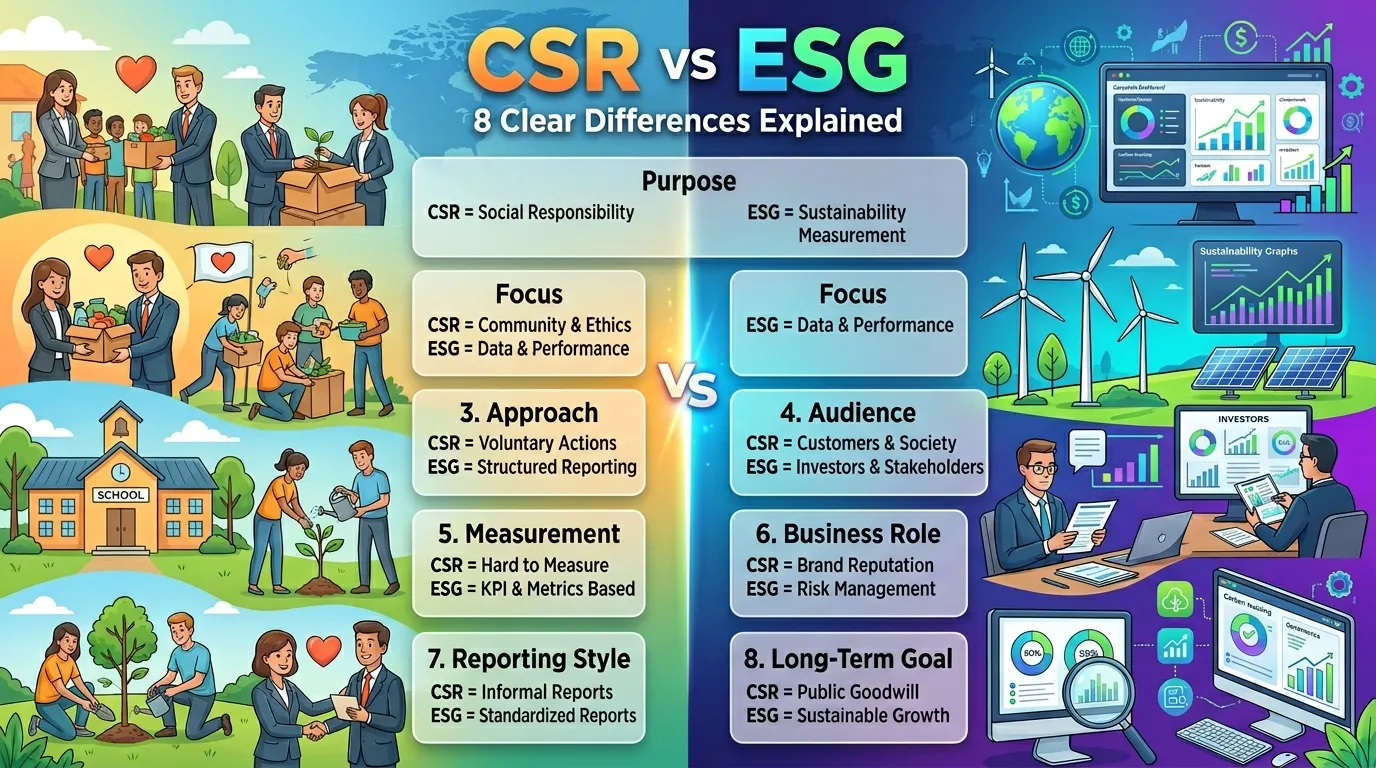
Many users get confused about the difference between CSR and ESG because both terms relate to business responsibility, sustainability, and ethical practices. In simple words, CSR focuses more on a company’s voluntary social responsibility activities, while ESG measures how a company performs in environmental, social, and governance areas using data and reporting standards.
Today, companies like Google, Meta, and Microsoft are not only judged by profits. Investors, customers, and even search engines care about sustainability, transparency, ethics, and long-term impact. That is why people search for the difference between CSR and ESG more than ever in 2026.
In this article, you will learn:
- what CSR and ESG actually mean
- how they work
- key differences and similarities
- real-world business examples
- when companies use each model
- why ESG is becoming more important for investors
If you want complete clarity without reading multiple articles, this guide covers everything in simple language.
Quick Answer: Difference Between CSR and ESG
The main difference between CSR and ESG is that CSR focuses on a company’s ethical and social responsibility efforts, while ESG measures business sustainability using data, metrics, and investor-focused reporting.
For example:
- A company donating to schools is CSR.
- A company reporting carbon emissions and governance practices to investors is ESG.
CSR is often voluntary and brand-focused. ESG is more measurable, strategic, and investment-driven.
Definition of CSR and ESG
- CSR (Corporate Social Responsibility): A business approach where companies voluntarily contribute to society through ethical practices, charity, employee welfare, or environmental support.
- ESG (Environmental, Social, and Governance): A framework used to evaluate a company’s sustainability, ethical impact, and governance performance using measurable standards.
Example
If Apple plants trees for communities, that is CSR.
If investors analyze Apple’s carbon reduction targets and governance reports, that becomes ESG.
Pronunciation of Both Terms
- CSR
- US: /siː es ɑːr/
- UK: /siː es ɑː/
- ESG
- US: /iː es dʒiː/
- UK: /iː es dʒiː/
Now that the basic meaning is clear, let’s understand the real difference between CSR and ESG in detail because this is where most beginners and even business owners get confused.
Difference Between CSR and ESG Table
| Feature | CSR | ESG | Similarity |
| Meaning | Focuses on social responsibility | Measures sustainability performance | Both improve business reputation |
| Main Purpose | Community and ethical contribution | Investor and risk evaluation | Both support responsible business |
| Approach | Voluntary activities | Data-driven framework | Both involve ethical practices |
| Measurement | Hard to measure accurately | Uses measurable metrics | Both assess company impact |
| Audience | Customers and society | Investors and stakeholders | Both affect public trust |
| Reporting | Informal or optional | Structured reporting standards | Both improve transparency |
| Focus Area | Charity and ethics | Environment, social, governance | Both involve sustainability |
| Business Impact | Brand image improvement | Long-term investment value | Both influence business growth |
This table clearly shows the difference and similarity between CSR and ESG for quick understanding.
Key Differences Explained Between CSR and ESG
1. Purpose and Core Goal
CSR mainly exists to help society and improve a company’s image. ESG exists to evaluate long-term sustainability and investment risk.
For example, a company sponsoring a local school program is CSR.
A company reducing carbon emissions because investors track environmental performance is ESG.
2. Voluntary vs Measurable
CSR activities are usually voluntary. Companies decide what they want to do.
ESG is more structured. Investors and regulators often expect measurable reporting.
In practical use, ESG has become more important because businesses now need proof, not just promises.
3. Investor Importance
Most beginners think CSR and ESG are only marketing terms. That is not true.
ESG directly influences investment decisions today. Major firms like BlackRock analyze ESG scores before investing.
CSR usually affects public perception more than investor risk analysis.
4. Reporting Style
CSR reports often focus on storytelling and brand image.
ESG reports include:
- carbon emissions
- governance transparency
- diversity metrics
- labor practices
- sustainability targets
This makes ESG more data-focused.
5. Business Strategy Integration
CSR can exist separately from company operations.
ESG is often integrated into the full business strategy, risk management, and long-term planning.
For example, Tesla heavily depends on ESG-related investor confidence because sustainability is part of its business identity.
6. Time Horizon
CSR usually focuses on present social contributions.
ESG focuses on long-term sustainability, future regulations, and operational risks.
That is why modern investors pay more attention to ESG frameworks.
7. Public Relations vs Risk Management
CSR supports goodwill and community trust.
ESG helps companies manage:
- environmental risks
- governance issues
- compliance risks
- reputation damage
This is a major strategic difference.
What Is CSR and Why Does It Exist?
Corporate Social Responsibility started as a way for businesses to give back to society.
Years ago, companies mainly focused on profit. Over time, customers demanded ethical behavior, employee care, and environmental awareness.
CSR activities often include:
- charity programs
- employee welfare
- education support
- community development
- environmental campaigns
For example, Coca-Cola running clean water projects is considered CSR.
The main goal is building trust and positive public relationships.
What Is ESG and How Does It Work?
ESG stands for:
- Environmental
- Social
- Governance
It helps investors and stakeholders measure how responsibly a company operates.
Environmental
Focuses on:
- pollution
- climate impact
- carbon emissions
- renewable energy
Social
Focuses on:
- employee treatment
- diversity
- workplace safety
- customer relations
Governance
Focuses on:
- leadership ethics
- transparency
- executive pay
- shareholder rights
Companies like Unilever use ESG reporting to attract investors who care about sustainable business models.
Why ESG Is Becoming More Important Than CSR
In real scenarios, many companies still use CSR programs. However, ESG has become more powerful because investors now want measurable accountability.
Modern businesses face pressure from:
- climate regulations
- investors
- consumers
- governments
- sustainability standards
CSR alone is no longer enough.
For example:
A company may donate millions to charity through CSR. But if it pollutes rivers or hides governance issues, investors may still avoid it due to poor ESG performance.
This shift is one of the biggest business changes in recent years.
Difference Between CSR and ESG in Business Strategy
CSR in Business
CSR often improves:
- customer loyalty
- public image
- employee morale
ESG in Business
ESG improves:
- investment attractiveness
- long-term sustainability
- compliance readiness
- operational risk reduction
That is why global companies now combine both systems.
Similarities Between Both
Even though there are major differences, CSR and ESG also share similarities.
Both:
- promote ethical business behavior
- improve company reputation
- support sustainability goals
- build public trust
- encourage accountability
Many companies use CSR initiatives to support their broader ESG goals.
Real Life Examples with Difference Between CSR and ESG
Example 1: Local Business
A local bakery donating food weekly is practicing CSR.
If the bakery tracks waste reduction and employee policies for investors, that becomes ESG.
Example 2: Technology Industry
Google uses renewable energy initiatives as part of ESG reporting while also supporting digital education projects through CSR programs.
Example 3: Fashion Industry
Fashion brands often use CSR for charity partnerships.
But ESG evaluates:
- labor conditions
- supply chain ethics
- environmental manufacturing impact
Example 4: Investment Firms
Investment companies now compare ESG scores before funding businesses.
CSR activities alone rarely influence billion-dollar investment decisions today.
When to Use Each: CSR vs ESG
Use CSR When:
- improving public image
- supporting communities
- increasing employee engagement
- building customer trust
Use ESG When:
- attracting investors
- measuring sustainability
- improving governance
- reducing long-term business risks
Most modern companies use both together.
Why People Get Confused about Both
There are several reasons why people mix these terms.
Similar Sustainability Language
Both discuss ethics, society, and environmental responsibility.
Media Influence
News articles often use CSR and ESG interchangeably even though they are different systems.
Business Marketing
Some companies market CSR campaigns as ESG achievements, which creates confusion.
Overlapping Goals
Both aim to improve business responsibility, so beginners assume they are identical.
Expert Insight on Both
From a professional business perspective, ESG is not replacing CSR completely. Instead, ESG is evolving business responsibility into a measurable system.
In practical use:
- CSR builds emotional trust
- ESG builds financial trust
Most successful companies combine:
- CSR for brand relationships
- ESG for sustainability strategy and investor confidence
Businesses that ignore ESG may struggle with future regulations and investor expectations.
At the same time, companies without authentic CSR programs may appear disconnected from communities and employees.
The strongest strategy is balance.
Frequently Asked Questions About Difference Between CSR and ESG
Is ESG better than CSR?
ESG is more measurable and investor-focused, but CSR is still important for public trust and community relationships.
What is the main difference between CSR and ESG?
CSR focuses on voluntary social responsibility, while ESG measures sustainability and governance performance using structured data.
Can a company have CSR without ESG?
Yes. Many businesses still run CSR programs without formal ESG reporting.
Why do investors prefer ESG?
Because ESG provides measurable data about long-term business risks, ethics, and sustainability performance.
Is CSR part of ESG?
CSR can support ESG goals, especially in the social category, but they are not the same thing.
Which came first, CSR or ESG?
CSR existed earlier. ESG became more popular later as investors demanded measurable sustainability standards.
Why is ESG important in 2026?
Climate concerns, regulations, and investor expectations have made ESG a major business priority worldwide.
Do small businesses need ESG?
Not always formally, but sustainability and ethical practices are becoming important even for small businesses.
Conclusion
Understanding the difference between CSR and ESG is essential for modern businesses, investors, and even consumers. While both concepts focus on responsible business practices, they serve different purposes.
CSR mainly revolves around voluntary ethical actions, community support, and building positive public relationships. ESG, on the other hand, is a structured framework that measures environmental, social, and governance performance using data and accountability standards.
The smartest companies combine both:
- CSR for human connection
- ESG for measurable long-term sustainability
If you were confused earlier, the key takeaway is simple:
CSR shows what a company does for society, while ESG measures how responsibly the company actually operates.

Sarfraz Ahmad is language researcher and content writer who specializes in explaining the difference between commonly confused English words. Through WordClearify, learners understand subtle word distinctions in a simple, structured, and practical way. My writing focuses on clarity, real-life examples, and easy comparisons for students, bloggers, and professionals worldwide.