Many people use the terms battle and war as if they mean the same thing. However, there is a significant difference between battle and war. Understanding the difference both them helps explain military history, international conflicts, and even how news reports describe armed struggles.
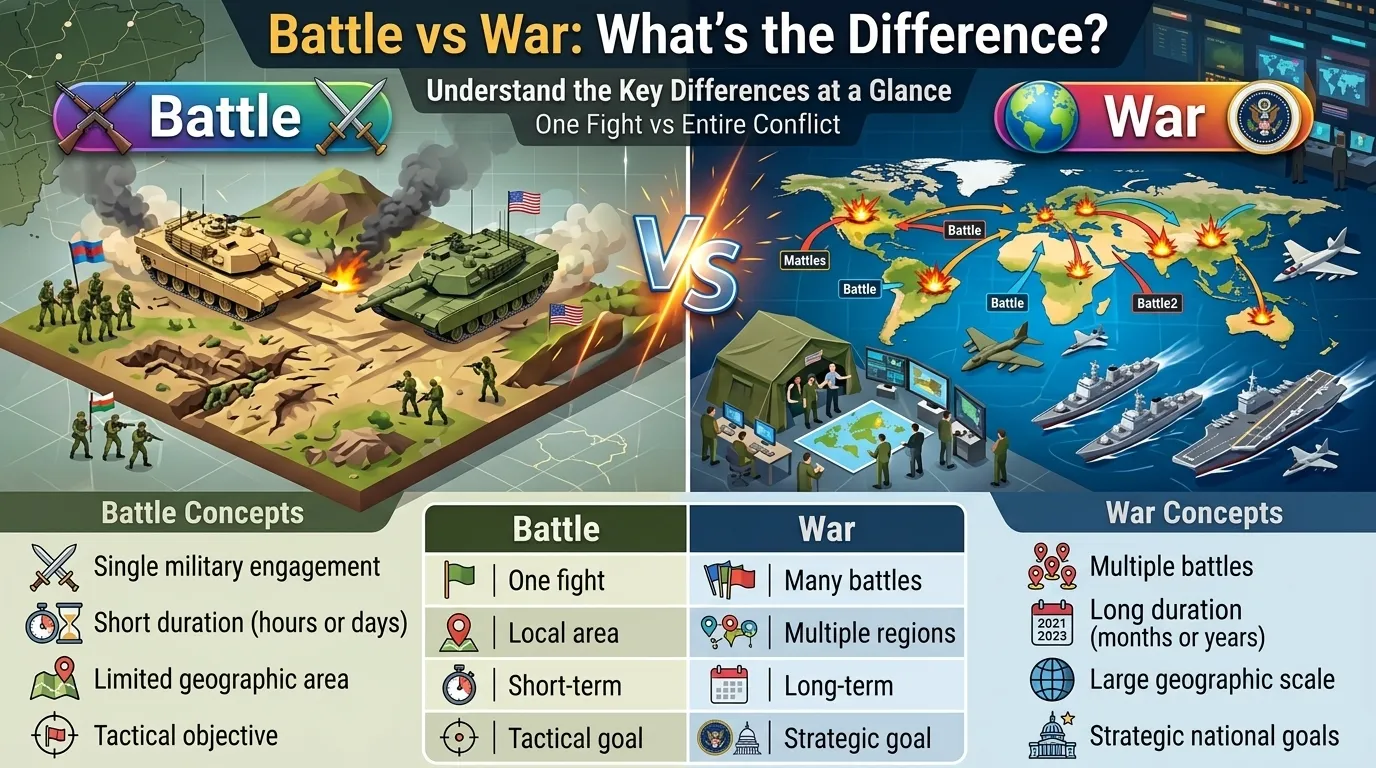
In simple terms, a battle is a specific military fight, while a war is the larger conflict that may include many battles over months or years. The difference between both is one of the most searched military comparison topics because the two terms are closely related but not interchangeable.
In this guide, you will learn definitions, pronunciations, key differences, similarities, real-world examples, common mistakes, and expert insights so you never confuse these terms again.
Quick Answer: Difference Between Both
A battle is a single military engagement fought between opposing forces at a particular place and time.
A war is a prolonged conflict between nations, states, or groups that can include many battles, campaigns, and military operations.
Example: The Battle of Gettysburg was one battle, while the American Civil War was the larger war that included numerous battles.
Definition of Battle and War
- Battle: A specific armed confrontation between opposing military forces in a defined location and timeframe.
- War: A large-scale and extended conflict between countries, governments, or organized groups involving multiple military actions and political objectives.
Example: The Battle of Waterloo was one battle within the broader conflicts known as the Napoleonic Wars.
Pronunciation of Both Terms (US & UK)
| Term | US Pronunciation | UK Pronunciation |
| Battle | BAT-ul (/ˈbætl/) | BAT-ul (/ˈbætl/) |
| War | WOR (/wɔr/) | WAW (/wɔː/) |
Now that you know the definitions and pronunciations, let’s understand the difference between battle and war in greater detail.
Battle vs War Comparison Table
| Feature | Battle | War |
| Meaning | A single military fight | A large-scale conflict |
| Duration | Hours, days, or weeks | Months, years, or decades |
| Scope | Limited | Broad and extensive |
| Participants | Military units or forces | Nations, alliances, or groups |
| Objective | Win a specific engagement | Achieve political or strategic goals |
| Location | Usually one area | Multiple regions or countries |
| Number Involved | One confrontation | Multiple battles and campaigns |
| Outcome | Tactical victory or defeat | Strategic victory, defeat, or peace settlement |
| Planning Level | Operational or tactical | National or international strategy |
| Historical Example | Battle of Gettysburg | American Civil War |
Key Differences Explained Between Both
1. Size and Scope
A battle is smaller in scale. A war is much larger and may stretch across continents.
Example: The Battle of Stalingrad was part of World War II.
2. Duration
Battles are usually short-term events. Wars can last for years.
Example: The Battle of Waterloo lasted one day, while the Napoleonic Wars lasted many years.
3. Objectives
A battle aims to gain a tactical advantage. A war seeks broader political, territorial, or ideological goals.
4. Geographic Coverage
A battle occurs in a specific location. A war may involve numerous countries and regions.
5. Leadership Level
Military commanders often direct battles, while national leaders and governments shape wars.
6. Resources Required
Wars require economic, political, and military resources on a massive scale compared to battles.
7. Historical Significance
A battle may influence a war, but one battle rarely defines the entire conflict.
8. Outcome Impact
Winning a battle does not always mean winning the war.
Example: Several armies have won important battles yet eventually lost the overall war.
Why Does the Difference Between Both Matter?
Understanding the difference helps people correctly interpret history, military strategy, and current events.
When news organizations report armed conflicts, they often describe:
- Individual battles
- Military campaigns
- Entire wars
Confusing these terms can lead to misunderstanding the scale of a conflict.
For example, when reading about the Battle of Mosul, it is important to know that it was one military engagement within a broader conflict.
How Does a Battle Fit Into a War?
Think of a war as a book and battles as individual chapters.
A war usually contains:
- Military campaigns
- Battles
- Political negotiations
- Economic actions
- Diplomatic efforts
Without battles, wars cannot be fought. Without the broader conflict, battles become isolated events.
Simple Formula
War = Multiple Battles + Strategy + Politics + Resources
This formula helps beginners quickly understand the relationship.
Can a Battle Exist Without a War?
Yes, in some situations.
Not every military engagement becomes a full-scale war.
Examples include:
- Border clashes
- Limited military operations
- Short-term armed confrontations
- Peacekeeping conflicts
However, major wars almost always consist of multiple battles.
Historical Examples of Battle vs War
The American Civil War
War: American Civil War
Battles Included:
- Battle of Gettysburg
- Battle of Antietam
- Battle of Bull Run
The war lasted years and included many separate battles.
World War II
War: World War II
Battles Included:
- Battle of Britain
- Battle of Midway
- Battle of Stalingrad
Each battle contributed to the overall outcome of the war.
Napoleonic Wars
War: Napoleonic Wars
Battle Included:
- Battle of Waterloo
Waterloo was a decisive battle, but it was not the entire war.
Difference Between Both in Military Strategy
Military planners view battles and wars differently.
Battle Strategy
Focuses on:
- Troop movements
- Terrain
- Weapons deployment
- Immediate objectives
War Strategy
Focuses on:
- National goals
- Economic resources
- Alliances
- Long-term outcomes
- Public support
In practical military planning, tactical success in battles must support strategic success in war.
Difference and Similarity Between Battle and War
| Feature | Battle | War | Similarity |
| Meaning | Single military engagement | Extended conflict | Both involve armed conflict |
| Purpose | Tactical objective | Strategic objective | Both seek victory |
| Participants | Military forces | Nations or groups | Both involve organized forces |
| Duration | Short-term | Long-term | Both may involve planning |
| Location | Specific area | Multiple regions | Both occur in physical locations |
| Leadership | Military commanders | Governments and military leaders | Both require leadership |
| Resources | Limited resources | Large-scale resources | Both consume resources |
| Outcome | Local success or failure | Overall conflict result | Both influence history |
This table clearly shows the difference and similarity between both for quick understanding.
Why People Get Confused Between Both
Many users get confused because the terms are closely connected.
Media Influence
News headlines often use military terms interchangeably for simplicity.
Historical Storytelling
History books may focus on famous battles while discussing entire wars.
Entertainment Industry
Movies, games, and documentaries sometimes blur the distinction.
Lack of Military Knowledge
Most beginners are unfamiliar with military terminology.
Common Mistakes With Both
| Mistake | Correction |
| Calling every battle a war | A battle is only one part of a larger conflict |
| Assuming wars happen in one location | Wars often span multiple regions |
| Thinking battle and war are synonyms | They have different meanings |
| Believing winning a battle wins the war | Many wars continue after major battles |
| Ignoring political objectives | Wars involve political goals beyond combat |
| Using terms interchangeably in academic writing | Use precise military terminology |
Real-Life Examples With Both
Scenario 1: Student Studying History
A student learns that the Battle of Gettysburg was one event inside the American Civil War.
Scenario 2: News Reporting
A journalist reports a battle occurring during an ongoing regional war.
Scenario 3: Military Education
Cadets study battles to understand tactics and wars to understand strategy.
Scenario 4: Documentary Production
Filmmakers often create episodes about individual battles within larger wars.
Scenario 5: Academic Research
Historians analyze how specific battles influenced the final outcome of wars.
When to Use Each Term
Use “Battle” When:
- Referring to one military engagement
- Discussing tactical operations
- Describing a specific confrontation
- Talking about a defined place and time
Use “War” When:
- Referring to an entire conflict
- Discussing national objectives
- Analyzing long-term military campaigns
- Talking about multiple battles collectively
Expert Insight
From a military history perspective, the most important concept is that wars are strategic while battles are tactical.
In real scenarios, military leaders may lose individual battles but still win the overall war through superior resources, alliances, logistics, or political strategy.
Most beginners focus only on famous battles because they are dramatic and easier to remember. However, professional historians and military analysts evaluate how those battles contribute to the broader war effort.
Understanding this distinction provides a deeper and more accurate view of history and international relations.
Frequently Asked Questions (FAQs)
Is a battle the same as a war?
No. A battle is a specific military engagement, while a war is the broader conflict containing multiple battles.
Can one war have many battles?
Yes. Most wars consist of numerous battles and campaigns.
Which is bigger, a battle or a war?
A war is significantly larger in scope and duration than a battle.
Can a battle determine the outcome of a war?
Sometimes. Certain decisive battles can strongly influence the final result of a war.
What is the simplest difference between battle and war?
A battle is one fight; a war is the entire conflict.
Is World War II a battle or a war?
World War II was a war that included many famous battles.
Can you win a battle and lose the war?
Yes. History contains many examples where tactical victories did not lead to overall success.
Why do historians distinguish between battle and war?
Because each term describes a different level of military conflict and analysis.
Why is understanding battle vs war important?
It improves historical understanding, military literacy, and interpretation of current events.
Conclusion
The difference between battle and war is straightforward once you understand their scope and purpose. A battle is a specific military engagement fought at a particular place and time, while a war is a larger conflict involving multiple battles, campaigns, political goals, and strategic decisions.
In practical terms, battles are the building blocks of wars. The Battle of Waterloo, the Battle of Gettysburg, and the Battle of Stalingrad were all significant military engagements, but each belonged to broader wars. This distinction is essential for understanding history, military strategy, and modern conflicts.
If you remember one key idea, let it be this: a battle is one fight, while a war is the entire struggle. Understanding the difference between both helps you interpret historical events more accurately and communicate about military topics with confidence.

David Anderson
I am David Anderson, a USA-based content writer and digital author. I create clear, engaging, and well-structured articles focused on delivering valuable and well-researched information. I specialize in blog writing and digital content that helps websites grow visibility and build strong online authority.