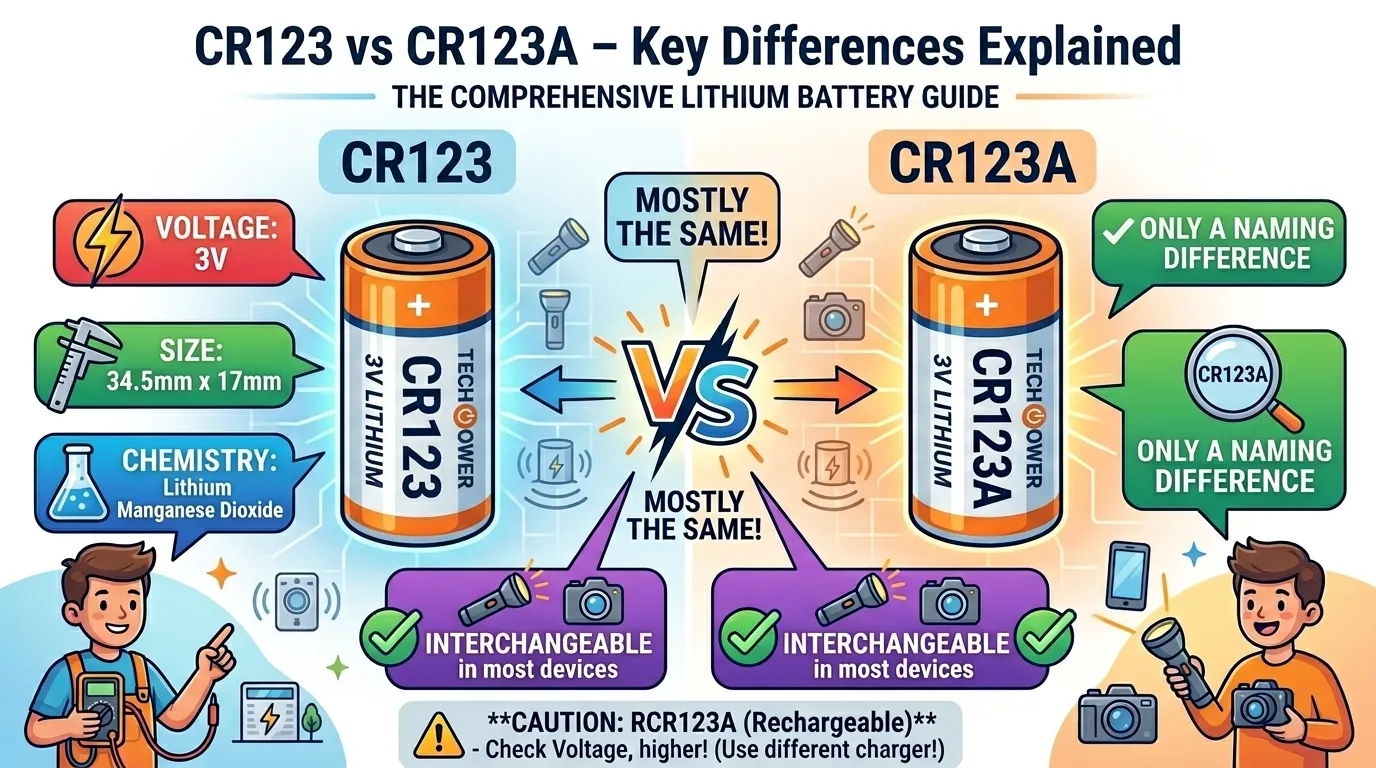
Many users get confused when comparing the difference between CR123 and CR123A batteries. You might be shopping for a flashlight, security camera, tactical device, or photography equipment and notice both names listed. Naturally, the question arises: are they the same battery or different products?
The short answer is that the difference between CR123 and CR123A is mostly related to naming conventions rather than major technical differences. In most real-world situations, CR123 and CR123A refer to the same lithium battery size and can be used interchangeably. However, understanding the small distinctions can help prevent compatibility issues and improve device performance.
In this guide, you’ll learn what CR123 and CR123A batteries are, how they work, where they are used, why manufacturers label them differently, and which one you should choose in 2026 and beyond.
Quick Answer: Difference Between CR123 and CR123A
The difference between CR123 and CR123A is primarily a naming variation.
- CR123A is the officially recognized designation used by most battery manufacturers.
- CR123 is often used as a shortened version of the same battery type.
For example, if a flashlight manual recommends a CR123 battery and a battery package says CR123A, they are typically the same 3-volt lithium battery and will work in the same device.
Definition of CR123 and CR123A
- CR123: A common shorthand name for a 3V lithium manganese dioxide battery used in cameras, flashlights, and electronic devices.
- CR123A: The official battery designation for the same 3V lithium battery size recognized by most manufacturers and industry standards.
Example: A tactical flashlight requiring a CR123 battery can generally use a CR123A battery without any issue.
Pronunciation of Both Terms (US & UK)
| Term | US Pronunciation | UK Pronunciation |
| CR123 | See-Are-One-Two-Three | See-Are-One-Two-Three |
| CR123A | See-Are-One-Two-Three-A | See-Are-One-Two-Three-A |
Now that the names are clear, let’s understand whether any practical differences actually matter.
CR123 vs CR123A Comparison Table
| Feature | CR123 | CR123A |
| Official Name | Informal shorthand | Official designation |
| Battery Chemistry | Lithium manganese dioxide | Lithium manganese dioxide |
| Voltage | 3V | 3V |
| Physical Size | Same dimensions | Same dimensions |
| Capacity Range | Typically 1300–1700 mAh | Typically 1300–1700 mAh |
| Device Compatibility | Compatible with CR123A devices | Compatible with CR123 devices |
| Market Usage | Common in product descriptions | Common on packaging |
| Industry Standard | Informal naming | Formal naming standard |
| Performance | Same performance | Same performance |
| Replacement Ability | Direct replacement | Direct replacement |
What This Means in Practice
For most consumers, the comparison above reveals that there is virtually no functional difference. Manufacturers, retailers, and online stores often use the terms interchangeably.
Key Differences Explained Between CR123 and CR123A
1. Naming Convention
The biggest difference is simply the label.
CR123A is the formal battery designation, while CR123 is a shortened version often used in marketing materials and user manuals.
Real-world example: Many flashlight brands advertise “CR123 compatible” even though the actual battery sold is labeled CR123A.
2. Manufacturer Preference
Different battery brands choose different naming styles.
Companies such as Duracell, Energizer, and Panasonic frequently use CR123A on packaging.
3. Retail Listings
Online marketplaces often simplify battery names to improve search visibility.
This is why users searching “CR123 battery” frequently receive CR123A results.
4. Technical Specifications
There is generally no measurable difference in voltage, chemistry, or dimensions.
5. Device Documentation
Some manuals use CR123 while others specify CR123A, creating unnecessary confusion among beginners.
6. Industry Standards
Battery standards typically recognize CR123A as the formal naming convention.
7. Consumer Perception
Many users mistakenly assume CR123A is a newer or upgraded version, which is usually not true.
What Is a CR123 or CR123A Battery?
A CR123A battery is a high-performance lithium battery designed for devices that require reliable power, long shelf life, and strong performance in extreme temperatures.
Common specifications include:
| Specification | Value |
| Chemistry | Lithium Manganese Dioxide |
| Nominal Voltage | 3 Volts |
| Diameter | 17 mm |
| Height | 34.5 mm |
| Shelf Life | Up to 10 years |
| Weight | Approximately 17 g |
Because CR123 is usually shorthand for CR123A, these specifications apply to both names.
Why Does the CR123A Naming System Exist?
Battery naming follows international standards to help manufacturers and consumers identify battery types accurately.
Breaking down the designation:
- C = Lithium chemistry category
- R = Round cell shape
- 123 = Size classification
- A = Specific version identifier
Over time, many retailers dropped the final letter because consumers found “CR123” easier to remember.
How Does a CR123A Battery Work?
A CR123A battery uses lithium manganese dioxide chemistry.
Here’s a simplified process:
- Lithium reacts internally to create electrical energy.
- The battery provides a stable 3-volt output.
- Electronic devices convert that energy into usable power.
- The battery gradually depletes until replacement is needed.
This chemistry offers:
- High energy density
- Long storage life
- Excellent cold-weather performance
- Reliable output for high-drain devices
Where Are CR123 and CR123A Batteries Commonly Used?
Digital Cameras
Professional photography equipment often relies on CR123A batteries because of their consistent power delivery.
Tactical Flashlights
Many law-enforcement and outdoor flashlights use CR123A batteries for brightness and reliability.
Security Systems
Wireless sensors and alarms frequently utilize CR123A cells.
Medical Equipment
Certain portable medical devices depend on lithium battery stability.
Smart Home Devices
Modern sensors, detectors, and monitoring systems continue to use CR123A batteries due to their long lifespan.
Difference Between CR123 and CR123A for Flashlights
Flashlight owners are among the most common searchers of this topic.
In practical use:
- Brightness remains the same.
- Runtime remains the same.
- Safety remains the same.
- Compatibility remains the same.
If your flashlight manual says CR123 and the battery package says CR123A, they will normally work identically.
Difference Between CR123 and CR123A for Cameras
Photography users often worry about compatibility.
The reality is simple:
Most cameras designed for CR123 batteries were originally engineered around CR123A specifications.
This means:
✔ Same voltage
✔ Same dimensions
✔ Same chemistry
✔ Same performance
Photographers using older film cameras often encounter both labels during battery replacement.
Are CR123 and CR123A Batteries Interchangeable?
Yes, In Most Cases
Most manufacturers and battery experts consider CR123 and CR123A interchangeable.
However, always verify:
- Device voltage requirements
- Manufacturer recommendations
- Battery chemistry specifications
A quick check of the device manual prevents unexpected issues.
Difference Between CR123 and Rechargeable RCR123A
This is where confusion becomes important.
| Feature | CR123A | RCR123A |
| Type | Disposable | Rechargeable |
| Voltage | 3V | Usually 3.6V–3.7V |
| Chemistry | Lithium manganese dioxide | Lithium-ion |
| Lifespan | Single use | Rechargeable |
| Compatibility | Universal CR123A devices | Device-specific |
Many beginners mistakenly assume RCR123A is simply a rechargeable CR123A replacement. Because the voltage differs, compatibility should always be checked first.
Difference and Similarity Between CR123 and CR123A
| Feature | CR123 | CR123A | Similarity |
| Name | Shortened version | Official designation | Both identify the same battery family |
| Voltage | 3V | 3V | Same electrical output |
| Size | 17×34.5 mm | 17×34.5 mm | Identical dimensions |
| Chemistry | Lithium manganese dioxide | Lithium manganese dioxide | Same battery technology |
| Usage | Cameras, lights, sensors | Cameras, lights, sensors | Same applications |
| Performance | High energy density | High energy density | Same performance level |
| Shelf Life | Long-lasting | Long-lasting | Similar storage capability |
| Replacement | Replaces CR123A | Replaces CR123 | Generally interchangeable |
This table clearly shows the difference and similarity between CR123 and CR123A for quick understanding.
Common Mistakes With Both
Mistake 1: Assuming They Are Different Sizes
Correction: The physical dimensions are generally identical.
Mistake 2: Thinking CR123A Is an Upgrade
Correction: It is usually just the formal name.
Mistake 3: Confusing CR123A With RCR123A
Correction: Rechargeable versions often use different voltage levels.
Mistake 4: Ignoring Device Specifications
Correction: Always verify manufacturer recommendations.
Mistake 5: Buying Based Only on Name
Correction: Check voltage, chemistry, and compatibility instead.
Real-Life Examples With CR123 and CR123A
Example 1: Home Security Sensor
A homeowner replaces a CR123 battery with a CR123A battery and experiences identical performance.
Example 2: Outdoor Flashlight
A camping enthusiast uses CR123A batteries in a flashlight labeled for CR123 cells without any issues.
Example 3: Professional Photography
A photographer purchases CR123A batteries for a camera manual that mentions CR123 batteries.
Example 4: Industrial Equipment
Maintenance teams often stock CR123A batteries for multiple devices because they are widely compatible.
Example 5: Emergency Preparedness
Emergency kits frequently include CR123A batteries due to their long shelf life.
When to Use Each
Use CR123 When:
- The device manual specifically uses the CR123 term.
- Retailers list batteries using shorthand naming.
Use CR123A When:
- Purchasing replacement batteries.
- Following manufacturer packaging labels.
- Comparing official battery specifications.
In practical scenarios, either name usually refers to the same battery.
Why People Get Confused in Both
Several factors contribute to confusion:
Different Labeling Systems
Manufacturers, retailers, and device makers may use different names.
Online Marketplace Listings
Search platforms often shorten battery names for convenience.
Technical Terminology
Many consumers assume the added “A” indicates a newer model.
Rechargeable Alternatives
The existence of RCR123A batteries creates additional misunderstandings.
Expert Insight
From a battery technology perspective, the most important takeaway is not the difference between both but the distinction between CR123A and rechargeable alternatives like RCR123A.
In real scenarios, experienced technicians focus on:
- Voltage compatibility
- Device requirements
- Battery chemistry
- Brand quality
Most beginners spend time worrying about the CR123 vs CR123A naming difference, while professionals concentrate on electrical specifications and safety requirements.
That practical approach helps avoid compatibility mistakes and extends device reliability.
Frequently Asked Questions (FAQs)
Is CR123 the same as CR123A?
Yes. In most cases, CR123 is simply a shortened name for CR123A.
Can I replace a CR123 battery with a CR123A battery?
Yes. Most devices treat them as interchangeable.
Which battery is newer, CR123 or CR123A?
Neither. CR123A is generally the formal naming designation.
Do CR123 and CR123A have the same voltage?
Yes. Both typically provide 3 volts.
Are CR123A batteries rechargeable?
Standard CR123A batteries are not rechargeable. Rechargeable versions are usually labeled RCR123A.
Why do some manufacturers use CR123 while others use CR123A?
It mainly comes down to branding, packaging, and naming preferences.
Are CR123A batteries good for emergency kits?
Yes. Their long shelf life makes them popular for emergency preparedness.
Can CR123A batteries be used in security cameras?
Yes. Many security systems and sensors use CR123A batteries.
What is the biggest mistake users make?
Confusing CR123A batteries with RCR123A rechargeable batteries.
How long do CR123A batteries last in storage?
Many quality brands offer shelf lives of up to 10 years.
Conclusion
Understanding the difference between CR123 and CR123A is much easier than many people expect. Despite the different labels, both names generally refer to the same 3-volt lithium battery used in cameras, flashlights, security systems, medical devices, and smart home equipment. The primary distinction lies in naming conventions, not performance, size, voltage, or compatibility.
If you are replacing a battery today, focus less on whether it says CR123 or CR123A and more on verifying voltage, chemistry, and manufacturer recommendations. Once you understand that simple principle, choosing the correct battery becomes straightforward. In practical use, the difference between both is largely a matter of terminology rather than functionality, making them effectively the same battery for the vast majority of devices.

Sarfraz Ahmad is language researcher and content writer who specializes in explaining the difference between commonly confused English words. Through WordClearify, learners understand subtle word distinctions in a simple, structured, and practical way. My writing focuses on clarity, real-life examples, and easy comparisons for students, bloggers, and professionals worldwide.