Many users get confused about the difference between disinfection and sterilization because both processes are used to control harmful microorganisms. However, they are not the same thing. The difference between disinfection and sterilization lies mainly in the level of microbial elimination. While disinfection reduces or destroys most disease-causing microorganisms, sterilization eliminates all forms of microbial life, including bacterial spores.
Understanding the difference between disinfection and sterilization is important in healthcare, laboratories, food processing, pharmaceutical manufacturing, and even daily household cleaning. Whether you are a student, healthcare professional, business owner, or simply curious about infection control, knowing when and why each method is used can help prevent contamination and improve safety.
In this guide, you will learn what disinfection and sterilization mean, how they work, their key differences, similarities, real-life applications, common mistakes, and expert insights.
Quick Answer: Difference Between Disinfection and Sterilization
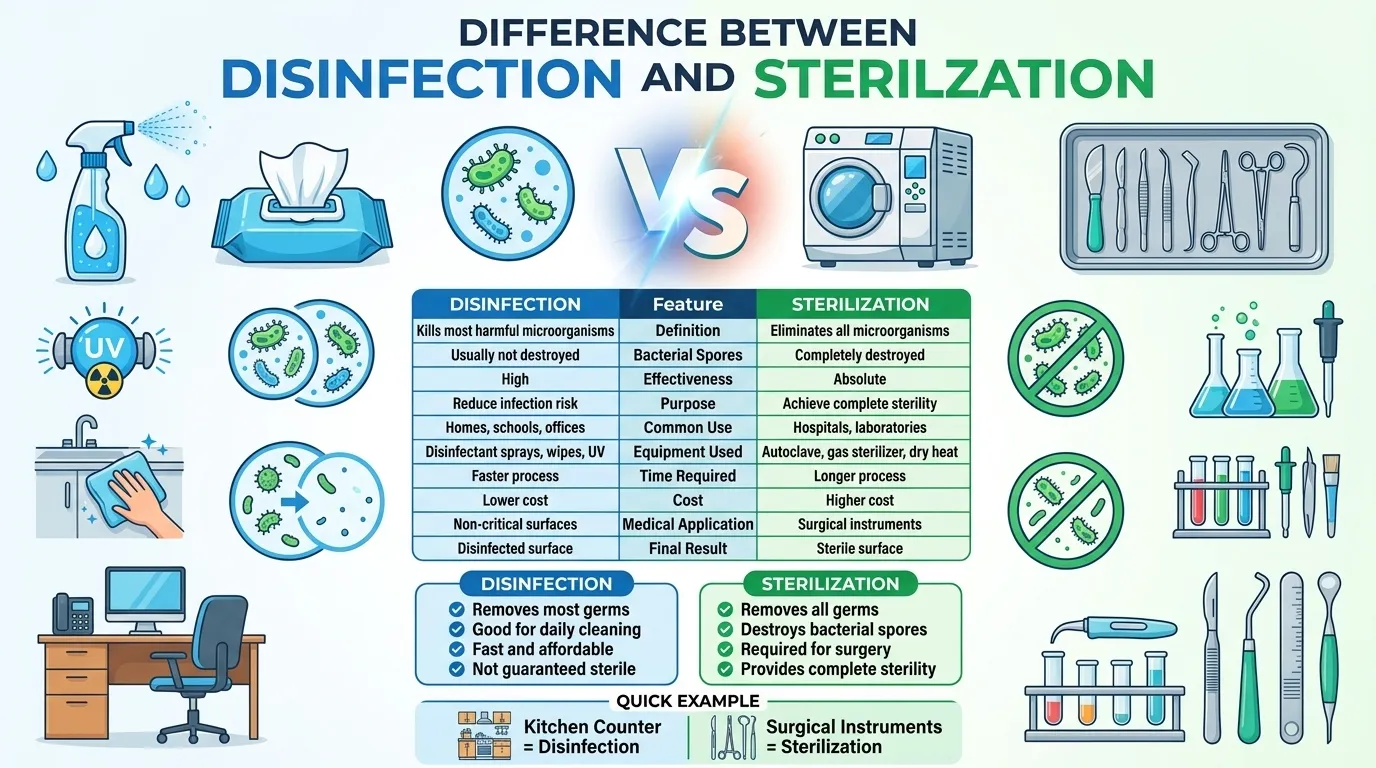
Disinfection destroys most harmful microorganisms but may not eliminate bacterial spores. Sterilization completely removes or destroys all microorganisms, including spores.
Example: Cleaning a kitchen countertop with disinfectant is disinfection. Sterilizing surgical instruments in an autoclave before surgery is sterilization.
Definition of Disinfection and Sterilization
- Disinfection: A process that kills or inactivates most harmful microorganisms on surfaces or objects, but usually does not destroy bacterial spores.
- Sterilization: A process that completely eliminates all microorganisms, including bacteria, viruses, fungi, and bacterial spores.
Simple Example: A disinfectant spray used on office desks performs disinfection, while an autoclave used in hospitals performs sterilization.
Pronunciation of Both Terms
Disinfection
- US: /ˌdɪs.ɪnˈfek.ʃən/
- UK: /ˌdɪs.ɪnˈfek.ʃən/
Sterilization
- US: /ˌster.ə.ləˈzeɪ.ʃən/
- UK: /ˌster.ɪ.laɪˈzeɪ.ʃən/
Now that the definitions are clear, let’s understand the deeper differences and why both methods are essential in modern hygiene and infection control systems.
Disinfection vs Sterilization: Comparison Table
| Feature | Disinfection | Sterilization |
|---|---|---|
| Purpose | Reduce harmful microorganisms | Eliminate all microorganisms |
| Spore Removal | Usually does not destroy spores | Destroys all spores |
| Effectiveness | High but not absolute | Complete microbial elimination |
| Typical Use | Homes, offices, public areas | Hospitals, laboratories |
| Time Required | Usually faster | Often takes longer |
| Equipment | Chemical disinfectants, UV systems | Autoclaves, dry heat, gas sterilizers |
| Cost | Generally lower | Usually higher |
| Risk Level | Suitable for moderate-risk items | Required for critical items |
| Healthcare Use | Non-critical equipment | Surgical instruments |
| End Result | Safe but not sterile | Completely sterile |
Key Differences Explained Between Disinfection and Sterilization
1. Level of Microbial Control
Disinfection reduces microorganisms to safe levels, while sterilization removes every form of microbial life.
Example: A hospital floor can be disinfected, but surgical tools must be sterilized.
2. Bacterial Spores
Spores are highly resistant structures produced by some bacteria.
Disinfection often fails to destroy spores, whereas sterilization removes them completely.
3. Application Areas
Disinfection is common in homes, schools, gyms, and offices.
Sterilization is essential in operating rooms and pharmaceutical facilities.
4. Equipment Used
Disinfection uses chemicals such as alcohol and chlorine solutions.
Sterilization uses specialized equipment like autoclaves and gas sterilizers.
5. Cost and Complexity
Disinfection is generally simpler and cheaper.
Sterilization requires controlled environments and professional equipment.
6. Risk Management
Low-risk surfaces often require disinfection.
High-risk medical instruments require sterilization.
7. Regulatory Requirements
Healthcare and pharmaceutical industries often have strict sterilization standards.
Disinfection standards are generally less demanding.
Why Do Disinfection and Sterilization Exist?
The primary goal is infection prevention.
Microorganisms can spread diseases through surfaces, instruments, water, food, and air. Different environments require different levels of microbial control.
For example:
- Homes usually need disinfection.
- Dental clinics often need sterilization.
- Food factories may use both methods.
- Research laboratories depend heavily on sterilization.
Without these processes, contamination risks increase significantly.
How Does Disinfection Work?
Disinfection works by damaging microorganisms so they cannot survive or reproduce.
Common methods include:
Chemical Disinfection
- Alcohol
- Chlorine compounds
- Hydrogen peroxide
- Quaternary ammonium compounds
Physical Disinfection
- Ultraviolet (UV) light
- Heat treatment
These methods target microbial cell walls, proteins, or genetic material.
How Does Sterilization Work?
Sterilization achieves complete microbial destruction.
Steam Sterilization (Autoclaving)
Uses high-pressure steam and heat.
Dry Heat Sterilization
Uses extremely high temperatures.
Gas Sterilization
Uses gases such as ethylene oxide.
Radiation Sterilization
Uses gamma rays or electron beams.
These methods are designed to destroy even highly resistant bacterial spores.
Difference Between Disinfection and Sterilization in Healthcare
Healthcare settings provide one of the clearest examples of the difference between disinfection and sterilization.
Disinfection in Hospitals
Used for:
- Beds
- Floors
- Walls
- Examination tables
Sterilization in Hospitals
Used for:
- Surgical instruments
- Catheters
- Implants
- Medical devices entering the body
In practical use, using disinfection where sterilization is required can lead to serious infection risks.
Difference Between Disinfection and Sterilization in Laboratories
Laboratories require strict contamination control.
Disinfection
Suitable for:
- Work benches
- Laboratory floors
- External equipment surfaces
Sterilization
Required for:
- Culture media
- Glassware
- Pipette tips
- Biological instruments
Most beginners underestimate how even a tiny contamination can affect research results.
When Should You Use Disinfection?
Disinfection is usually the best choice when:
- Cleaning household surfaces
- Sanitizing office desks
- Maintaining gym equipment
- Disinfecting public transport surfaces
- Reducing infection risk in daily environments
It offers a practical balance between effectiveness and convenience.
When Should You Use Sterilization?
Sterilization is necessary when:
- Performing surgery
- Manufacturing pharmaceuticals
- Conducting microbiological research
- Processing invasive medical devices
- Producing sterile healthcare products
Whenever absolute microbial elimination is required, sterilization is the preferred option.
Difference and Similarity Table Between Disinfection and Sterilization
| Feature | Disinfection | Sterilization | Similarity |
|---|---|---|---|
| Meaning | Reduces harmful microbes | Removes all microbes | Both control contamination |
| Goal | Make surfaces safer | Achieve complete sterility | Both improve safety |
| Spores | Usually remain | Completely destroyed | Both target microorganisms |
| Common Users | Homes and businesses | Hospitals and laboratories | Used across many industries |
| Cost | Lower | Higher | Investment depends on risk level |
| Equipment | Disinfectants, UV systems | Autoclaves, gas sterilizers | Require proper procedures |
| Speed | Faster | Slower | Effectiveness depends on method |
| Outcome | Disinfected surface | Sterile surface | Both reduce infection risk |
This table clearly shows the difference and similarity between difference between disinfection and sterilization for quick understanding.
Common Mistakes with Difference Between Disinfection and Sterilization
Mistake 1: Assuming They Mean the Same Thing
Correction: Sterilization provides a much higher level of microbial control.
Mistake 2: Using Disinfectants on Surgical Instruments
Correction: Critical instruments require sterilization.
Mistake 3: Ignoring Contact Time
Correction: Disinfectants need sufficient exposure time to work effectively.
Mistake 4: Believing Clean Means Sterile
Correction: A clean-looking object may still contain microorganisms.
Mistake 5: Overusing Sterilization
Correction: Not every item requires complete sterilization.
Real-Life Examples with Difference Between Disinfection and Sterilization
Personal Use
Cleaning a smartphone with disinfectant wipes.
Household Use
Disinfecting kitchen counters after food preparation.
Business Use
Regular disinfection of office workstations.
Healthcare Use
Sterilization of surgical tools before procedures.
Pharmaceutical Industry
Sterilization of production equipment.
Research Laboratory
Sterilization of culture containers to avoid contamination.
Why People Get Confused in Difference Between Disinfection and Sterilization
Several factors contribute to confusion:
Similar Language
Both terms involve killing microorganisms.
Marketing Messages
Many cleaning products imply complete protection, which can blur distinctions.
Media Usage
News reports sometimes use the terms interchangeably.
Lack of Technical Knowledge
Most people rarely encounter sterilization outside healthcare or laboratory settings.
Expert Insight
From an infection-control perspective, the choice between disinfection and sterilization should always be based on risk.
In real scenarios, professionals do not ask, “Which method is better?” Instead, they ask, “What level of microbial control is required?”
A hospital operating room demands sterilization because patient safety depends on complete microbial elimination. Meanwhile, a classroom desk typically only requires effective disinfection.
Understanding this distinction helps organizations allocate resources efficiently while maintaining safety standards.
Frequently Asked Questions (FAQs)
What is the main difference between disinfection and sterilization?
Disinfection removes most harmful microorganisms, while sterilization eliminates all microorganisms, including spores.
Does disinfection kill viruses?
Yes, many disinfectants effectively kill or inactivate viruses.
Can sterilization remove bacterial spores?
Yes, sterilization destroys bacterial spores completely.
Is alcohol a disinfectant or sterilant?
Alcohol is generally used as a disinfectant.
Why is sterilization important in hospitals?
It prevents infections by ensuring medical instruments are completely free of microorganisms.
Which is more effective: disinfection or sterilization?
Sterilization is more effective because it removes all microbial life.
Can household items be sterilized?
Some can be sterilized using heat or specialized equipment, but disinfection is usually sufficient for home use.
Is UV light used for disinfection or sterilization?
Depending on intensity and application, UV systems are mainly used for disinfection.
Do laboratories require sterilization?
Yes, especially for equipment and materials used in microbiological work.
Why do bacterial spores matter?
Spores are highly resistant and can survive many disinfection methods.
Conclusion
Understanding the difference between disinfection and sterilization is essential for effective infection control. Although both processes reduce the risk of contamination, they serve different purposes. Disinfection destroys most harmful microorganisms and is ideal for everyday environments such as homes, schools, offices, gyms, and public spaces. Sterilization, on the other hand, eliminates all forms of microbial life, including highly resistant bacterial spores, making it critical for healthcare, laboratory, and pharmaceutical applications.
The easiest way to remember the distinction is this: disinfection makes something safe, while sterilization makes it sterile. In practical situations, the correct choice depends on the level of risk involved. Low-risk surfaces generally require disinfection, while high-risk medical and scientific equipment requires sterilization.

David Anderson
I am David Anderson, a USA-based content writer and digital author. I create clear, engaging, and well-structured articles focused on delivering valuable and well-researched information. I specialize in blog writing and digital content that helps websites grow visibility and build strong online authority.