The difference between UFL and NFL rules has become a hot topic as the United Football League (UFL) continues to grow alongside the National Football League (NFL).
While both leagues follow the same core concept of American football, the UFL introduces modern, faster, and more offensive-friendly rules, whereas the NFL sticks to traditional and highly competitive gameplay.
This guide explains every major rule difference with clear examples, so you can easily understand how both leagues differ.
What is UFL?
The United Football League (UFL) is a relatively new professional football league formed by merging other spring leagues. It focuses on providing off-season football entertainment and opportunities for players who want to develop their careers.
Key Features of UFL:
- Spring football league
- Development platform for players
- Smaller teams and fanbase
- Innovative rules and experimentation
Applications & Purpose:
- Player development
- Talent scouting for bigger leagues
- Entertainment during NFL offseason
Simple idea: UFL = developing talent + off-season football
What is NFL?
The National Football League (NFL) is the premier professional American football league in the world. It consists of the best players, biggest teams, and highest competition level.
Key Features of NFL:
- Top-level professional league
- Massive global audience
- High salaries and sponsorships
- Long-established history
Applications & Purpose:
- Elite-level competition
- Major entertainment industry
- Professional career peak for players
Simple idea: NFL = top-level professional football
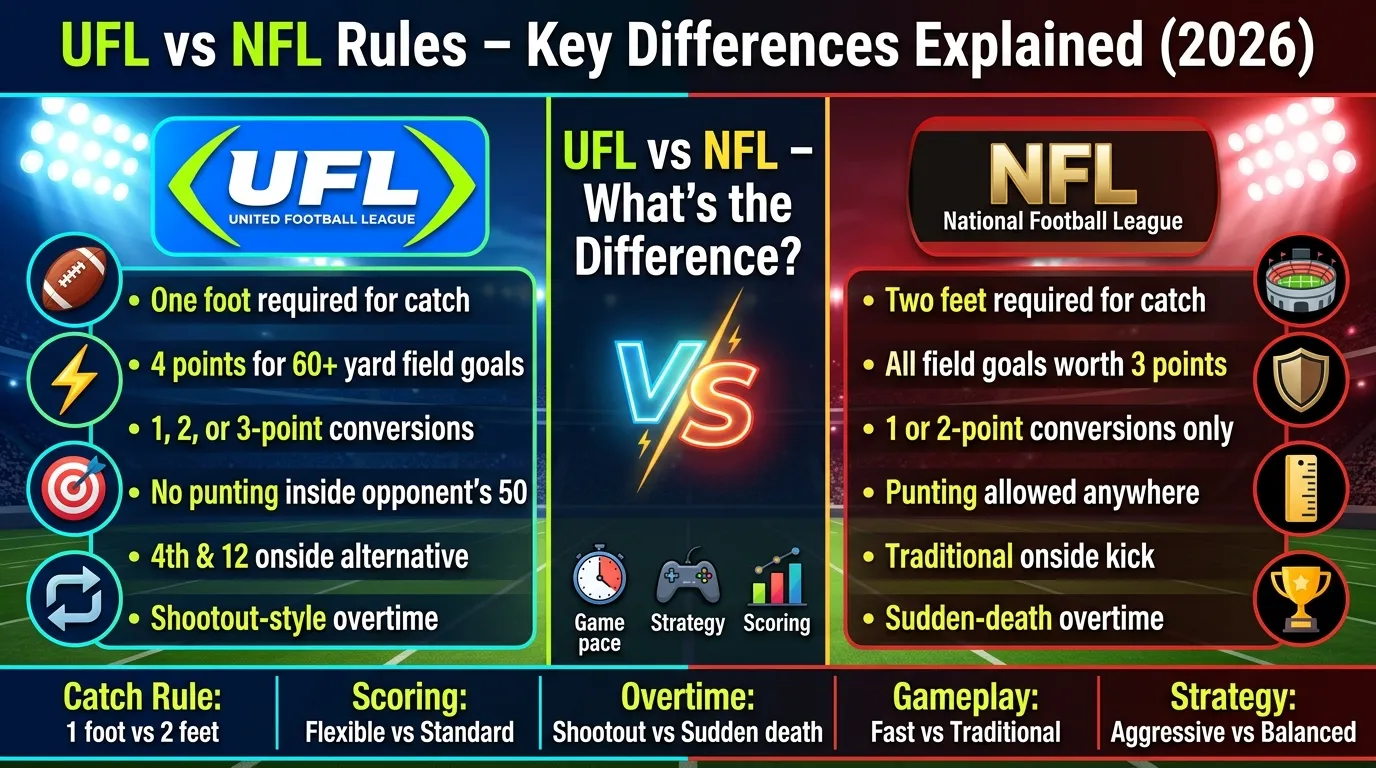
Quick Comparison Table (UFL vs NFL)
| Feature | UFL | NFL |
| Catch Rule | 1 foot in bounds | 2 feet required |
| Field Goals | 4 points (60+ yards) | Always 3 points |
| PAT Options | 1, 2, or 3 points | 1 or 2 points |
| Punting | Restricted zone | Allowed anywhere |
| Kickoffs | Modified safe system | Traditional system |
| Tush Push | Not allowed | Allowed |
| Overtime | Shootout format | Sudden death |
| Onside Option | 4th & 12 play | Traditional kick |
15 Key Differences Between UFL and NFL Rules with Examples
1. Catch Rule (Feet Requirement)
UFL requires only one foot in bounds, while NFL requires two feet for a legal catch.
Example:
A receiver catching the ball with one foot inside counts in UFL but is incomplete in NFL.
2. Tush Push Rule
The UFL has banned the “tush push”, while the NFL allows it.
Example:
In NFL, teams push the quarterback forward for short gains. In UFL, this play is illegal.
3. Field Goal Scoring
UFL rewards long kicks more by giving 4 points for 60+ yard field goals, while NFL always gives 3 points.
Example:
A 62-yard kick = 4 points in UFL, only 3 in NFL.
4. Point After Touchdown (PAT Options)
UFL offers 3 scoring options (1, 2, or 3 points), while NFL offers only 1 or 2.
Example:
Teams in UFL can attempt a 3-point conversion from the 8-yard line.
5. Punting Restrictions
UFL does not allow punting inside the opponent’s 50-yard line (with some exceptions), while NFL allows punting anytime.
Example:
In UFL, a team must go for it instead of punting near scoring range.
6. Kickoff Rules
UFL uses a safer kickoff system with a landing zone, while NFL uses traditional kickoffs.
Example:
If the ball doesn’t land in the UFL landing zone, the receiving team gets strong field position.
7. Onside Kick Alternative
UFL allows a 4th-and-12 play instead of an onside kick, while NFL uses traditional onside kicks.
Example:
Instead of kicking, a UFL team can try to gain 12 yards to keep possession.
8. Overtime Format
UFL uses a shootout-style overtime, while NFL uses sudden death rules.
Example:
Teams take turns scoring from the 5-yard line in UFL.
9. Game Pace
UFL rules are designed to increase speed and scoring, while NFL focuses on balanced gameplay.
Example:
No-punt zones in UFL lead to more aggressive play.
10. Player Safety Rules
UFL modifies rules to improve safety, especially in kickoffs.
Example:
Players line up closer together to reduce high-speed collisions.
11. Strategic Flexibility
UFL provides more strategic options (like 3-point conversions), while NFL has more fixed rules.
Example:
Teams can make bigger comebacks in UFL using higher scoring options.
12. Scoring Opportunities
UFL creates more scoring chances due to rule changes, while NFL scoring is more traditional.
13. Coaching Strategy
Coaches in UFL must take more risks due to restrictions (like no punting zones).
Example:
4th down decisions happen more frequently in UFL.
14. Fan Experience
UFL focuses on excitement and entertainment, while NFL focuses on competition and legacy.
15. Overall Gameplay Style
UFL is modern, fast, and experimental, while NFL is traditional, structured, and elite.
When to Watch UFL vs NFL
Watch UFL if:
- You enjoy fast-paced and high-scoring games
- You like innovative rules
- You want football in the offseason
Watch NFL if:
- You want elite competition
- You enjoy traditional football
- You follow major teams and players
Advantages and Disadvantages
UFL
✔ More exciting and fast-paced
✔ Innovative rules
✔ More scoring opportunities
❌ Less tradition
❌ Lower competition level
NFL
✔ Highest level of football
✔ Massive fanbase
✔ Strong legacy
❌ Slower pace (sometimes)
❌ Limited rule flexibility
Conclusion
The difference between UFL and NFL rules comes down to innovation vs tradition. The UFL introduces modern changes to make the game faster and more exciting, while the NFL maintains a structured and competitive format.
Final takeaway:
- UFL = Fast, experimental, offensive-focused
- NFL = Traditional, competitive, elite-level
FAQs
1. Why are UFL rules different from NFL?
To make the game faster, safer, and more exciting.
2. Is UFL more entertaining than NFL?
It depends—UFL is faster, NFL is more competitive.
3. Can UFL rules come to NFL?
Some experimental rules may be adopted in the future.
4. Which league has better players?
NFL has the best players in the world.
5. What is the biggest rule difference?
The scoring system and punting rules in UFL.

Sarfraz Ahmad is language researcher and content writer who specializes in explaining the difference between commonly confused English words. Through WordClearify, learners understand subtle word distinctions in a simple, structured, and practical way. My writing focuses on clarity, real-life examples, and easy comparisons for students, bloggers, and professionals worldwide.