Many users get confused about the difference between lead and led because the two words look almost identical but have completely different meanings and uses. In fact, one of the most common grammar mistakes in emails, blogs, business reports, and social media posts is using lead when led is correct.
The difference between both becomes easier to understand when you know that lead is usually the present tense form of the verb, while led is its past tense. However, things become more confusing because lead can also refer to a metal element.
If you’ve ever searched “lead vs led,” “what is lead and led,” or “how to use both correctly,” this guide will give you a complete answer. You’ll learn definitions, pronunciation, examples, common mistakes, real-world applications, and why even experienced writers sometimes mix them up.
Quick Answer: Difference Between Both
Lead means to guide, direct, or be in charge in the present or future.
Led is the past tense of lead and means someone guided or directed something in the past.
Example:
- Present: “She will lead the project.”
- Past: “She led the project successfully last year.”
Definition of Both
- Lead: A verb meaning to guide, direct, influence, or be ahead of others. It can also be a noun referring to a metal.
- Led: The simple past tense and past participle of the verb lead. It describes an action that already happened.
Example:
- Lead: “I lead the marketing team.”
- Led: “I led the marketing team in 2024.”
Pronunciation of Both (US & UK)
| Word | US Pronunciation | UK Pronunciation |
|---|---|---|
| Lead (verb) | LEED | LEED |
| Led | LED | LED |
| Lead (metal) | LED | LED |
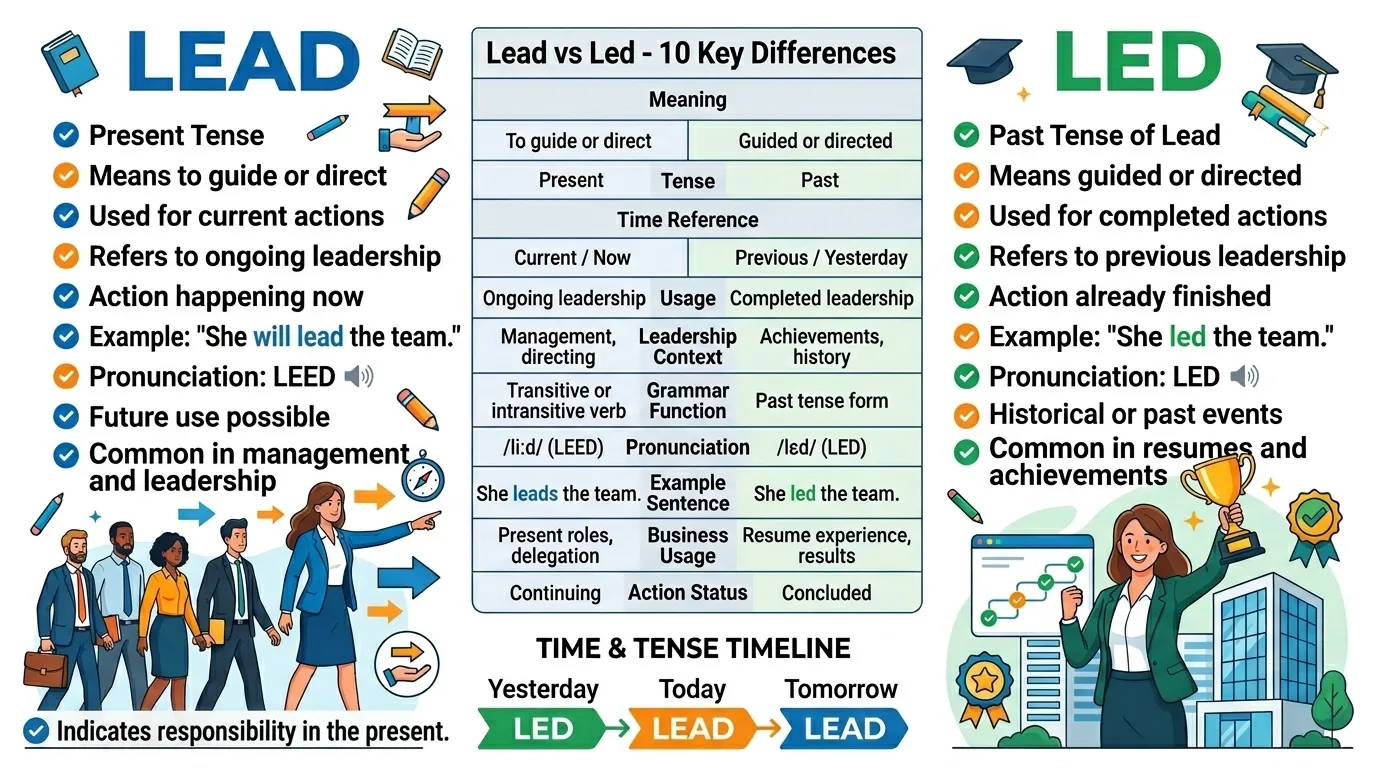
Lead vs Led: Comparison Table
| Feature | Lead | Led |
|---|---|---|
| Part of Speech | Verb (present/future) | Verb (past tense) |
| Time Reference | Current or future action | Completed past action |
| Meaning | Guide or direct | Guided or directed |
| Usage | Present tense sentences | Past tense sentences |
| Example | “I lead the team.” | “I led the team.” |
| Grammar Role | Base form verb | Past form verb |
| Common Context | Leadership, management, instruction | Historical actions, completed events |
| Writing Mistake | Often confused with led | Often replaced incorrectly by lead |
Deep Explanation of the Comparison Points
| Comparison Point | Lead | Led | Real-World Example |
|---|---|---|---|
| Time | Present/Future | Past | Today I lead; yesterday I led |
| Leadership | Current leadership | Previous leadership | CEO leads today; CEO led last year |
| Projects | Active project management | Completed project management | Lead a launch vs led a launch |
| Teaching | Currently teaching | Taught earlier | Lead training today; led training yesterday |
| Sports | Team captain now | Team captain before | Leads team now; led team last season |
| Communication | Present guidance | Past guidance | Lead discussion vs led discussion |
| Business Reports | Current status | Historical record | Lead growth initiative vs led initiative |
Key Differences Between Lead and Led
1. Time Is the Biggest Difference
Lead refers to the present or future, while led refers to the past.
Example:
“I lead meetings every Monday.”
“I led the meeting last Monday.”
2. Grammar Changes the Meaning
Using the wrong word changes the tense and can confuse readers.
3. Business Writing Requires Accuracy
In resumes and LinkedIn profiles, professionals often write “led” because they describe past achievements.
4. Leadership Contexts Use Both Words
Managers may currently lead teams but previously led different departments.
5. Spoken English Can Cause Confusion
Since “lead” (verb) and “led” are spelled similarly, many learners mix them up in writing.
6. Professional Communication Depends on Correct Usage
Using the right tense improves credibility in reports, emails, and presentations.
What Is Lead and How Is It Used?
Lead is a verb that means:
- Guide
- Direct
- Influence
- Be in charge
Examples
- She will lead the conference.
- They lead innovation in the industry.
- The coach will lead the team to the finals.
In practical use, organizations, schools, and businesses frequently use the word lead to describe leadership responsibilities.
What Is Led and How Is It Used?
Led is the past tense of lead.
Examples
- She led the conference successfully.
- They led the industry for several years.
- The coach led the team to victory.
Most beginners understand the concept quickly when they remember that led always refers to something that already happened.
Why Does the Difference Between Both Exist?
English verbs often change form to show time.
Examples:
- Speak → Spoke
- Write → Wrote
- Lead → Led
The language evolved to help readers and listeners understand when an action occurred.
Without these tense changes, communication would be less precise.
How to Remember the Difference Between Both
A simple memory trick:
Lead = Present
Think of:
“I lead today.”
Led = Past
Think of:
“I led yesterday.”
Another useful tip:
If the action already happened, choose led.
If the action is happening now or will happen later, choose lead.
Difference Between Both in Professional Writing
Professional communication relies heavily on correct tense usage.
Resume Example
Correct:
- Led a team of 20 employees.
- Led product development initiatives.
Incorrect:
- Lead a team of 20 employees. (when describing past work)
Recruiters and hiring managers often notice tense errors immediately.
Business Reports
Correct grammar creates clarity and professionalism.
Difference Between Both in Digital Content and Social Media
Content creators on platforms like Google, YouTube, Instagram, and Meta regularly publish content where grammar accuracy matters.
For example:
- “Our expert will lead today’s webinar.”
- “Our expert led last week’s webinar.”
Search engines analyze language patterns to understand content quality and relevance.
Clear grammar improves readability, user experience, and trust.
Common Mistakes with Difference Between Both
Mistake 1
Incorrect:
“I lead the team last year.”
Correct:
“I led the team last year.”
Mistake 2
Incorrect:
“She led the meeting tomorrow.”
Correct:
“She will lead the meeting tomorrow.”
Mistake 3
Confusing lead (verb) with lead (metal).
Mistake 4
Using present tense on resumes describing past achievements.
Mistake 5
Writing based on pronunciation instead of grammar rules.
Real Life Examples with Difference Between Both
Personal Example
“I lead family discussions every weekend.”
Past Personal Example
“I led the discussion last weekend.”
Business Example
“The manager led a successful transformation project.”
Education Example
“The professor led research on language development.”
Industry Example
“The executive led the company’s expansion into international markets.”
Marketing Example
“The team lead oversees campaigns while the former director led earlier initiatives.”
When to Use Each
Use Lead When
- Talking about current actions
- Discussing future responsibilities
- Giving instructions
- Describing ongoing leadership
Use Led When
- Referring to completed actions
- Writing resumes
- Discussing historical events
- Reporting previous achievements
Why People Get Confused in Difference Between Both
Several factors create confusion:
Similar Spelling
Only one letter changes.
Unusual Pronunciation
Lead sounds like “leed.”
Led sounds like “led.”
Metal Exception
The metal lead is pronounced “led,” creating another layer of confusion.
Online Content Errors
Many websites, social posts, and comments use the wrong form, spreading mistakes.
ESL Learning Challenges
English learners often expect regular verb patterns and may not anticipate the change from lead to led.
Expert Insight
From an editorial and content-quality perspective, the distinction between lead and led is more important than many writers realize.
In real scenarios, grammar mistakes can affect credibility in business reports, academic writing, marketing materials, and professional resumes.
Most beginners focus only on spelling. Experienced writers focus on tense accuracy because tense communicates time, and time communicates meaning.
A useful professional habit is to ask:
“Did this happen already?”
If yes, use led.
If not, use lead.
That single question prevents most mistakes.
FAQs
Is led the past tense of lead?
Yes. Led is the past tense and past participle of the verb lead.
What is the difference between lead and led?
Lead refers to present or future action, while led refers to past action.
Why is lead pronounced differently?
The verb lead is pronounced “leed,” while the metal lead is pronounced “led.”
Can lead and led be used interchangeably?
No. They represent different tenses and should be used in different contexts.
Is “I lead the project yesterday” correct?
No. The correct sentence is “I led the project yesterday.”
Why do resumes often use led?
Resumes usually describe completed accomplishments, making led the correct choice.
Is lead a noun?
Yes. Lead can be a noun referring to a metal or a sales prospect.
What does lead mean in business?
It can mean guiding a team or, in sales, a potential customer.
Is led ever used as a noun?
No. Led functions as a verb form, not a noun.
Conclusion
Understanding the difference between lead and led is essential for clear and professional communication. In simple words, lead is used when talking about present or future actions, while led is used when describing actions that happened in the past. Although the spelling difference is small, the meaning difference is significant.
Whether you’re writing a resume, publishing content online, preparing a report, or simply improving your English grammar, using the correct form strengthens clarity and credibility. Remember the simple rule: If the action happened already, use led. If the action is happening now or in the future, use lead. That distinction is the core difference between lead and led.

David Anderson
I am David Anderson, a USA-based content writer and digital author. I create clear, engaging, and well-structured articles focused on delivering valuable and well-researched information. I specialize in blog writing and digital content that helps websites grow visibility and build strong online authority.