Sleep Apnea treatment can feel confusing, especially when comparing CPAP and APAP machines. Many users search for the difference between CPAP and APAP because both devices help people breathe during sleep, yet they work in different ways.
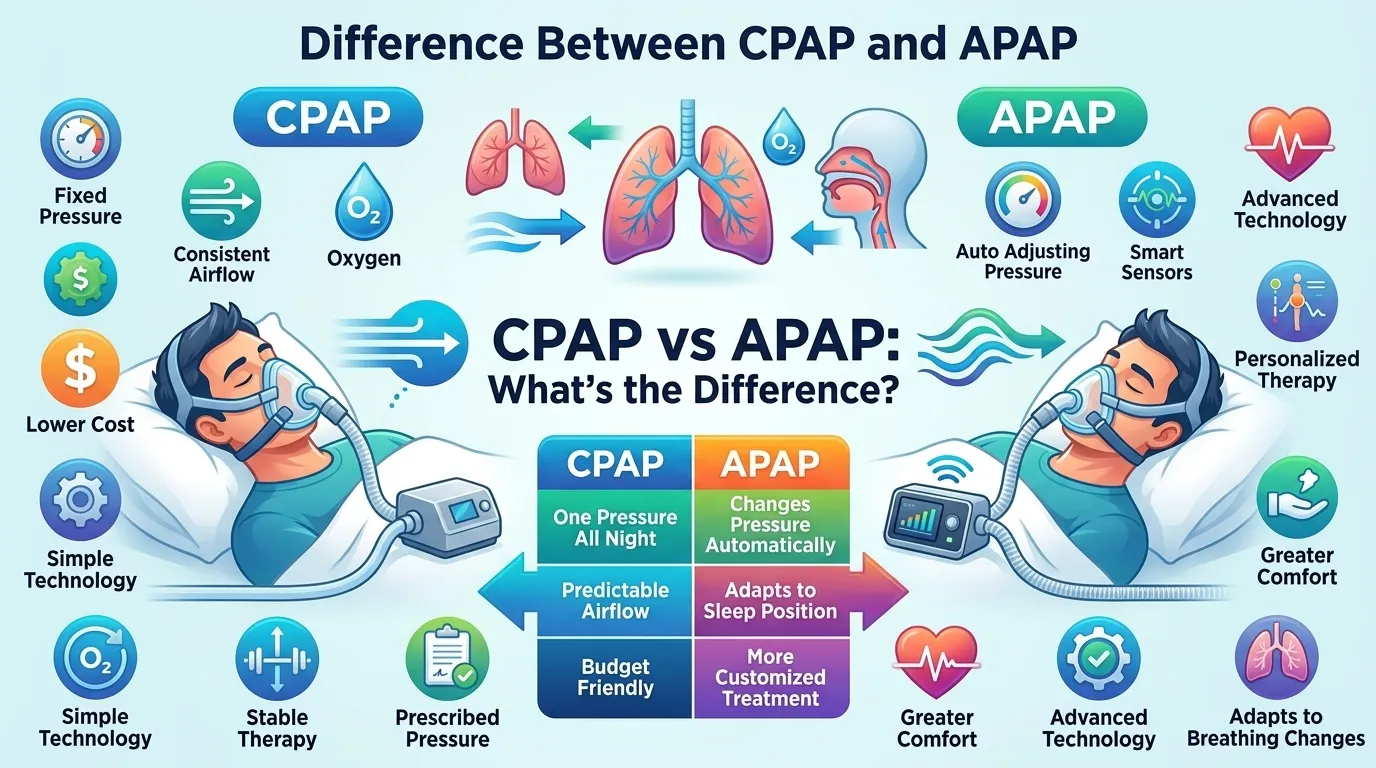
The difference between CPAP and APAP mainly comes down to air pressure delivery. A CPAP machine provides one fixed pressure throughout the night, while an APAP machine automatically adjusts pressure based on your breathing patterns. Understanding the difference between CPAP and APAP can help patients choose the most comfortable and effective therapy.
In this guide, you’ll learn what CPAP and APAP are, how they work, their advantages and disadvantages, key differences, similarities, real-life examples, common mistakes, and expert recommendations for choosing the right sleep apnea treatment.
Quick Answer: Difference Between CPAP and APAP
CPAP delivers a constant air pressure all night, while APAP automatically changes pressure as needed.
For example, if a person’s breathing becomes restricted while sleeping on their back, an APAP machine can increase pressure temporarily. A CPAP machine continues delivering the same pressure regardless of position changes.
Definition of CPAP and APAP
- CPAP (Continuous Positive Airway Pressure): A sleep apnea machine that delivers one fixed level of air pressure throughout the night.
- APAP (Automatic Positive Airway Pressure): A sleep apnea machine that automatically adjusts air pressure based on breathing patterns and airway resistance.
Example: If a prescribed pressure is 10 cmH₂O, CPAP stays at 10 all night, while APAP may vary between 6 and 12 depending on the user’s needs.
Pronunciation of Both Terms
| Term | US Pronunciation | UK Pronunciation |
| CPAP | SEE-pap | SEE-pap |
| APAP | AY-pap | AY-pap |
Now that you know what each machine is called and how it is pronounced, let’s understand how they differ in real-world sleep therapy.
CPAP vs APAP Comparison Table
| Feature | CPAP | APAP |
| Pressure Delivery | Fixed pressure | Automatic pressure adjustment |
| Comfort Level | Moderate | Often more comfortable |
| Customization | Limited | Highly personalized |
| Technology | Simpler system | Advanced sensors |
| Cost | Usually lower | Usually higher |
| Pressure Changes | Does not adjust | Adjusts continuously |
| Sleep Position Adaptation | No | Yes |
| Data Tracking | Basic to advanced | Typically advanced |
| Prescription Setup | Specific pressure required | Pressure range required |
| Best For | Stable pressure needs | Variable pressure needs |
Key Differences Explained Between Difference Between CPAP and APAP
1. Pressure Delivery Method
The biggest difference is how pressure is delivered.
A CPAP machine maintains one prescribed pressure.
An APAP machine constantly monitors breathing and adjusts pressure when needed.
Real-life example: A user who sleeps differently throughout the night may benefit from APAP because pressure changes automatically.
2. Comfort During Sleep
Many users find APAP more comfortable.
When less pressure is needed, APAP reduces airflow levels.
CPAP continues delivering the same pressure even when lower pressure would be sufficient.
3. Adaptability
APAP responds to:
- Sleep position changes
- Weight fluctuations
- Nasal congestion
- Alcohol consumption effects
- Different sleep stages
CPAP does not automatically respond to these changes.
4. Data Collection
Modern APAP machines often provide detailed therapy reports.
These reports help sleep specialists optimize treatment.
5. Cost Differences
CPAP machines generally cost less because they use simpler technology.
APAP devices include advanced algorithms and sensors, increasing overall cost.
6. Treatment Flexibility
APAP offers greater flexibility for users whose pressure needs vary from night to night.
7. Clinical Use
Doctors may recommend CPAP when pressure requirements are consistent.
APAP is often recommended when pressure requirements fluctuate.
What Is CPAP and How Does It Work?
CPAP stands for Continuous Positive Airway Pressure.
The machine pushes a steady stream of air through a mask. This airflow keeps the airway open during sleep and prevents breathing interruptions.
Why CPAP Exists
Sleep apnea causes airway collapse during sleep.
CPAP was developed to prevent these collapses using consistent air pressure.
Benefits of CPAP
- Proven sleep apnea treatment
- Lower cost
- Simple setup
- Reliable performance
- Long clinical history
Drawbacks of CPAP
- Fixed pressure may feel uncomfortable
- Some users struggle during exhalation
- Less adaptable to changing conditions
What Is APAP and How Does It Work?
APAP stands for Automatic Positive Airway Pressure.
Unlike CPAP, APAP uses sensors and software algorithms to detect breathing resistance.
When signs of obstruction appear, pressure increases automatically.
When breathing normalizes, pressure decreases.
Why APAP Exists
Researchers recognized that many patients do not need the same pressure all night.
APAP was created to provide personalized therapy.
Benefits of APAP
- Greater comfort
- Automatic adjustments
- Better adaptability
- Potentially improved compliance
- Personalized treatment
Drawbacks of APAP
- Higher cost
- More complex technology
- May not be ideal for every patient
Difference Between CPAP and APAP for Sleep Apnea Treatment
When treating obstructive sleep apnea, both machines aim to achieve the same goal:
Keep the airway open and prevent breathing interruptions.
However, their approach differs.
CPAP Approach
Uses one constant therapeutic pressure.
APAP Approach
Uses a pressure range and automatically adjusts based on need.
In practical use, both therapies can be highly effective when properly prescribed.
Which Is More Comfortable: CPAP or APAP?
Comfort is one of the most searched questions regarding the difference between CPAP and APAP.
For many users, APAP feels more natural because pressure changes only when needed.
However, comfort depends on individual factors such as:
- Sleep habits
- Airway anatomy
- Pressure requirements
- Mask fit
- Medical conditions
Some users actually prefer CPAP because they enjoy predictable airflow throughout the night.
Who Should Use CPAP?
CPAP may be ideal for:
- Patients with stable pressure requirements
- Budget-conscious users
- Long-term sleep apnea patients
- Individuals who respond well to fixed pressure
Real Scenario
A patient consistently requires 10 cmH₂O pressure every night. CPAP may provide effective therapy without needing automatic adjustments.
Who Should Use APAP?
APAP may be ideal for:
- New sleep apnea patients
- Users with changing pressure needs
- Individuals experiencing weight changes
- People who sleep in multiple positions
- Patients seeking enhanced comfort
Real Scenario
A person who experiences worse apnea while sleeping on their back can benefit from APAP’s automatic pressure adjustments.
Difference and Similarity Table Generation for Difference Between CPAP and APAP
| Feature | CPAP | APAP | Similarity |
| Meaning | Continuous pressure | Automatic pressure | Both treat sleep apnea |
| Airflow | Fixed | Variable | Both use positive airway pressure |
| Comfort | Consistent feel | Adaptive feel | Both aim for effective therapy |
| Technology | Simpler | More advanced | Both use masks and tubing |
| Cost | Lower | Higher | Both require prescription in many regions |
| Monitoring | Basic to advanced | Often advanced | Both collect treatment data |
| Purpose | Airway support | Airway support | Same treatment goal |
| Sleep Apnea Use | Commonly prescribed | Commonly prescribed | Both help reduce apnea events |
This table clearly shows the difference and similarity between difference between CPAP and APAP for quick understanding.
Common Mistakes with Difference Between CPAP and APAP
Mistake 1: Assuming APAP Is Always Better
Correction: The best machine depends on individual medical needs.
Mistake 2: Ignoring Doctor Recommendations
Correction: Follow sleep study results and professional guidance.
Mistake 3: Focusing Only on Price
Correction: Comfort and treatment effectiveness matter more than upfront cost.
Mistake 4: Using Incorrect Mask Settings
Correction: Proper machine configuration is essential.
Mistake 5: Believing Both Machines Work Identically
Correction: Their pressure delivery systems differ significantly.
Real Life Examples with Difference Between CPAP and APAP
Personal Use Example
A patient with stable sleep apnea successfully uses CPAP for years.
Frequent Traveler Example
An APAP user benefits from automatic adjustments while sleeping in different environments.
Weight Loss Example
After losing weight, a patient’s pressure requirements decrease. APAP adapts automatically.
Sleep Clinic Example
Sleep specialists often use APAP during therapy optimization.
Long-Term Therapy Example
Many experienced patients remain satisfied with traditional CPAP therapy.
When to Use Each
Choose CPAP When:
- Pressure needs remain stable
- Cost is a major concern
- A doctor prescribes fixed pressure therapy
Choose APAP When:
- Pressure needs fluctuate
- Comfort is a priority
- Lifestyle or health factors change frequently
Why People Get Confused in Difference Between CPAP and APAP
Several reasons create confusion:
Similar Names
CPAP and APAP sound nearly identical.
Same Goal
Both machines treat sleep apnea.
Similar Appearance
Most devices look alike externally.
Marketing Messages
Manufacturers often emphasize features differently, making comparisons difficult.
Medical Terminology
Many beginners are unfamiliar with positive airway pressure technology.
Expert Insight
From a sleep therapy perspective, neither CPAP nor APAP is universally superior.
In real scenarios, the best choice depends on the patient’s airway behavior, comfort preferences, pressure requirements, and physician recommendations.
Many beginners assume APAP is automatically better because it uses newer technology. However, countless patients achieve excellent long-term outcomes with CPAP.
The most important factor is consistent therapy use. A comfortable machine that a patient uses every night is often more valuable than a technically advanced machine that remains unused.
Frequently Asked Questions
Is APAP better than CPAP?
Not necessarily. APAP offers more flexibility, but CPAP can be equally effective for many patients.
What is the biggest difference between CPAP and APAP?
CPAP uses fixed pressure, while APAP automatically adjusts pressure.
Can APAP replace CPAP?
In many cases yes, but medical recommendations vary.
Which machine is more comfortable?
Many users find APAP more comfortable because pressure changes according to need.
Is APAP more expensive?
Generally yes, due to advanced technology and automation features.
Do both machines treat sleep apnea?
Yes. Both are designed to keep the airway open during sleep.
Can I switch from CPAP to APAP?
Many patients can, but changes should be discussed with a healthcare provider.
Which machine is best for beginners?
Many new users benefit from APAP because of its adaptive pressure settings.
Does insurance cover CPAP and APAP?
Coverage depends on the insurer, policy, and medical requirements.
Do CPAP and APAP use the same masks?
In many cases, yes. Most masks are compatible with both systems.
Conclusion
Understanding the difference between CPAP and APAP is essential for anyone considering sleep apnea treatment. While both machines serve the same purpose—keeping the airway open during sleep—they achieve that goal differently. CPAP delivers a fixed pressure throughout the night, whereas APAP automatically adjusts pressure based on changing breathing patterns.
The most important takeaway is that neither machine is universally better. The right choice depends on individual needs, sleep study results, comfort preferences, and professional medical guidance. By understanding the difference between CPAP and APAP, patients can make more informed decisions and improve their chances of successful long-term sleep apnea therapy.

Sarfraz Ahmad is language researcher and content writer who specializes in explaining the difference between commonly confused English words. Through WordClearify, learners understand subtle word distinctions in a simple, structured, and practical way. My writing focuses on clarity, real-life examples, and easy comparisons for students, bloggers, and professionals worldwide.