Many people get confused about the difference between insect and animal because insects are actually animals too. That sounds surprising at first. In simple words, every insect is an animal, but not every animal is an insect. This is one of the most searched biology comparison topics because students, parents, and even content creators often mix these terms.
Understanding the difference between insect and animal becomes easier when you learn how scientists classify living things. Insects belong to a special animal group called arthropods, while the word “animal” is much broader and includes mammals, birds, reptiles, fish, and insects themselves.
In this guide, you will learn:
- what insects and animals really are
- key differences and similarities
- real-life examples
By the end, you will not need another article to understand this concept clearly.
Quick Answer: Difference Between Insect and Animal
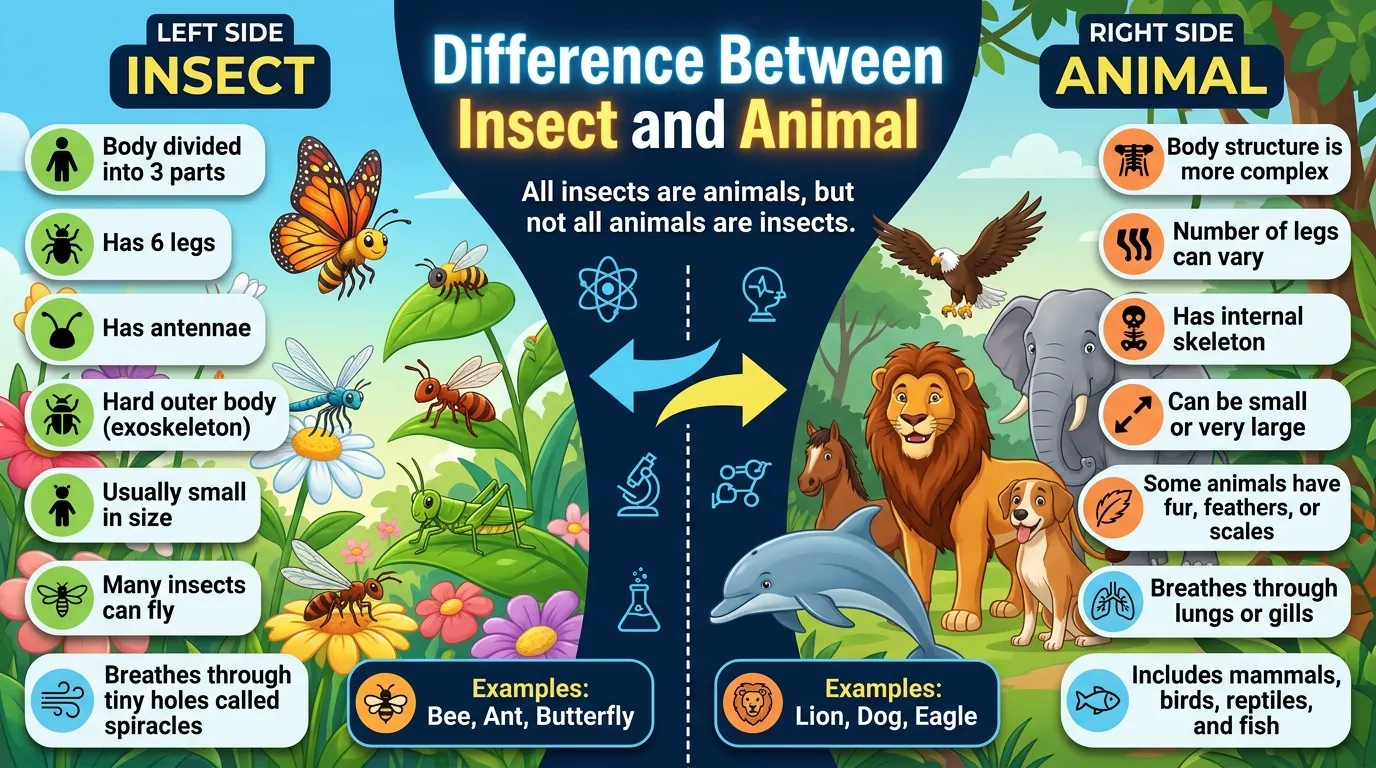
The main difference between insect and animal is that an insect is a specific type of animal with six legs, three body parts, and an exoskeleton.
Animals are a huge kingdom of living organisms that include insects, humans, dogs, birds, fish, and more.
For example:
- A butterfly is both an insect and an animal.
- A cat is an animal but not an insect.
Definition of Difference Between Insect and Animal
- Insect: A small animal with six legs, three body sections (head, thorax, abdomen), antennae, and usually wings.
- Animal: Any living organism that belongs to the animal kingdom, including mammals, birds, reptiles, fish, insects, and amphibians.
Simple Example
A bee is an insect because it has six legs and an exoskeleton. A tiger is an animal but not an insect because it is a mammal.
Pronunciation of Both Terms
| Word | US Pronunciation | UK Pronunciation |
| Insect | IN-sekt | IN-sekt |
| Animal | AN-uh-muhl | AN-i-muhl |
Now that the basic meaning is clear, let’s understand the deeper biological and practical differences between insects and animals.
Difference Between Insect and Animal Comparison Table
| Feature | Insect | Animal |
| Meaning | A specific type of animal | A complete biological kingdom |
| Body Structure | 3 body parts | Different body structures |
| Legs | Always 6 legs | Legs vary by species |
| Skeleton Type | Exoskeleton outside body | Usually internal skeleton |
| Size | Mostly small | Can be tiny or huge |
| Examples | Ant, bee, butterfly | Lion, fish, bird, insect |
| Breathing System | Through spiracles/tracheae | Lungs, gills, skin, or other systems |
| Classification | Arthropod class | Entire animal kingdom |
| Wings | Many insects have wings | Most animals do not |
| Habitat | Land, air, some water | Every ecosystem |
KEY DIFFERENCES EXPLAINED BETWEEN DIFFERENCE BETWEEN INSECT AND ANIMAL
1. Insects Are Only One Group of Animals
This is the biggest confusion. Insects are not separate from animals. They are one category inside the animal kingdom.
For example:
- Spider, ant, and mosquito = animals
- Dog, whale, and eagle = also animals
In practical biology classes, teachers explain insects as “specialized animals.”
2. Body Structure Is Completely Different
Most insects have:
- head
- thorax
- abdomen
Animals like humans or cats do not follow this body pattern.
A human body has:
- head
- torso
- limbs
This structural difference helps scientists classify species quickly.
3. Insects Have Exoskeletons
Insects wear their skeleton outside the body. This hard outer covering protects them.
Many animals have internal skeletons instead.
Example:
- Beetle → hard outer shell
- Dog → bones inside body
This difference changes movement, growth, and survival systems.
4. Leg Count Helps Easy Identification
One of the easiest ways to identify insects:
- insects always have six legs
Many beginners mistakenly call spiders insects, but spiders have eight legs, so they belong to arachnids.
5. Breathing Systems Work Differently
Insects breathe using tiny openings called spiracles.
Humans and mammals breathe through lungs.
Fish use gills.
This biological system is one reason scientists separate insects into their own category.
6. Size and Growth Patterns Differ
Most insects stay small because their exoskeleton limits growth.
Animals can grow extremely large:
- elephants
- whales
- giraffes
The blue whale is the largest animal on Earth, while most insects are tiny.
7. Lifespan Differences
Many insects live only days or months.
Animals like turtles or elephants may live decades.
Real-world example:
- Housefly → short lifespan
- Parrot → can live many years
Why Are Insects Considered Animals?
Scientifically, insects meet all requirements of animals:
- multicellular organisms
- consume food for energy
- move independently
- reproduce
- respond to surroundings
That is why biology places insects under the animal kingdom.
Many users search:
- “Are insects animals?”
- “Why are bugs animals?”
- “Are insects different from animals?”
The confusion usually happens because people use the word “animal” only for mammals.
What Makes an Insect Unique Among Animals?
Not all animals have:
- six legs
- antennae
- segmented body
- metamorphosis
These features make insects unique.
For example:
- butterfly changes from caterpillar to adult
- bee communicates through movement
- ants build organized colonies
In real ecosystems, insects are extremely important for pollination and food chains.
How Scientists Classify Insects and Animals
Biologists use taxonomy to organize life forms.
Animal Kingdom Hierarchy
- Kingdom: Animalia
- Phylum
- Class
- Order
- Family
- Species
Insects belong mainly to:
- Phylum: Arthropoda
- Class: Insecta
Meanwhile, mammals belong to Mammalia.
This classification system helps schools, research labs, and educational platforms organize biological information correctly.
Why People Get Confused in Difference Between Insect and Animal
Everyday Language Causes Confusion
Most people say:
- “animals and insects”
This sounds like separate categories even though insects are animals.
Media and Cartoons Influence Understanding
Movies, cartoons, and games often separate insects from animals.
Platforms like YouTube and Instagram contain educational and entertainment videos where creators sometimes simplify biology incorrectly.
School-Level Learning Simplification
Many beginner textbooks separate:
- insects
- birds
- mammals
This helps children learn categories but can create misunderstanding later.
Real Life Examples With Difference Between Insect and Animal
1. Personal Learning Example
A child sees a butterfly and a dog.
- Butterfly = insect + animal
- Dog = animal only
2. Farming Industry Example
Farmers study insects separately because:
- some help crops
- some damage plants
But scientifically, they are still animals.
3. Medical Research Example
Mosquitoes spread diseases. Scientists classify them as insects within the animal kingdom.
4. Environmental Science Example
Bees are insects that support ecosystems through pollination.
Without these animal species, food systems would collapse.
5. Advanced Biology Example
Researchers studying biodiversity compare insects with vertebrate animals to understand evolution and adaptation.
Common Mistakes With Difference Between Insect and Animal
| Mistake | Correction |
| Thinking insects are not animals | Insects are animals |
| Calling spiders insects | Spiders are arachnids |
| Believing all animals have bones | Many animals do not |
| Assuming insects are bugs only | Not all insects are “bugs” scientifically |
| Thinking insects are separate kingdom | They belong to Animalia |
| Confusing worms with insects | Worms are different animal groups |
When to Use Each Term
Use “Insect” When:
- talking about six-legged arthropods
- discussing ants, bees, flies, butterflies
- studying entomology
Use “Animal” When:
- discussing all members of Animalia
- talking generally about living creatures
- comparing species broadly
Practical example:
- “A mosquito is an insect.”
- “A mosquito is also an animal.”
Both statements are correct.
How Does the Difference Between Insect and Animal Matter in Science?
This difference helps experts in:
- biology
- agriculture
- medicine
- environmental science
- zoology
For example:
- pest control targets insects specifically
- wildlife conservation may focus on larger animals
- ecological studies compare insect populations with vertebrates
Understanding classification improves research accuracy.
Expert Insight
In practical teaching scenarios, most beginners struggle because everyday language does not match scientific classification.
A biology educator or zoology expert usually explains this concept using taxonomy first. Once learners understand that “animal” is a broad kingdom and “insect” is a subgroup, the confusion disappears quickly.
Another important insight is that insects are among the most successful animal groups on Earth. Scientists estimate millions of insect species exist, many still undiscovered. Their survival systems, fast reproduction, and adaptability make them biologically unique compared to larger animals.
Frequently Asked Questions
Is an insect considered an animal?
Yes. Every insect belongs to the animal kingdom.
What is the main difference between insect and animal?
An insect is one specific type of animal with six legs and three body sections.
Are all animals insects?
No. Only some animals are insects.
Is a spider an insect or animal?
A spider is an animal but not an insect because it has eight legs.
Why do people separate insects from animals?
Mostly because of everyday language and educational simplification.
Are insects mammals?
No. Mammals and insects are different animal groups.
Which is bigger: insects or animals?
“Insect” is a subgroup. “Animal” includes all animal species.
Do insects have bones?
No. They have exoskeletons outside the body.
Are worms insects?
No. Worms belong to different animal groups.
Why is classification important in biology?
Classification helps scientists organize and study living organisms accurately.
Conclusion
Understanding the difference between insect and animal becomes simple once you know that insects are actually part of the animal kingdom. The word “animal” is broad and includes mammals, reptiles, birds, fish, insects, and many other life forms. An insect is just one specialized category inside that larger system.
In practical terms, insects differ from many other animals because they have six legs, segmented bodies, antennae, and exoskeletons. These unique features make them easy to identify scientifically. At the same time, they still share core animal traits such as movement, reproduction, and the need for food and oxygen.
Whether you are a student, parent, teacher, or curious reader, knowing the real difference between insect and animal helps you understand science more accurately and avoid common misconceptions.

Sarfraz Ahmad is language researcher and content writer who specializes in explaining the difference between commonly confused English words. Through WordClearify, learners understand subtle word distinctions in a simple, structured, and practical way. My writing focuses on clarity, real-life examples, and easy comparisons for students, bloggers, and professionals worldwide.