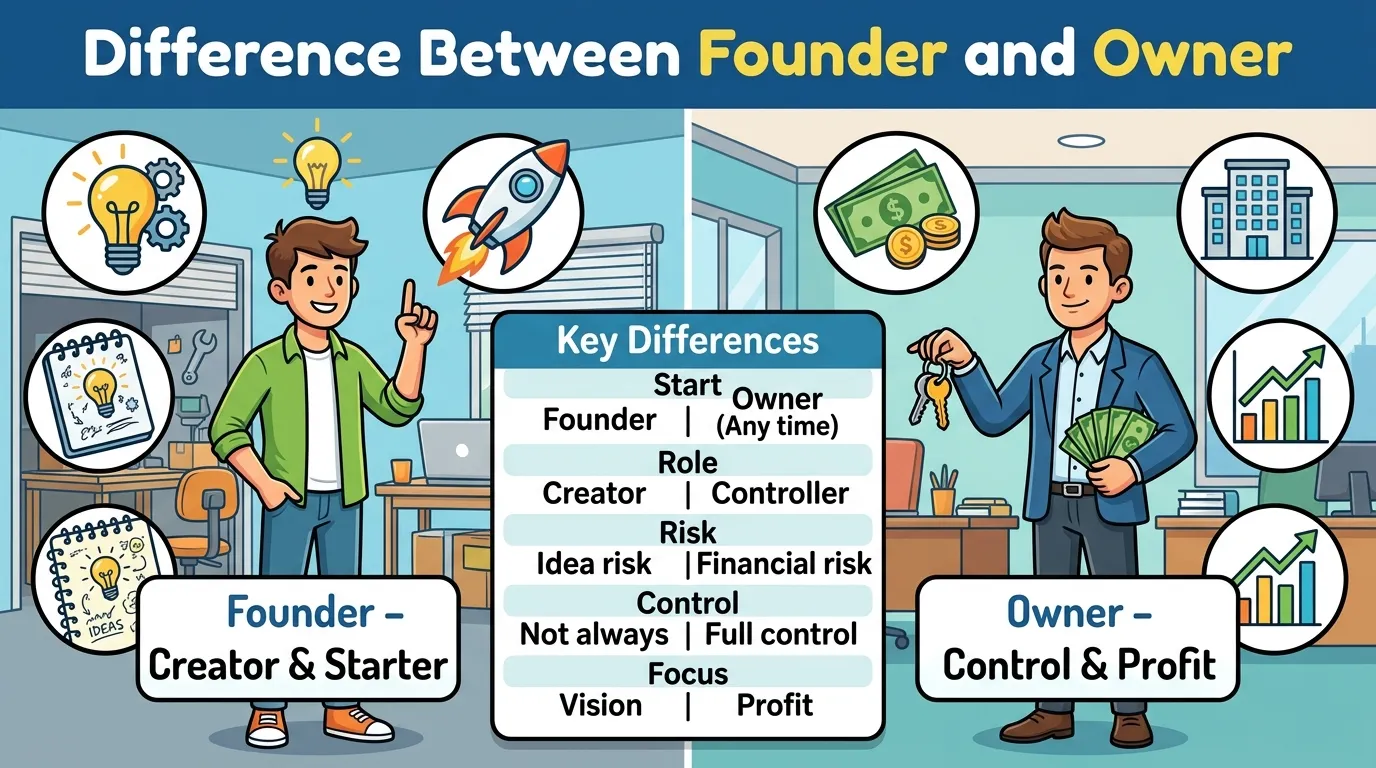
Many people use the terms founder and owner as if they mean the same thing. However, there is an important difference between founder and owner that affects businesses, startups, brands, and even small local companies.
In simple words, a founder is the person who creates a business, while an owner is the person who legally possesses all or part of that business. Understanding the difference between founder and owner is essential for entrepreneurs, investors, employees, and anyone interested in business.
Whether you’re researching startup leadership, company structures, or wondering who has more authority, this guide explains the difference between both clearly with examples, tables, and real-world scenarios.
Quick Answer: Difference Between Founder and Owner
A founder is the individual who starts or establishes a company from scratch.
An owner is the person or entity that legally owns the business or its shares.
Example: If Sarah creates a software company in 2026, she is the founder. If she later sells 100% of the company to another investor, Sarah remains the founder, but the investor becomes the owner.
Definition of Founder and Owner
- Founder: A person who starts, creates, or establishes a business, startup, organization, or company.
- Owner: A person, group, or company that legally possesses all or part of a business.
Example
If someone launches an online store and later sells it, they will always be the founder, but the new buyer becomes the owner.
Pronunciation of Both Terms
| Term | US Pronunciation | UK Pronunciation |
|---|---|---|
| Founder | /ˈfaʊn.dɚ/ | /ˈfaʊn.də/ |
| Owner | /ˈoʊ.nɚ/ | /ˈəʊ.nə/ |
Now that the basic definitions are clear, let’s understand the deeper business meaning behind these two commonly confused terms.
Founder vs Owner Comparison Table
| Feature | Founder | Owner |
|---|---|---|
| Meaning | Creates the business | Legally possesses the business |
| Business Creation | Starts the company | May or may not start it |
| Ownership Required | Not always | Yes |
| Legal Rights | Depends on shareholding | Based on ownership stake |
| Status After Selling | Remains founder | May lose ownership after sale |
| Decision Authority | Depends on role | Usually linked to ownership |
| Startup Connection | Common in startups | Common in all businesses |
| Equity Relationship | May own shares | Owns shares or assets |
| Identity | Historical role | Legal role |
| Can Be Multiple People | Yes | Yes |
Key Differences Explained Between Founder and Owner
1. Creation vs Possession
The founder creates the company.
The owner possesses the company legally.
Example: The person who starts a bakery is the founder. The person who later buys it becomes the owner.
2. Founder Status Is Permanent
Once someone establishes a business, they remain its founder forever.
Ownership can change many times.
Real-life example: Many startup founders eventually leave their companies but still retain founder status.
3. Owners May Never Build the Business
Many owners purchase existing businesses.
They did not create them.
This is one of the biggest differences between founder and owner.
4. Ownership Can Be Shared
A company can have numerous owners through stock ownership.
Founders are usually limited to the individuals who originally established the business.
5. Authority Depends on Equity
People often assume founders always have the most power.
In reality, owners with larger ownership stakes often hold greater control.
6. Investors Can Become Owners
Startup investors commonly become partial owners after funding rounds.
However, they are not founders because they did not create the business.
7. Founders Can Lose Ownership
A founder may sell shares over time.
Eventually, they might own none of the company.
Yet they remain the founder.
What Is a Founder in Business?
A founder is the visionary who identifies an opportunity and creates a company around that idea.
Founders typically:
- Develop the original concept
- Build the initial business model
- Recruit early employees
- Seek funding
- Establish company culture
Many famous companies began with founders who transformed simple ideas into global organizations.
Examples include:
- Google founders Larry Page and Sergey Brin
- Meta founder Mark Zuckerberg
- YouTube founders Chad Hurley, Steve Chen, and Jawed Karim
These individuals created the companies, which is why they are called founders.
What Is an Owner in Business?
An owner is the individual, partnership, corporation, or shareholder that legally owns business assets or equity.
Owners may:
- Buy existing companies
- Inherit businesses
- Invest capital
- Acquire ownership through mergers
- Hold company shares
Ownership is primarily a legal and financial relationship.
Unlike founders, owners are defined by possession rather than creation.
Difference Between Founder and Owner in Startups
The distinction becomes especially important in startups.
| Startup Stage | Founder Role | Owner Role |
|---|---|---|
| Idea Stage | Creates concept | Usually same person |
| Early Launch | Builds company | Usually founder-owner |
| Funding Stage | Raises capital | Investors become owners |
| Growth Stage | Leads vision | Ownership may be shared |
| Acquisition Stage | May exit company | New buyer becomes owner |
Many startup founders experience dilution when raising investment capital.
As investors receive shares, founders may own a smaller percentage of the company while retaining founder status.
Can a Founder Be an Owner?
Yes.
In fact, most businesses start with founders who are also owners.
Example
A freelancer launches a digital marketing agency.
They:
- Create the company
- Register the business
- Own 100% of it
They are both founder and owner.
However, these roles can separate later.
Can an Owner Be a Founder?
Not always.
Many owners never participate in the creation of the business.
Example
Suppose someone purchases a profitable restaurant.
They become the owner.
But the original entrepreneur remains the founder.
This practical example helps explain why ownership and founding are different concepts.
Is Founder and Owner the Same Thing?
No, a founder and an owner are not always the same thing. A founder is the person who starts or creates a business, while an owner is the person or entity that legally owns the business. In many cases, a founder is also the owner when the company is first established. However, ownership can change over time if the business is sold, receives investors, or transfers shares.
For example, if someone launches a startup, they are both the founder and owner initially. If they later sell the company to another person, they remain the founder because they created the business, but the buyer becomes the new owner. In simple terms, a founder builds the business, while an owner possesses the business. This is the key difference between the two roles.
Difference Between Founder and Owner in Large Companies
In large corporations, founder and owner distinctions become even clearer.
Consider major technology companies:
- Founders create the organization.
- Shareholders become owners.
- Boards govern management.
- Executives operate daily activities.
For example, millions of investors may own shares in companies like Google or Meta, but only the original creators are recognized as founders.
Why Does the Founder Role Exist?
The founder title exists because society values innovation and entrepreneurship.
The term identifies the people who:
- Took the original risk
- Developed the concept
- Built the first version
- Created the company structure
It acknowledges contribution rather than ownership.
That is why founder status usually remains attached to a person permanently.
Difference and Similarity Table for Founder and Owner
| Feature | Founder | Owner | Similarity |
|---|---|---|---|
| Basic Meaning | Starts business | Possesses business | Both are connected to the company |
| Business Relationship | Creator | Legal holder | Both influence business success |
| Ownership Requirement | Not required forever | Required | Both may hold shares |
| Decision Making | Depends on role | Depends on ownership | Both can influence strategy |
| Financial Interest | May have equity | Usually has equity | Both can benefit financially |
| Business Recognition | Historical title | Legal title | Both can be publicly associated |
| Transferability | Cannot transfer founder status | Ownership can transfer | Both remain important identities |
| Startup Importance | Creates vision | Provides capital or control | Both contribute to growth |
This table clearly shows the difference and similarity between Founder and Owner for quick understanding.
Common Mistakes With Founder and Owner
Mistake 1: Assuming They Mean the Same Thing
Many beginners think every founder is automatically an owner forever.
Correction: Ownership can change.
Mistake 2: Thinking Investors Are Founders
Investors provide funding.
They do not create the company.
Correction: Investors become owners, not founders.
Mistake 3: Believing Founders Always Control Companies
Ownership often determines control.
Correction: Large shareholders may have greater influence.
Mistake 4: Assuming Owners Started the Business
Many businesses are purchased.
Correction: Owners may never have participated in creation.
Mistake 5: Ignoring Shared Ownership
Companies can have multiple owners.
Correction: Ownership percentages vary.
Real-Life Examples With Founder and Owner
Scenario 1: Small Business
Ali starts a clothing store.
He is both founder and owner.
Scenario 2: Business Sale
Ali sells the store to Ahmed.
Ali remains founder.
Ahmed becomes owner.
Scenario 3: Startup Funding
A tech startup receives investment.
Founders stay founders.
Investors become partial owners.
Scenario 4: Family Business
A parent creates a manufacturing company.
Children inherit ownership.
The parent remains founder.
Scenario 5: Corporate Acquisition
A large corporation buys a startup.
The acquiring corporation becomes owner.
Original creators remain founders.
When to Use Each Term
Use Founder when discussing:
- Business creation
- Entrepreneurship
- Startup history
- Original vision
- Company beginnings
Use Owner when discussing:
- Legal control
- Equity
- Assets
- Financial rights
- Business possession
A useful rule is:
Founder = Created it.
Owner = Owns it.
Why People Get Confused in Founder and Owner
Several factors cause confusion:
Overlapping Roles
Many businesses begin with the same person acting as founder and owner.
Media Usage
News articles often use the terms interchangeably.
Startup Culture
Startup communities frequently highlight founders more than owners.
Business Evolution
Ownership structures change over time while founder status remains constant.
Public Perception
People naturally assume creators continue owning their businesses.
In reality, this is not always true.
Expert Insight
From a business and entrepreneurship perspective, the most important thing to remember is that founder is a historical role, while owner is a legal role.
In real scenarios, founders often raise investment, issue shares, merge with larger organizations, or sell their businesses entirely. As a result, ownership can shift many times throughout a company’s life cycle.
Most beginners focus on who started the company. Experienced business professionals usually focus on who owns and controls it today.
Understanding this distinction helps entrepreneurs make smarter decisions about equity, investment, leadership, and long-term business growth.
FAQs
Is a founder always an owner?
No. A founder may sell their ownership stake while retaining founder status.
Can an owner become a founder?
No. Founder status belongs to the people who originally established the business.
Which role has more power, founder or owner?
Usually, power depends on ownership percentage and governance structure, not founder status alone.
Can there be multiple founders?
Yes. Many startups have co-founders who build the company together.
Can a company have multiple owners?
Yes. Shareholders, partners, and investors can all be owners.
Why is founder status permanent?
Because it recognizes the act of creating the company, which cannot be changed later.
Are investors founders?
No. Investors provide capital and may become owners, but they are not founders.
What happens when a founder sells the company?
The founder remains the founder, while ownership transfers to the buyer.
Is CEO the same as founder?
No. A CEO manages the company. A founder creates it. One person can hold both roles, but they are different positions.
What is the simplest difference between founder and owner?
A founder starts the business. An owner legally owns the business.
Conclusion
Understanding the difference between founder and owner is crucial for anyone involved in business, startups, investing, or entrepreneurship. While the terms are often used interchangeably, they describe two very different concepts.
A founder is the person who creates and establishes a company. An owner is the individual or entity that legally owns the business or its shares. A founder may also be an owner, and an owner may never have been involved in creating the business. This distinction becomes especially important as companies grow, attract investors, merge, or change hands.
In practical terms, remember this simple rule: founders build businesses, owners possess businesses. Founder status reflects creation and vision, while ownership reflects legal and financial rights. Once you understand this principle, the difference between founder and owner becomes easy to recognize in startups, family businesses, corporations, and global brands alike.

Sarfraz Ahmad is language researcher and content writer who specializes in explaining the difference between commonly confused English words. Through WordClearify, learners understand subtle word distinctions in a simple, structured, and practical way. My writing focuses on clarity, real-life examples, and easy comparisons for students, bloggers, and professionals worldwide.