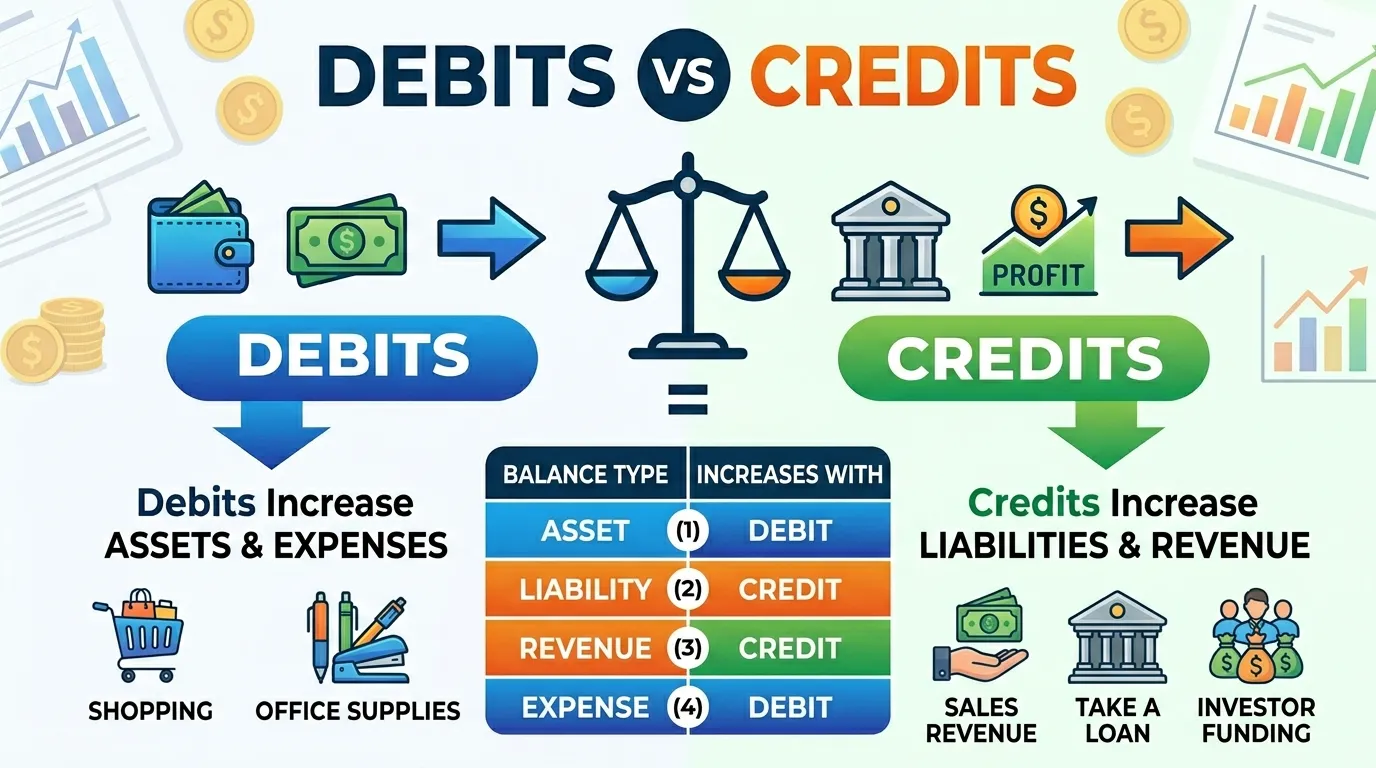
Many people get confused when learning accounting because the terms debits and credits seem opposite, yet both are essential for recording financial transactions. Understanding the difference between debits and credits is one of the most important steps in learning bookkeeping, financial accounting, and business finance.
Whether you are a student, small business owner, freelancer, or preparing for accounting exams, knowing how debits and credits work helps you read financial statements accurately and avoid costly mistakes. In simple words, debits and credits are the foundation of the double-entry accounting system used worldwide.
In this guide, you’ll learn what debits and credits mean, how they work, why they exist, real-life examples, common mistakes, practical applications, and expert insights that make the concept easy to understand.
Quick Answer: Difference Between Debits and Credits
A debit is an accounting entry recorded on the left side of an account, while a credit is recorded on the right side.
For example, if a business buys office equipment with cash:
- Equipment Account → Debit
- Cash Account → Credit
This keeps the accounting equation balanced and ensures accurate financial records.
Definition of Debits and Credits
Debit
A debit is an accounting entry made on the left side of an account that generally increases assets and expenses while decreasing liabilities, equity, and revenue.
Credit
A credit is an accounting entry made on the right side of an account that generally increases liabilities, equity, and revenue while decreasing assets and expenses.
Simple Example
If a company receives cash from a customer:
- Cash increases → Debit
- Revenue increases → Credit
Pronunciation of Both Terms
| Term | US Pronunciation | UK Pronunciation |
|---|---|---|
| Debit | DEB-it | DEB-it |
| Credit | KRED-it | KRED-it |
Now that you know what these terms mean and how to pronounce them, let’s understand the real logic behind why accounting uses debits and credits.
Debits vs Credits Comparison Table
| Feature | Debits | Credits |
|---|---|---|
| Position in Account | Left side | Right side |
| Assets | Increase assets | Decrease assets |
| Expenses | Increase expenses | Decrease expenses |
| Liabilities | Decrease liabilities | Increase liabilities |
| Owner’s Equity | Decrease equity | Increase equity |
| Revenue | Decrease revenue | Increase revenue |
| Cash Transactions | Often records incoming value | Often records outgoing value from asset accounts |
| Accounting Entry | First part of transaction | Second balancing part |
| Financial Impact | Depends on account type | Depends on account type |
| Purpose | Maintains accounting balance | Maintains accounting balance |
Example Transaction
Business purchases inventory worth $1,000 in cash.
| Account | Entry |
|---|---|
| Inventory | Debit $1,000 |
| Cash | Credit $1,000 |
Key Differences Explained Between Debits and Credits
1. Position in Accounting Records
Debits always appear on the left side, while credits appear on the right side of a ledger account.
Real-life example: When recording a cash sale, cash is debited and sales revenue is credited.
2. Impact on Assets
Debits increase asset accounts, whereas credits reduce asset accounts.
Example: Depositing money into a business bank account increases cash and requires a debit entry.
3. Impact on Liabilities
Credits increase liabilities while debits decrease them.
Example: Taking a business loan creates a liability and is recorded as a credit.
4. Effect on Revenue
Revenue accounts increase with credits.
Example: A consulting firm earning service income records revenue as a credit.
5. Effect on Expenses
Expense accounts increase with debits.
Example: Paying rent creates a debit to Rent Expense.
6. Relationship in Double-Entry Accounting
Every transaction must contain at least one debit and one credit.
This system ensures financial accuracy and reduces bookkeeping errors.
7. Financial Statement Impact
Debits and credits eventually affect the balance sheet and income statement.
Understanding this relationship helps accountants prepare reliable reports.
Why Do Debits and Credits Exist?
Many beginners ask, “Why can’t accounting simply record money in and money out?”
The answer lies in accountability and accuracy.
The double-entry accounting system was designed centuries ago to ensure every transaction affects at least two accounts. This creates a built-in error-checking mechanism.
For example:
- Buying equipment affects Equipment Account.
- It also affects Cash Account.
Without debits and credits, businesses would struggle to track assets, liabilities, income, and expenses accurately.
How Does the Debit and Credit System Work?
The system follows the accounting equation:
Assets = Liabilities + Owner’s\ Equity
Every transaction must keep this equation balanced.
Example
A business owner invests $10,000 cash.
| Account | Entry |
|---|---|
| Cash | Debit $10,000 |
| Owner’s Capital | Credit $10,000 |
Assets increase and owner’s equity increases by the same amount.
The equation remains balanced.
Difference Between Debits and Credits in Common Accounts
Asset Accounts
Examples:
- Cash
- Equipment
- Inventory
- Accounts Receivable
Rule:
- Debit = Increase
- Credit = Decrease
Liability Accounts
Examples:
- Loans Payable
- Accounts Payable
Rule:
- Debit = Decrease
- Credit = Increase
Revenue Accounts
Examples:
- Sales Revenue
- Service Revenue
Rule:
- Debit = Decrease
- Credit = Increase
Expense Accounts
Examples:
- Rent Expense
- Utilities Expense
- Salaries Expense
Rule:
- Debit = Increase
- Credit = Decrease
Difference and Similarity Between Debits and Credits
| Feature | Debits | Credits | Similarity |
|---|---|---|---|
| Meaning | Left-side entry | Right-side entry | Both record transactions |
| Purpose | Tracks increases or decreases | Tracks increases or decreases | Maintain accounting accuracy |
| Position | Left | Right | Both appear in ledger accounts |
| Double Entry | One side of transaction | Other side of transaction | Work together |
| Financial Records | Used in bookkeeping | Used in bookkeeping | Required in accounting |
| Business Usage | Daily transactions | Daily transactions | Used by all organizations |
| Accounting Software | Recorded automatically | Recorded automatically | Supported by modern systems |
| Financial Statements | Affects reports | Affects reports | Essential for reporting |
This table clearly shows the difference and similarity between Debits and Credits for quick understanding.
Common Mistakes With Debits and Credits
Mistake 1: Assuming Debit Means Increase
A debit does not always mean an increase.
The effect depends on the account type.
Mistake 2: Assuming Credit Means Decrease
Credits can increase liabilities, equity, and revenue.
Mistake 3: Ignoring Account Categories
Many beginners forget whether an account is an asset, liability, expense, revenue, or equity account.
Mistake 4: Recording Only One Side
Every transaction must have matching debit and credit entries.
Mistake 5: Confusing Banking Terms With Accounting Terms
In banking, debit and credit often mean something different from accounting records.
Real-Life Examples With Debits and Credits
Example 1: Personal Banking
Salary deposited into your account.
- Bank’s perspective → Credit
- Your cash asset increases
Example 2: Small Business Purchase
Buying a laptop for $1,500 cash.
- Equipment → Debit
- Cash → Credit
Example 3: Retail Store Sale
Store sells products worth $500.
- Cash → Debit
- Sales Revenue → Credit
Example 4: Loan Received
Business receives a bank loan.
- Cash → Debit
- Loan Payable → Credit
Example 5: Technology Company
A company like Google records billions of dollars in revenue transactions through debit and credit entries to maintain accurate financial statements.
Example 6: Social Media Businesses
Companies such as Meta, Instagram, and YouTube rely on accounting systems that use debits and credits to track advertising revenue, expenses, and assets.
When to Use Each
Use Debits When
- Increasing assets
- Increasing expenses
- Decreasing liabilities
- Decreasing equity
- Decreasing revenue
Use Credits When
- Increasing liabilities
- Increasing owner’s equity
- Increasing revenue
- Decreasing assets
- Decreasing expenses
A helpful memory tool is:
DEALER
- Dividends → Debit Increase
- Expenses → Debit Increase
- Assets → Debit Increase
- Liabilities → Credit Increase
- Equity → Credit Increase
- Revenue → Credit Increase
Why People Get Confused in Debits and Credits
Several factors create confusion:
Banking Terminology
Banks often use debit and credit differently from accounting textbooks.
Everyday Language
People associate “credit” with something positive and “debit” with money leaving an account.
Software Automation
Modern accounting software hides much of the debit-credit process.
Lack of Account Classification Knowledge
Without understanding assets, liabilities, equity, revenue, and expenses, debit-credit rules seem random.
Expert Insight
In practical accounting environments, most professionals do not memorize hundreds of transaction rules individually. Instead, they understand how account categories behave.
Most beginners struggle because they focus on the words “debit” and “credit” rather than the underlying account type.
A useful professional approach is:
- Identify the account category.
- Determine whether it is increasing or decreasing.
- Apply the debit or credit rule.
This method significantly reduces errors and improves accounting accuracy.
Frequently Asked Questions (FAQs)
What is the main difference between debits and credits?
Debits are recorded on the left side of an account, while credits are recorded on the right side.
Do debits always increase an account?
No. It depends on the account type. Debits increase assets and expenses but decrease liabilities, equity, and revenue.
Why are debits and credits important?
They maintain balance in the double-entry accounting system and ensure accurate financial reporting.
What is a debit example?
Buying equipment with cash results in a debit to Equipment and a credit to Cash.
What is a credit example?
Recording sales revenue creates a credit in the Revenue account.
Are debits bad and credits good?
No. These are accounting terms and do not indicate something positive or negative.
Can a transaction have multiple debits and credits?
Yes. Complex transactions often involve multiple accounts while keeping total debits equal to total credits.
Is accounting possible without debits and credits?
Modern accounting systems rely on the double-entry method, making debits and credits essential.
How do accountants remember debit and credit rules?
Many use memory aids like DEALER or focus on account classifications.
Do accounting software programs still use debits and credits?
Yes. Software automates the process, but debits and credits operate behind the scenes.
Conclusion
Understanding the difference between debits and credits is fundamental to accounting, bookkeeping, and financial management. Although the terms initially seem confusing, the concept becomes much easier once you understand how different account categories behave.
A debit is recorded on the left side and generally increases assets and expenses, while a credit is recorded on the right side and generally increases liabilities, equity, and revenue. Together, they form the backbone of the double-entry accounting system that businesses worldwide rely on to maintain accurate records.
By using the examples, comparison tables, practical scenarios, and expert insights in this guide, you now have a complete understanding of debits and credits without needing to read another article.

Sarfraz Ahmad is language researcher and content writer who specializes in explaining the difference between commonly confused English words. Through WordClearify, learners understand subtle word distinctions in a simple, structured, and practical way. My writing focuses on clarity, real-life examples, and easy comparisons for students, bloggers, and professionals worldwide.