If you’ve ever looked at eco-friendly packaging, food containers, or shopping bags, you’ve probably seen the terms biodegradable and compostable used interchangeably. However, understanding Biodegradable vs Compostable is important because they are not the same thing. While both materials break down naturally over time, the way they decompose and their impact on the environment can be very different.
Many consumers search for Biodegradable vs Compostable because they want to make sustainable choices and reduce waste. In simple words, all compostable products are biodegradable, but not all biodegradable products are compostable. This distinction affects recycling, waste management, and environmental sustainability.
In this guide, you’ll learn the exact difference between biodegradable and compostable materials, how they work, where they are used, and which option is generally better for the environment in real-world situations.
Quick Answer: Biodegradable vs Compostable
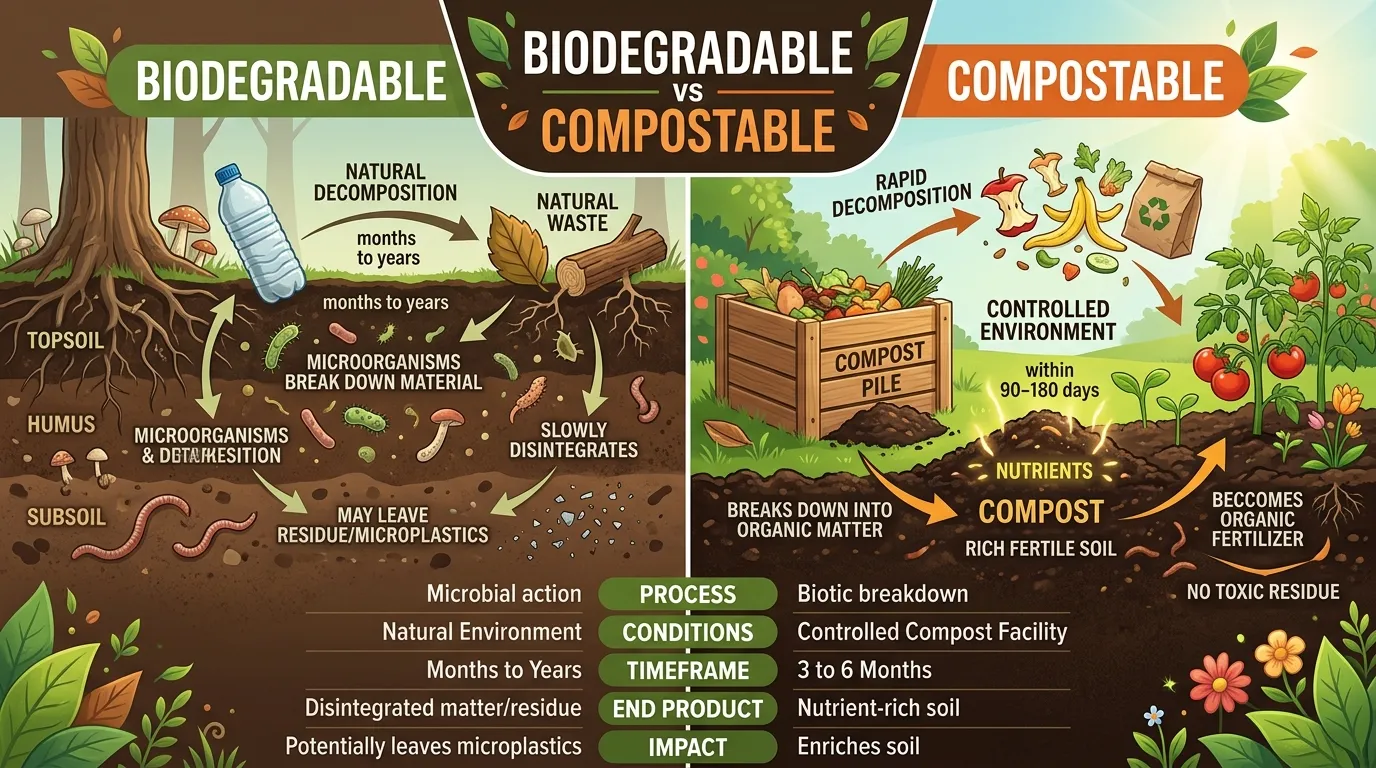
The main difference between biodegradable and compostable materials is how they break down and what remains afterward.
- Biodegradable materials can be broken down naturally by microorganisms over time, but there is often no specific timeframe or guarantee that they leave behind harmless substances.
- Compostable materials break down within a defined period under composting conditions and turn into nutrient-rich organic matter that benefits soil.
Example:
A biodegradable plastic bag may eventually decompose, but it could leave microplastic residues behind. A compostable food container, on the other hand, breaks down into natural compost that enriches the soil.
Definition of Biodegradable vs Compostable
- Biodegradable: A material that can be naturally broken down by bacteria, fungi, and other microorganisms into simpler substances over time.
- Compostable: A material that decomposes under composting conditions into nutrient-rich organic matter without leaving harmful residues.
Quick Example:
A fallen tree branch is biodegradable. Fruit peels placed in a compost bin are compostable.
Pronunciation of Both Terms (US & UK)
| Term | US Pronunciation | UK Pronunciation |
|---|---|---|
| Biodegradable | BY-oh-duh-GRAY-duh-bul | BY-oh-dee-GRAY-duh-bul |
| Compostable | Kum-POH-stuh-bul | KOM-post-uh-bul |
Now that we know what these terms mean, let’s understand why they are often confused and what separates them in practical environmental use.
Biodegradable vs Compostable Comparison Table
| Feature | Biodegradable | Compostable |
|---|---|---|
| Definition | Breaks down naturally through microorganisms | Breaks down into nutrient-rich compost |
| Breakdown Time | No fixed timeframe | Usually within a defined composting period |
| End Result | Can leave residues depending on material | Leaves beneficial organic matter |
| Environmental Benefit | Varies by product and conditions | Generally higher environmental benefit |
| Compost Requirement | Not required | Required for proper decomposition |
| Soil Enrichment | Usually does not enrich soil | Helps improve soil quality |
| Certification Standards | Often less regulated | Frequently certified under strict standards |
| Common Materials | Certain plastics, paper, wood | Food scraps, compostable packaging, plant fibers |
| Waste Management | May still end up in landfill | Best processed in composting systems |
| Sustainability Impact | Depends on product composition | Designed specifically for circular waste systems |
What Is a Biodegradable Material and How Does It Work?
A biodegradable material is any substance that microorganisms such as bacteria, fungi, and algae can break down naturally over time.
The process happens when living organisms consume and decompose the material. Eventually, it is converted into simpler compounds such as:
- Water
- Carbon dioxide
- Biomass
- Natural minerals
However, there is one important detail many people overlook.
A product labeled biodegradable does not necessarily specify how long decomposition will take. Some materials may break down within months, while others can take years or even decades depending on environmental conditions.
Real-World Example
A paper bag left outdoors may decompose relatively quickly because moisture, sunlight, and microorganisms help accelerate the process. A biodegradable plastic item buried in a landfill may take much longer because it lacks sufficient oxygen and microbial activity.
What Is a Compostable Material and How Does It Work?
Compostable materials are specifically designed to break down into organic matter that can support healthy soil.
Unlike general biodegradable products, compostable products must meet stricter environmental standards. They are expected to:
- Break down within a reasonable timeframe
- Leave no toxic residue
- Produce nutrient-rich compost
- Support soil health
This is why compostable products are often viewed as a more environmentally responsible solution.
Real-World Example
Food scraps, coffee grounds, vegetable peels, and certified compostable food containers can decompose in a compost pile and become valuable compost used in gardens and agriculture.
Why Does the Difference Between Biodegradable and Compostable Matter?
Many users assume these labels mean the same thing, but the distinction has real environmental consequences.
Consider two disposable cups:
- Cup A is biodegradable.
- Cup B is certified compostable.
If both are discarded improperly, neither may decompose efficiently. However, if Cup B enters a commercial composting facility, it can become useful organic matter rather than waste.
This difference affects:
- Waste management systems
- Landfill volume
- Soil health
- Sustainability goals
- Corporate environmental programs
As governments and businesses continue focusing on reducing waste in 2026 and beyond, understanding these terms is becoming increasingly important for consumers and organizations alike.
How Are Biodegradable and Compostable Products Used in Everyday Life?
You may encounter these materials more often than you realize.
Common Biodegradable Products
- Paper packaging
- Wooden utensils
- Certain biodegradable plastics
- Cotton products
- Natural fiber materials
Common Compostable Products
- Food waste
- Compostable coffee pods
- Compostable food containers
- Plant-based packaging
- Compostable cutlery
Many restaurants, grocery stores, and environmentally conscious brands now use compostable packaging as part of their sustainability initiatives.
Are All Compostable Products Biodegradable?
Yes.
Every compostable product is biodegradable because it can be broken down naturally by microorganisms.
However, the reverse is not always true.
Many biodegradable products do not meet compostability standards because they may:
- Take too long to break down
- Leave harmful residues
- Fail to produce useful compost
- Require special environmental conditions
This is one of the most important concepts to understand when comparing Biodegradable vs Compostable.
Key Differences Explained Between Biodegradable vs Compostable
Understanding Biodegradable vs Compostable becomes much easier when you look at how these materials behave in real-world conditions. Let’s break down the most important differences.
1. Breakdown Requirements
Biodegradable materials can decompose naturally in many environments, including soil, water, and landfills.
Compostable materials require specific composting conditions such as proper moisture, oxygen, temperature, and microbial activity.
Example:
A wooden stick can biodegrade outdoors. A compostable food container may need a compost facility to break down efficiently.
2. Decomposition Time
There is usually no legally defined timeframe for biodegradable products.
Compostable products are often required to decompose within a specific period under proper composting conditions.
User Insight:
This is why many environmental experts prefer compostable certifications over vague biodegradable claims.
3. End Product
Biodegradable items may leave residues depending on their composition.
Compostable products are designed to become nutrient-rich organic matter.
Example:
Fruit peels become compost that helps plants grow. Some biodegradable plastics may leave fragments behind.
4. Environmental Impact
Both options can reduce waste, but compostable products are typically designed with a circular economy in mind.
They return nutrients to the soil rather than simply disappearing.
Real-Life Scenario:
A city composting program benefits more from compostable food packaging than generic biodegradable packaging.
5. Certification Standards
Compostable products are often tested against strict industry standards.
Biodegradable products may not always require the same level of verification.
This is why environmental organizations frequently encourage consumers to look for recognized compostable certifications.
6. Waste Management Compatibility
Biodegradable products may still end up in landfills.
Compostable products work best when collected through composting systems.
Example:
A compostable cup thrown into a regular landfill may not break down as intended.
7. Soil Benefits
Biodegradable materials do not necessarily improve soil quality.
Compostable materials are specifically intended to support healthy soil ecosystems.
This distinction is especially important for agriculture and sustainable landscaping.
Biodegradable vs Compostable: Detailed Comparison Table
| Comparison Factor | Biodegradable | Compostable |
|---|---|---|
| Breakdown Method | Natural decomposition | Controlled composting process |
| Time Requirement | Can vary greatly | Usually defined by standards |
| Residue Risk | Possible | Minimal or none |
| Soil Improvement | Not guaranteed | Designed to enrich soil |
| Environmental Goal | Reduce waste accumulation | Create useful organic matter |
| Certification Need | Often optional | Frequently required |
| Best Disposal Method | Depends on material | Composting facility or compost bin |
| Sustainability Rating | Moderate to high | Generally higher |
| Consumer Clarity | Sometimes confusing | Usually more transparent |
Which Is Better for the Environment: Biodegradable or Compostable?
This is one of the most searched questions related to Biodegradable vs Compostable.
The answer depends on how the product is disposed of.
When Compostable Is Usually Better
Compostable products are often considered the stronger environmental choice because they:
- Return nutrients to soil
- Support circular waste systems
- Produce useful organic matter
- Reduce dependence on landfill disposal
When Biodegradable Can Still Be Valuable
Biodegradable materials remain useful when:
- Composting facilities are unavailable
- Natural decomposition is expected
- Products are made from renewable materials
Practical Perspective
In real scenarios, proper disposal matters more than the label itself.
A compostable product sent to landfill may perform worse than expected, while a biodegradable natural material managed responsibly may have minimal environmental impact.
How Does the Composting Process Actually Work?
Many people see the word compostable without understanding the science behind it.
Composting is a biological process where microorganisms break down organic materials into nutrient-rich compost.
The process generally requires:
- Oxygen
- Moisture
- Microorganisms
- Heat
- Organic matter
When these elements work together, waste transforms into a soil-enhancing material rather than becoming pollution.
The Four Main Stages of Composting
Stage 1: Collection
Organic materials such as food scraps and compostable packaging are gathered.
Stage 2: Decomposition
Microorganisms begin consuming the material.
Stage 3: Heat Generation
The compost pile naturally heats up, accelerating decomposition.
Stage 4: Finished Compost
The material becomes dark, nutrient-rich compost suitable for gardens and agriculture.
Why Do Biodegradable Products Sometimes Create Confusion?
One reason consumers struggle with Biodegradable vs Compostable is marketing language.
The word “biodegradable” sounds environmentally friendly, but it does not always explain:
- How long decomposition takes
- What conditions are required
- Whether harmful residues remain
- What disposal method works best
Common Consumer Assumption
Many people assume biodegradable means a product will quickly disappear anywhere.
In reality, decomposition speed depends heavily on:
- Temperature
- Moisture
- Sunlight
- Oxygen availability
- Microbial activity
Without favorable conditions, biodegradation can be extremely slow.
Industrial Composting vs Home Composting
Not all compostable products break down the same way.
Industrial Composting
Industrial composting facilities create controlled environments with:
- High temperatures
- Consistent moisture
- Large-scale microbial activity
These facilities can process many certified compostable products efficiently.
Home Composting
Home composting relies on backyard compost bins or small compost systems.
Conditions are usually less intense than industrial facilities.
Important Insight
Some products labeled compostable are only suitable for industrial composting.
Always check packaging instructions before disposal.
What Certifications Should Consumers Look For?
When comparing biodegradable and compostable products, certifications provide valuable guidance.
Common certification programs evaluate:
- Decomposition rate
- Toxicity levels
- Compost quality
- Environmental safety
Certified compostable products generally offer greater transparency than products carrying only biodegradable claims.
Why Certifications Matter
Certifications help consumers avoid greenwashing.
They provide evidence that environmental claims have been independently tested rather than simply being marketing language.
How Businesses Use Biodegradable and Compostable Materials
Sustainability is becoming a major business priority.
Restaurants, retailers, and manufacturers increasingly use environmentally friendly packaging.
Businesses Often Choose Biodegradable Products For:
- Packaging materials
- Shipping supplies
- Agricultural applications
Businesses Often Choose Compostable Products For:
- Food-service containers
- Coffee cups
- Catering products
- Event packaging
Many organizations now align these choices with environmental, social, and governance (ESG) goals.
What Role Does the Circular Economy Play in Biodegradable vs Compostable?
The concept of a circular economy has become increasingly important in sustainability discussions.
A traditional economy often follows this model:
Make → Use → Dispose
A circular economy aims for:
Make → Use → Recover → Reuse
Compostable products fit naturally into circular systems because they can become valuable compost instead of waste.
This is one reason governments, environmental agencies, and sustainability professionals frequently promote composting initiatives.
Common Mistakes with Biodegradable vs Compostable
Many consumers genuinely want to make environmentally responsible choices. However, a few common misunderstandings can lead to improper disposal and reduced environmental benefits.
Mistake 1: Assuming Biodegradable Means It Disappears Quickly
Many people think biodegradable products break down within days or weeks.
Correction:
The actual decomposition time depends on temperature, moisture, oxygen, and microbial activity.
Example:
A biodegradable item in a landfill may take years to fully decompose.
Mistake 2: Treating Compostable and Biodegradable as Identical Terms
This is perhaps the biggest misconception.
Correction:
Remember the simple rule:
All compostable materials are biodegradable, but not all biodegradable materials are compostable.
Mistake 3: Throwing Compostable Products Into Regular Recycling Bins
Many compostable items are not suitable for traditional recycling systems.
Correction:
Follow local waste management guidelines and composting instructions.
Mistake 4: Ignoring Disposal Instructions
Consumers often focus on the label but overlook disposal requirements.
Correction:
Read packaging carefully to determine whether industrial composting is required.
Mistake 5: Believing Eco-Friendly Labels Always Mean the Same Thing
Terms like biodegradable, compostable, recyclable, and sustainable are often confused.
Correction:
Understand the specific meaning of each environmental claim before making purchasing decisions.
Mistake 6: Assuming Compostable Products Work Everywhere
Some compostable products need commercial composting facilities.
Correction:
Check whether your local area supports industrial composting programs.
Real-Life Examples with Biodegradable vs Compostable
Understanding real-world applications makes the difference much easier to remember.
Example 1: Personal Household Use
A family uses compostable food scraps and compostable kitchen waste bags in their backyard compost bin.
The result is nutrient-rich compost for their garden.
Example 2: Coffee Shop Operations
A coffee shop replaces traditional cups with certified compostable cups and lids.
When collected properly, the cups become compost rather than landfill waste.
Example 3: Grocery Store Packaging
A retailer uses biodegradable packaging materials for shipping products.
These materials can naturally break down over time, reducing long-term waste.
Example 4: Agricultural Applications
Farmers often use biodegradable mulch films designed to decompose after use.
This helps reduce plastic waste in agricultural fields.
Example 5: Large Public Events
Event organizers increasingly choose compostable food containers and utensils.
This simplifies waste collection and supports sustainability goals.
Example 6: Corporate Sustainability Programs
Large companies use compostable packaging as part of broader environmental initiatives aimed at reducing landfill contributions.
When to Use Each: Practical Decision-Making Guide
Many users searching for Biodegradable vs Compostable are really asking one question:
Which option should I choose?
The answer depends on your situation.
Choose Biodegradable Products When:
- Composting facilities are unavailable.
- Natural decomposition is acceptable.
- The product is made from renewable materials.
- Long-term waste reduction is the primary goal.
Choose Compostable Products When:
- Composting systems are accessible.
- Food-service packaging is involved.
- Soil health benefits are desired.
- Circular waste management is a priority.
Quick Decision Rule
If the product can realistically enter a composting system, compostable is often the preferred environmental choice.
If composting infrastructure does not exist, a responsibly sourced biodegradable product may still provide benefits.
Why People Get Confused in Biodegradable vs Compostable
Even environmentally conscious consumers frequently misunderstand these terms.
1. Similar Language
Both words describe materials that break down naturally.
This makes them sound interchangeable.
2. Marketing Messages
Some packaging emphasizes environmental claims without fully explaining the differences.
As a result, consumers may assume all eco-friendly labels mean the same thing.
3. Lack of Public Awareness
Many people understand recycling but know little about composting systems.
Without this knowledge, the distinction becomes harder to recognize.
4. Regional Waste Management Differences
Some communities have advanced composting programs, while others rely heavily on landfills.
This affects how consumers interpret environmental labels.
5. Greenwashing Concerns
Certain products use vague environmental terminology that can create confusion.
Consumers often struggle to determine which claims are scientifically meaningful.
6. Industry Terminology
Environmental science, waste management, packaging, and sustainability sectors sometimes use technical language that is unfamiliar to the average shopper.
How Consumer Buying Decisions Are Changing in 2026
Consumer behavior continues to evolve.
More shoppers now consider:
- Packaging materials
- Sustainability certifications
- Carbon footprint concerns
- Waste management impact
- Compostability claims
Environmental awareness is no longer limited to activists or sustainability professionals.
In practical use, everyday consumers increasingly evaluate products based on how they affect the environment after disposal.
What Manufacturers Consider When Choosing Between Biodegradable and Compostable Materials
Businesses face a different challenge.
They must balance:
- Cost
- Performance
- Regulatory compliance
- Customer expectations
- Environmental goals
For example:
A food-delivery company may prioritize compostable packaging because food contamination often makes recycling difficult.
A shipping company may choose biodegradable materials that offer greater durability during transport.
The best choice depends on product requirements and disposal infrastructure.
Expert Insight
After reviewing sustainability programs, waste-management practices, and packaging trends, one observation becomes clear:
The label itself is only part of the story.
In real-world situations, disposal infrastructure often determines environmental outcomes more than product claims.
For example:
A certified compostable container can deliver significant environmental benefits when processed in a composting facility. However, if that same container ends up in a landfill, many of those benefits may never be realized.
Likewise, some biodegradable materials perform well when exposed to natural environmental conditions but may degrade very slowly in landfill environments.
Professional Perspective
The most environmentally responsible choice is not always the product with the “greenest” label.
Instead, it is the product that matches the waste-management systems available in your community.
Consumers, businesses, and policymakers who understand this distinction tend to make more effective sustainability decisions.
Frequently Asked Questions (FAQs)
What is the main difference between biodegradable and compostable?
Biodegradable materials break down naturally over time, while compostable materials break down into nutrient-rich compost under specific composting conditions.
Is compostable better than biodegradable?
In many cases, yes. Compostable products are designed to leave behind beneficial organic matter and often follow stricter environmental standards.
Are all compostable products biodegradable?
Yes. Every compostable material is biodegradable because it can be broken down by microorganisms.
Can biodegradable products leave harmful residues?
Some biodegradable products may leave residues depending on their composition and decomposition process.
Can I put compostable products in a recycling bin?
Usually not. Compostable products generally belong in composting systems rather than standard recycling streams.
How long does it take biodegradable material to decompose?
The timeframe varies widely depending on the material and environmental conditions. It may range from months to many years.
Do compostable products require special facilities?
Some do. Certain compostable products are designed for industrial composting facilities and may not break down efficiently in home compost bins.
What are examples of compostable materials?
Examples include:
- Fruit peels
- Vegetable scraps
- Coffee grounds
- Compostable food containers
- Plant-based packaging
What are examples of biodegradable materials?
Examples include:
- Paper
- Wood
- Cotton
- Natural fibers
- Certain biodegradable plastics
How can consumers make better eco-friendly choices?
Look beyond marketing labels. Check certifications, understand local waste-management options, and choose products that can be properly disposed of in your area.
Conclusion
Understanding Biodegradable vs Compostable is essential for making smarter environmental choices. While both terms describe materials that break down naturally, they are not identical.
Biodegradable products can decompose through natural biological processes, but there is often no guarantee regarding timeframe, residue, or environmental impact. Compostable products go a step further by breaking down into nutrient-rich organic matter that supports soil health and contributes to a circular economy.
The key takeaway is simple:
All compostable materials are biodegradable, but not all biodegradable materials are compostable.

Sarfraz Ahmad is language researcher and content writer who specializes in explaining the difference between commonly confused English words. Through WordClearify, learners understand subtle word distinctions in a simple, structured, and practical way. My writing focuses on clarity, real-life examples, and easy comparisons for students, bloggers, and professionals worldwide.