Many students and even biology enthusiasts get confused about the difference between chromatin and chromatid because both are connected to chromosomes and genetic material inside the cell nucleus. In simple words, chromatin is the loose, thread-like form of DNA, while a chromatid is a tightly condensed structure formed during cell division. Understanding the difference between chromatin and chromatid is important in genetics, cell biology, and modern medical science.
If you have ever wondered what happens to DNA before a cell divides, or why chromosomes change shape during mitosis, this guide will explain everything clearly. This article covers the difference between chromatin and chromatid, their functions, structure, similarities, real-life examples, and why many learners mix them up.
You will also learn how DNA packaging works, why chromatin becomes chromatids during cell division, and how modern biology systems study these structures in genetics research.
Quick Answer: Difference Between Chromatin and Chromatid
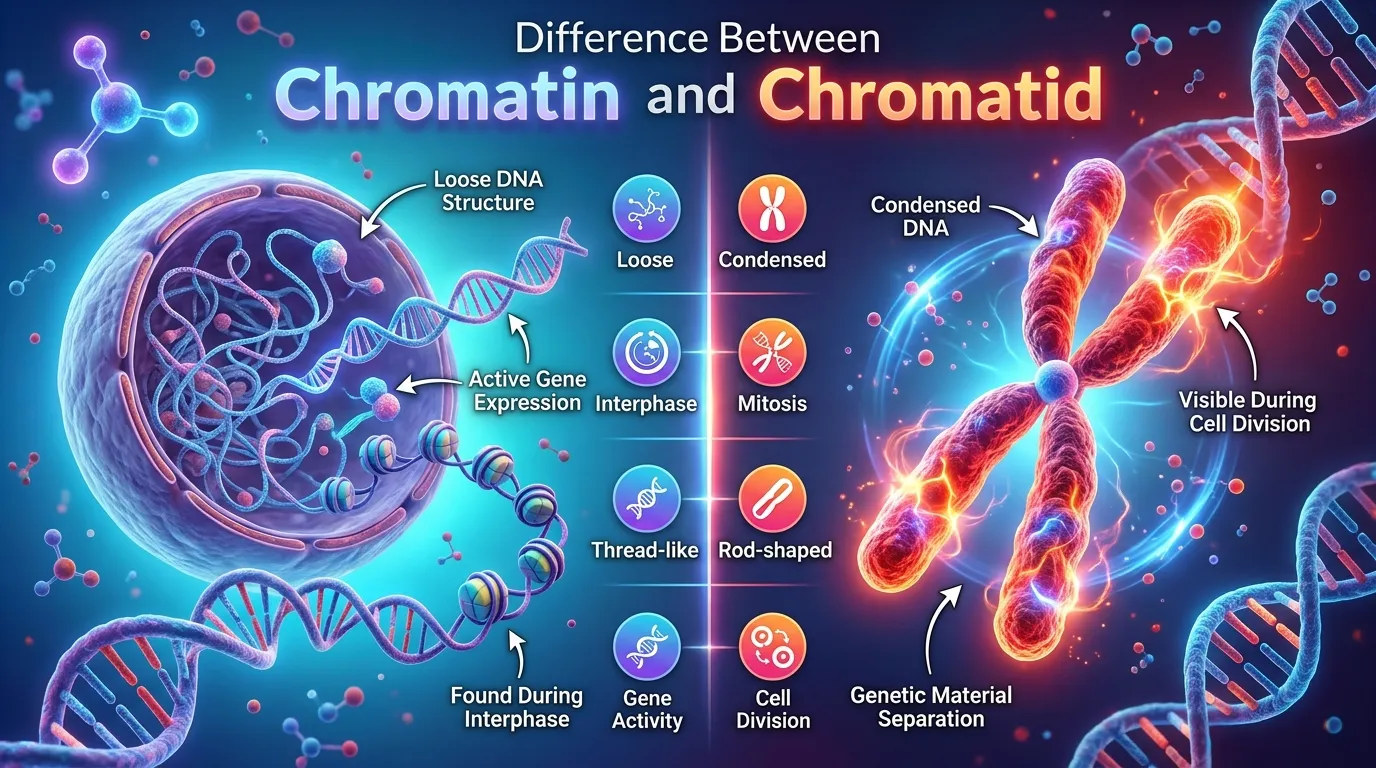
Chromatin is the loose and uncoiled form of DNA found inside the nucleus during normal cell activities. A chromatid is one-half of a duplicated chromosome that appears during cell division.
For example, before a cell divides, DNA exists as chromatin. When the cell prepares for mitosis, chromatin condenses into chromatids to ensure genetic material is copied correctly.
Definition of Difference Between Chromatin and Chromatid
- Chromatin: A soft, thread-like complex of DNA and proteins found inside the nucleus when the cell is not dividing.
- Chromatid: One identical half of a duplicated chromosome connected by a centromere during cell division.
Simple Example
Think of chromatin as a long, loose thread, while a chromatid is that same thread tightly folded and packed for transport.
Pronunciation of Both Terms
| Term | US Pronunciation | UK Pronunciation |
| Chromatin | kroh-muh-tin | kroh-muh-tin |
| Chromatid | kroh-muh-tid | kroh-muh-tid |
Now that the pronunciation is clear, let’s understand how these structures actually work inside living cells.
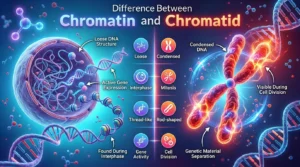
Difference Between Chromatin and Chromatid Table
| Feature | Chromatin | Chromatid |
| Definition | Loose DNA-protein structure | Condensed half of a chromosome |
| Appearance | Thin and thread-like | Thick and rod-shaped |
| Cell Stage | Present during interphase | Present during mitosis and meiosis |
| DNA Packing | Less condensed | Highly condensed |
| Visibility | Hard to see under microscope | Easily visible during division |
| Function | Supports gene expression and DNA replication | Helps equal DNA distribution |
| Structure | DNA wrapped around histones | Identical copy of chromosome |
| Location | Inside nucleus | Attached to sister chromatid |
| Activity | Active in protein synthesis | Mainly involved in cell division |
| Formation | Exists naturally in resting cells | Formed when chromosomes duplicate |
This comparison clearly explains the difference between chromatin and chromatid in an easy-to-understand format.
Key Differences Explained Between Chromatin and Chromatid
1. Level of DNA Condensation
Chromatin is loosely packed, which allows genes to stay active. Chromatids are tightly condensed for safe movement during mitosis.
In real scenarios, loose DNA helps cells produce proteins efficiently, while condensed DNA prevents damage during division.
2. Role Inside the Cell
Chromatin mainly supports normal cellular functions like transcription and DNA replication. Chromatids help distribute identical genetic material into daughter cells.
Most beginners confuse this because both contain DNA, but their jobs are completely different.
3. Appearance Under Microscope
Chromatin looks like tangled threads inside the nucleus. Chromatids appear as visible rod-like structures during metaphase.
This is why biology diagrams often show chromatids clearly but not chromatin.
4. Timing in Cell Cycle
Chromatin exists during interphase when the cell grows and performs daily functions. Chromatids appear during mitosis or meiosis.
The timing difference is one of the easiest ways to identify them.
5. Genetic Activity
Genes within chromatin are more accessible and active. In chromatids, DNA becomes tightly packed, so gene activity decreases temporarily.
This packaging system protects DNA integrity.
6. Structural Organization
Chromatin contains DNA and histone proteins arranged loosely. Chromatids are highly organized structures formed after DNA replication.
In practical genetics labs, scientists study chromatin to analyze gene expression patterns.
7. Biological Purpose
Chromatin helps store and use genetic instructions. Chromatids mainly ensure accurate chromosome separation during cell division.
Without chromatids, proper inheritance would not occur.
What Is Chromatin and Why Does It Exist?
Chromatin exists because DNA molecules are extremely long. If DNA remained completely stretched out, it would not fit inside the tiny nucleus.
DNA + Histone\ Proteins \rightarrow Chromatin
Histone proteins help wrap DNA into manageable structures. This organization also controls which genes remain active or inactive.
There are two main forms of chromatin:
Euchromatin
- Loosely packed
- Gene-rich
- Active in transcription
Heterochromatin
- Densely packed
- Less active
- Mainly structural
In modern genetics research, chromatin studies help scientists understand diseases like cancer and genetic disorders.
What Is a Chromatid and How Does It Form?
A chromatid forms after DNA replication. Each chromosome duplicates itself and creates two identical sister chromatids connected by a centromere.
Chromosome \rightarrow Sister\ Chromatids
During mitosis:
- DNA duplicates
- Chromatin condenses
- Chromosomes become visible
- Sister chromatids separate
This process ensures both daughter cells receive the same genetic information.
Why Does Chromatin Turn Into Chromatids?
This transformation happens for protection and organization.
Imagine trying to move loose threads from one place to another. They would tangle easily. Cells solve this problem by condensing chromatin into compact chromatids.
Benefits include:
- Prevents DNA breakage
- Makes chromosome movement easier
- Ensures accurate genetic distribution
- Supports successful mitosis
This is one of the most important concepts in cell biology.
Difference Between Chromatin and Chromatid During Cell Division
During interphase, DNA stays as chromatin because the cell needs access to genes for protein production.
As the cell enters prophase:
- Chromatin condenses
- Chromosomes become visible
- Each chromosome contains two chromatids
Later:
- Sister chromatids separate
- Each moves to opposite poles
- New nuclei form
This transition is essential for healthy growth and tissue repair.
Common Mistakes With Chromatin and Chromatid
Mistake 1: Thinking They Are the Same Thing
Many learners assume both terms describe identical structures.
Correction: Chromatin is loose DNA, while chromatids are condensed duplicated structures.
Mistake 2: Confusing Chromatid With Chromosome
A chromatid is only one half of a duplicated chromosome.
Correction: Two sister chromatids together form one chromosome.
Mistake 3: Ignoring Cell Cycle Stages
Students often forget timing differences.
Correction: Chromatin appears mostly during interphase, while chromatids appear during division.
Mistake 4: Believing Chromatin Is Inactive
Some think chromatin is just stored DNA.
Correction: Chromatin actively controls gene expression and protein synthesis.
Mistake 5: Assuming Chromatids Exist Permanently
Chromatids are temporary structures formed during replication.
Correction: After separation, chromatids become independent chromosomes.
Real-Life Examples With Chromatin and Chromatid
1. Human Growth
Every time skin cells divide, chromatin condenses into chromatids to pass DNA correctly.
2. Cancer Research
Scientists study chromatin structure changes to understand tumor growth and gene mutations.
3. Genetic Testing Labs
Chromatids are examined during chromosome analysis to detect disorders like Down syndrome.
4. Medical Treatments
Epigenetic therapies target chromatin modifications in diseases.
5. Biotechnology Industry
DNA packaging studies help improve gene editing technologies like CRISPR.
When to Use Each Concept
Use “Chromatin” When Talking About:
- DNA organization
- Gene expression
- Interphase cells
- Histone interaction
- Epigenetics
Use “Chromatid” When Talking About:
- Mitosis
- Meiosis
- Chromosome duplication
- Cell division stages
- Genetic inheritance
Understanding context helps avoid confusion in exams and scientific discussions.
Why People Get Confused in Chromatin and Chromatid
There are several reasons behind this confusion:
Similar Names
Both terms start with “chrom-,” which comes from the Greek word for color.
Related Functions
Both are connected to DNA and chromosomes.
Biology Diagrams
Textbooks often simplify images, making structures look similar.
Complex Cell Cycle Concepts
Many beginners struggle with chromosome transformations during mitosis.
Scientific Vocabulary
Terms like chromosome, chromatin, and chromatid sound closely related.
In simple words, the concepts are connected, but they represent different stages of DNA organization.
Expert Insight
From a biological and educational perspective, understanding the difference between chromatin and chromatid is foundational for genetics, molecular biology, and medical science.
In practical use, most beginners memorize definitions without understanding the transformation process between chromatin and chromatids. However, experienced biology educators focus on the cell cycle connection because that is where real conceptual clarity develops.
In modern research, chromatin studies are especially important in:
- cancer biology,
- epigenetics,
- DNA repair,
- and gene regulation.
Meanwhile, chromatids are critical for studying chromosome abnormalities and inheritance patterns.
That deeper understanding is what separates memorization from true biological knowledge.
FAQs About Difference Between Chromatin and Chromatid
What is the main difference between chromatin and chromatid?
Chromatin is loose DNA inside the nucleus, while a chromatid is a condensed duplicated chromosome structure.
Is chromatin a chromosome?
No. Chromatin is the material that forms chromosomes when condensed.
Are chromatids visible under a microscope?
Yes. Chromatids become clearly visible during cell division.
Why does chromatin condense into chromatids?
It condenses to protect DNA and ensure proper chromosome separation.
Do chromatids contain identical DNA?
Yes. Sister chromatids contain identical genetic information.
Where is chromatin found?
Chromatin is found inside the nucleus of eukaryotic cells.
When do chromatids separate?
Chromatids separate during anaphase in mitosis.
Is chromatin active in protein synthesis?
Yes. Chromatin allows genes to be accessed for transcription and protein production.
Why do students confuse chromatin and chromatid?
Because both involve DNA organization and have similar names.
Conclusion
Understanding the difference between chromatin and chromatid becomes much easier when you focus on their role in the cell cycle. Chromatin is the loose, functional form of DNA used during normal cellular activities, while chromatids are tightly packed structures formed for safe DNA distribution during cell division.
In simple words, chromatin helps the cell read and use genetic information, whereas chromatids help the cell divide accurately. Both are essential parts of chromosome organization and genetic stability.
Whether you are a student, teacher, medical learner, or biology enthusiast, knowing the difference between chromatin and chromatid provides a strong foundation for understanding genetics, molecular biology, and modern biomedical science.

Sarfraz Ahmad is language researcher and content writer who specializes in explaining the difference between commonly confused English words. Through WordClearify, learners understand subtle word distinctions in a simple, structured, and practical way. My writing focuses on clarity, real-life examples, and easy comparisons for students, bloggers, and professionals worldwide.