Have you ever noticed that some materials glow only while a UV light is shining on them, while others continue glowing even after the light is turned off? This common observation is the reason many people search for the difference between fluorescence and phosphorescence.
The difference between fluorescence and phosphorescence is one of the most important concepts in chemistry, physics, material science, and optical technology. Although both phenomena involve light emission after absorbing energy, they behave very differently. Understanding the difference between fluorescence and phosphorescence helps explain glow-in-the-dark products, forensic tools, medical imaging, security inks, and modern display technologies.
In this guide, you’ll learn what fluorescence and phosphorescence are, how they work, their key differences, similarities, real-world applications, common misconceptions, and expert insights in a simple and practical way.
Quick Answer: Difference Between Fluorescence and Phosphorescence
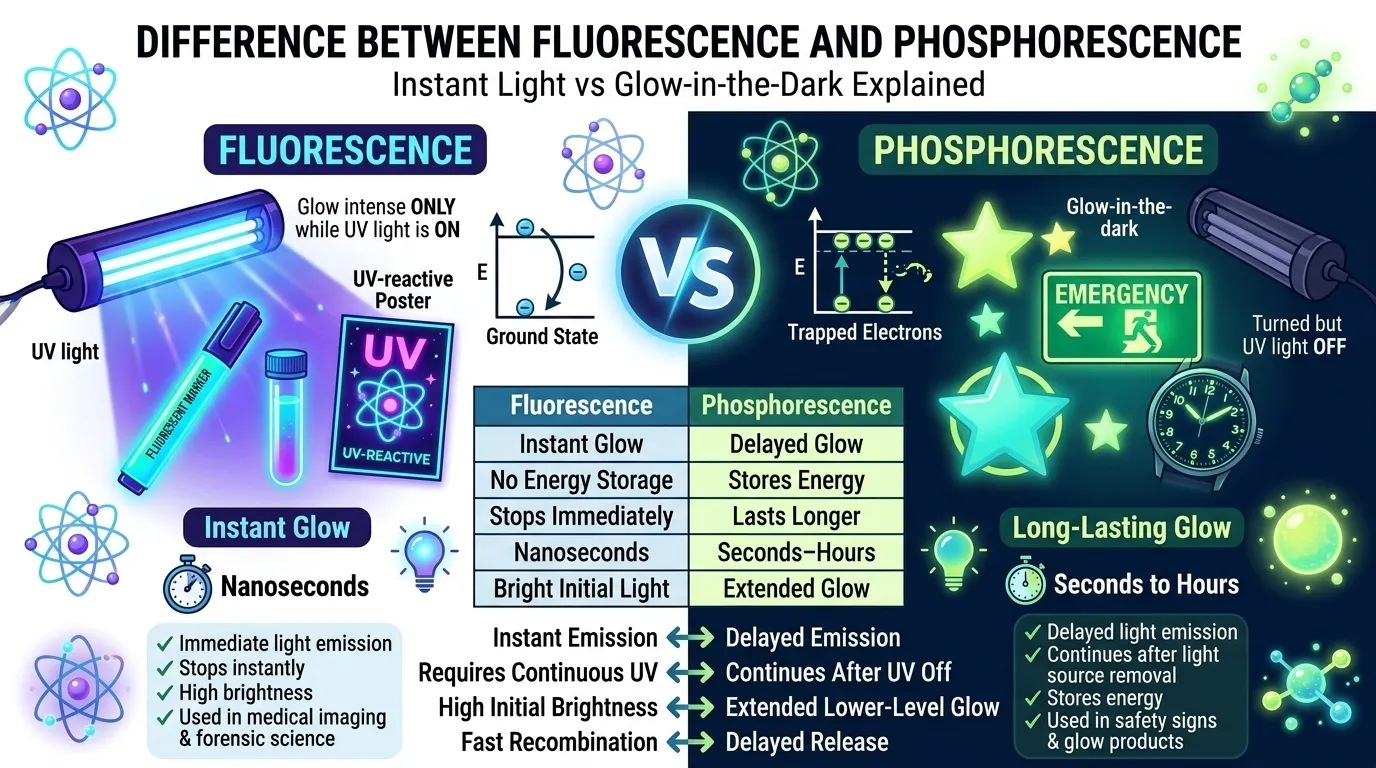
The main difference between fluorescence and phosphorescence is how long the emitted light lasts after the energy source is removed.
- Fluorescence stops almost immediately when the excitation source is removed.
- Phosphorescence continues glowing for seconds, minutes, or even hours after the excitation source disappears.
Example
A fluorescent highlighter glows only under UV light. A glow-in-the-dark sticker continues glowing after the lights are switched off. This is phosphorescence.
Definition of Fluorescence and Phosphorescence
- Fluorescence: The immediate emission of light by a substance after absorbing energy, usually disappearing within nanoseconds once the energy source is removed.
- Phosphorescence: The delayed emission of light by a substance after absorbing energy, allowing the glow to continue even after the energy source is removed.
Simple Example
- Fluorescent marker under UV lamp = Fluorescence
- Glow-in-the-dark star sticker = Phosphorescence
Pronunciation of Both Terms
| Term | US Pronunciation | UK Pronunciation |
|---|---|---|
| Fluorescence | floor-ESS-uhns | floor-ESS-uhns |
| Phosphorescence | fos-for-ESS-uhns | fos-for-ESS-uhns |
Now that we know the basic definitions and pronunciation, let’s understand what truly creates the difference between fluorescence and phosphorescence at the molecular level.
Fluorescence vs Phosphorescence Comparison Table
| Feature | Fluorescence | Phosphorescence |
|---|---|---|
| Glow Duration | Stops immediately | Continues after light source removal |
| Electron Transition | Allowed transition | Forbidden transition |
| Speed of Emission | Extremely fast | Slower |
| Lifetime | Nanoseconds | Milliseconds to hours |
| Energy Storage | Minimal | Stores energy temporarily |
| Visibility After Light Removal | No | Yes |
| Common Examples | Fluorescent dyes, markers | Glow-in-the-dark materials |
| Industrial Uses | Medical imaging, microscopy | Emergency signs, safety markings |
| Brightness | Usually brighter initially | Usually dimmer but longer-lasting |
| Mechanism | Singlet to singlet transition | Triplet to singlet transition |
Key Differences Explained Between Fluorescence and Phosphorescence
1. Duration of Glow
The most noticeable difference is the glow duration.
- Fluorescence disappears instantly.
- Phosphorescence remains visible after excitation ends.
Real-life example: A nightclub UV poster glows only under UV light, while a glow-in-the-dark toy keeps glowing afterward.
2. Electron Behavior
Fluorescence involves electrons returning quickly to their original state.
Phosphorescence involves a more complicated electron pathway that delays light emission.
3. Energy Storage
Fluorescent materials do not store much energy.
Phosphorescent materials temporarily trap energy and release it slowly.
4. Brightness
Fluorescence often appears brighter initially because energy is released rapidly.
Phosphorescence tends to be less intense but lasts much longer.
5. Scientific Applications
Fluorescence is heavily used in biological research and diagnostics.
Phosphorescence is widely used in safety and visibility systems.
6. Response Time
Fluorescent materials react almost instantly.
Phosphorescent materials continue emitting light over time.
7. Everyday Visibility
Most people encounter fluorescence in highlighters and UV-reactive materials.
Most people encounter phosphorescence in glow-in-the-dark products.
What Is Fluorescence and How Does It Work?
Fluorescence occurs when a substance absorbs energy and immediately re-emits part of that energy as visible light.
Simple Process
- Material absorbs UV or visible light.
- Electrons become excited.
- Electrons quickly return to a lower energy level.
- Light is emitted instantly.
The entire process occurs in billionths of a second.
Common Examples
- Fluorescent highlighters
- Security markings on currency
- Forensic dyes
- Biological stains
- UV-reactive posters
What Is Phosphorescence and How Does It Work?
Phosphorescence also begins with energy absorption, but electrons become trapped in a metastable state.
Simple Process
- Material absorbs energy.
- Electrons move to an excited state.
- Electrons become temporarily trapped.
- Energy releases gradually.
- Glow continues after the light source disappears.
This delayed release creates the familiar glow-in-the-dark effect.
Common Examples
- Emergency exit signs
- Glow-in-the-dark stars
- Safety pathways
- Nighttime visibility products
- Watch dials
Why Does the Difference Between Fluorescence and Phosphorescence Exist?
Many beginners wonder why two similar glowing phenomena behave differently.
The answer lies in quantum mechanics and electron transitions.
In fluorescence, electrons take an easy route back to their original state.
In phosphorescence, electrons become trapped in a different energy state called a triplet state. Because returning from this state is less probable, light is released slowly.
This tiny molecular difference creates a dramatic visual effect.
Difference Between Fluorescence and Phosphorescence in Jablonski Diagram Terms
Scientists often use a Jablonski diagram to visualize energy transitions.
Fluorescence
- Excited singlet state
- Rapid return
- Immediate light emission
Phosphorescence
- Excited singlet state
- Intersystem crossing
- Triplet state formation
- Delayed light emission
This extra step is responsible for the persistent glow.
Real-World Applications of Fluorescence
Medical Imaging
Doctors use fluorescent dyes to detect tissues and diseases.
Biological Research
Scientists track proteins, DNA, and cells using fluorescent markers.
Forensic Science
Crime investigators identify evidence using fluorescent chemicals.
Security Features
Banknotes and official documents often contain fluorescent inks.
Display Technologies
Many modern screens rely on fluorescent materials.
Real-World Applications of Phosphorescence
Emergency Safety Systems
Exit signs remain visible during power failures.
Aerospace Industry
Glow materials help identify controls in low-light environments.
Consumer Products
Toys, decorations, and novelty items use phosphorescent compounds.
Road and Traffic Safety
Some safety markers incorporate long-lasting glow materials.
Military and Navigation Systems
Low-light visibility systems often utilize phosphorescence.
Difference and Similarity Table Generation: Difference Between Fluorescence and Phosphorescence
| Feature | Fluorescence | Phosphorescence | Similarity |
|---|---|---|---|
| Meaning | Instant light emission | Delayed light emission | Both emit light after energy absorption |
| Energy Source | UV or visible light | UV or visible light | Both require excitation |
| Duration | Very short | Long-lasting | Both eventually stop glowing |
| Electron State | Singlet state | Triplet state involved | Both involve excited electrons |
| Brightness | Often brighter initially | Usually dimmer over time | Both can appear colorful |
| Applications | Imaging and detection | Safety and visibility | Both have industrial uses |
| Energy Release | Immediate | Gradual | Both convert absorbed energy into light |
| Scientific Field | Spectroscopy and biology | Materials science and safety | Both are photoluminescence phenomena |
This table clearly shows the difference and similarity between fluorescence and phosphorescence for quick understanding.
Common Mistakes with Difference Between Fluorescence and Phosphorescence
Mistake 1: Thinking Both Mean Glow-in-the-Dark
Correction: Only phosphorescence typically creates a lasting glow.
Mistake 2: Assuming They Use Different Energy Sources
Correction: Both commonly use UV light as excitation.
Mistake 3: Believing Fluorescence Lasts Several Minutes
Correction: Fluorescence disappears almost instantly.
Mistake 4: Ignoring Electron States
Correction: Electron transitions explain the entire difference.
Mistake 5: Using Terms Interchangeably
Correction: Scientists treat them as distinct photoluminescent processes.
Real-Life Examples with Difference Between Fluorescence and Phosphorescence
Scenario 1: School Highlighter
A fluorescent highlighter glows under UV light but stops immediately when the UV lamp is removed.
Scenario 2: Child’s Bedroom Ceiling Stars
Glow-in-the-dark stars continue shining long after the room becomes dark.
Scenario 3: Airport Emergency Signage
Many emergency signs rely on phosphorescence for visibility during power outages.
Scenario 4: Biomedical Laboratory
Researchers use fluorescent markers to observe living cells.
Scenario 5: Counterfeit Detection
Security personnel inspect fluorescent features in currency and identification documents.
When to Use Each
Use Fluorescence When
- Instant detection is required.
- Biological imaging is needed.
- High sensitivity is important.
- Fast measurements are necessary.
Use Phosphorescence When
- Long-lasting visibility is required.
- Emergency lighting is important.
- Power-free illumination is desired.
- Safety systems need extended glow.
Why People Get Confused About Fluorescence and Phosphorescence
Several factors contribute to confusion.
Similar Appearance
Both involve glowing materials.
Educational Oversimplification
Basic explanations often group them together.
Marketing Language
Manufacturers frequently use “glow-in-the-dark” without explaining the science.
Media Representation
Movies and social media videos often blur the distinction.
Lack of Exposure to Photophysics
Most people never study electron transitions in detail.
Expert Insight
From a materials science perspective, the most important distinction is not the visible glow itself but the electron pathway responsible for that glow.
In practical use, fluorescence is preferred when immediate detection and high sensitivity matter, such as laboratory diagnostics and biomedical imaging.
Phosphorescence becomes valuable when sustained visibility is required without continuous power, such as emergency signage and safety systems.
Most beginners focus only on glow duration. Professionals focus on electron states, transition probabilities, and energy-release mechanisms because these determine performance in real-world applications.
Frequently Asked Questions (FAQ)
What is the main difference between fluorescence and phosphorescence?
Fluorescence stops immediately after the light source is removed, while phosphorescence continues glowing for some time.
Which lasts longer, fluorescence or phosphorescence?
Phosphorescence lasts significantly longer.
Is glow-in-the-dark paint fluorescent or phosphorescent?
Most glow-in-the-dark paints are phosphorescent.
Does fluorescence require UV light?
Not always, but UV light is a common excitation source.
Is phosphorescence brighter than fluorescence?
Usually no. Fluorescence is often brighter initially.
Why do scientists study fluorescence?
It provides valuable information about molecules, cells, and materials.
Can a material show both fluorescence and phosphorescence?
Yes. Some materials can exhibit both under specific conditions.
Conclusion
Understanding the difference between fluorescence and phosphorescence becomes much easier when you focus on one key idea: timing. Fluorescence emits light almost instantly and stops immediately when the excitation source disappears. Phosphorescence stores energy temporarily and releases it slowly, creating the familiar glow-in-the-dark effect.
Although both are forms of photoluminescence, they differ in electron transitions, energy storage behavior, glow duration, and practical applications. Fluorescence dominates fields such as medical imaging, biological research, forensic science, and optical detection. Phosphorescence excels in safety systems, emergency signage, navigation aids, and products requiring long-lasting visibility.

David Anderson
I am David Anderson, a USA-based content writer and digital author. I create clear, engaging, and well-structured articles focused on delivering valuable and well-researched information. I specialize in blog writing and digital content that helps websites grow visibility and build strong online authority.