Imagine two friends planning their financial future. One buys a policy to protect his car from accidents, while the other invests in a life policy that guarantees payment to his family someday. Both think they are doing the same thing but they are not. This is where the difference between insurance vs assurance becomes important.
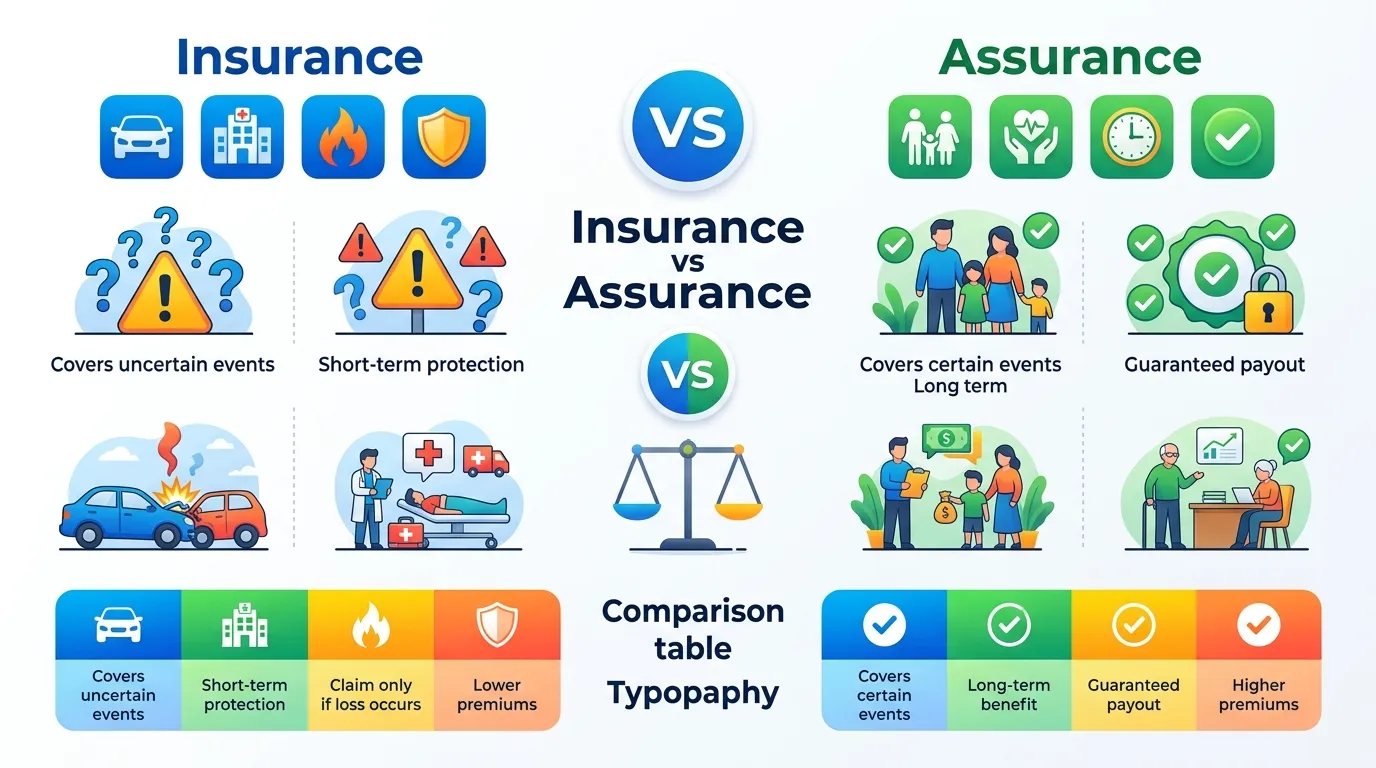
In simple words, insurance is about protection against uncertain events, while assurance guarantees a payout that will definitely happen. Understanding insurance vs assurance helps people make smarter financial decisions in real life.
Many learners and even professionals often mix these terms because they sound similar, yet their meanings are quite different. In this guide, we will clearly explain both using real-life examples, so you can easily understand when and how to use each concept correctly. By the end, the confusion around insurance vs assurance will completely disappear.
Key Difference Between Insurance and Assurance
The core difference lies in certainty:
- Insurance covers events that may or may not happen (e.g., accidents, theft).
- Assurance covers events that will definitely happen (e.g., death in life assurance).
Why Is Their Difference Necessary to Know?
Understanding the difference between insurance and assurance is essential for both learners and experts because it directly impacts financial planning, risk management, and decision-making.
For individuals, knowing this difference helps in choosing the right financial product—whether to protect against risks or secure future certainty. For professionals such as financial advisors, bankers, and economists, this knowledge ensures accurate communication and ethical guidance.
In society, both concepts play a vital role. Insurance protects businesses and individuals from unexpected losses, stabilizing the economy. Assurance, on the other hand, provides long-term financial security, especially for families after the loss of a breadwinner. Without clearly understanding insurance vs assurance, people may invest in the wrong policies, leading to financial confusion or loss.
Pronunciation of Both (US & UK)
- Insurance
- US: in-SHUR-uhns
- UK: in-SHOOR-uhns
- Assurance
- US: uh-SHUR-uhns
- UK: uh-SHOOR-uhns
Now that you know how they sound, let’s explore their deeper differences in detail.
Insurance vs Assurance Difference in Depth
1. Nature of Risk
- Insurance deals with uncertain risks.
Example 1: Car accident may or may not happen.
Example 2: House fire risk is unpredictable. - Assurance deals with certain events.
Example 1: Death is inevitable.
Example 2: Maturity of policy is guaranteed.
2. Purpose
- Insurance protects against possible loss.
Example 1: Health insurance covers hospital bills.
Example 2: Travel insurance protects from trip cancellation. - Assurance provides guaranteed benefit.
Example 1: Life assurance pays after death.
Example 2: Endowment policy pays after a fixed time.
3. Time Factor
- Insurance is usually short-term.
Example 1: Annual car insurance.
Example 2: One-year health plan. - Assurance is long-term.
Example 1: Whole life policy.
Example 2: 20-year assurance plan.
4. Payment Condition
- Insurance pays only if the event occurs.
Example 1: No claim if no accident.
Example 2: No payout if theft doesn’t happen. - Assurance always pays.
Example 1: Paid after death.
Example 2: Paid at maturity.
5. Premium Cost
- Insurance premiums are generally lower.
Example 1: Car insurance yearly payment.
Example 2: Health insurance monthly premium. - Assurance premiums are higher.
Example 1: Life assurance policy.
Example 2: Long-term savings plan.
6. Type of Contract
- Insurance is a contract of indemnity.
Example 1: Property damage compensation.
Example 2: Loss recovery policy. - Assurance is a contract of certainty.
Example 1: Fixed sum payout.
Example 2: Guaranteed financial support.
7. Beneficiary
- Insurance benefits policyholder.
Example 1: You claim for your car.
Example 2: You claim medical bills. - Assurance benefits family/nominee.
Example 1: Family receives money.
Example 2: Nominee gets payout.
8. Coverage Type
- Insurance covers general risks.
Example 1: Fire insurance.
Example 2: Theft insurance. - Assurance covers life events.
Example 1: Death benefit.
Example 2: Retirement payout.
9. Renewal
- Insurance requires renewal.
Example 1: Annual policy renewal.
Example 2: Yearly health plan renewal. - Assurance does not require frequent renewal.
Example 1: Long-term contract continues.
Example 2: Policy runs till maturity.
10. Emotional Value
- Insurance provides temporary relief.
Example 1: Relief after accident.
Example 2: Security during illness. - Assurance provides long-term peace.
Example 1: Family financial stability.
Example 2: Future security guaranteed.
Nature and Behaviour of Both
Insurance is reactive—it responds when something goes wrong. It focuses on minimizing loss and protecting assets. Assurance, however, is proactive—it plans for the future and guarantees financial support regardless of circumstances. Insurance is uncertainty-based, while assurance is certainty-based.
Why People Are Confused About Their Use (Insurance vs Assurance)?
| Aspect | Insurance | Assurance | Similarity |
|---|---|---|---|
| Meaning | Risk protection | Guaranteed payout | Both financial tools |
| Usage | General risks | Life-related events | Used in policies |
| Certainty | Uncertain | Certain | Provide security |
| Duration | Short-term | Long-term | Require premium |
People confuse them because both involve money, risk, and protection, and are often used interchangeably in everyday language.
Which Is Better in What Situation?
Insurance is better when dealing with uncertain risks such as accidents, illness, or theft. It is ideal for short-term protection and financial safety against unexpected events. For example, car and health insurance are essential for daily life uncertainties.
Assurance is better for long-term financial planning and guaranteed benefits. It is ideal for securing your family’s future, retirement, or life coverage. Life assurance ensures that your loved ones receive financial support no matter what happens.
Use in Metaphors and Similes
- “Her smile was an assurance of hope.”
- “His support was like insurance against failure.”
Connotative Meaning of Both
- Insurance: Neutral to positive
Example: “Insurance gives financial protection.” - Assurance: Strongly positive
Example: “Her assurance gave him confidence.”
Idioms or Proverbs Related
- “Better safe than sorry” (related to insurance)
Example: Buying insurance follows this proverb. - “A promise is a promise” (related to assurance)
Example: Assurance guarantees fulfillment.
Works in Literature
- “The Wealth of Nations” – Economics – Adam Smith – 1776
- “Capital” – Political Economy – Karl Marx – 1867
Movies Related to the Concepts
- “The Pursuit of Happyness” – 2006 – USA
- “Wall Street” – 1987 – USA
Frequently Asked Questions
1. What is the main difference between insurance and assurance?
Insurance covers uncertain events, while assurance guarantees payment.
2. Is life insurance actually assurance?
Yes, life insurance is technically life assurance.
3. Which is more expensive?
Assurance policies are usually more expensive.
4. Can insurance become assurance?
No, both are fundamentally different concepts.
5. Why are the terms used interchangeably?
Because of similar usage in everyday language.
How Both Are Useful for Surroundings
Insurance protects individuals, businesses, and society from sudden financial losses, helping maintain economic stability. Assurance ensures long-term financial security, especially for families, promoting social well-being and confidence in the future.
Final Words for Both
Insurance and assurance are both essential financial tools. While one protects you from uncertainty, the other guarantees your future. Understanding their roles helps you make smarter financial choices.
Conclusion
The difference between insurance and assurance is simple yet powerful. Insurance deals with uncertainty and protects against unexpected risks, while assurance guarantees financial support for inevitable events. Knowing the distinction between insurance vs assurance helps individuals plan better, avoid confusion, and choose the right financial solutions. Whether you are protecting your present or securing your future, both concepts are equally important. By clearly understanding insurance vs assurance, you can build a stable and secure financial life for yourself and your loved ones.

Sarfraz Ahmad is language researcher and content writer who specializes in explaining the difference between commonly confused English words. Through WordClearify, learners understand subtle word distinctions in a simple, structured, and practical way. My writing focuses on clarity, real-life examples, and easy comparisons for students, bloggers, and professionals worldwide.