Many people use the words tire and wheel as if they mean the same thing. However, understanding the difference between tires and wheels is important for vehicle maintenance, safety, performance, and buying the correct replacement parts.
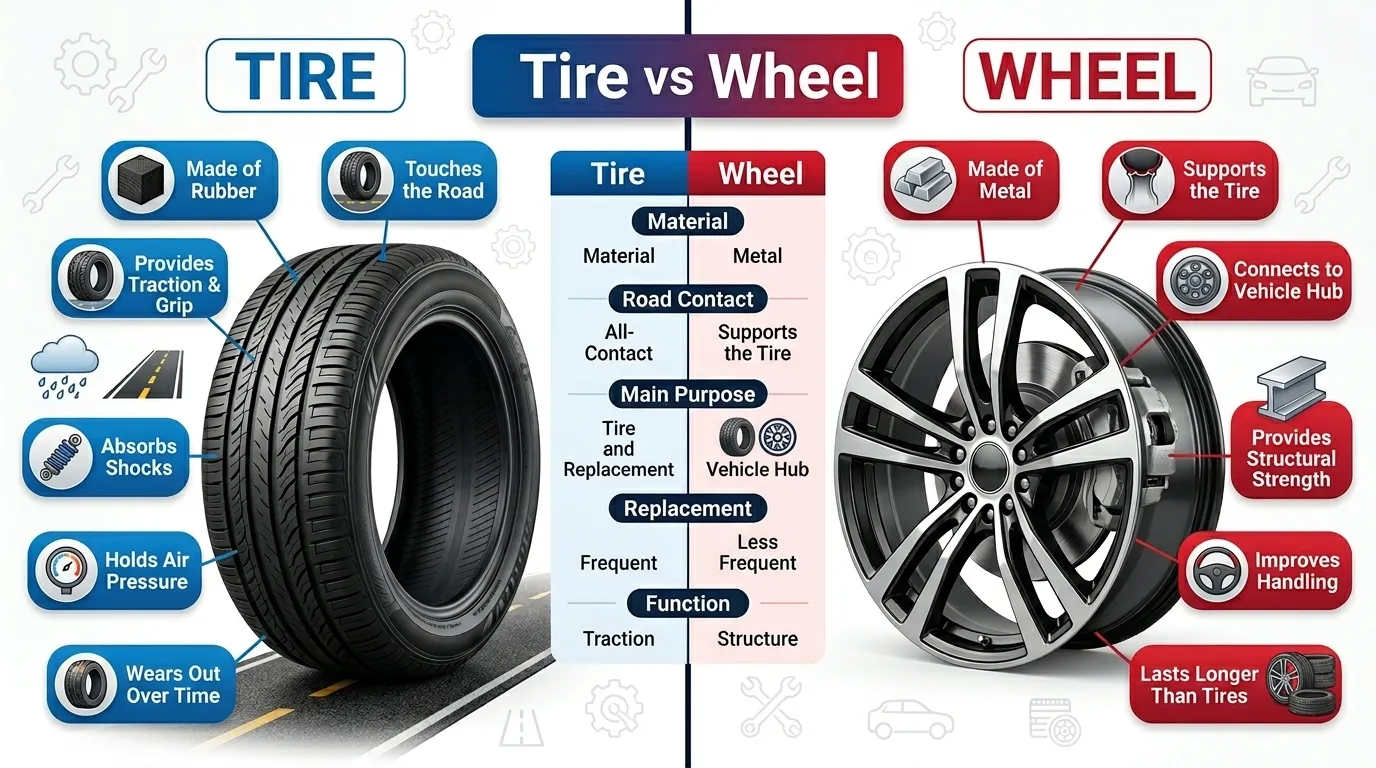
The difference between tires and wheels is simple: a tire is the rubber component that touches the road, while a wheel is the metal structure that supports the tire and connects it to the vehicle. Despite this clear distinction, many drivers still confuse the two terms because they work together as one assembly.
In this guide, you’ll learn the exact difference between tires and wheels, how each component functions, why they matter, common misconceptions, real-world examples, and how search engines understand this topic. By the end, you’ll have complete clarity without needing another article.
Quick Answer: Difference Between Tires and Wheels
A tire is the rubber outer covering that provides grip, cushioning, and traction on the road.
A wheel is the metal framework, usually made of steel or aluminum alloy, that holds the tire and attaches to the vehicle’s hub.
Example: If your car gets a flat, usually only the tire is damaged. The wheel often remains usable unless it has been bent or cracked.
Definition of Tires and Wheels
- Tire: A rubber component filled with air (or sometimes solid material) that contacts the road surface and provides traction, comfort, and shock absorption.
- Wheel: A circular metal structure that supports the tire and connects it to the vehicle’s axle and braking system.
Simple Example: Think of a bicycle. The rubber outer layer is the tire, while the metal circular frame underneath is the wheel.
Pronunciation of Both Terms
| Term | US Pronunciation | UK Pronunciation |
| Tire | /taɪr/ | /taɪə/ |
| Wheel | /wiːl/ | /wiːl/ |
Now that you know what each term means and how they are pronounced, let’s understand the differences in greater detail.
Tires vs Wheels: Side-by-Side Comparison
| Feature | Tire | Wheel |
| Material | Rubber and synthetic compounds | Steel, aluminum, or alloy |
| Main Function | Provides traction and cushioning | Supports tire and vehicle load |
| Road Contact | Directly touches the road | Does not touch the road |
| Air Holding | Holds air pressure | Does not hold air directly |
| Wear Rate | Wears out regularly | Usually lasts much longer |
| Replacement Frequency | Every few years | Only when damaged or upgraded |
| Performance Impact | Grip, handling, braking | Strength, weight, aesthetics |
| Cost Range | Usually less expensive | Often more expensive |
| Maintenance | Pressure checks and rotation | Inspection for bends and cracks |
| Customization | Different tread designs | Different sizes and styles |
Key Differences Explained Between Tires and Wheels
1. Different Materials
Tires are made primarily from rubber compounds.
Wheels are manufactured from metal such as steel or aluminum alloy.
Real-life example: A pothole may tear a tire, but a severe impact can bend the wheel underneath.
2. Different Purposes
The tire grips the road.
The wheel provides structural support.
Without the tire, driving would be unsafe. Without the wheel, mounting the tire would be impossible.
3. Different Lifespans
Most tires need replacement after thousands of miles due to tread wear.
Wheels often last many years unless damaged.
4. Different Maintenance Needs
Tires require:
- Air pressure checks
- Rotations
- Balancing
- Tread inspections
Wheels require:
- Crack inspections
- Corrosion checks
- Alignment inspections
5. Different Effects on Vehicle Performance
Tires influence:
- Traction
- Braking
- Wet-weather performance
- Ride comfort
Wheels influence:
- Weight distribution
- Handling response
- Fuel efficiency
- Appearance
6. Different Replacement Reasons
Drivers replace tires because of:
- Worn tread
- Punctures
- Aging rubber
Drivers replace wheels because of:
- Cracks
- Bending
- Corrosion
- Custom upgrades
7. Different Cost Factors
Premium performance tires can be expensive.
Custom alloy wheels may cost significantly more than tires.
8. Different Safety Roles
A tire’s safety role involves maintaining grip.
A wheel’s safety role involves structural integrity and secure vehicle support.
Why Do Vehicles Need Both Tires and Wheels?
The tire and wheel function as a team.
The wheel provides a rigid structure that transfers engine power and braking force.
The tire provides flexibility and grip, helping the vehicle maintain control.
Without this partnership:
- Braking would be ineffective.
- Steering would become difficult.
- Ride comfort would decrease dramatically.
- Road grip would be severely reduced.
In simple words, the wheel provides strength while the tire provides traction.
How Does a Tire Work?
A tire performs several critical tasks:
Traction
The tread pattern grips the road surface.
Shock Absorption
The air inside the tire cushions impacts from potholes and bumps.
Load Support
Tires support the vehicle’s weight.
Stability
Modern tire designs improve cornering and handling.
For example, all-season tires are designed to perform in various weather conditions, while winter tires use special rubber compounds for cold temperatures.
How Does a Wheel Work?
The wheel acts as the structural foundation.
Its responsibilities include:
Supporting the Tire
The tire is mounted directly onto the wheel.
Connecting to the Vehicle
The wheel attaches to the hub assembly.
Housing Brake Components
Brake rotors and other components interact with the wheel assembly.
Distributing Forces
Acceleration, braking, and cornering forces are transferred through the wheel.
A lightweight alloy wheel can improve handling because it reduces unsprung weight.
Difference Between Tires and Wheels in Performance Vehicles
Performance vehicles highlight the distinction even more.
Sports cars often use:
- High-performance tires for maximum grip
- Lightweight alloy wheels for quicker handling
For example, performance brands such as Michelin, Bridgestone, and Goodyear focus heavily on tire technology because grip dramatically affects lap times.
Meanwhile, wheel manufacturers focus on reducing weight and increasing strength.
This is why racers carefully choose both tires and wheels instead of treating them as identical components.
Difference Between Tires and Wheels: Similarity Table
| Feature | Tire | Wheel | Similarity |
| Purpose | Provides road grip | Provides structural support | Both help vehicle movement |
| Location | Mounted outside | Located beneath tire | Work together as one assembly |
| Safety Role | Maintains traction | Maintains structural stability | Both affect driving safety |
| Performance Impact | Influences grip | Influences handling | Both impact driving experience |
| Maintenance | Requires inspections | Requires inspections | Both need regular checks |
| Replacement | Sometimes necessary | Sometimes necessary | Both wear or become damaged |
| Vehicle Function | Supports movement | Supports movement | Essential vehicle components |
| Customization | Available in different styles | Available in different styles | Can improve appearance and performance |
This table clearly shows the difference and similarity between tires and wheels for quick understanding.
Real-Life Examples With Tires and Wheels
Scenario 1: Daily Commuter
A commuter notices worn tread.
Solution: Replace the tires while keeping the original wheels.
Scenario 2: Pothole Impact
A vehicle hits a deep pothole.
Result: The tire may burst, and the wheel may bend.
Scenario 3: Off-Road Driving
SUV owners often choose stronger wheels and aggressive tires.
Scenario 4: Racing Applications
Race teams frequently change tires but reuse wheels.
Scenario 5: Fleet Vehicles
Business fleets monitor tire wear closely because it affects fuel efficiency and safety.
Scenario 6: Custom Car Enthusiasts
Some drivers upgrade wheels primarily for appearance while keeping quality tires for performance.
When to Use Each: Tires vs Wheels
Focus on Tires When:
- Replacing worn tread
- Improving traction
- Preparing for winter driving
- Improving ride comfort
- Enhancing braking performance
Focus on Wheels When:
- Upgrading vehicle appearance
- Reducing wheel weight
- Repairing structural damage
- Changing wheel size
- Improving handling characteristics
A practical rule: If the issue involves grip, think tires. If it involves structure or style, think wheels.
Why People Get Confused About Tires and Wheels
Several factors contribute to confusion.
Everyday Language
People often use the terms interchangeably.
Automotive Marketing
Some advertisements refer to complete wheel-and-tire packages simply as “wheels.”
Visual Appearance
The two components are physically attached and appear as one unit.
Social Media Influence
Platforms like YouTube and Instagram frequently feature automotive content where terminology is used casually, leading many viewers to adopt incorrect terms.
Regional Differences
In some regions, the word “wheel” is casually used to describe the entire assembly.
Frequently Asked Questions (FAQs)
Is a tire the same as a wheel?
No. A tire is the rubber outer component, while a wheel is the metal structure underneath.
What comes first, the tire or the wheel?
The wheel serves as the foundation, and the tire is mounted onto it.
Can I replace only the tire?
Yes. If the wheel is undamaged, only the tire may need replacement.
Can a wheel work without a tire?
Technically yes, but driving would be unsafe and could damage the vehicle.
Why are wheels made of metal?
Metal provides strength and structural support needed for vehicle operation.
Which is more important, tires or wheels?
Both are essential. Tires provide grip, while wheels provide support.
How often should tires be replaced?
Replacement depends on tread wear, age, driving habits, and manufacturer recommendations.
Do larger wheels require different tires?
Yes. Tire size must match wheel size to ensure proper fitment.
Can damaged wheels affect tire wear?
Yes. Bent or misaligned wheels can cause uneven tire wear.
Why do people call wheels tires?
Because both parts are attached together, many people use the terms interchangeably in everyday conversation.
Conclusion
Understanding the difference between tires and wheels is easier once you know the role each component plays. A tire is the rubber part that contacts the road, provides traction, absorbs shocks, and supports safe driving. A wheel is the metal framework that supports the tire and connects it to the vehicle.
In practical use, if you are dealing with worn tread, air pressure issues, or traction problems, you are likely dealing with a tire issue. If you have a bent rim, cracked metal structure, or want a cosmetic upgrade, you are dealing with a wheel issue.
The final answer is simple: a tire is the rubber component that touches the road, while a wheel is the metal structure that holds the tire and connects it to the vehicle. Understanding this distinction can save money, improve safety, and make vehicle ownership much easier.

David Anderson
I am David Anderson, a USA-based content writer and digital author. I create clear, engaging, and well-structured articles focused on delivering valuable and well-researched information. I specialize in blog writing and digital content that helps websites grow visibility and build strong online authority.