The difference between allusion and illusion is one of the most commonly searched grammar and vocabulary questions because the two words look and sound similar. Many users accidentally interchange them in writing, conversations, school assignments, and even professional content.
In simple words, an allusion is an indirect reference to something, while an illusion is a false perception or deceptive appearance. Understanding the difference between allusion and illusion can improve your writing, reading comprehension, and communication skills.
If you have ever wondered, “What is an allusion?”, “What is an illusion?”, or “How do I know which word to use?”, this guide provides everything you need. You’ll learn definitions, pronunciation, comparison tables, real-life examples, common mistakes, and expert insights in one place.
Quick Answer: Difference Between Allusion and Illusion
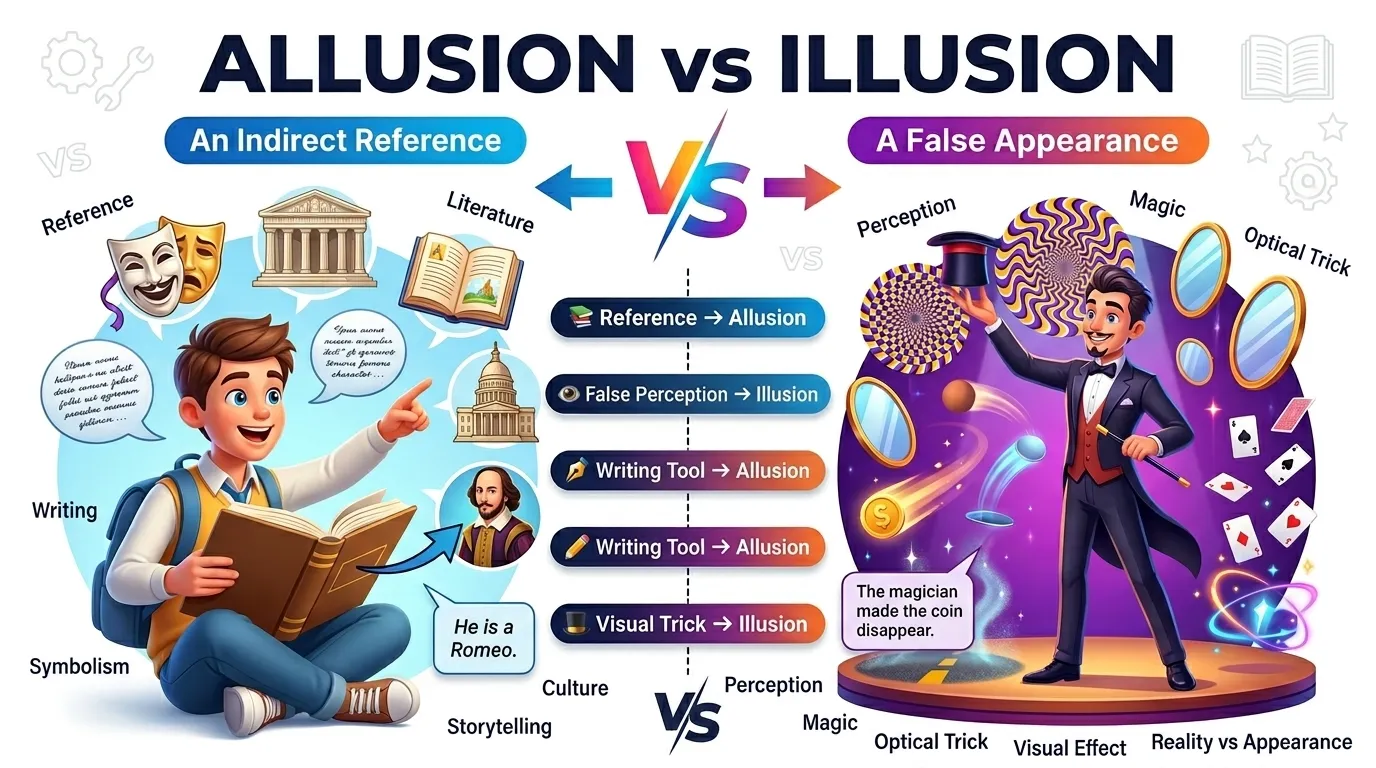
An allusion is a brief or indirect reference to a person, event, book, movie, or idea.
An illusion is something that deceives the senses or creates a false impression of reality.
Example
- Allusion: “He was her Romeo.” (Reference to Romeo from Shakespeare.)
- Illusion: “The magician created the illusion of levitation.” (A deceptive visual effect.)
Definition of Allusion and Illusion
- Allusion: An indirect mention or reference to a famous person, event, story, place, or idea without explicitly explaining it.
- Illusion: A misleading image, perception, or belief that makes something appear different from reality.
Quick Examples
- Allusion: “This place is like Eden.” (Reference to the Garden of Eden.)
- Illusion: “The desert heat created the illusion of water.”
Pronunciation of Both Terms (US & UK)
| Word | US Pronunciation | UK Pronunciation |
|---|---|---|
| Allusion | uh-LOO-zhən | uh-LOO-zhən |
| Illusion | ih-LOO-zhən | ih-LOO-zhən |
Notice that the words sound very similar. This similarity is one reason many people confuse them.
Now let’s understand the core distinction more clearly.
Allusion vs Illusion Comparison Table
| Feature | Allusion | Illusion |
|---|---|---|
| Meaning | Indirect reference | False appearance |
| Purpose | Connect ideas or cultural references | Create deception or misunderstanding |
| Common Use | Literature, writing, speeches | Psychology, magic, visual perception |
| Related To | Language and communication | Senses and perception |
| Reader Requirement | Recognize the reference | Experience the false impression |
| Example | “He met his Waterloo.” | “The mirror created an illusion.” |
| Context | Literary device | Optical or mental phenomenon |
| Reality | Reference is real or known | Appearance differs from reality |
Quick Example
A writer may use an allusion to reference a famous movie. A magician may create an illusion that tricks the audience’s eyes.
Key Differences Explained Between Allusion and Illusion
1. Reference vs Deception
An allusion refers to something indirectly.
An illusion creates a false perception.
Example:
- Allusion: “She opened a Pandora’s box.”
- Illusion: “The stage lighting created an illusion of floating objects.”
2. Language vs Perception
Allusions belong to language and writing.
Illusions belong to visual, mental, or sensory experiences.
3. Reader Knowledge vs Viewer Experience
An allusion works only if the audience understands the reference.
An illusion works when the audience experiences the deceptive effect.
4. Literary Tool vs Psychological Effect
Writers use allusions as literary devices.
Scientists, psychologists, and magicians study illusions as perception phenomena.
5. Communication vs Observation
Allusions communicate meaning through references.
Illusions affect what people observe or believe.
6. Education vs Entertainment
Allusions frequently appear in books, speeches, and educational content.
Illusions often appear in magic shows, advertisements, and visual arts.
7. Hidden Meaning vs False Appearance
An allusion hides additional meaning behind a reference.
An illusion hides reality behind appearance.
8. Cultural Understanding vs Sensory Processing
Understanding an allusion requires cultural or historical knowledge.
Understanding an illusion involves how the brain processes information.
What Is an Allusion and Why Do Writers Use It?
An allusion is a powerful literary device that enriches communication without lengthy explanations.
For example:
- “He’s a real Einstein.”
- “That project became my Mount Everest.”
- “She sang like Beyoncé.”
These references instantly communicate meaning because readers already recognize the people or concepts mentioned.
Why Allusions Exist
Allusions help writers:
- Save words
- Create deeper meaning
- Connect with audiences
- Add emotional impact
- Build cultural relevance
In real scenarios, journalists, bloggers, teachers, and marketers use allusions to make content more engaging.
What Is an Illusion and How Does It Work?
An illusion occurs when reality and perception do not match.
Your brain receives information but interprets it incorrectly.
Common Types of Illusions
Optical Illusions
Images that trick the eyes.
Auditory Illusions
Sounds perceived differently from reality.
Cognitive Illusions
Mental shortcuts causing mistaken judgments.
Magical Illusions
Effects used by performers and magicians.
For example, a magician may make a coin appear to vanish, creating an illusion even though the coin still exists.
Difference Between Allusion and Illusion in Literature
Literature uses both concepts, but in different ways.
Allusion in Literature
Authors frequently reference:
- Greek mythology
- Biblical stories
- Historical events
- Popular culture
Example:
“He had the patience of Job.”
This alludes to the biblical figure Job.
Illusion in Literature
Illusion may describe:
- False beliefs
- Deceptive appearances
- Imaginary perceptions
Example:
“The kingdom’s prosperity was merely an illusion.”
How to Remember the Difference Between Allusion and Illusion
A simple memory trick helps.
Allusion = A = Association
Think:
Allusion → A → Association or Reference
It points to something else.
Illusion = I = Imaginary Appearance
Think:
Illusion → I → Imaginary View
It tricks perception.
Memory Sentence
“An allusion points somewhere; an illusion fools someone.”
Many beginners find this trick useful because it focuses on the core distinction.
Difference Between Allusion and Illusion in Everyday Communication
People often use these words outside academic settings.
Social Media
On platforms like Meta, users may allude to movies, celebrities, or trending events through memes.
Example:
“He’s basically the Tony Stark of our office.”
This is an allusion.
Advertising
Advertisements sometimes create illusions through camera angles, lighting, and visual effects.
Business Presentations
Professionals use allusions to explain ideas quickly.
For example:
“This project became our Titanic moment.”
The audience understands the reference immediately.
Why People Get Confused in Difference Between Allusion and Illusion
Several factors contribute to confusion.
Similar Pronunciation
The words sound nearly identical.
Similar Spelling
Only a few letters differ.
Shared Origins
Both words originate from Latin roots.
Lack of Context Awareness
Many users focus on pronunciation rather than meaning.
Online Content Errors
Content on blogs, social media, and even videos sometimes misuses the terms, spreading confusion.
Difference and Similarity Between Allusion and Illusion
| Feature | Allusion | Illusion | Similarity |
|---|---|---|---|
| Meaning | Reference to something | False perception | Both involve indirect understanding |
| Field | Language and literature | Psychology and perception | Both appear in communication |
| Purpose | Add meaning | Create deceptive appearance | Both affect interpretation |
| Reader Role | Recognize reference | Experience perception | Audience participation matters |
| Education Use | Writing and reading | Science and psychology | Both taught in schools |
| Common Confusion | Often mistaken for illusion | Often mistaken for allusion | Similar pronunciation |
| Cultural Impact | References shared knowledge | Influences perception | Both shape understanding |
| Usage Style | Figurative language | Sensory experience | Both require context |
This table clearly shows the difference and similarity between allusion and illusion for quick understanding.
Common Mistakes With Allusion and Illusion
Mistake 1: Using Illusion Instead of Allusion
❌ “The author made an illusion to Shakespeare.”
✅ “The author made an allusion to Shakespeare.”
Mistake 2: Using Allusion for Magic Tricks
❌ “The magician performed an allusion.”
✅ “The magician performed an illusion.”
Mistake 3: Confusing Reference With Appearance
Always ask:
- Is someone referring to something?
- Or is something appearing falsely?
Mistake 4: Ignoring Context
The surrounding sentence usually reveals the correct choice.
Mistake 5: Assuming They Mean the Same Thing
Despite sounding alike, they belong to different concepts entirely.
Real-Life Examples With Allusion and Illusion
Personal Communication
“My brother thinks he’s Superman.”
This is an allusion.
Education
A teacher says:
“This struggle was your Odyssey.”
This alludes to Homer’s epic journey.
Marketing
Brands often use visual illusions in advertisements to attract attention.
Entertainment Industry
Movies use CGI effects to create realistic illusions.
Technology and Social Media
On platforms like YouTube and Instagram, creators frequently use allusions to popular films, games, and celebrities to connect with audiences.
When to Use Each
Use Allusion When
- Writing essays
- Creating speeches
- Producing content
- Referencing history
- Mentioning famous figures indirectly
Use Illusion When
- Discussing magic tricks
- Talking about perception
- Describing visual effects
- Explaining psychological phenomena
- Analyzing misleading appearances
Expert Insight
From an editorial and language-learning perspective, the distinction is easier than many people think.
Most beginners focus on pronunciation because both words sound similar. Experienced writers focus on function instead.
A practical rule used by editors is:
- If the sentence contains a reference, choose allusion.
- If the sentence contains a deception or false appearance, choose illusion.
In professional writing, applying this simple test eliminates most mistakes immediately.
Frequently Asked Questions (FAQs)
Is allusion the same as illusion?
No. An allusion is a reference, while an illusion is a false perception.
Which is used in literature more often?
Allusion is much more common in literature and academic writing.
What is a famous example of an allusion?
Calling someone “a Romeo” is a famous allusion to Shakespeare’s character.
What is a common example of an illusion?
A mirage in a desert is a classic optical illusion.
Why are allusion and illusion confusing?
They have similar spelling, pronunciation, and Latin origins.
Can an illusion be psychological?
Yes. Cognitive and psychological illusions affect how people interpret information.
Do authors use allusions intentionally?
Yes. Writers use allusions to add depth, symbolism, and cultural meaning.
Is a magic trick an allusion or illusion?
A magic trick creates an illusion.
How can I remember the difference quickly?
Remember:
- Allusion = Reference
- Illusion = False appearance
Which word appears more in academic writing?
Allusion appears more frequently because it is a literary and rhetorical device.
Conclusion
Understanding the difference between allusion and illusion becomes simple once you focus on what each word does. An allusion points readers toward a known person, event, story, or idea without directly explaining it. An illusion, on the other hand, creates a misleading appearance or false perception that differs from reality.
If you’re ever unsure, use this quick test: Is the sentence making a reference? Choose allusion. Is it describing a deceptive appearance or false perception? Choose illusion. This simple rule solves most confusion instantly.

Sarfraz Ahmad is language researcher and content writer who specializes in explaining the difference between commonly confused English words. Through WordClearify, learners understand subtle word distinctions in a simple, structured, and practical way. My writing focuses on clarity, real-life examples, and easy comparisons for students, bloggers, and professionals worldwide.