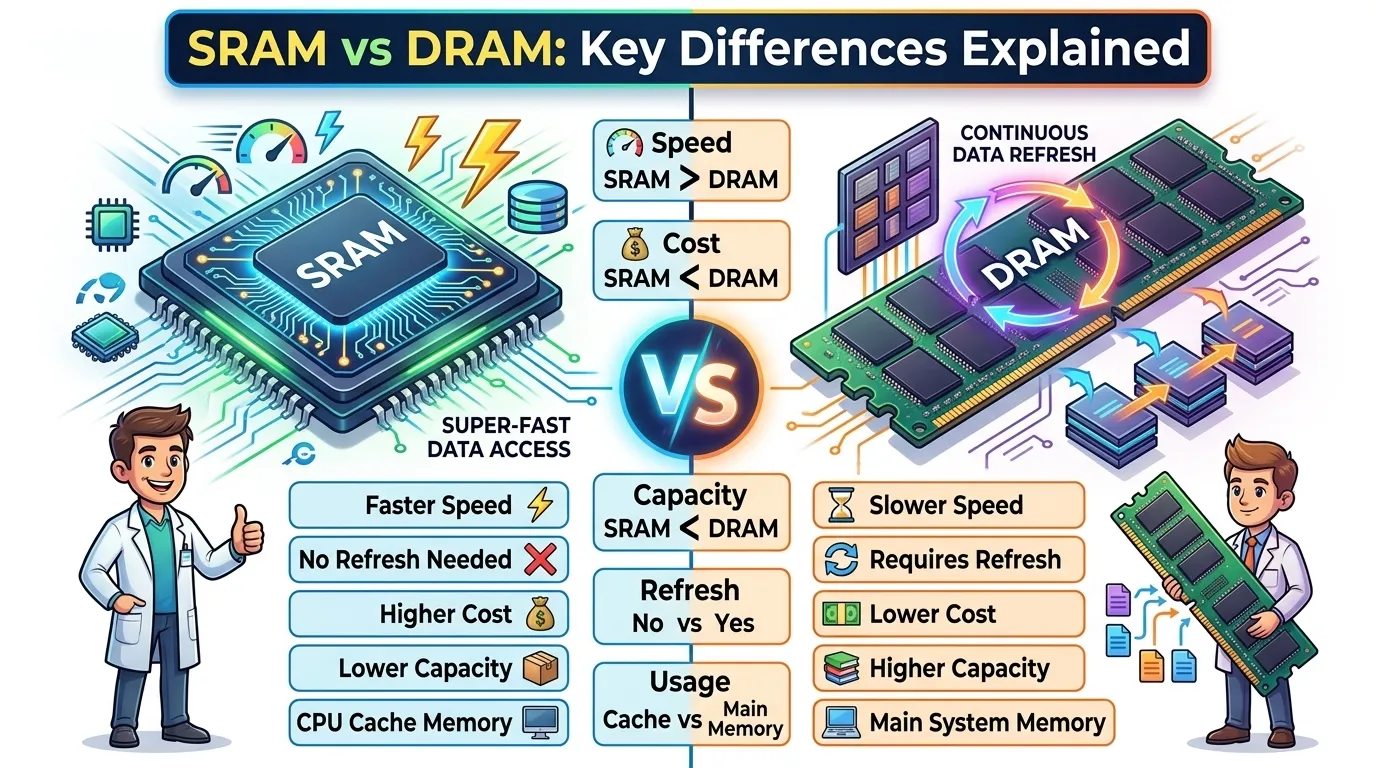
If you are learning about computer memory, one of the most common questions is the difference between SRAM and DRAM. Both are types of RAM (Random Access Memory), but they work differently and serve different purposes inside computers, smartphones, gaming consoles, servers, and modern digital systems.
Many users get confused because SRAM and DRAM are both temporary memory technologies. However, the difference between SRAM and DRAM lies in their speed, structure, cost, power consumption, and practical applications.
In this guide, you’ll learn what SRAM and DRAM are, how they work, where they are used, why manufacturers choose one over the other, and which memory type performs better in specific situations. Whether you are a student, IT professional, computer enthusiast, or preparing for exams, this article covers everything you need to know.
Quick Answer: Difference Between SRAM and DRAM
SRAM (Static Random Access Memory) stores data using flip-flops and does not require constant refreshing, making it extremely fast but expensive.
DRAM (Dynamic Random Access Memory) stores data using capacitors that need regular refreshing, making it slower than SRAM but much cheaper and more suitable for large memory capacities.
Example: A computer’s CPU cache typically uses SRAM for speed, while the main system memory uses DRAM because it offers larger storage at a lower cost.
Definition of SRAM and DRAM
- SRAM (Static Random Access Memory): A type of memory that stores data using bistable flip-flop circuits and retains data as long as power is supplied.
- DRAM (Dynamic Random Access Memory): A type of memory that stores data in capacitors and requires continuous refreshing to maintain stored information.
Simple Example: CPU cache memory uses SRAM, while your laptop’s RAM module uses DRAM.
Pronunciation of Both Terms
| Term | US Pronunciation | UK Pronunciation |
|---|---|---|
| SRAM | /ˈes.ræm/ | /ˈes.ræm/ |
| DRAM | /ˈdiː.ræm/ | /ˈdiː.ræm/ |
Now that you know what SRAM and DRAM mean, let’s understand their differences in detail and see why both remain essential in modern computing systems.
SRAM vs DRAM Comparison Table
| Feature | SRAM | DRAM |
|---|---|---|
| Full Form | Static Random Access Memory | Dynamic Random Access Memory |
| Storage Method | Flip-flops | Capacitors |
| Refresh Requirement | No refresh needed | Requires continuous refresh |
| Speed | Very fast | Relatively slower |
| Cost | Expensive | Affordable |
| Density | Lower density | Higher density |
| Power Consumption | Higher when active | Lower per bit |
| Capacity | Smaller | Larger |
| Complexity | More complex design | Simpler design |
| Main Usage | CPU cache memory | Main system memory |
Key Differences Explained Between SRAM and DRAM
1. Data Storage Technology
SRAM stores information using multiple transistors arranged as flip-flops. DRAM stores information inside capacitors.
Real-life example: Think of SRAM as a stable switch that stays in position, while DRAM acts like a small bucket that slowly leaks water and needs refilling.
2. Speed Performance
SRAM provides much faster access times because it does not require refresh operations.
Example: Modern processors from companies like Intel and AMD use SRAM-based cache memory to deliver rapid data access.
3. Refresh Requirement
DRAM cells lose charge over time, requiring periodic refresh cycles.
SRAM maintains data without refreshing as long as power remains available.
4. Manufacturing Cost
SRAM requires more transistors per memory cell, making it significantly more expensive.
DRAM uses fewer components, lowering production costs.
5. Memory Capacity
Because SRAM cells are larger, fewer can fit on a chip.
DRAM offers much higher memory density, allowing larger capacities.
6. Power Efficiency
Although SRAM avoids refresh operations, its larger transistor count increases overall power usage.
DRAM often provides better power efficiency per stored bit.
7. Applications
SRAM is commonly used for cache memory.
DRAM is used as primary memory in desktops, laptops, smartphones, and servers.
8. Physical Size
SRAM cells occupy more silicon space.
DRAM cells are smaller, enabling larger memory modules.
How Does SRAM Work?
SRAM stores each bit using a set of transistors configured as a flip-flop.
Key Characteristics
- No refresh cycle required
- Fast read and write operations
- Stable data retention
- Higher manufacturing cost
Why SRAM Exists
Processors operate at incredibly high speeds. Waiting for slower memory would create bottlenecks. SRAM bridges this gap by providing ultra-fast temporary storage.
For example, when using applications from Google, data frequently accessed by the CPU may be temporarily stored in SRAM-based cache memory.
How Does DRAM Work?
DRAM stores bits as electrical charges within capacitors.
Because capacitors gradually lose charge, the memory controller must repeatedly refresh data.
Key Characteristics
- High storage density
- Lower cost
- Larger capacities
- Requires refreshing
Why DRAM Exists
Modern systems require gigabytes or even terabytes of memory. Using SRAM for such large capacities would be extremely expensive.
This is why computers running services from Meta, Google, and YouTube depend heavily on DRAM for large-scale memory needs.
Why Is SRAM Faster Than DRAM?
This is one of the most searched questions regarding the difference between SRAM and DRAM.
SRAM Speed Advantages
- No refresh operations
- Direct transistor-based storage
- Lower latency
- Faster access cycles
DRAM Speed Limitations
- Refresh overhead
- Capacitor charging and discharging
- Additional memory controller operations
In simple words, SRAM is always ready to provide data, while DRAM occasionally pauses to refresh stored information.
Difference Between SRAM and DRAM in Computer Architecture
Computer systems use a memory hierarchy.
Typical Memory Hierarchy
- CPU Registers
- SRAM Cache (L1, L2, L3)
- DRAM Main Memory
- SSD Storage
- Hard Disk Storage
The closer memory is to the processor, the faster it becomes.
SRAM sits near the CPU because speed is critical.
DRAM serves as the primary working memory because capacity matters more.
Why Do Computers Use Both?
A common beginner question is:
Why Not Use Only SRAM?
Because SRAM is expensive and takes more chip space.
Why Not Use Only DRAM?
Because DRAM is slower than CPU cache requirements.
The Balanced Solution
Modern computers combine both:
- SRAM for speed-critical tasks
- DRAM for large memory requirements
This combination delivers the best balance of performance and affordability.
Difference Between Them for Gaming and High Performance Computing
Gaming Systems
Gaming PCs require both memory types.
- SRAM accelerates processor operations through cache memory.
- DRAM stores game assets, textures, and active game data.
Data Centers
Cloud providers and AI systems use enormous amounts of DRAM.
Meanwhile, processors rely on SRAM caches to reduce latency.
Artificial Intelligence
AI workloads need fast access to huge datasets.
SRAM speeds up processing, while DRAM handles large-scale storage requirements.
Difference and Similarity Between Both
| Feature | SRAM | DRAM | Similarity |
|---|---|---|---|
| Meaning | Static memory | Dynamic memory | Both are RAM types |
| Storage Method | Flip-flops | Capacitors | Both store binary data |
| Refreshing | Not required | Required | Both need power |
| Speed | Faster | Slower | Both enable quick access |
| Cost | High | Lower | Both are semiconductor memory |
| Capacity | Smaller | Larger | Both support computing tasks |
| Usage | Cache memory | Main memory | Both improve system performance |
| Volatility | Loses data without power | Loses data without power | Both are volatile memory |
This table clearly shows the difference and similarity between both for quick understanding.
Real-Life Examples with SRAM and DRAM
Scenario 1: Personal Laptop
- CPU cache = SRAM
- Installed RAM = DRAM
Scenario 2: Smartphone
Apps running on smartphones use DRAM, while processors utilize SRAM caches.
Scenario 3: Gaming Console
Fast cache memory uses SRAM.
Game data loads into DRAM.
Scenario 4: Business Server
Large databases rely on DRAM.
Server processors depend on SRAM for fast execution.
Scenario 5: AI Data Center
Machine learning systems combine massive DRAM pools with high-speed SRAM caches.
When to Use Each
Use SRAM When:
- Maximum speed is required
- Low latency is critical
- Cache memory is needed
- Processor performance is the priority
Use DRAM When:
- Large capacity is required
- Cost efficiency matters
- Main system memory is needed
- Scalability is important
Why People Get Confused in Both
Several factors create confusion:
Similar Names
Both contain “RAM,” making them seem identical.
Shared Purpose
Both temporarily store data.
Hidden Operation
Most users never see memory hierarchy in action.
Technical Terminology
Terms like cache, latency, refresh cycles, and memory cells can be confusing for beginners.
Expert Insight
From a computer architecture perspective, SRAM and DRAM are not competitors. They are partners.
In real scenarios, the most efficient systems combine both technologies strategically. SRAM delivers instant access to frequently used instructions, while DRAM provides affordable large-scale storage.
Most beginners focus only on speed, but engineers often prioritize the balance between speed, cost, power consumption, and capacity. That balance is exactly why modern processors and memory systems continue to rely on both SRAM and DRAM in 2026.
Frequently Asked Questions (FAQs)
What is the main difference between SRAM and DRAM?
SRAM uses flip-flops and requires no refreshing, while DRAM uses capacitors and must be refreshed regularly.
Which is faster, SRAM or DRAM?
SRAM is significantly faster because it does not require refresh cycles.
Why is SRAM more expensive?
SRAM uses more transistors per memory cell, increasing manufacturing costs.
Is cache memory SRAM or DRAM?
Most CPU cache memory is SRAM.
Is laptop RAM SRAM or DRAM?
Laptop memory modules are generally DRAM.
Why does DRAM need refreshing?
Capacitors gradually lose electrical charge, so stored data must be refreshed periodically.
Are SRAM and DRAM volatile memory?
Yes. Both lose stored data when power is removed.
Can DRAM replace SRAM?
No. DRAM cannot provide the extremely low latency required for processor cache memory.
Which memory is used in smartphones?
Smartphones use both SRAM and DRAM for different functions.
Why do modern processors use SRAM?
Because SRAM provides ultra-fast access times needed for high-performance computing.
Conclusion
Understanding the difference between SRAM and DRAM is essential for anyone studying computer architecture, memory systems, or modern computing technology. Although both are forms of RAM, they serve very different purposes.
SRAM offers exceptional speed, low latency, and reliable performance without refresh cycles, making it ideal for CPU cache memory. DRAM, on the other hand, provides large storage capacity at a much lower cost, making it the preferred choice for main system memory in computers, smartphones, servers, gaming systems, and cloud infrastructure.
The key takeaway is that SRAM and DRAM are designed to solve different problems. SRAM focuses on speed, while DRAM focuses on capacity and affordability. Modern devices depend on both technologies working together to deliver efficient performance.

Sarfraz Ahmad is language researcher and content writer who specializes in explaining the difference between commonly confused English words. Through WordClearify, learners understand subtle word distinctions in a simple, structured, and practical way. My writing focuses on clarity, real-life examples, and easy comparisons for students, bloggers, and professionals worldwide.