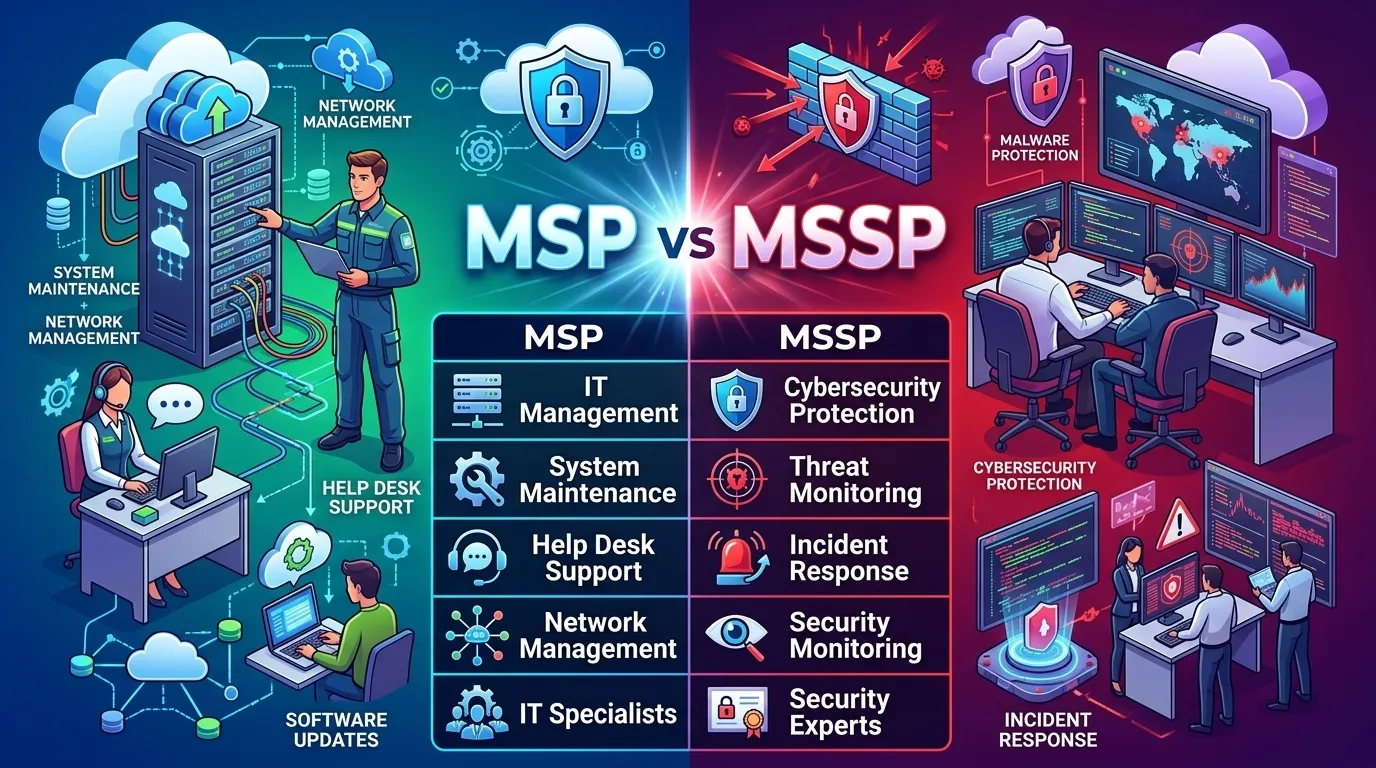
Many businesses searching for cybersecurity solutions often get confused about the difference between MSP and MSSP. At first glance, both seem to provide outsourced IT services, but their goals, responsibilities, and security focus are very different.
Understanding the difference between MSP and MSSP is important because choosing the wrong provider can affect your company’s technology performance, cybersecurity posture, and compliance requirements. While an MSP helps manage and maintain IT infrastructure, an MSSP focuses on protecting systems, networks, and data from cyber threats.
In this guide, you’ll learn what MSP and MSSP mean, how they work, their key differences, similarities, real-world examples, and how to choose the right option for your business in 2026 and beyond.
Quick Answer: Difference Between MSP and MSSP
An MSP (Managed Service Provider) manages a company’s IT operations, such as networks, servers, cloud systems, and technical support.
An MSSP (Managed Security Service Provider) specializes in cybersecurity services like threat monitoring, incident response, vulnerability management, and security compliance.
Example:
If your office computers stop working, an MSP helps fix the issue.
If hackers attempt to access your network, an MSSP helps detect and stop the attack.
Definition of MSP and MSSP
- MSP (Managed Service Provider): A company that remotely manages and maintains IT infrastructure, software, cloud systems, and technical support services.
- MSSP (Managed Security Service Provider): A company that provides specialized cybersecurity services designed to monitor, detect, prevent, and respond to cyber threats.
Simple Example
An MSP keeps your technology running smoothly.
An MSSP keeps your technology secure from cybercriminals.
Pronunciation of Both Terms
| Term | US Pronunciation | UK Pronunciation |
|---|---|---|
| MSP | em-es-pee | em-es-pee |
| MSSP | em-es-es-pee | em-es-es-pee |
Now that you know what these terms mean, let’s understand how they differ in practical business environments.
MSP vs MSSP Comparison Table
| Feature | MSP | MSSP |
|---|---|---|
| Primary Focus | IT management | Cybersecurity protection |
| Main Goal | Improve IT performance | Reduce security risks |
| Monitoring | Network and systems monitoring | Security threat monitoring |
| Support | Help desk and IT support | Security operations and incident response |
| Compliance | Basic assistance | Advanced compliance support |
| Security Expertise | General IT knowledge | Specialized cybersecurity experts |
| Threat Detection | Limited | Advanced and continuous |
| SOC Services | Usually not included | Often included |
| Risk Management | Basic | Extensive |
| Typical Clients | Small and medium businesses | Organizations with security concerns |
Key Differences Explained Between MSP and MSSP
1. Core Purpose
An MSP focuses on keeping IT systems operational.
An MSSP focuses on protecting those systems from cyber threats.
Real-world example: A retail store may hire an MSP to maintain point-of-sale systems, while an MSSP protects customer payment data from attackers.
2. Security Expertise
MSPs generally have broad IT expertise.
MSSPs employ cybersecurity specialists, threat analysts, and security engineers.
3. Monitoring Approach
MSPs monitor uptime and system performance.
MSSPs monitor suspicious activities, malware, ransomware, and unauthorized access attempts.
4. Incident Response
Most MSPs provide technical troubleshooting.
MSSPs provide structured incident response plans for cyberattacks.
5. Compliance Management
Industries such as healthcare and finance often require strict compliance.
MSSPs usually offer deeper support for regulations and security frameworks.
6. Tools Used
MSPs commonly use IT management tools.
MSSPs use SIEM platforms, endpoint detection systems, threat intelligence tools, and Security Operations Centers (SOC).
7. Risk Reduction
MSPs improve operational efficiency.
MSSPs reduce cybersecurity risk and business exposure.
Why Do MSPs and MSSPs Exist?
Technology has become more complex than ever. Businesses rely on cloud platforms, remote work systems, applications, and digital communications.
An MSP exists because many organizations lack internal IT teams.
An MSSP exists because cyber threats have increased dramatically, making dedicated security expertise necessary.
In simple words:
- MSP solves IT challenges.
- MSSP solves cybersecurity challenges.
How Does an MSP Work?
An MSP remotely manages technology infrastructure.
Common MSP services include:
- Network management
- Server administration
- Cloud management
- Data backup
- Software updates
- Help desk support
- Device management
Example
A company using cloud services from Google Cloud, Microsoft Azure, or Amazon Web Services (AWS) may hire an MSP to manage performance, updates, and daily operations.
How Does an MSSP Work?
An MSSP continuously monitors and protects digital assets.
Typical MSSP services include:
- Threat detection
- Security monitoring
- Vulnerability assessments
- Firewall management
- Endpoint security
- Incident response
- Security compliance support
- Threat intelligence
Example
If attackers target company accounts on platforms like Google Workspace, Microsoft 365, or corporate networks, an MSSP works to detect and stop the threat before damage occurs.
Difference Between MSP and MSSP for Small Businesses
Small businesses often wonder whether they need an MSP or MSSP.
Choose an MSP if:
- You need IT support.
- You have limited internal IT staff.
- Your main concern is system maintenance.
- You need cloud or network management.
Choose an MSSP if:
- You store sensitive customer information.
- You face compliance requirements.
- You need advanced threat monitoring.
- Cybersecurity is a major concern.
Best Practice
Many growing companies use both an MSP and MSSP together.
Difference Between MSP and MSSP in Cloud Environments
Cloud adoption continues to grow in 2026.
Businesses using:
- Google Cloud
- AWS
- Microsoft Azure
- SaaS applications
often require both operational management and security protection.
MSP Responsibilities
- Cloud optimization
- Performance management
- Resource allocation
- Technical support
MSSP Responsibilities
- Cloud security monitoring
- Access control
- Identity protection
- Threat detection
- Compliance monitoring
This partnership helps businesses achieve both efficiency and security.
MSP vs MSSP: Cost Considerations
Pricing varies depending on company size and requirements.
MSP Costs
Typically based on:
- Number of devices
- Users
- Servers
- Cloud resources
MSSP Costs
Usually based on:
- Security monitoring scope
- Number of endpoints
- Compliance requirements
- Security tools deployed
While MSSP services may cost more initially, they can help prevent expensive data breaches and ransomware incidents.
Difference and Similarity Between MSP and MSSP
Difference Between MSP and MSSP: Similarities and Differences Table
| Feature | MSP | MSSP | Similarity |
|---|---|---|---|
| Main Purpose | Manage IT systems | Protect IT systems | Both support business technology |
| Remote Services | Yes | Yes | Both work remotely |
| Monitoring | Performance monitoring | Security monitoring | Both provide monitoring |
| Expertise | IT specialists | Security specialists | Both employ technical experts |
| Business Goal | Operational efficiency | Risk reduction | Both improve business continuity |
| Technology Tools | IT management platforms | Security platforms | Both rely on advanced software |
| Service Model | Ongoing management | Ongoing protection | Both use subscription models |
| Reporting | IT reports | Security reports | Both provide insights and analytics |
This table clearly shows the difference and similarity between difference between MSP and MSSP for quick understanding.
Common Mistakes with MSP and MSSP
Mistake 1: Thinking They Are the Same
Many users assume both providers offer identical services.
Correction: MSP focuses on IT management, while MSSP focuses on cybersecurity.
Mistake 2: Expecting an MSP to Handle Advanced Security
Not all MSPs offer sophisticated security operations.
Correction: Verify security capabilities before signing contracts.
Mistake 3: Ignoring Compliance Needs
Businesses in regulated industries often underestimate compliance requirements.
Correction: Choose an MSSP if compliance is critical.
Mistake 4: Choosing Based Only on Cost
The cheapest provider may not meet security needs.
Correction: Evaluate expertise and services first.
Mistake 5: Delaying Security Investments
Many businesses wait until after a breach occurs.
Correction: Implement proactive security measures early.
Real-Life Examples with MSP and MSSP
Scenario 1: Small Startup
A startup uses an MSP to manage laptops, cloud services, and software updates.
Scenario 2: Healthcare Organization
A healthcare provider uses an MSSP to maintain HIPAA compliance and monitor threats.
Scenario 3: E-commerce Business
An online store uses both an MSP and MSSP.
The MSP manages infrastructure.
The MSSP protects customer payment information.
Scenario 4: Manufacturing Company
The MSP manages operational systems while the MSSP protects industrial networks from cyberattacks.
Scenario 5: Enterprise Organization
Large enterprises often combine internal IT teams, MSP support, and MSSP security services.
When to Use Each
1. Use an MSP When:
- You need IT support.
- Your systems require maintenance.
- You need cloud administration.
- You want predictable IT management.
2. Use an MSSP When:
- Security threats are increasing.
- Compliance is important.
- Customer data protection is essential.
- You need continuous security monitoring.
3. Use Both When:
- Technology and security are equally important.
- Business operations depend heavily on digital systems.
Why People Get Confused in MSP and MSSP
Several factors create confusion:
Similar Acronyms
The names look nearly identical.
Overlapping Services
Some MSPs offer limited security services.
Industry Marketing
Many vendors promote themselves as complete technology providers.
Growing Cybersecurity Demands
As cybersecurity becomes more important, service offerings often overlap.
However, their primary missions remain different.
Expert Insight
As organizations continue moving toward cloud-first and hybrid work environments, cybersecurity has become just as important as IT management.
In practical use, businesses rarely fail because their software needs updating. They often suffer significant losses from security incidents, ransomware attacks, or data breaches.
Many organizations start with an MSP and later add MSSP services as security risks grow.
The most successful companies view MSPs and MSSPs as complementary partners rather than competing options. One manages technology operations, while the other protects those operations from threats.
That distinction is becoming increasingly important in 2026 and beyond.
Frequently Asked Questions (FAQs)
What is the main difference between MSP and MSSP?
An MSP manages IT infrastructure, while an MSSP specializes in cybersecurity protection and threat monitoring.
Can an MSP provide security services?
Yes, some MSPs offer basic security services, but they typically do not provide the advanced security capabilities of an MSSP.
Do small businesses need an MSSP?
Many small businesses benefit from MSSP services, especially if they handle customer data or face compliance requirements.
Is an MSSP more expensive than an MSP?
Usually yes, because cybersecurity monitoring and threat response require specialized expertise and tools.
Can a company use both an MSP and MSSP?
Absolutely. Many organizations use both to achieve strong IT management and cybersecurity protection.
What industries commonly use MSSPs?
Healthcare, finance, e-commerce, government, education, and manufacturing frequently use MSSPs.
Does an MSSP replace an internal security team?
Not always. Many MSSPs work alongside internal teams to strengthen overall security.
Which is better: MSP or MSSP?
Neither is universally better. The right choice depends on whether your priority is IT management, cybersecurity, or both.
Why are MSSPs becoming more popular?
Cyber threats, ransomware attacks, and compliance requirements continue to increase worldwide.
Can cloud businesses benefit from MSSPs?
Yes. MSSPs help secure cloud environments, identities, applications, and sensitive business data.
Conclusion
Understanding the difference between MSP and MSSP is essential for any business that relies on technology. Although both providers offer managed services, their objectives are very different. An MSP focuses on maintaining and optimizing IT systems, while an MSSP focuses on protecting those systems from cyber threats.
In real-world business environments, the choice is not always MSP versus MSSP. Many organizations benefit from using both. The MSP ensures technology runs efficiently, while the MSSP ensures it remains secure.
Ultimately, the best decision depends on your organization’s risk profile, technology needs, and long-term business goals. By understanding the difference between MSP and MSSP, you can make a smarter investment in both operational success and cybersecurity resilience.

Sarfraz Ahmad is language researcher and content writer who specializes in explaining the difference between commonly confused English words. Through WordClearify, learners understand subtle word distinctions in a simple, structured, and practical way. My writing focuses on clarity, real-life examples, and easy comparisons for students, bloggers, and professionals worldwide.