Many users get confused when comparing the difference between ecommerce and mcommerce because both involve buying and selling products online. However, the difference between ecommerce and mcommerce lies mainly in the devices, user experience, and technology used during transactions.
If you have ever purchased something from a laptop through a website or ordered a product from your smartphone using an app, you have already experienced both models. Understanding the difference between them helps businesses improve customer experiences and helps consumers choose the most convenient shopping method.
In this guide, you’ll learn what ecommerce and mcommerce are, how they work, their advantages, disadvantages, similarities, key differences, real-life examples, and when each option makes the most sense in today’s digital economy.
Quick Answer: Difference Between Ecommerce and Mcommerce
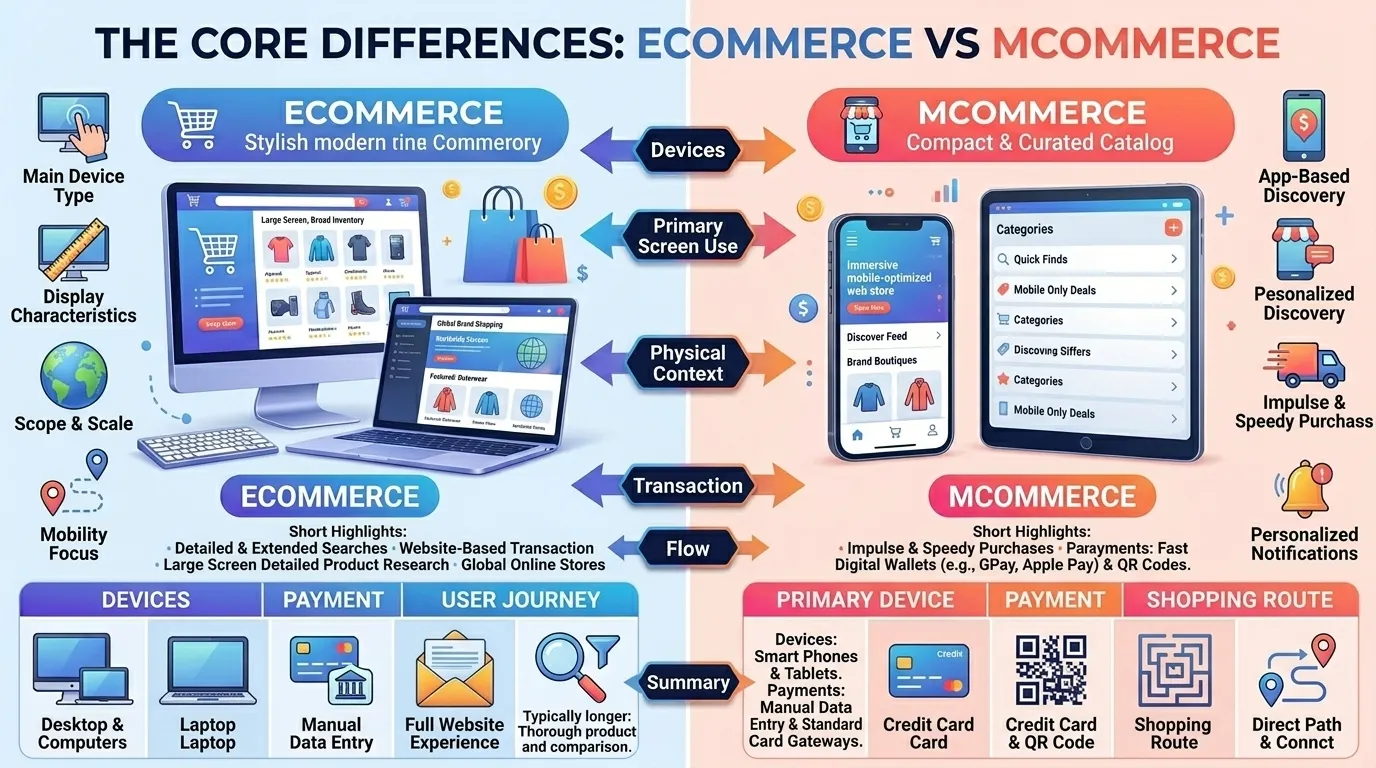
The difference between ecommerce and mcommerce is that ecommerce refers to all online buying and selling activities conducted through the internet, while mcommerce (mobile commerce) is a subset of ecommerce that specifically uses mobile devices such as smartphones and tablets for transactions.
Example:
- Buying a laptop from Amazon using a desktop computer = Ecommerce
- Ordering food through a mobile app on your smartphone = Mcommerce
In simple words, all mcommerce is ecommerce, but not all ecommerce is mcommerce.
Definition of Ecommerce and Mcommerce
- Ecommerce: The buying and selling of products or services through the internet using devices such as desktops, laptops, tablets, and smartphones.
- Mcommerce: A form of ecommerce that allows users to buy, sell, pay, or conduct transactions specifically through mobile devices such as smartphones and tablets.
Simple Example
A customer purchasing shoes from an online store using a desktop computer is engaging in ecommerce.
The same customer purchasing through a mobile app is engaging in mcommerce.
Pronunciation of Both Terms (US & UK)
| Term | US Pronunciation | UK Pronunciation |
|---|---|---|
| Ecommerce | ee-kom-urs | ee-kom-urs |
| Mcommerce | em-kom-urs | em-kom-urs |
Now that we understand the basic definitions, let’s explore the key differences in greater detail.
Ecommerce vs Mcommerce Comparison Table
| Feature | Ecommerce | Mcommerce |
|---|---|---|
| Device Used | Desktop, laptop, tablet, mobile | Primarily smartphones and tablets |
| Accessibility | Internet-enabled devices | Mobile devices only |
| User Experience | Website-focused | Mobile app-focused |
| Portability | Limited | Highly portable |
| Location Usage | Often home or office | Anywhere, anytime |
| Payment Methods | Cards, bank transfers, digital wallets | Mobile wallets, QR payments, one-click checkout |
| Speed | Moderate | Faster transactions |
| Personalization | Standard personalization | Highly personalized using mobile data |
| Notifications | Email-based | Push notifications |
| GPS Integration | Limited | Strong location-based features |
Key Differences Explained Between Ecommerce and Mcommerce
1. Device Dependency
Ecommerce works across multiple devices including desktops and laptops.
Mcommerce relies mainly on smartphones and tablets.
Real-world example: Shopping from a Dell laptop is ecommerce, while purchasing through a mobile Amazon app is mcommerce.
2. Mobility
One major difference between both is convenience.
Users can complete purchases while traveling, commuting, or waiting in line through mobile commerce.
3. Speed of Transactions
Modern mobile apps offer saved payment methods, biometric authentication, and one-tap purchasing.
This makes mcommerce transactions faster than many traditional ecommerce experiences.
4. Location-Based Services
Mcommerce can use GPS technology.
Food delivery apps, ride-sharing platforms, and local shopping services often use location data to improve customer experiences.
5. Customer Engagement
Mcommerce benefits from push notifications.
Businesses can instantly notify customers about discounts, promotions, and abandoned carts.
6. User Experience Design
Ecommerce websites are designed for larger screens.
Mcommerce interfaces are optimized for touchscreens and smaller displays.
7. Payment Technologies
Mcommerce commonly integrates:
- Apple Pay
- Google Pay
- Samsung Pay
- QR Code Payments
- Mobile Wallets
These payment options make mobile transactions seamless.
What is Ecommerce and How Does It Work?
Ecommerce refers to digital buying and selling through internet-connected platforms.
The process generally follows these steps:
- Customer visits online store
- Browses products
- Adds items to cart
- Completes checkout
- Makes payment
- Receives delivery
Popular ecommerce platforms include:
- Amazon
- eBay
- Shopify
- Walmart
- Alibaba
Ecommerce transformed retail by allowing businesses to reach customers worldwide without physical storefronts.
What is Mcommerce and How Does It Work?
Mcommerce is designed specifically for mobile users.
Customers use:
- Mobile apps
- Mobile browsers
- Digital wallets
- SMS purchasing systems
Popular examples include:
- Amazon Mobile App
- Instagram Shop
- TikTok Shop
- Uber
- Foodpanda
Mcommerce exists because mobile device usage has grown dramatically. Today’s consumers expect quick, convenient, and mobile-friendly shopping experiences.
Why Did Mcommerce Evolve from Ecommerce?
Many people ask why mcommerce exists when ecommerce already works.
The answer is simple: user behavior changed.
As smartphones became essential daily tools, businesses needed shopping experiences optimized for smaller screens.
Key reasons include:
- Growing smartphone adoption
- Faster mobile internet
- Mobile payment innovation
- Demand for convenience
- Location-based services
Mcommerce emerged to meet modern consumer expectations.
Advantages of Ecommerce
Wider Screen Experience
Large screens make product research easier.
Better Product Comparison
Customers can compare multiple products simultaneously.
Suitable for Complex Purchases
Buying expensive products often feels easier on desktops.
Detailed Product Information
Websites can display extensive product descriptions, specifications, and reviews.
Strong Business Scalability
Companies can serve global audiences efficiently.
Advantages of Mcommerce
Shop Anywhere
Users can purchase products anytime and anywhere.
Faster Checkout
Saved payment methods reduce friction.
Personalized Shopping
Apps collect user preferences and browsing behavior.
Push Notifications
Businesses can communicate instantly.
GPS Integration
Location-based recommendations improve relevance.
Disadvantages of Ecommerce
- Less portable
- Requires larger devices
- Slower checkout process
- Limited mobile-specific features
- Lower real-time engagement
Disadvantages of Mcommerce
- Smaller screen size
- App development costs
- Security concerns on public networks
- Potential battery consumption
- Limited product display space
Difference and Similarity Between Both
| Feature | Ecommerce | Mcommerce | Similarity |
|---|---|---|---|
| Meaning | Online buying and selling | Mobile-based online buying and selling | Both involve digital commerce |
| Internet Requirement | Required | Required | Both depend on internet access |
| Transactions | Online payments | Mobile payments | Both process digital transactions |
| Customer Goal | Purchase products or services | Purchase products or services | Same business objective |
| Platform | Websites and apps | Mobile apps and mobile browsers | Both use digital platforms |
| Marketing | Email and web marketing | Push notifications and app marketing | Both rely on digital marketing |
| Customer Experience | Desktop-focused | Mobile-focused | Both aim to improve convenience |
| Revenue Generation | Online sales | Mobile online sales | Both generate digital revenue |
This table clearly shows the difference and similarity between both for quick understanding.
Which Industries Use Ecommerce and Mcommerce the Most?
Retail Industry
Online stores heavily depend on both models.
Food Delivery Industry
Mobile commerce dominates because users order on the go.
Banking Industry
Mobile banking apps are a major example of mcommerce.
Travel Industry
Flight bookings, hotel reservations, and ticket purchases use both channels.
Entertainment Industry
Streaming subscriptions and digital purchases frequently occur through mobile devices.
Real-Life Examples of Ecommerce and Mcommerce
Example 1: Personal Use
Purchasing clothing from a desktop website is ecommerce.
Buying through a smartphone app is mcommerce.
Example 2: Business Use
A company purchasing office supplies through a supplier website uses ecommerce.
Example 3: Banking
Checking balances through a banking app is mcommerce.
Example 4: Social Commerce
Buying products through Instagram Shop represents mobile commerce.
Example 5: Transportation
Booking a ride through Uber is a common mcommerce activity.
When to Use Each
Choose Ecommerce When:
- Conducting detailed research
- Comparing multiple products
- Managing large orders
- Viewing detailed specifications
Choose Mcommerce When:
- Shopping on the move
- Making quick purchases
- Using mobile wallets
- Accessing location-based services
Why People Get Confused About Them
Several factors cause confusion:
Mcommerce is Part of Ecommerce
Since mcommerce belongs to the broader ecommerce category, many people assume both terms mean exactly the same thing.
Businesses Use Both Together
Most companies operate websites and mobile apps simultaneously.
Marketing Terminology
Articles often use the terms interchangeably.
Consumer Perspective
Customers usually focus on shopping itself rather than the technology behind it.
Expert Insight
From a digital commerce perspective, the future is increasingly mobile-first rather than desktop-first.
In practical use, most beginners assume mcommerce will replace ecommerce completely. However, businesses continue to need both channels. Large purchases, business procurement, and detailed product research still happen frequently on desktops, while quick purchases and everyday transactions increasingly occur on mobile devices.
The most successful brands create seamless experiences across both platforms. Instead of choosing one over the other, modern businesses focus on integrating ecommerce and mcommerce into a unified customer journey.
Common Mistakes with Ecommerce and Mcommerce
| Mistake | Correction |
|---|---|
| Thinking they are identical | Mcommerce is a subset of ecommerce |
| Assuming ecommerce only means websites | Ecommerce includes multiple digital channels |
| Believing mobile apps are separate from ecommerce | Mobile apps are often part of mcommerce |
| Ignoring mobile optimization | Mobile users represent a large market segment |
| Focusing only on desktop users | Businesses should support both experiences |
| Assuming mcommerce will replace ecommerce completely | Both continue to coexist |
Frequently Asked Questions
What is the main difference between ecommerce and mcommerce?
Ecommerce covers all online buying and selling activities, while mcommerce specifically focuses on transactions conducted through mobile devices.
Is mcommerce part of ecommerce?
Yes. Mcommerce is a subset of ecommerce.
Which is more popular today, ecommerce or mcommerce?
Mcommerce continues to grow rapidly because smartphone usage has increased worldwide.
Can ecommerce exist without mcommerce?
Yes. Traditional ecommerce existed before smartphones became common.
Why is mcommerce important for businesses?
It provides convenience, personalization, and access to mobile-first consumers.
Is online banking considered mcommerce?
Yes, when conducted through a mobile banking app.
Does Amazon use ecommerce or mcommerce?
Amazon uses both ecommerce and mcommerce through its website and mobile application.
Is Instagram shopping an example of mcommerce?
Yes. Most Instagram shopping activity occurs through mobile devices.
Which offers better user experience?
It depends on the situation. Desktop experiences are often better for detailed research, while mobile experiences are better for convenience.
Will mcommerce replace ecommerce in the future?
Most experts believe both will continue working together rather than one replacing the other completely.
Conclusion
Understanding the difference between ecommerce and mcommerce is essential in today’s digital marketplace. While both involve online transactions, their primary distinction lies in how consumers access and complete purchases. Ecommerce covers the broader world of internet-based commerce across desktops, laptops, tablets, and mobile devices. Mcommerce focuses specifically on transactions conducted through smartphones and tablets.
In real-world scenarios, ecommerce and mcommerce work together rather than compete. A customer might discover a product on a desktop website, compare reviews on a laptop, and finally complete the purchase through a smartphone app. This connected experience reflects how modern consumers shop.
If you’re still wondering about the difference between both, remember one simple rule: ecommerce is the umbrella term, while mcommerce is the mobile-focused branch of digital commerce.

Sarfraz Ahmad is language researcher and content writer who specializes in explaining the difference between commonly confused English words. Through WordClearify, learners understand subtle word distinctions in a simple, structured, and practical way. My writing focuses on clarity, real-life examples, and easy comparisons for students, bloggers, and professionals worldwide.