The difference between blouse and shirt is a common fashion question because both garments cover the upper body and can sometimes look similar. However, the difference between blouse and shirt becomes clear when you examine their design, fit, fabric, purpose, and styling.
Many people get confused when shopping online, reading clothing descriptions, or following fashion trends on Instagram and other style platforms. In simple words, a blouse is usually designed for women with softer fabrics, decorative details, and a more tailored appearance, while a shirt generally has a structured design, collars, buttons, and a more formal or unisex style.
In this guide, you’ll learn what a blouse and shirt are, how they differ, when to wear each one, their similarities, common mistakes people make, and practical examples to help you choose the right garment confidently.
Quick Answer: Difference Between Blouse and Shirt
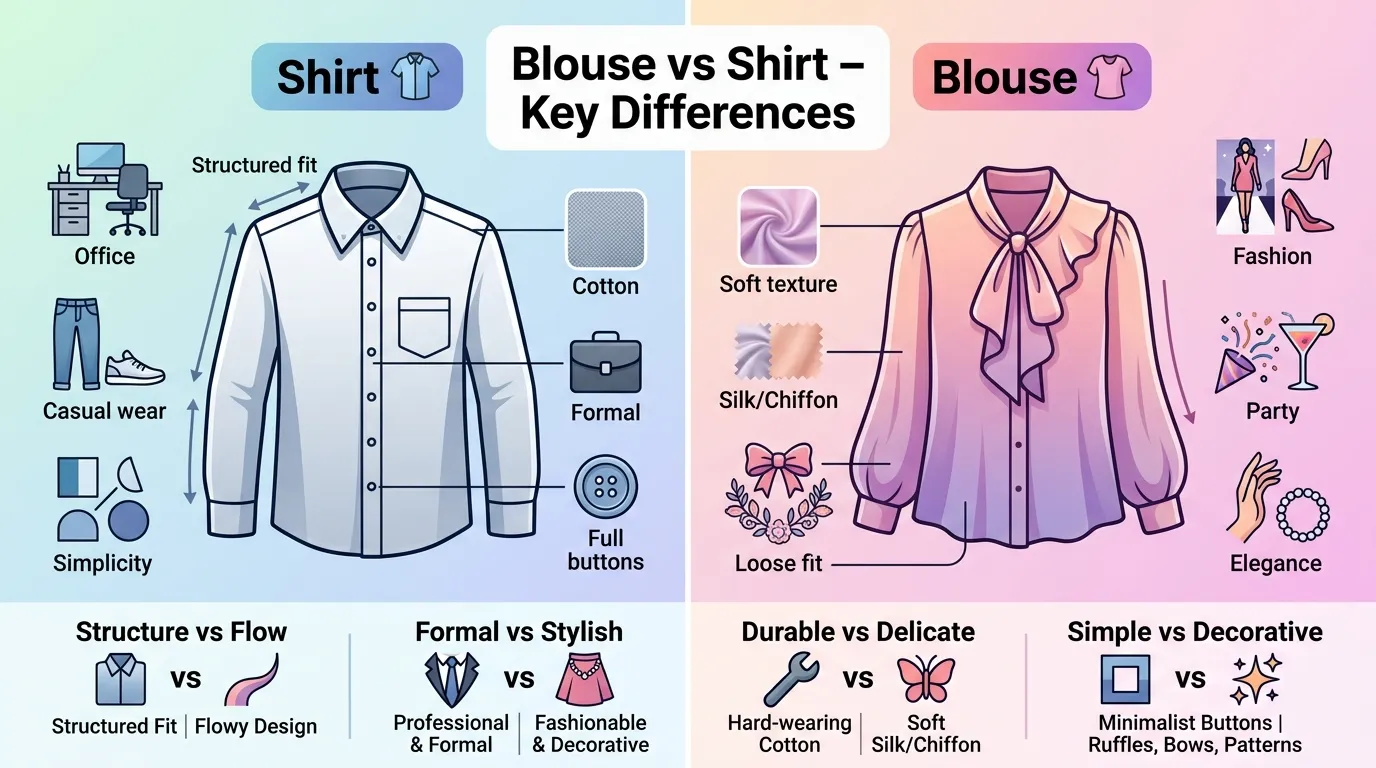
A blouse is typically a women’s upper-body garment made from lightweight fabrics and often includes decorative or feminine design elements.
A shirt is a structured upper-body garment with a collar, button-front closure, and a more formal or versatile design.
Example: A silk top worn with a skirt for an office meeting is usually called a blouse, while a button-down cotton garment worn with trousers is generally called a shirt.
Definition of Blouse and Shirt
- Blouse: A loose or fitted upper-body garment, usually designed for women and often made from soft, flowing fabrics such as silk, chiffon, or satin.
- Shirt: A structured garment with sleeves, collar, and front buttons, designed for men, women, or unisex wear in both casual and formal settings.
Example: A chiffon office top is often a blouse, whereas an Oxford button-down is a shirt.
Pronunciation of Both Terms
| Word | US Pronunciation | UK Pronunciation |
|---|---|---|
| Blouse | /blaʊs/ | /blaʊs/ |
| Shirt | /ʃɝːt/ | /ʃɜːt/ |
Now that you know what each garment means, let’s explore the key differences in detail.
Blouse vs Shirt Comparison Table
| Feature | Blouse | Shirt |
|---|---|---|
| Primary Audience | Mostly women | Men, women, and unisex |
| Fabric | Soft and flowing | Structured and firm |
| Collar | Optional | Usually included |
| Buttons | May or may not have buttons | Typically button-front |
| Fit | More tailored or relaxed | More structured |
| Design | Decorative details common | Simpler design |
| Formality | Business casual to elegant | Casual to formal |
| Styling | Often paired with skirts | Common with trousers and jeans |
| Fashion Purpose | Stylish appearance | Functional and versatile |
| Construction | Fashion-focused | Utility-focused |
Key Differences Explained Between Blouse and Shirt
1. Purpose of Design
A blouse is often designed to enhance style and elegance.
A shirt is generally designed for practicality and versatility.
Example: Office professionals may choose a blouse for a polished feminine look and a shirt for a classic business appearance.
2. Fabric Selection
Blouses commonly use lighter materials like chiffon, satin, silk, and rayon.
Shirts frequently use cotton, Oxford cloth, linen, or blends.
3. Structure
Shirts have a more rigid construction.
Blouses often feature softer draping and movement.
4. Collar Style
Many shirts include standard collars.
Blouses may have ruffles, V-necks, tie-necks, or collarless designs.
5. Decorative Features
Blouses frequently include bows, lace, pleats, or embroidery.
Shirts tend to maintain a cleaner, simpler appearance.
6. Professional Appearance
Both can be professional, but they create different impressions.
A blouse often appears more fashionable, while a shirt appears more traditional.
7. Gender Association
Historically, blouses were associated with women’s fashion.
Shirts have long been worn by all genders.
8. Styling Flexibility
Shirts transition easily between casual and formal settings.
Blouses excel in professional and dressier environments.
Why Does the Difference Between Blouse and Shirt Exist?
Fashion evolved to meet different social and functional needs.
Historically, shirts were undergarments before becoming everyday outerwear. Their structure made them suitable for work, uniforms, and professional settings.
Blouses developed as women’s fashion expanded, offering greater variety in fabrics, cuts, and decorative elements. Designers created blouses to provide elegance while maintaining comfort.
Today, fashion trends have blurred some boundaries, but the traditional distinctions still influence clothing labels and consumer expectations.
How Does a Blouse Fit Compared to a Shirt?
Fit is one of the easiest ways to identify the difference.
Blouse Fit
- Often designed around body contours
- May drape naturally
- Can include gathered fabric
- Usually prioritizes style and comfort
Shirt Fit
- More structured silhouette
- Defined shoulder seams
- Straight or tailored cut
- Designed for consistency and function
In real scenarios, most beginners identify garments by fit before noticing fabric or construction.
Which Fabrics Are Commonly Used for Blouses and Shirts?
Popular Blouse Fabrics
- Silk
- Satin
- Chiffon
- Georgette
- Rayon
- Crepe
These fabrics create a flowing appearance.
Popular Shirt Fabrics
- Cotton
- Oxford cloth
- Linen
- Flannel
- Twill
- Polyester blends
These fabrics provide durability and structure.
The fabric choice alone often reveals whether a garment is intended to be a blouse or a shirt.
Difference Between Blouse and Shirt in Professional Fashion
Modern workplaces accept both garments.
When a Blouse Works Best
- Business casual offices
- Client meetings
- Presentations
- Corporate events
When a Shirt Works Best
- Formal business environments
- Uniform requirements
- Executive settings
- Traditional workplaces
Many companies showcased on professional networks and business platforms emphasize polished dress codes where both garments have a place.
Are Blouses and Shirts Used Differently in Modern Fashion?
Fashion trends have evolved significantly.
Social media platforms such as Instagram and fashion content creators often use the terms interchangeably. However, clothing retailers still categorize them separately because shoppers search for different styles and fits.
A fashion brand may label a flowing satin top as a blouse while labeling a structured button-down version as a shirt.
Understanding these distinctions helps consumers make better purchasing decisions online.
Difference and Similarity Between Blouse and Shirt
| Feature | Blouse | Shirt | Similarity |
|---|---|---|---|
| Meaning | Fashion-focused upper garment | Structured upper garment | Both cover the upper body |
| Fabric | Soft and lightweight | Structured and durable | Both use textile fabrics |
| Gender Use | Primarily women | All genders | Both can be worn by women |
| Collar | Optional | Usually present | Both may include collars |
| Buttons | Sometimes included | Common feature | Both may have buttons |
| Formal Use | Business casual and dressy | Business and formal | Both suit professional settings |
| Styling | Decorative | Functional | Both pair with various outfits |
| Fashion Category | Women’s apparel | General apparel | Both are clothing items |
This table clearly shows the difference and similarity between blouse and shirt for quick understanding.
Common Mistakes With Difference Between Blouse and Shirt
Mistake 1: Assuming Every Women’s Top Is a Blouse
Not every women’s top qualifies as a blouse. T-shirts, tunics, and sweaters are different garment categories.
Mistake 2: Thinking Shirts Are Only for Men
Modern fashion includes women’s shirts, oversized shirts, and fitted shirts.
Mistake 3: Ignoring Fabric Type
Fabric often provides the strongest clue about classification.
Mistake 4: Focusing Only on Buttons
Some blouses have buttons, and some shirts have hidden plackets.
Mistake 5: Using Retail Labels as Universal Rules
Different brands may classify similar garments differently.
Real-Life Examples With Difference Between Blouse and Shirt
Scenario 1: Office Meeting
A marketing manager wears a silk blouse with tailored pants.
Scenario 2: Business Conference
An executive wears a white button-down shirt with a blazer.
Scenario 3: Casual Weekend
A person wears a linen shirt with jeans.
Scenario 4: Dinner Event
A satin blouse paired with a skirt creates an elegant appearance.
Scenario 5: Retail Uniform
Employees often wear structured shirts because they appear professional and durable.
When to Use Each
Choose a Blouse When:
- You want a softer appearance.
- You prefer elegant fabrics.
- You need a business-casual look.
- You want decorative details.
Choose a Shirt When:
- You need a classic professional outfit.
- You want versatility.
- You prefer structured clothing.
- You require durability for daily wear.
A practical rule is simple: choose a blouse for style-focused outfits and a shirt for structure-focused outfits.
Why People Get Confused in Difference Between Blouse and Shirt
Several factors create confusion:
Changing Fashion Trends
Modern designs blend characteristics of both garments.
Regional Language Differences
Some countries use “shirt” broadly for many upper garments.
Retail Marketing
Brands sometimes label similar products differently.
Social Media Influence
Fashion influencers may use the terms interchangeably.
E-Commerce Descriptions
Online stores often prioritize search behavior rather than strict fashion definitions.
Expert Insight
From a fashion and apparel perspective, the distinction between a blouse and a shirt comes down to construction, intended style, and fabric behavior rather than gender alone.
In practical use, many modern garments exist in a gray area between the two categories. Professional stylists often evaluate fabric, silhouette, collar design, and garment structure before assigning a label.
The most reliable approach is to focus on how the garment is constructed and how it functions within an outfit rather than relying solely on marketing descriptions.
Frequently Asked Questions (FAQs)
Is a blouse the same as a shirt?
No. A blouse is generally softer and more fashion-oriented, while a shirt is usually more structured and functional.
Can women wear shirts instead of blouses?
Yes. Many women wear shirts for business, casual, and formal occasions.
What makes a blouse different from a shirt?
The main differences are fabric, fit, structure, and design details.
Is a button-down always a shirt?
Most button-down garments are shirts, but some fashion blouses also include buttons.
Which is more formal, a blouse or a shirt?
Both can be formal depending on fabric, tailoring, and styling.
Can a blouse have a collar?
Yes. Some blouses include collars, although many do not.
Are silk tops considered blouses?
In most cases, yes, especially when they have a flowing design.
Why do clothing stores separate blouses and shirts?
Because shoppers often search for different styles, fits, and fashion purposes.
Can a shirt be fashionable?
Absolutely. Modern shirts come in many stylish designs and cuts.
How can I quickly tell the difference?
Check the fabric and structure. Soft draping usually suggests a blouse, while a structured design usually indicates a shirt.
Conclusion
Understanding the difference between blouse and shirt becomes much easier when you focus on their purpose, construction, and styling. A blouse is typically softer, more decorative, and designed to create an elegant appearance, while a shirt is structured, versatile, and often associated with classic professional or casual wear.
Although modern fashion has blurred the boundaries between these garments, the core distinctions remain relevant. Fabric choice, collar style, fit, and overall design provide the clearest clues. In real-world situations, a flowing silk garment is generally considered a blouse, while a structured button-down garment is usually classified as a shirt.

Sarfraz Ahmad is language researcher and content writer who specializes in explaining the difference between commonly confused English words. Through WordClearify, learners understand subtle word distinctions in a simple, structured, and practical way. My writing focuses on clarity, real-life examples, and easy comparisons for students, bloggers, and professionals worldwide.