Many users get confused when comparing Production vs Manufacturing because both terms are often used interchangeably. In reality, they are closely related but not identical. Understanding the difference between production and manufacturing is important for students, business owners, supply chain professionals, and anyone involved in creating goods or services.
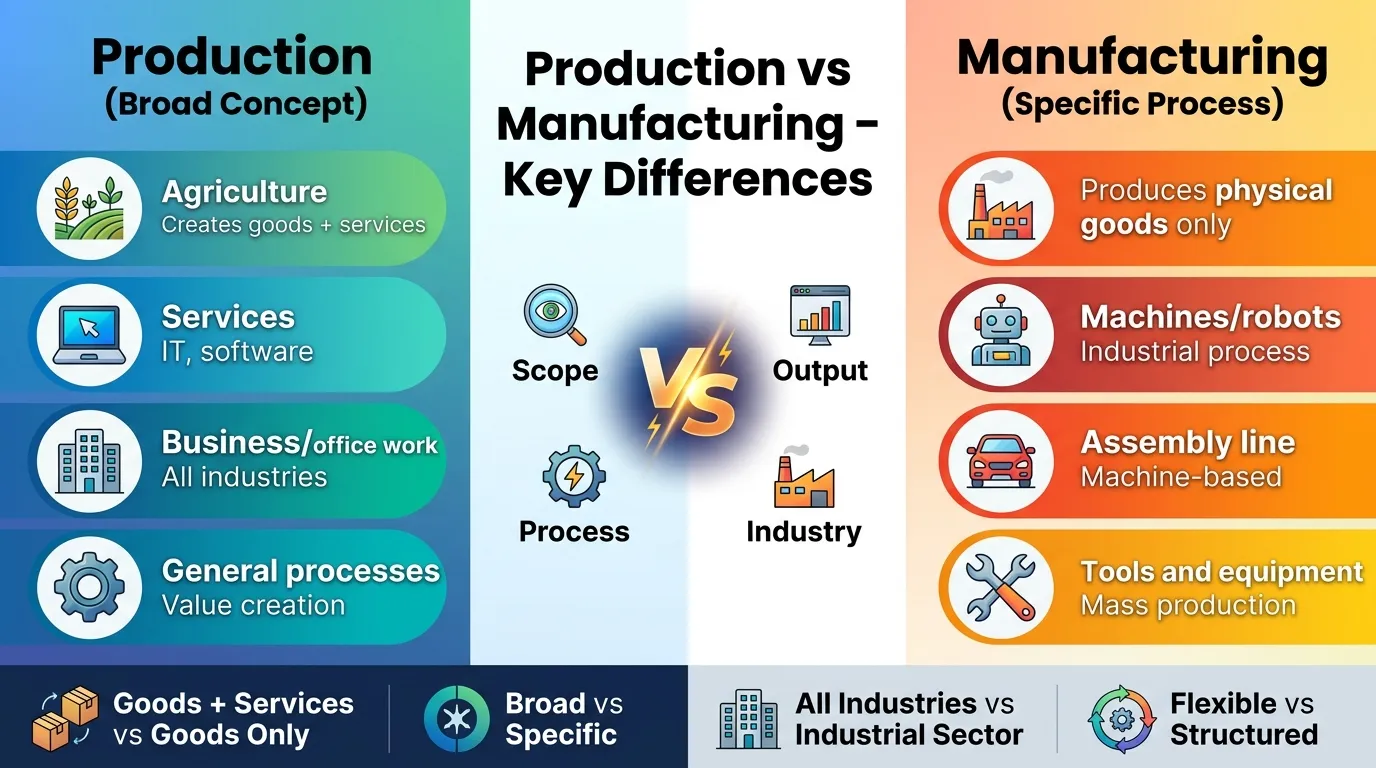
In simple words, production vs manufacturing is a comparison between a broad process and a specific industrial process. Production covers the creation of both goods and services, while manufacturing focuses on converting raw materials into finished physical products.
If you’ve ever wondered what is production, what is manufacturing, how manufacturing differs from production, or which term should be used in business and industry, this guide provides complete answers. You’ll learn definitions, examples, similarities, differences, practical applications, and expert insights in one place.
Quick Answer: Production vs Manufacturing
Production is the overall process of creating goods or services to satisfy customer needs.
Manufacturing is a specific type of production that converts raw materials into finished products using machinery, tools, and labor.
Example: A software company produces digital services, but it does not manufacture them. A car factory both produces and manufactures vehicles.
Definition of Production vs Manufacturing
- Production: The process of creating goods or services by combining resources such as labor, technology, capital, and materials.
- Manufacturing: The process of transforming raw materials into finished physical products through machinery, equipment, and industrial operations.
Simple Example:
A restaurant produces meals, while a furniture factory manufactures chairs and tables.
Pronunciation of Both Terms (US & UK)
| Term | US Pronunciation | UK Pronunciation |
|---|---|---|
| Production | pruh-DUK-shun | pruh-DUK-shun |
| Manufacturing | man-yuh-FAK-chur-ing | man-yuh-FAK-chuh-ring |
Now that the definitions are clear, let’s understand the deeper differences and why these terms matter in modern business and industry.
Production vs Manufacturing Comparison Table
| Comparison Point | Production | Manufacturing |
|---|---|---|
| Meaning | Creation of goods or services | Creation of physical products |
| Scope | Broad concept | Specific process |
| Output | Goods and services | Tangible goods only |
| Raw Materials | May or may not be required | Always required |
| Machinery Use | Optional | Usually essential |
| Industry Type | All industries | Industrial sectors |
| Examples | Education, healthcare, software | Automobiles, electronics, furniture |
| Value Creation | Through services or products | Through physical transformation |
| Flexibility | Wider application | More specialized |
| Economic Category | Primary, secondary, tertiary sectors | Mainly secondary sector |
Mini Summary
Every manufacturing activity is production, but not every production activity is manufacturing.
Key Differences Explained Between Production vs Manufacturing
1. Scope of Activity
Production is much broader.
Manufacturing is only one category within production.
Example: Teaching students is production of educational services but not manufacturing.
2. Type of Output
Production can create products or services.
Manufacturing creates only physical goods.
Example: Streaming platforms produce entertainment services while smartphone factories manufacture devices.
3. Requirement for Raw Materials
Manufacturing requires raw materials.
Production may not always require physical materials.
Example: Consulting firms provide services without producing physical products.
4. Machinery Dependence
Manufacturing often relies heavily on machinery.
Production can be manual, digital, or service-based.
5. Industry Application
Production applies across all sectors.
Manufacturing mainly belongs to industrial operations.
6. Value Creation Method
Production creates utility and customer value.
Manufacturing creates value by physically transforming materials.
7. Measurement Metrics
Production often measures output volume and service delivery.
Manufacturing tracks efficiency, defects, quality control, and throughput.
8. Supply Chain Role
Manufacturing is usually one stage within the larger production process.
Production includes planning, sourcing, operations, delivery, and customer fulfillment.
Why Does Production Exist?
Production exists because people have needs and wants.
Businesses combine resources to create value for consumers.
Without production:
- No products
- No services
- No economic growth
- No employment opportunities
Whether a company develops software, delivers healthcare, or builds automobiles, production remains the foundation of economic activity.
How Does Manufacturing Work?
Manufacturing follows a structured process:
- Raw material sourcing
- Product design
- Processing and assembly
- Quality control
- Packaging
- Distribution
For example, a smartphone manufacturer sources metals, semiconductors, and components before assembling them into a finished device.
Modern manufacturing increasingly uses automation, robotics, artificial intelligence, and smart factory systems.
Production vs Manufacturing in Real Business Operations
In practical business environments, the distinction becomes very important.
A company like Google produces digital services such as search, cloud solutions, and advertising platforms.
A company like Tesla manufactures electric vehicles while also producing software-based services.
Similarly, Meta produces social media platforms and digital experiences but does not primarily manufacture physical products.
This demonstrates how production extends beyond factories into the digital economy.
Where Is Production Used Today?
Production exists in nearly every sector:
Service Industry
- Healthcare
- Banking
- Education
- Tourism
Technology Industry
- Software development
- Cloud computing
- Digital marketing
Industrial Sector
- Automotive manufacturing
- Electronics manufacturing
- Food processing
Creative Industry
- Video creation
- Music production
- Content production
Platforms like YouTube and Instagram support content production even though no manufacturing occurs.
What Are the Similarities Between Production and Manufacturing?
Although different, they share several characteristics:
| Similarity | Explanation |
|---|---|
| Value Creation | Both create value for customers |
| Resource Usage | Both use labor, capital, and technology |
| Business Goal | Both aim to satisfy demand |
| Economic Contribution | Both support economic growth |
| Process-Oriented | Both follow organized workflows |
| Quality Focus | Both require quality standards |
| Customer Satisfaction | Both seek positive outcomes |
| Efficiency Importance | Both benefit from optimization |
Difference and Similarity Table for Production vs Manufacturing
| Feature | Production | Manufacturing | Similarity |
|---|---|---|---|
| Meaning | Creates goods or services | Creates physical products | Both create value |
| Output | Tangible and intangible | Tangible only | Both generate outputs |
| Industry Use | All sectors | Industrial sectors | Both support business operations |
| Raw Materials | Optional | Required | Both use resources |
| Technology | May or may not be used | Frequently used | Technology improves efficiency |
| Workforce | Service and product workers | Factory workers and engineers | Human skills remain important |
| Goal | Meet customer needs | Produce usable products | Customer satisfaction matters |
| Economic Role | Broad economy | Industrial economy | Both drive growth |
This table clearly shows the difference and similarity between Production vs Manufacturing for quick understanding.
Common Mistakes with Production vs Manufacturing
Mistake 1: Assuming They Mean Exactly the Same Thing
Correction: Manufacturing is only one type of production.
Mistake 2: Thinking Services Cannot Be Produced
Correction: Services are produced even when no physical product exists.
Mistake 3: Using Manufacturing for Digital Products
Correction: Software is produced, not manufactured.
Mistake 4: Ignoring Industry Context
Correction: Business context often determines the correct term.
Mistake 5: Believing Factories Represent All Production
Correction: Production occurs far beyond factory environments.
Real-Life Examples with Production vs Manufacturing
Example 1: Restaurant Business
Meals are produced and served.
No manufacturing takes place.
Example 2: Car Factory
Vehicles are manufactured and produced.
Both terms apply.
Example 3: Software Company
Applications are produced.
Manufacturing does not occur.
Example 4: Furniture Industry
Wood becomes tables and chairs.
Manufacturing is clearly involved.
Example 5: Online Content Creator
Videos for YouTube are produced.
No manufacturing is required.
Example 6: Pharmaceutical Plant
Medicines are manufactured under controlled industrial processes.
When to Use Each?
Use “Production” When:
- Discussing services
- Talking about broad business operations
- Referring to overall output creation
- Describing digital products
Use “Manufacturing” When:
- Discussing factories
- Referring to physical products
- Talking about industrial processes
- Explaining material transformation
A simple rule:
If raw materials become physical products, use manufacturing. If value is being created generally, use production.
Why People Get Confused in Production vs Manufacturing
Several factors cause confusion:
Overlapping Usage
Many companies use both terms interchangeably.
Business Language
Corporate reports often simplify terminology.
Educational Differences
Different textbooks explain the concepts differently.
Industrial Influence
Manufacturing industries dominate discussions about production.
Everyday Conversations
People naturally associate production with factories.
Expert Insight
From an operations management perspective, the most important concept to remember is that manufacturing represents a subset of production.
In real scenarios, organizations increasingly blend physical and digital outputs. A modern automotive company may manufacture vehicles while simultaneously producing software updates, customer support services, and connected mobility solutions.
Most beginners focus only on factories. Industry professionals focus on value creation across the entire business ecosystem. That broader perspective helps explain why production remains the larger concept.
Frequently Asked Questions (FAQ)
Is production the same as manufacturing?
No. Manufacturing is a type of production focused on physical products.
Which is broader, production or manufacturing?
Production is broader because it includes both goods and services.
Is manufacturing always production?
Yes. Manufacturing is a subset of production.
Why do businesses use both terms?
Because some organizations create both physical products and services.
What is an example of manufacturing?
Building cars, electronics, furniture, or appliances.
What is an example of production?
Teaching, software development, healthcare, and content creation.
Does manufacturing require machinery?
Usually yes, although manual manufacturing can exist.
Why is understanding the difference important?
It improves communication in business, economics, operations, and supply chain management.
Conclusion
Understanding Production vs Manufacturing becomes much easier when you recognize the relationship between the two concepts. Production is the broader process of creating value through goods or services, while manufacturing is a specialized process that transforms raw materials into physical products.
The key takeaway is simple: all manufacturing is production, but not all production is manufacturing. A factory manufacturing automobiles, a software company developing applications, and a hospital delivering healthcare services are all involved in production, yet only some engage in manufacturing.
If someone asks for the difference between production and manufacturing, the most accurate answer is this: production creates value; manufacturing creates physical products as part of that value-creation process.

Sarfraz Ahmad is language researcher and content writer who specializes in explaining the difference between commonly confused English words. Through WordClearify, learners understand subtle word distinctions in a simple, structured, and practical way. My writing focuses on clarity, real-life examples, and easy comparisons for students, bloggers, and professionals worldwide.