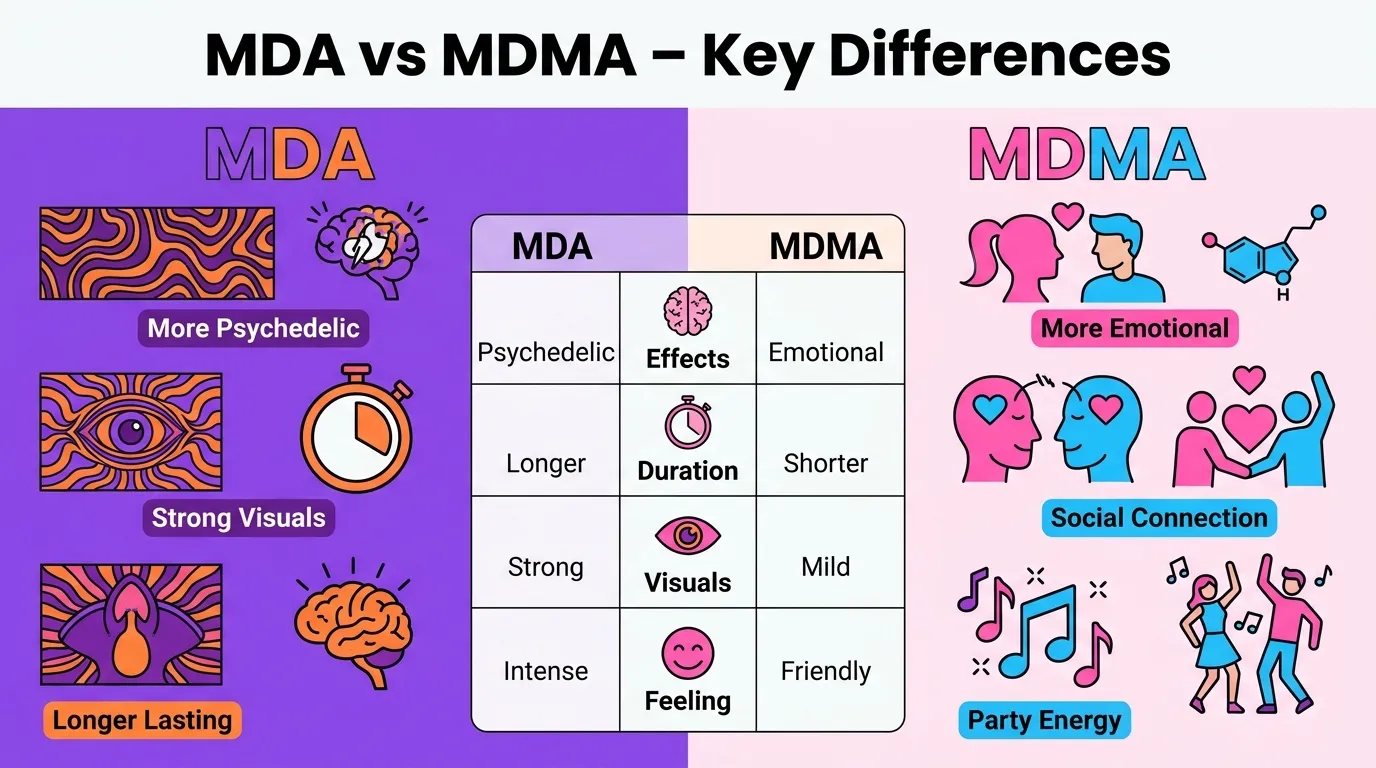
Many users get confused when searching for the difference between MDA and MDMA because both substances sound similar and belong to the same chemical family. However, they are not exactly the same. MDMA is mainly known for emotional warmth, empathy, and social connection, while MDA is usually stronger in terms of psychedelic and visual effects.
In simple words, the difference between both comes down to how each substance affects the brain, emotions, energy levels, and perception. MDMA is often associated with party culture, therapy research, and emotional openness, whereas MDA is considered more intense, longer-lasting, and visually stimulating.
In this guide, you’ll learn:
- what MDA and MDMA actually are
- how they work differently
- key similarities and risks
- real-world examples
- why people often confuse the two
This article explains everything in simple language while still giving expert-level depth and trustworthy information.
Quick Answer: Difference Between MDA and MDMA
MDA and MDMA are stimulant and psychedelic drugs from the amphetamine family, but they produce different experiences.
- MDMA is usually more emotional, empathic, and social.
- MDA is often stronger visually, longer-lasting, and more psychedelic.
For example, someone using MDMA at a music event may feel emotionally connected and energetic, while MDA may create stronger hallucination-like visuals and a heavier mental experience.
Definition of MDA and MDMA
- MDA (3,4-Methylenedioxyamphetamine): A psychoactive stimulant and hallucinogenic drug known for stronger psychedelic effects and longer duration.
- MDMA (3,4-Methylenedioxymethamphetamine): A psychoactive drug commonly associated with empathy, emotional openness, energy, and social connection.
Simple Example
MDMA is often called more “heart-opening,” while MDA is considered more “mind-altering” and visual.
Pronunciation of Both Terms
| Term | US Pronunciation | UK Pronunciation |
|---|---|---|
| MDA | em-dee-ay | em-dee-ay |
| MDMA | em-dee-em-ay | em-dee-em-ay |
MDA vs MDMA: Effects, Risks & Key Differences (Comparison Table)
| Feature | MDA | MDMA | Similarity |
|---|---|---|---|
| Full Form | Methylenedioxyamphetamine | Methylenedioxymethamphetamine | Both belong to the amphetamine family |
| Main Effect | More psychedelic and stimulating | More empathic and emotional | Both affect serotonin and dopamine |
| Emotional Feeling | Less emotional warmth | Strong emotional connection | Both can change mood |
| Visual Effects | Stronger visuals and distortions | Mild visuals in some cases | Both alter perception |
| Duration | Usually longer lasting | Slightly shorter duration | Both effects can last several hours |
| Energy Level | Intense stimulation | Energetic but smoother | Both increase activity and alertness |
| Social Experience | Can feel more intense or detached | Often highly social | Both common in party settings |
| Brain Impact | Stronger neurotoxic concern in some studies | Also carries neurological risks | Both may affect serotonin systems |
This table clearly shows the difference and similarity between MDA and MDMA for quick understanding.
Key Differences Explained Between Difference Between MDA and MDMA
1. Emotional vs Psychedelic Experience
MDMA is usually associated with emotional warmth and empathy. Users often report feeling emotionally open and connected to others.
MDA, on the other hand, tends to feel more psychedelic. Visual distortions, enhanced colors, and altered thinking are more common.
In real scenarios, festival-goers often describe MDMA as “social,” while MDA feels “trippy.”
2. Duration of Effects
MDA generally lasts longer than MDMA.
- MDMA effects may last around 4–6 hours.
- MDA can continue for 6–8 hours or more.
This longer duration is one reason experienced users distinguish the two quickly.
3. Visual Hallucinations
One major difference between MDA and MDMA is visual intensity.
MDA can produce:
- moving patterns
- enhanced lights
- visual distortions
MDMA usually creates emotional enhancement rather than strong visuals.
4. Body Stimulation
Both substances stimulate the nervous system, but MDA often feels physically heavier and more intense.
Some users report:
- jaw tension
- increased heart rate
- stronger stimulation
MDMA is typically described as smoother and more manageable socially.
5. Neurochemical Effects
Both affect serotonin, dopamine, and norepinephrine systems in the brain.
However:
- MDMA strongly boosts empathy-related serotonin release.
- MDA may produce more dopamine-related stimulation and psychedelic activity.
This explains why the experiences feel different even though the chemicals are closely related.
6. Street Market Confusion
Many people accidentally consume one thinking it is the other.
In illegal markets:
- pills may be mislabeled
- substances may be mixed
- purity varies heavily
That confusion drives huge search interest around “difference between MDA and MDMA.”
Why Do MDA and MDMA Exist Separately?
Chemically, MDA and MDMA are very similar, but one small molecular change creates a noticeable shift in how the brain processes them.
MDMA includes an additional methyl group, which changes:
- emotional intensity
- serotonin interaction
- hallucinogenic strength
This is a good example of how tiny chemical changes can produce dramatically different psychological experiences.
How Does MDMA Work in the Brain?
MDMA mainly increases serotonin activity.
Serotonin is linked to:
- mood
- empathy
- emotional bonding
- happiness
That’s why many users describe feelings of closeness and emotional openness.
In practical use, therapists and researchers have studied MDMA-assisted therapy in controlled medical environments for trauma-related conditions. However, recreational use carries serious risks and legal consequences.
How Does MDA Affect the Brain Differently?
MDA affects serotonin too, but it also produces stronger stimulant and psychedelic effects.
Many users experience:
- sensory enhancement
- altered visual perception
- mental overstimulation
Most beginners underestimate how intense MDA can feel compared to MDMA.
That difference becomes important in nightlife settings, especially where substances are not properly identified.
Difference Between both in Real-World Use
Music Festivals and Club Culture
MDMA became strongly associated with rave and electronic music culture because of its emotional and social effects.
MDA appears less common but is often discussed in underground party scenes due to stronger visuals.
Platforms like YouTube and Instagram have influenced how these drugs are portrayed online, sometimes creating misleading impressions.
Research and Medical Interest
MDMA has received more scientific attention for therapeutic research.
MDA has far less medical focus because:
- effects are less predictable
- psychedelic intensity is higher
- safety concerns remain significant
User Experience Differences
In practical scenarios:
- MDMA users often seek emotional connection
- MDA users may seek stronger sensory experiences
This behavioral difference shapes how both substances are discussed online and in harm-reduction communities.
Similarities Between both
Even though users focus on the difference between MDA and MDMA, they also share many similarities.
Shared Characteristics
- Both are psychoactive amphetamines
- Both affect serotonin levels
- Both are illegal in many countries
- Both can increase energy and mood
- Both carry physical and mental health risks
This overlap is exactly why confusion happens so often.
Why People Get Confused in Difference Between MDA and MDMA
Similar Names
The names look almost identical, especially for beginners.
Similar Street Culture
Both substances appear in:
- party environments
- rave culture
- online forums
Misleading Media Discussions
Social media discussions on Meta platforms and short-form content often oversimplify effects, making the substances sound interchangeable.
Counterfeit Products
Illegal pills and powders may contain:
- mixed compounds
- unknown chemicals
- inaccurate labeling
This creates major confusion and risk.
Common Mistakes with Difference Between MDA and MDMA
| Mistake | Why It Happens | Correct Understanding |
|---|---|---|
| Thinking they are identical | Similar names | Effects differ significantly |
| Assuming both are equally emotional | Internet myths | MDA is usually more psychedelic |
| Ignoring duration differences | Lack of research | MDA often lasts longer |
| Trusting unverified pills | Counterfeit market | Contents may differ entirely |
| Believing “natural” means safe | Online misinformation | Both carry serious risks |
Real Life Examples with Difference Between MDA and MDMA
1. Beginner Party User
A new user expects emotional warmth from a pill but experiences intense visuals because it contains MDA instead of MDMA.
2. Music Festival Scenario
Someone using MDMA feels socially connected and energetic throughout a concert.
3. Online Community Discussions
Users on forums compare “rolling” on MDMA versus stronger psychedelic experiences with MDA.
4. Harm Reduction Testing
Experienced users often use testing kits to identify substances before consumption because appearance alone is unreliable.
When to Use Each (Educational Context Only)
This section is purely educational and not a recommendation for drug use.
MDMA Discussions Usually Focus On
- emotional openness
- therapy research
- social connection
MDA Discussions Usually Focus On
- psychedelic experiences
- visual effects
- longer duration
Understanding these contexts helps explain why search intent around these terms differs.
Expert Insight
From a health education perspective, the most important issue is not just the chemical difference between MDA and MDMA — it is unpredictability.
In real scenarios, many users never truly know what substance they are consuming because illegal drug markets lack quality control. That uncertainty increases health risks significantly.
Health professionals and harm-reduction organizations consistently emphasize:
- education
- testing awareness
- hydration safety
- avoiding substance mixing
Most beginners underestimate how powerful these compounds can be on mood, body temperature, and brain chemistry.
FAQ
Is MDA stronger than MDMA?
MDA is often considered more intense visually and mentally, while MDMA is usually more emotional and empathic.
What is the main difference between both?
The biggest difference is effect style. MDMA is more social and emotional, while MDA is more psychedelic and stimulating.
Does MDA last longer than MDMA?
Yes. MDA generally lasts longer than MDMA.
Why do people confuse MDA and MDMA?
Because the names, appearance, and environments where they are used are very similar.
Are MDA and MDMA chemically related?
Yes. Both belong to the amphetamine family and affect serotonin systems.
Which causes stronger visuals?
MDA usually produces stronger visual effects.
Is MDMA used in therapy research?
Yes. Researchers have explored MDMA-assisted therapy in controlled clinical settings.
Are both substances risky?
Yes. Both can impact physical and mental health and may become dangerous in uncontrolled environments.
Conclusion
Understanding the difference between MDA and MDMA is important because the two substances may appear similar but can produce very different experiences and risks. MDMA is generally associated with emotional openness, empathy, and social energy, while MDA is known for stronger psychedelic effects, longer duration, and more intense sensory changes.
Many users get confused because the names are nearly identical, online discussions often oversimplify the topic, and illegal markets frequently mislabel substances. In practical terms, this confusion can create serious health risks.
The key takeaway is simple:
- MDMA tends to feel more emotional and socially focused.
- MDA tends to feel more visual, stimulating, and psychedelic.

Sarfraz Ahmad is language researcher and content writer who specializes in explaining the difference between commonly confused English words. Through WordClearify, learners understand subtle word distinctions in a simple, structured, and practical way. My writing focuses on clarity, real-life examples, and easy comparisons for students, bloggers, and professionals worldwide.