The Difference Between Ecstasy and Molly is one of the most searched questions related to party drugs, club culture, and MDMA. Many users get confused because the two terms are often used interchangeably. However, the difference between Ecstasy and Molly is not always about the active ingredient—it’s often about purity, form, and the risk of contamination.
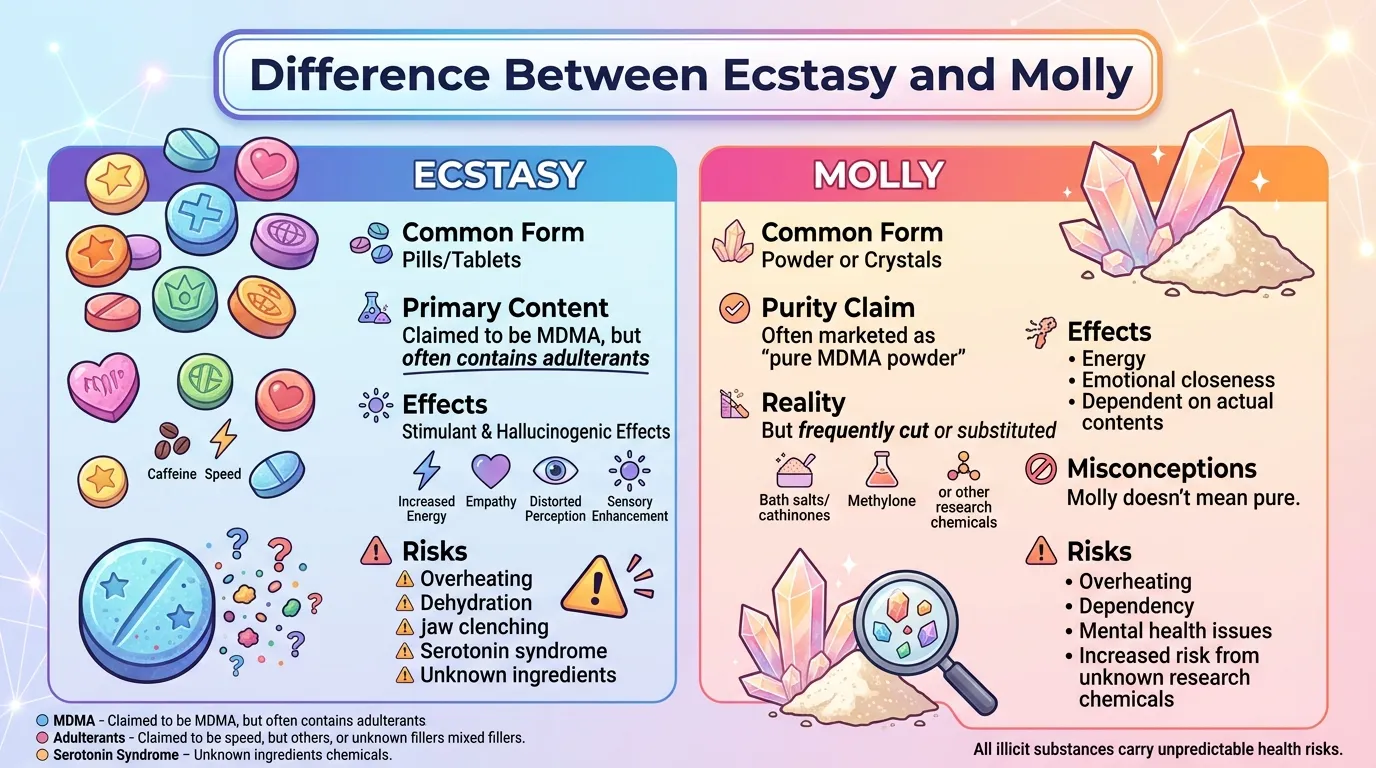
In simple words, both Ecstasy and Molly are commonly associated with MDMA, a synthetic psychoactive substance. The key difference is that Ecstasy is usually sold as tablets, while Molly is typically sold as a powder or capsule and marketed as a “pure” form of MDMA. Understanding this distinction is important because purity claims are not always accurate.
In this guide, you’ll learn what Ecstasy and Molly are, how they differ, why people confuse them, potential risks, real-world examples, and what health experts want people to know.
Quick Answer: Difference Between Ecstasy and Molly
Ecstasy and Molly both generally refer to products that contain MDMA, but they are usually sold in different forms.
- Ecstasy: Commonly sold as tablets or pills and may contain MDMA mixed with other substances.
- Molly: Usually sold as powder or capsules and often marketed as pure MDMA, though it may also contain other ingredients.
Example: A person buying a colorful tablet at a music festival may be purchasing Ecstasy, while someone buying a capsule containing powder may be purchasing Molly.
Definition of Ecstasy and Molly
- Ecstasy: A street name for tablets that often contain MDMA and may include additional substances or fillers.
- Molly: A street name generally used for powder or capsule forms marketed as pure MDMA.
Example: Both products may contain MDMA, but their composition and purity can vary significantly.
Pronunciation of Both Terms (US & UK)
Ecstasy
- US: /ˈek.stə.si/
- UK: /ˈek.stə.si/
Molly
- US: /ˈmɑː.li/
- UK: /ˈmɒl.i/
Now that we know the basic definitions, let’s understand where the confusion comes from and why the difference matters in real-world situations.
Ecstasy vs Molly Comparison Table
| Feature | Ecstasy | Molly |
|---|---|---|
| Common Form | Tablet or pill | Powder or capsule |
| Marketing | Party drug tablet | Marketed as pure MDMA |
| Appearance | Often colorful and stamped | Usually white or off-white powder |
| Purity Claims | Rarely advertised as pure | Often advertised as pure |
| Risk of Adulterants | High | Can also be high |
| Street Perception | Traditional club drug | Seen as a modern version |
| Packaging | Pill form | Capsule or powder packets |
| User Expectations | Mixed ingredients possible | Users often expect purity |
Key Differences Explained Between Difference Between Ecstasy and Molly
1. Physical Form
The easiest way to identify the difference is appearance.
Ecstasy usually comes as a pill.
Molly is usually sold as powder or capsules.
Real-life example: Someone at a nightclub may receive a pressed tablet, while someone at a music festival may receive a capsule containing powder.
2. Purity Expectations
Many users believe Molly is pure MDMA.
In reality, laboratory testing frequently finds unexpected substances in both products.
User intent insight: People often search “Is Molly safer than Ecstasy?” because of this common assumption.
3. Marketing Image
Molly is often marketed as a cleaner or more natural product.
Ecstasy has historically been associated with colorful party pills.
4. Manufacturing Differences
Ecstasy requires pill pressing equipment.
Molly is usually packaged as powder or capsules.
5. User Perception
Many beginners assume Molly is safer.
Experts emphasize that appearance alone does not guarantee purity.
6. Street Terminology
Different regions and social groups may use the terms differently.
Sometimes both names are used interchangeably.
7. Risk of Unknown Ingredients
Both products can contain substances other than MDMA.
This is one of the biggest reasons health professionals caution against assuming either product is pure.
What Is MDMA and How Does It Relate to Ecstasy and Molly?
MDMA stands for 3,4-methylenedioxymethamphetamine.
It is a synthetic psychoactive substance that affects neurotransmitters such as serotonin, dopamine, and norepinephrine.
Many people searching for the difference between Ecstasy and Molly are actually trying to understand their relationship with MDMA.
In practical use:
- Ecstasy often contains MDMA.
- Molly often contains MDMA.
- Neither name guarantees purity.
Why Does the Difference Between Ecstasy and Molly Matter?
At first glance, the difference may seem like a simple naming issue.
However, understanding the distinction matters because users frequently make decisions based on assumptions about purity and safety.
Key Reasons It Matters
- Health risk awareness
- Consumer expectations
- Harm reduction education
- Drug testing considerations
- Public health messaging
Many health organizations emphasize that appearance and branding do not reliably indicate contents.
Why Do People Think Molly Is Pure MDMA?
This belief became popular through:
- Music festival culture
- Entertainment media
- Online discussions
- Social media platforms
Platforms such as Meta, Instagram, and YouTube have contributed to widespread conversations about Molly over the years.
However, health experts consistently warn that marketing language and user claims do not guarantee chemical purity.
Difference Between Ecstasy and Molly: Health and Safety Considerations
One of the most important aspects of this topic is safety.
Potential concerns include:
- Dehydration
- Overheating
- Increased heart rate
- Anxiety
- Sleep disruption
- Unknown contaminants
A major issue is that users often do not know exactly what a product contains.
This uncertainty can increase health risks.
Difference and Similarity Table Generation: Difference Between Ecstasy and Molly
| Feature | Ecstasy | Molly | Similarity |
|---|---|---|---|
| Meaning | Tablet form often linked to MDMA | Powder/capsule form linked to MDMA | Both are commonly associated with MDMA |
| Appearance | Pressed pill | Powder or capsule | Both sold in recreational settings |
| Purity Claims | Usually mixed | Often marketed as pure | Neither guarantees purity |
| Packaging | Pill form | Loose powder or capsules | Both can vary by source |
| Public Perception | Traditional club drug | Modern festival drug | Both share similar cultural associations |
| User Expectations | Mixed ingredients expected | Pure MDMA expected | Expectations may be inaccurate |
| Risk Factors | Unknown contents possible | Unknown contents possible | Both carry similar uncertainty |
| Terminology | Older street term | Newer street term | Both may refer to MDMA-containing products |
This table clearly shows the difference and similarity between Difference Between Ecstasy and Molly for quick understanding.
Common Mistakes with Difference Between Ecstasy and Molly
Mistake 1: Assuming Molly Is Always Pure
Correction: Purity varies widely.
Mistake 2: Believing Different Names Mean Different Drugs
Correction: Both terms are commonly associated with MDMA.
Mistake 3: Judging Safety by Appearance
Correction: Pills and powders can contain unexpected substances.
Mistake 4: Trusting Marketing Claims
Correction: Labels and street names are not reliable indicators.
Mistake 5: Ignoring Regional Language Differences
Correction: Usage of these terms can vary by location and culture.
Real-Life Examples with Difference Between Ecstasy and Molly
Personal Scenario
A college student hears friends refer to Molly as pure MDMA and assumes it is safer than Ecstasy.
Festival Scenario
An attendee purchases a capsule marketed as Molly but has no reliable way to verify its contents.
Public Health Scenario
Health educators explain that both terms may refer to products containing MDMA and potentially other substances.
Media Scenario
A documentary discusses Ecstasy use in the 1990s and Molly use in modern festival culture.
Research Scenario
Researchers analyze samples sold under both names and find significant variability in contents.
When to Use Each Term
Use “Ecstasy” When
- Referring to pill or tablet forms.
- Discussing historical club culture.
- Talking about pressed tablets sold under street names.
Use “Molly” When
- Referring to powder or capsule forms.
- Discussing modern festival culture.
- Describing products marketed as pure MDMA.
Why People Get Confused in Difference Between Ecstasy and Molly
Several factors create confusion:
Language Evolution
Street terminology changes over time.
Media Influence
Movies, music, and social media often blur distinctions.
Regional Differences
Different countries and communities use the terms differently.
Online Information Gaps
Search results may oversimplify the topic.
Expert Insight
From a public health and educational perspective, the most important insight is that the distinction between Ecstasy and Molly is often less significant than people assume.
In real scenarios, many users focus heavily on names and appearances while overlooking a more important issue: actual chemical content.
Health researchers and substance education specialists consistently emphasize that labels, colors, logos, and marketing claims do not guarantee purity or safety. The biggest misconception is not understanding the name itself—it’s assuming the name accurately describes what’s inside.
FAQ Section
What is the difference between Ecstasy and Molly?
Ecstasy is usually sold as a pill, while Molly is typically sold as powder or capsules.
Is Molly the same as MDMA?
Molly is commonly marketed as MDMA, but purity can vary.
Is Ecstasy stronger than Molly?
Strength depends on actual contents, not the name alone.
Why do people think Molly is safer?
Many believe it is purer, although that assumption may not always be correct.
Can Ecstasy and Molly contain the same substance?
Yes. Both may contain MDMA.
Which came first, Ecstasy or Molly?
Ecstasy became widely known earlier in club culture.
Are the effects different?
If both contain MDMA, effects may be similar, though contents can vary.
Why do search engines group these terms together?
Because users frequently search them as related concepts.
Is Molly always a powder?
Most commonly yes, but it may also appear in capsules.
Why is there so much confusion online?
Street terminology, media influence, and inconsistent information all contribute.
Conclusion
Understanding the Difference Between Ecstasy and Molly starts with recognizing that both terms are commonly associated with MDMA, yet they are usually presented in different forms. Ecstasy is typically sold as a pill or tablet, while Molly is commonly sold as a powder or capsule and often marketed as a purer option.
For beginners, intermediate readers, and even advanced researchers, the key lesson is to focus on accurate information rather than assumptions. When comparing Ecstasy and Molly, understanding the relationship with MDMA, purity concerns, and public health considerations provides a much clearer picture than relying on names alone.

Sarfraz Ahmad is language researcher and content writer who specializes in explaining the difference between commonly confused English words. Through WordClearify, learners understand subtle word distinctions in a simple, structured, and practical way. My writing focuses on clarity, real-life examples, and easy comparisons for students, bloggers, and professionals worldwide.