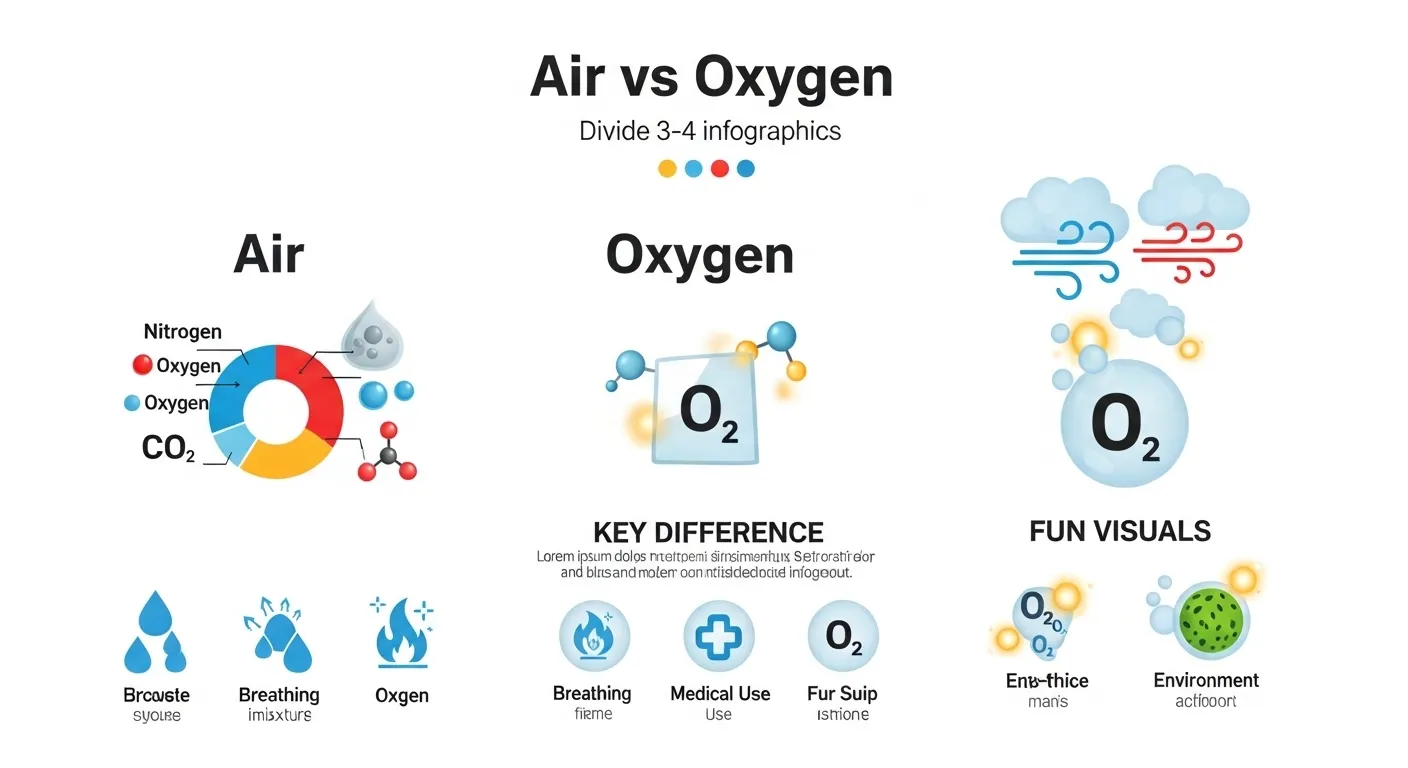
Many people think air and oxygen are the same thing, but they are actually different. This confusion is very common because both are connected to breathing and life. In simple words, oxygen is one gas, while air is a complete mixture of several gases found in Earth’s atmosphere.
Understanding the difference between air and oxygen helps students, beginners, and even professionals better understand breathing, health, science, and the environment. When users search questions like “what is air,” “what is oxygen,” or “how are air and oxygen different,” they usually want a simple and direct explanation without difficult scientific terms.
This guide explains everything clearly with tables, examples, practical uses, expert insights, and easy comparisons so you do not need another article.
Quick Answer: Difference Between Air and Oxygen
Air is a mixture of gases present around us, while oxygen is one specific gas found inside air.
For example, humans breathe air, but the body mainly uses oxygen from that air to survive.
Definition of Both Terms
- Air: A natural mixture of gases surrounding Earth, mainly nitrogen and oxygen.
- Oxygen: A chemical gas (O₂) required by humans, animals, and many living organisms for breathing.
Simple Example
A room is filled with air, but only part of that air is oxygen.
Pronunciation
Air
- US: /er/
- UK: /eə/
Oxygen
- US: /ˈɑːk.sɪ.dʒən/
- UK: /ˈɒk.sɪ.dʒən/
Now let’s understand the topic in a deeper and more practical way.
Air vs Oxygen Comparison Table
| Feature | Air | Oxygen |
|---|---|---|
| Type | Mixture of gases | Single gas element |
| Composition | Nitrogen, oxygen, CO₂, others | Only O₂ |
| Presence | Everywhere in atmosphere | About 21% of air |
| Main Purpose | Supports life and climate | Helps breathing |
| Scientific Nature | Gas mixture | Chemical element |
| Use in Hospitals | Limited | Used directly |
| Role in Fire | Indirect support | Direct support |
| Visibility | Invisible | Invisible |
Key Differences Explained
1. One Is a Mixture, the Other Is an Element
Air contains many gases together. Oxygen is only one gas.
For example, air contains nitrogen, oxygen, carbon dioxide, and water vapor.
2. Oxygen Directly Supports Life
Humans need oxygen to produce energy inside the body. Without enough oxygen, organs cannot work properly.
Air is important because it carries oxygen naturally.
3. Air Contains Mostly Nitrogen
Most beginners think air is mainly oxygen. In reality, nitrogen forms nearly 78% of air.
Oxygen makes up around 21%.
4. Oxygen Supports Burning Faster
Fire needs oxygen to burn properly.
A candle burns normally in air, but it burns more strongly in concentrated oxygen.
5. Air Controls Environmental Balance
Air helps create weather, clouds, wind, and temperature balance.
Oxygen alone cannot manage atmospheric systems.
6. Oxygen Is Used in Medical Treatment
Hospitals use oxygen cylinders for patients who have breathing problems or low oxygen levels.
Normal air is enough for healthy people in daily life.
What Is Air Made Of?
Air contains several gases mixed together naturally.
| Gas | Approximate Percentage |
|---|---|
| Nitrogen | 78% |
| Oxygen | 21% |
| Argon | 0.93% |
| Carbon Dioxide | 0.04% |
| Other Gases | Small amounts |
This clearly shows that oxygen is only one part of the atmosphere.
Why Oxygen Is Important for Humans
The body uses oxygen to create energy from food.
O_2 + Glucose \rightarrow Energy + CO_2 + H_2O
In simple words, oxygen helps cells stay alive and active.
In real scenarios, athletes, doctors, and fitness experts regularly monitor oxygen levels because low oxygen can affect performance and health.
Difference Between Air and Oxygen in Breathing
When humans inhale:
- Air enters the lungs
- Oxygen moves into the bloodstream
- Carbon dioxide leaves the body
Many users believe people breathe pure oxygen. Actually, humans breathe air, and the lungs separate oxygen from it.
Why Oxygen Matters for Fire
Oxygen plays a major role in combustion.
Examples include:
- Gas stoves
- Car engines
- Industrial welding
- Campfires
Without enough oxygen, fire becomes weak or completely stops.
Uses in Real Life
Medical Industry
Doctors use oxygen support for patients with breathing difficulties.
Aviation
Aircraft cabins maintain proper air and oxygen balance for passengers.
Sports and Fitness
Fitness systems and smart devices monitor oxygen saturation during workouts.
Manufacturing
Industries use oxygen in cutting, welding, and steel production.
Scientific Difference Between Both
Scientifically:
- Air is classified as a mixture
- Oxygen is classified as a chemical element
O_2
This distinction is important in chemistry, biology, and environmental science.
Common Mistakes People Make
Thinking Air Is Pure Oxygen
Air contains many gases, not only oxygen.
Believing More Oxygen Is Always Better
Too much oxygen can also become harmful in some medical situations.
Ignoring Nitrogen
Nitrogen is the largest part of air and helps stabilize the atmosphere.
Confusing Oxygen Therapy With Normal Breathing
Medical oxygen is concentrated and controlled differently.
Real-Life Examples
Hospital Oxygen Masks
Patients receive extra oxygen support.
Scuba Diving Tanks
Divers use special gas systems underwater.
Fire Experiments
Flames become stronger with more oxygen.
Airplane Cabins
Passengers breathe controlled cabin air during flights.
Sports Monitoring
Athletes track oxygen saturation using modern fitness technology.
When To Use Air and Oxygen
| Situation | Air | Oxygen |
|---|---|---|
| Daily breathing | ✔ | |
| Medical support | ✔ | |
| Industrial welding | ✔ | |
| Ventilation systems | ✔ | |
| Environmental balance | ✔ |
Why People Get Confused
Many people hear phrases like:
- “Need fresh air”
- “Need oxygen”
- “Low oxygen levels”
Because these terms are often used together, users think they mean the same thing.
In reality:
- Air is the full mixture
- Oxygen is one important part inside it
Expert Insight
In practical use, understanding the difference between these terms is important in healthcare, education, environmental science, and industrial safety.
Most beginners assume humans breathe only oxygen, but professionals know the body depends on a balanced atmosphere. Earth supports life because gases remain stable in the right proportion.
That balance is one of the biggest reasons life can exist naturally on our planet.
FAQs
Is oxygen the same as air?
No. Oxygen is only one gas found inside air.
How much oxygen is in air?
Air contains around 21% oxygen.
Can humans survive without oxygen?
No. The human body requires oxygen to stay alive.
Why does fire need oxygen?
Oxygen supports combustion and helps flames continue burning.
What is the main gas in air?
Nitrogen is the largest gas in air.
Why do hospitals use oxygen cylinders?
They help patients who cannot get enough oxygen naturally.
Is oxygen visible?
No. Oxygen is colorless and invisible.
Do humans breathe oxygen directly?
Humans inhale air, then the lungs absorb oxygen from it.
Conclusion
The difference between air and oxygen is simple once you understand their roles clearly. Air is a complete mixture of gases surrounding Earth, while oxygen is one essential gas inside that mixture. Humans breathe air every day, but the body mainly depends on oxygen for energy and survival.
This topic is important in daily life, healthcare, science, aviation, and environmental studies. Many people confuse these terms because they are closely connected, but scientifically they are very different.
In simple words:
- Air is the complete atmospheric package
- Oxygen is one critical component inside it
Once this basic concept becomes clear, understanding breathing, combustion, and atmospheric science becomes much easier.

Sarfraz Ahmad is language researcher and content writer who specializes in explaining the difference between commonly confused English words. Through WordClearify, learners understand subtle word distinctions in a simple, structured, and practical way. My writing focuses on clarity, real-life examples, and easy comparisons for students, bloggers, and professionals worldwide.