Many users get confused when comparing the difference between affirm and confirm because both words are connected to agreement, truth, and verification. In simple words, both terms show support for something, but they are used in different situations and carry slightly different meanings.
The difference between affirm and confirm becomes important in writing, business communication, legal documents, emails, and even daily conversations. For example, Google verification emails usually ask users to “confirm” an account, while courts or formal speeches may use the word “affirm.”
If you have ever wondered:
- what is the difference between affirm and confirm,
- how to use affirm and confirm correctly,
- or when to use each word,
this guide explains everything clearly with examples, comparison tables, pronunciation, real-life usage, SEO-friendly explanations, and expert insights.
Quick Answer: Difference Between Affirm and Confirm
The main difference between affirm and confirm is:
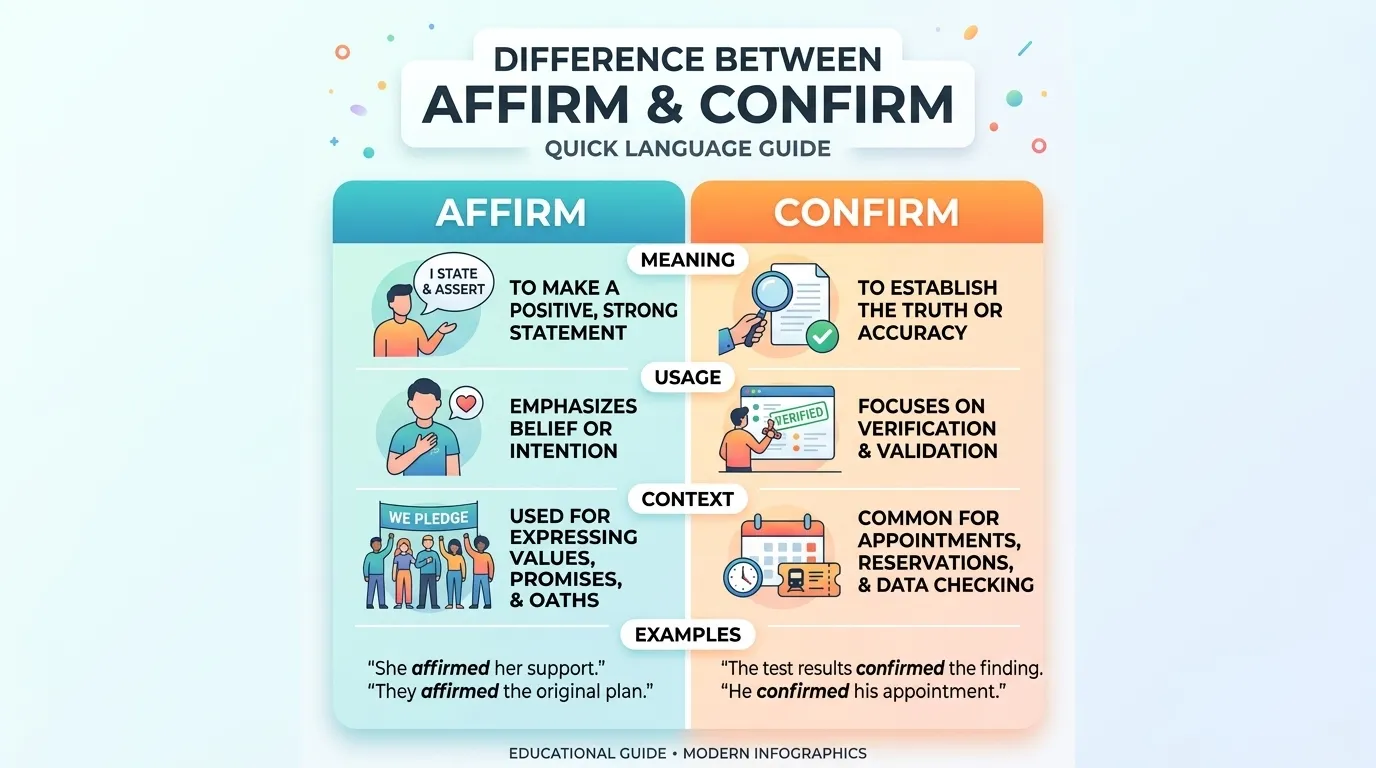
- Affirm means to state something positively, strongly, or officially.
- Confirm means to verify that something is true, correct, or finalized.
Example:
- “She affirmed her support for the project.”
- “The airline confirmed the booking.”
In real scenarios, people usually affirm beliefs, values, rights, or statements, while they confirm facts, reservations, appointments, or information.
Definition of Affirm and Confirm
- Affirm: To declare or state something firmly and confidently as true or valid.
- Confirm: To verify, prove, or establish that something is correct or certain.
Short Example:
- The witness affirmed his statement in court.
- The company confirmed the meeting schedule by email.
Pronunciation of Both Words (US & UK)
| Word | US Pronunciation | UK Pronunciation |
|---|---|---|
| Affirm | uh-FURM | uh-FERM |
| Confirm | kuhn-FURM | kuhn-FERM |
Now that the meanings are clear, let’s understand the deeper logic behind the difference between affirm and confirm and why English speakers often mix them up.
Difference Between Affirm and Confirm Table
| Feature | Affirm | Confirm |
|---|---|---|
| Main Meaning | To declare strongly | To verify or validate |
| Tone | Formal and supportive | Practical and factual |
| Common Usage | Beliefs, opinions, promises | Facts, bookings, information |
| Emotional Strength | Strong emotional or official tone | Neutral verification tone |
| Legal Usage | Used in oaths and declarations | Used for evidence verification |
| Business Usage | Affirm company values | Confirm meetings or payments |
| Social Media Usage | Affirm identity or support | Confirm account details |
| Action Type | Expression | Validation |
| Example | “He affirmed his loyalty.” | “She confirmed the date.” |
This table clearly shows the difference and similarity between affirm and confirm for quick understanding.
Key Differences Explained Between Affirm and Confirm
1. Affirm Is About Strong Declaration
When someone affirms something, they express it confidently and publicly.
Example:
A leader may affirm commitment to employee welfare during a company speech.
This usage is common in politics, law, motivational speaking, and formal communication.
2. Confirm Is About Verification
To confirm means checking whether something is true or finalized.
Example:
Instagram may send a code to confirm your identity during login.
This is more practical and system-oriented.
3. Affirm Often Carries Emotion
The word affirm sometimes includes emotional support or encouragement.
Example:
Parents affirm their children’s confidence by praising their efforts.
4. Confirm Is Data-Based
Businesses, apps, and digital systems use “confirm” because it relates to accuracy.
Example:
Google asks users to confirm email addresses for security purposes.
5. Affirm Is Common in Legal and Moral Contexts
Courts often ask witnesses to affirm statements instead of swearing religious oaths.
Example:
“He affirmed that his testimony was truthful.”
6. Confirm Is More Common in Technology
Apps, banks, Meta platforms, and YouTube systems use confirmation steps.
Example:
“You must confirm your password before continuing.”
7. Affirm Shows Support
People affirm beliefs, identities, and decisions.
Example:
A teacher may affirm a student’s abilities.
8. Confirm Shows Certainty
Companies confirm deliveries, appointments, and payments.
Example:
“The hotel confirmed our reservation.”
What Is the Real Difference Between Affirm and Confirm?
The real difference is connected to purpose.
Affirm = Expression of belief or support
Confirm = Proof or verification
That is why many English learners misuse these terms in emails or professional writing.
For instance:
- You affirm values
- You confirm information
Understanding this distinction improves communication clarity significantly.
Why Do People Confuse Affirm and Confirm?
Many beginners mix these words because both suggest agreement or truth. However, their functions are different.
Common Reasons:
- Both words relate to truth or correctness
- Both are used in formal English
- They appear in professional communication
- Translation from other languages often overlaps meanings
In practical use, the confusion usually happens because people focus on the “agreement” aspect rather than the actual intent behind the word.
How Does Affirm Work in Real-World Communication?
Personal Communication
People use affirm to encourage or emotionally support others.
Example:
“I affirm your decision.”
Legal Communication
Courts use affirm in witness statements and declarations.
Example:
“The witness affirmed the accuracy of his testimony.”
Corporate Branding
Modern companies like Meta often talk about affirming company values, diversity, and inclusion.
This usage creates trust and emotional connection.
Psychology and Self-Improvement
The word affirm is widely used in affirmations and motivational coaching.
Example:
Daily positive affirmations help improve confidence.
How Does Confirm Work in Digital Systems and Technology?
Technology platforms rely heavily on confirmation systems.
Google Verification
Google asks users to confirm accounts for security and identity verification.
Social Media Platforms
Instagram and YouTube confirm:
- phone numbers
- passwords
- email addresses
- account ownership
This reduces fraud and improves trust signals.
E-Commerce Platforms
Online stores confirm:
- orders
- payments
- shipping details
Without confirmation systems, digital businesses would face security problems.
Difference Between Affirm and Confirm in Grammar
| Grammar Area | Affirm | Confirm |
|---|---|---|
| Verb Type | Action verb | Action verb |
| Common Structure | Affirm + belief/statement | Confirm + fact/detail |
| Formality Level | More formal/emotional | Formal and practical |
| Common Object | Rights, support, truth | Booking, data, schedule |
When to Use Affirm
Use affirm when:
- expressing support
- declaring beliefs
- giving emotional assurance
- making official statements
- discussing identity or values
Examples:
- “She affirmed her commitment.”
- “The manager affirmed company ethics.”
- “He affirmed his loyalty.”
When to Use Confirm
Use confirm when:
- verifying facts
- checking information
- finalizing plans
- validating details
- approving data
Examples:
- “Please confirm your email.”
- “The office confirmed the appointment.”
- “The app confirmed successful payment.”
Common Mistakes With Affirm and Confirm
| Mistake | Why It Is Wrong | Correct Usage |
|---|---|---|
| “I affirm my booking.” | Booking needs verification | “I confirm my booking.” |
| “Google affirmed my email.” | Email requires validation | “Google confirmed my email.” |
| “She confirmed her beliefs.” | Beliefs are usually declared | “She affirmed her beliefs.” |
| “The witness confirmed an oath.” | Legal declarations use affirm | “The witness affirmed the oath.” |
| “I affirm the meeting time.” | Time needs verification | “I confirm the meeting time.” |
Real-Life Examples With Affirm and Confirm
1. Personal Use
A parent affirms a child’s confidence with encouragement.
2. Business Use
A company confirms an employee interview schedule.
3. Legal Use
A witness affirms testimony in court.
4. Technology Use
Meta confirms login identity using verification codes.
5. Healthcare Industry
Hospitals confirm patient appointments before visits.
6. Education
Teachers affirm students’ abilities to motivate learning.
Why the Difference Between Affirm and Confirm Matters
The difference matters because incorrect word choice changes meaning.
Example:
- “I affirm the booking” sounds unnatural.
- “I confirm the booking” sounds correct and professional.
In professional communication, precision builds trust.
This becomes especially important in:
- business emails
- customer support
- legal writing
- digital platforms
- academic communication
Expert Insight
In professional writing and communication training, the distinction between affirm and confirm is very important.
In real scenarios, most beginners incorrectly use “affirm” when they actually mean “confirm.” This happens frequently in business emails and customer communication.
Language experts generally recommend:
- use affirm for emotional, moral, or official declarations
- use confirm for verification and factual certainty
This small adjustment instantly makes English sound more natural and professional.
Frequently Asked Questions (FAQs)
What is the main difference between affirm and confirm?
Affirm means declaring something strongly, while confirm means verifying something as true or correct.
Can affirm and confirm be used interchangeably?
Sometimes, but not always. Their meanings overlap slightly, yet their usage contexts are different.
Is affirm more formal than confirm?
Yes. Affirm often sounds more formal, emotional, or official.
Why do apps use “confirm” instead of “affirm”?
Apps focus on verification, security, and accuracy, which matches the meaning of confirm.
What does affirm mean in law?
In law, affirm means making a formal declaration without taking a religious oath.
What does confirm mean in business?
In business, confirm means verifying meetings, payments, schedules, or agreements.
Which word is better for emotional support?
Affirm is better because it expresses encouragement and positive declaration.
Is “confirm your identity” correct English?
Yes. It means verifying identity through proof or validation.
What are positive affirmations?
Positive affirmations are encouraging statements people repeat to improve confidence and mindset.
Conclusion
Understanding the difference between affirm and confirm improves both spoken and written English. Although these words seem similar, their purposes are different. Affirm is mainly used for strong declarations, emotional support, beliefs, and official statements. Confirm, on the other hand, focuses on verification, accuracy, and factual validation.
In practical use, people affirm values, rights, promises, and identities, while they confirm bookings, appointments, emails, and information. This distinction is especially important in business communication, legal writing, digital systems, and professional conversations.
The next time you write an email, use a social media platform, or speak professionally, remember:
- affirm = declare strongly
- confirm = verify officially
That simple rule helps avoid confusion and makes communication sound more natural, clear, and professional.

Sarfraz Ahmad is language researcher and content writer who specializes in explaining the difference between commonly confused English words. Through WordClearify, learners understand subtle word distinctions in a simple, structured, and practical way. My writing focuses on clarity, real-life examples, and easy comparisons for students, bloggers, and professionals worldwide.