Many firearm owners, hunters, and shooting enthusiasts get confused about the difference between 308 and 7.62×51. At first glance, they seem identical because the cartridges look nearly the same and are often used in similar rifles. However, the difference between 308 and 7.62×51 involves chamber specifications, pressure standards, and intended applications.
If you’ve ever wondered whether you can safely shoot one cartridge in a rifle chambered for the other, you’re not alone. The difference between 308 and 7.62×51 is one of the most searched topics among rifle owners because it directly affects safety, accuracy, and performance.
In this guide, you’ll learn what each cartridge is, how they compare, where they are used, and which option is best for hunting, target shooting, tactical applications, and long-range precision.
Quick Answer: Difference Between 308 and 7.62×51
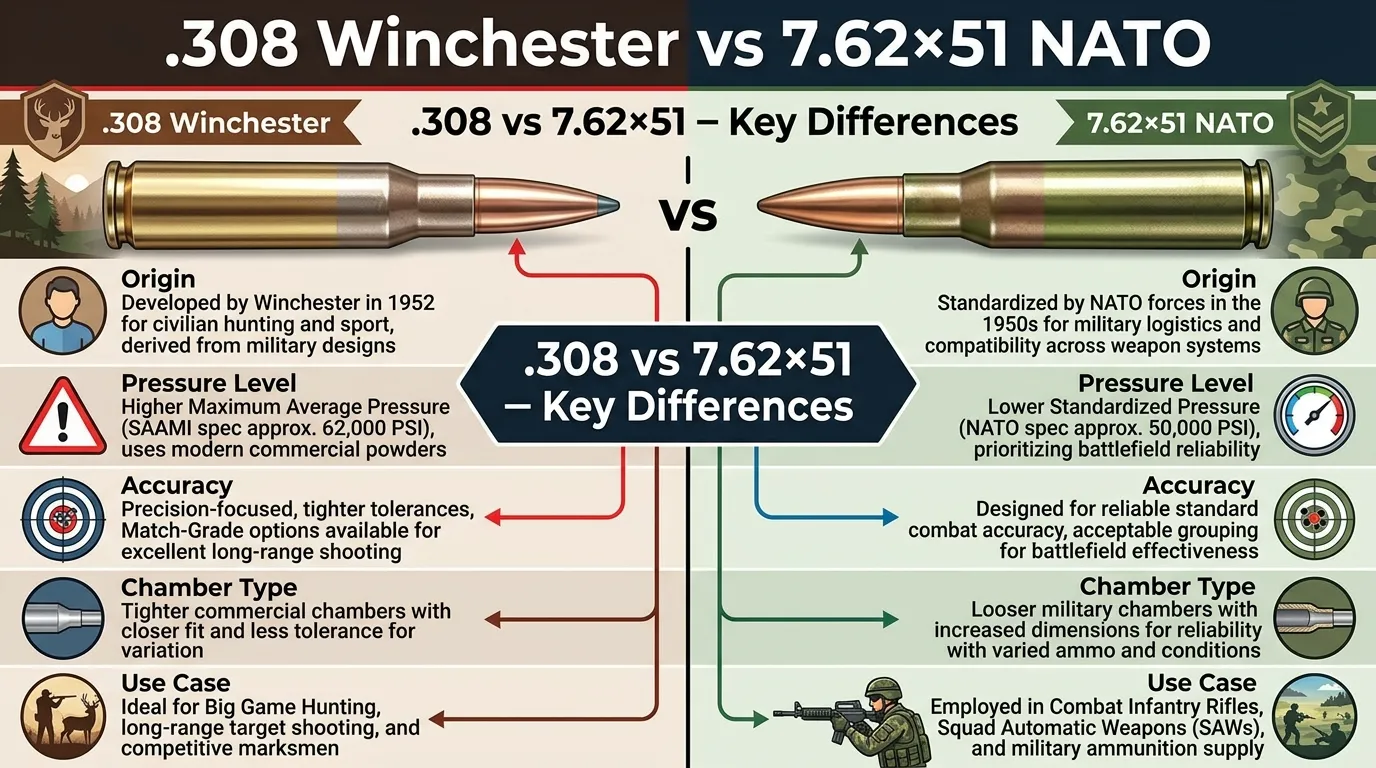
The main difference between .308 Winchester and 7.62×51 NATO is that .308 Winchester is a commercial cartridge, while 7.62×51 NATO is a military cartridge.
Although they share almost identical dimensions, .308 Winchester typically operates at higher pressure and is designed for commercial sporting rifles, while 7.62×51 NATO follows military specifications and is built for reliability in combat environments.
Example: A hunting rifle chambered in .308 Winchester may deliver slightly higher velocity than a military-style rifle using 7.62×51 NATO ammunition.
Definition of 308 and 7.62×51
- .308 Winchester: A commercial rifle cartridge introduced in 1952 for hunting, sport shooting, and precision rifle applications.
- 7.62×51 NATO: A military rifle cartridge standardized by NATO in the 1950s for service rifles, machine guns, and military operations.
Simple Example: Think of .308 Winchester as the civilian version and 7.62×51 NATO as the military-standard version of a very similar cartridge design.
Pronunciation (US & UK)
.308 Winchester
- US: “Three-oh-eight Winchester”
- UK: “Three-oh-eight Winchester”
7.62×51 NATO
- US: “Seven point six two by fifty-one NATO”
- UK: “Seven point six two by fifty-one NATO”
Now that you know what each cartridge is and how they’re pronounced, let’s understand the technical differences that matter in real-world shooting situations.
Difference Between 308 and 7.62×51 Comparison Table
| Feature | .308 Winchester | 7.62×51 NATO |
|---|---|---|
| Origin | Commercial cartridge | Military cartridge |
| Introduction | 1952 | 1954 |
| Primary Use | Hunting and sport shooting | Military and defense |
| Pressure Standard | Generally higher | Generally lower |
| Chamber Dimensions | Slightly tighter | Slightly larger |
| Brass Thickness | Usually thinner | Usually thicker |
| Accuracy Focus | Precision shooting | Reliability |
| Reloading Capacity | More internal volume | Less internal volume |
| Availability | Commercial market | Military surplus and commercial |
| Typical Users | Hunters, competitors | Military personnel, tactical shooters |
Key Differences Explained Between Difference Between 308 and 7.62×51
1. Pressure Levels
One of the biggest differences involves chamber pressure.
.308 Winchester ammunition is often loaded to higher pressure levels. This can provide slightly higher velocity and improved ballistic performance.
Real-life example: Long-range hunters often prefer .308 Winchester because of its consistent velocity.
2. Chamber Specifications
7.62×51 NATO chambers are generally built with slightly more room to ensure reliability under harsh battlefield conditions.
Practical use: Military rifles need to function even when dirty, dusty, or exposed to extreme weather.
3. Case Construction
NATO brass is often thicker and stronger.
This means reloaders may notice slightly reduced powder capacity compared to commercial .308 brass.
4. Intended Purpose
.308 Winchester focuses on hunting and precision.
7.62 NATO focuses on combat reliability.
5. Accuracy Potential
Many match-grade .308 loads are designed specifically for accuracy.
Competitive shooters often choose premium .308 ammunition for tighter groups.
6. Rifle Design Philosophy
Civilian rifles emphasize precision and comfort.
Military rifles emphasize durability and reliability.
7. Ammunition Variety
The commercial market offers far more .308 Winchester bullet weights and load options.
Hunters benefit from specialized ammunition designed for different game animals.
What Is the History Behind .308 Winchester and 7.62×51 NATO?
The development of both cartridges is closely connected.
After World War II, military planners wanted a cartridge that could provide similar performance to the older .30-06 Springfield while using a shorter case.
Winchester introduced .308 Winchester commercially in 1952.
Soon after, NATO adopted the similar 7.62×51 cartridge for military use.
This shared history explains why the two cartridges appear almost identical today.
How Does the Difference Between 308 and 7.62×51 Affect Performance?
Performance differences are usually small.
Most shooters will not notice dramatic changes during casual shooting.
However, advanced shooters may observe:
- Slight velocity differences
- Different pressure behavior
- Variations in brass durability
- Accuracy differences at longer ranges
In practical use, both cartridges remain excellent performers out to several hundred yards.
Can You Shoot .308 Winchester in a 7.62×51 NATO Rifle?
This is one of the most common questions.
The answer depends on the specific firearm manufacturer and chamber specifications.
Many modern rifles safely handle both cartridges, but not all rifles are designed identically.
Always follow:
- Manufacturer recommendations
- Rifle markings
- Official firearm documentation
Checking the owner’s manual is the safest approach before using either cartridge interchangeably.
Why Hunters Often Choose .308 Winchester
Hunters frequently prefer .308 Winchester because it offers:
- Extensive ammunition choices
- Premium hunting bullets
- Excellent accuracy
- Strong terminal performance
Common hunting applications include:
- Deer hunting
- Wild boar hunting
- Elk hunting
- General big-game hunting
Its versatility makes it one of the most popular hunting cartridges worldwide.
Why Military Forces Use 7.62×51 NATO
Military organizations prioritize reliability.
7.62 NATO was developed to:
- Function under extreme conditions
- Feed reliably in machine guns
- Operate consistently in service rifles
- Maintain NATO ammunition standardization
Examples of rifles that have historically used this cartridge include battle rifles and designated marksman rifles used by NATO-aligned forces.
Difference Between 308 and 7.62×51: Ballistics Comparison
| Ballistic Factor | .308 Winchester | 7.62×51 NATO |
|---|---|---|
| Velocity | Often slightly higher | Slightly lower |
| Energy | Higher in some loads | Consistent military performance |
| Accuracy | Excellent | Very good |
| Effective Range | Long-range capable | Long-range capable |
| Recoil | Similar | Similar |
| Trajectory | Very similar | Very similar |
For most users, field performance differences are relatively minor.
Difference and Similarity Table Generation: Difference Between 308 and 7.62×51
| Feature | .308 Winchester | 7.62×51 NATO | Similarity |
|---|---|---|---|
| Meaning | Commercial cartridge | Military cartridge | Same basic cartridge family |
| Purpose | Hunting and sport | Military service | Both fire .30-caliber projectiles |
| Pressure | Higher commercial loads | Military specifications | Both operate safely within design limits |
| Chamber | Tighter tolerances | Larger tolerances | Similar dimensions |
| Accuracy | Precision-focused | Reliability-focused | Both can be accurate |
| Availability | Sporting market | Military and civilian market | Widely available globally |
| Reloading | Popular among reloaders | Popular among reloaders | Both use similar components |
| Range | Long-range capable | Long-range capable | Comparable external ballistics |
This table clearly shows the difference and similarity between difference between 308 and 7.62×51 for quick understanding.
Common Mistakes with Difference Between 308 and 7.62×51
Mistake 1: Assuming They Are Exactly Identical
Many beginners believe they are completely interchangeable.
Correction: They are extremely similar but not technically identical.
Mistake 2: Ignoring Rifle Manufacturer Guidance
Some shooters skip reading firearm specifications.
Correction: Always verify approved ammunition.
Mistake 3: Comparing Only Cartridge Dimensions
Dimensions tell only part of the story.
Correction: Pressure and chamber specifications also matter.
Mistake 4: Mixing Reloading Data
Using incorrect load data can create problems.
Correction: Follow published reloading manuals carefully.
Mistake 5: Believing One Is Always More Accurate
Accuracy depends on rifle quality, ammunition, and shooter skill.
Correction: Test multiple loads in your specific firearm.
Real Life Examples with Difference Between 308 and 7.62×51
Scenario 1: Deer Hunter
A hunter chooses .308 Winchester for premium hunting ammunition and excellent accuracy.
Scenario 2: Tactical Training
A shooter uses surplus 7.62 NATO ammunition for affordable training sessions.
Scenario 3: Long-Range Competition
A competitor selects match-grade .308 loads for maximum precision.
Scenario 4: Military Operations
A designated marksman uses 7.62 NATO because of standard military logistics.
Scenario 5: Reloading Enthusiast
An experienced reloader experiments with both brass types to optimize performance.
When to Use Each
Choose .308 Winchester When:
- Hunting is the primary goal
- Precision shooting matters most
- You want premium ammunition options
- Long-range accuracy is important
Choose 7.62×51 NATO When:
- Using military-pattern rifles
- Training with surplus ammunition
- Reliability is the top priority
- Following military ammunition standards
Why People Get Confused in Difference Between 308 and 7.62×51
Several factors create confusion:
Similar Appearance
The cartridges look nearly identical.
Shared History
Both evolved from the same development program.
Online Discussions
Forums, YouTube channels, and social media often oversimplify the topic.
Mixed Terminology
Many retailers and shooters use the names interchangeably.
Military vs Civilian Standards
Different standards create subtle but important distinctions.
Expert Insight
From a practical shooting perspective, the debate is often larger than the actual performance difference.
Most beginners focus heavily on cartridge labels, but experienced shooters usually focus on rifle quality, ammunition consistency, optics, and training.
In real scenarios, shot placement and shooter skill matter far more than the small performance differences between .308 Winchester and 7.62×51 NATO.
Understanding chamber specifications and following manufacturer guidance is generally more important than chasing minor ballistic advantages.
Frequently Asked Questions (FAQ)
Is .308 Winchester the same as 7.62×51 NATO?
No. They are very similar but have different pressure and chamber specifications.
Which is more powerful, .308 or 7.62 NATO?
.308 Winchester often operates at slightly higher pressure and may deliver slightly higher velocity.
Which cartridge is better for hunting?
Many hunters prefer .308 Winchester because of the wide variety of hunting loads available.
Which is better for military use?
7.62×51 NATO was specifically designed and standardized for military applications.
Can both cartridges be used for long-range shooting?
Yes. Both cartridges are capable of excellent long-range performance.
Why does NATO brass seem thicker?
Military brass is often built for durability and reliability in demanding conditions.
Is recoil different between .308 and 7.62 NATO?
For most shooters, recoil feels nearly identical.
Which cartridge is easier to find?
Both are widely available, though availability depends on region and market conditions.
Does accuracy depend on the cartridge?
Accuracy depends on ammunition quality, rifle design, and shooter skill.
Why do experienced shooters discuss chamber dimensions?
Chamber dimensions affect pressure, reliability, and compatibility between rifles and ammunition.
Conclusion
Understanding the difference between 308 and 7.62×51 is important for anyone who owns, shoots, reloads, or researches rifles chambered for these cartridges. While the two rounds share a common heritage and appear almost identical, they were designed for different purposes. The .308 Winchester was developed primarily for civilian hunting and precision shooting, while the 7.62×51 NATO cartridge was standardized for military reliability and battlefield performance.
If you need maximum hunting flexibility and premium commercial ammunition choices, .308 Winchester is often the preferred option. If your focus is military-pattern rifles, training, or NATO-standard ammunition, 7.62×51 NATO remains an outstanding choice.
The final answer is simple: the difference between 308 and 7.62×51 exists mainly in pressure specifications, chamber design, and intended application—not in dramatic real-world performance. Understanding those distinctions helps shooters make safer and more informed decisions.

Sarfraz Ahmad is language researcher and content writer who specializes in explaining the difference between commonly confused English words. Through WordClearify, learners understand subtle word distinctions in a simple, structured, and practical way. My writing focuses on clarity, real-life examples, and easy comparisons for students, bloggers, and professionals worldwide.