Imagine you’re in a classroom where a teacher wants to share information. Sometimes, the teacher speaks to the entire class at once this is like broadcast. Other times, the teacher calls only a specific group of students for a discussion this resembles multicast. Understanding multicast vs broadcast helps you select the most appropriate communication method. In networking, these two methods define how data travels from one source to multiple recipients.
Understanding multicast vs broadcast is essential because both serve different communication purposes in digital systems. When comparing difference between multicast and broadcast, you’ll notice how efficiently data can be delivered depending on the need.
Many beginners struggle with multicast vs broadcast because both involve sending data to multiple users, yet their working mechanisms differ significantly. Mastering multicast and broadcast helps both learners and professionals optimize network performance and reduce unnecessary traffic.
Key Difference Between Multicast and Broadcast
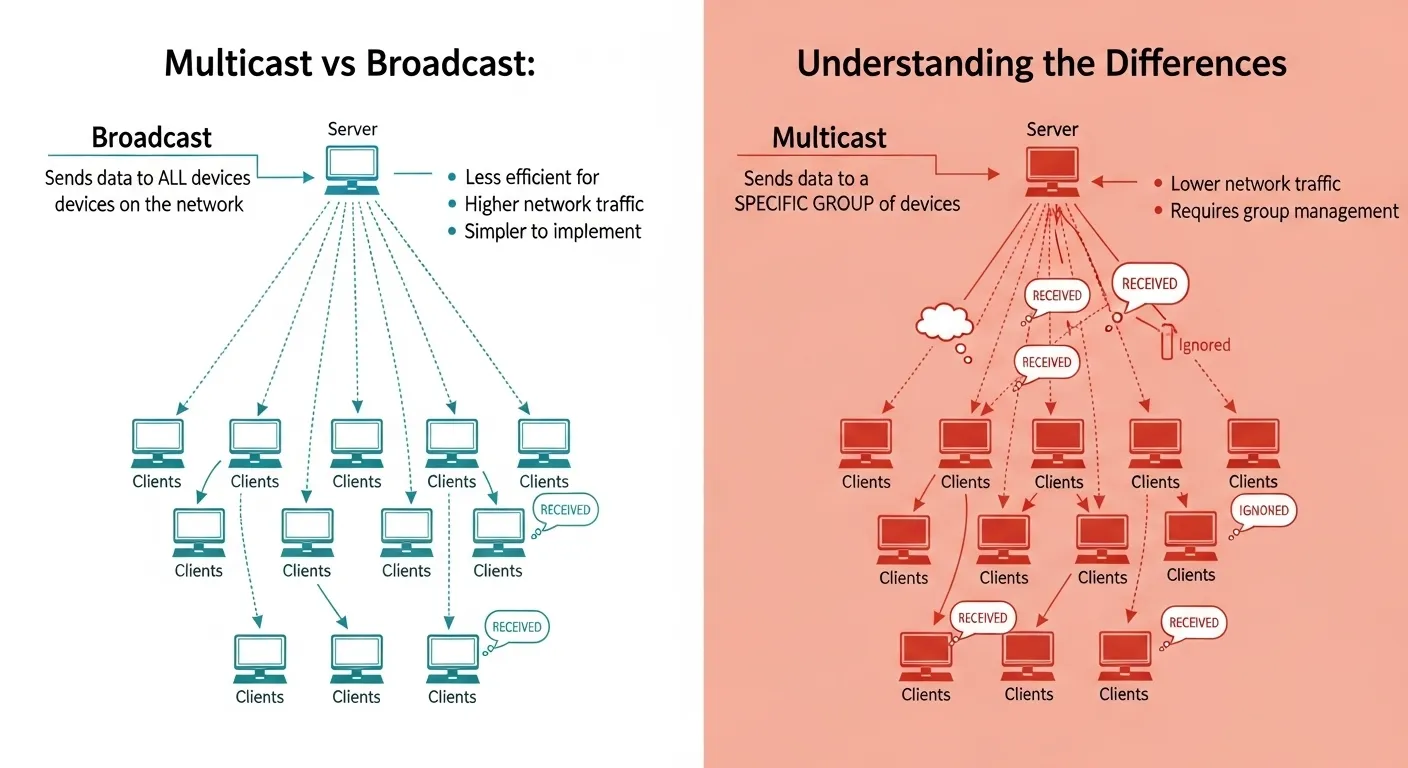
The primary difference lies in how data is delivered:
- Broadcast sends data to all devices in a network.
- Multicast sends data only to a specific group of interested devices.
Broadcast is like shouting in a crowd, while multicast is like speaking to a selected group.
Why Is Their Difference Important?
Understanding multicast vs broadcast is crucial for both learners and experts because it directly impacts network efficiency, bandwidth usage, and system performance.
- For learners: It builds foundational knowledge of networking concepts.
- For professionals: It helps design scalable and efficient networks.
- In society: Efficient communication systems power streaming services, online gaming, and live conferencing.
Without this understanding, networks may become overloaded, causing delays and inefficiencies.
Pronunciation of Both (US & UK)
- Multicast
- US: /ˈmʌl.ti.kæst/
- UK: /ˈmʌl.ti.kɑːst/
- Broadcast
- US: /ˈbrɔːd.kæst/
- UK: /ˈbrɔːd.kɑːst/
Now that you know how to say them correctly, let’s explore their differences in detail.
Multicast vs Broadcast Difference
1. Target Audience
- Multicast: Specific group of devices.
- Example 1: Live sports stream to subscribed users.
- Example 2: Online class for registered students.
- Broadcast: All devices in the network.
- Example 1: ARP request in LAN.
- Example 2: Emergency alert to all users.
2. Data Efficiency
- Multicast: Efficient, avoids unnecessary data transmission.
- Example 1: IPTV streaming.
- Example 2: Corporate video conferencing.
- Broadcast: Less efficient, sends data everywhere.
- Example 1: Network announcements.
- Example 2: DHCP discovery.
3. Bandwidth Usage
- Multicast: Uses less bandwidth.
- Example 1: Streaming to 100 users using one stream.
- Example 2: Software updates to selected devices.
- Broadcast: Consumes more bandwidth.
- Example 1: Sending updates to all devices.
- Example 2: Network-wide alerts.
4. Network Scope
- Multicast: Works across networks with routing support.
- Example 1: Global streaming services.
- Example 2: Enterprise WAN communication.
- Broadcast: Limited to local network.
- Example 1: LAN messages.
- Example 2: Router discovery.
5. Addressing Method
- Multicast: Uses multicast IP addresses (224.0.0.0 to 239.255.255.255).
- Example 1: Video streaming groups.
- Example 2: Online webinars.
- Broadcast: Uses broadcast address (255.255.255.255).
- Example 1: Local announcements.
- Example 2: Device discovery.
6. Receiver Control
- Multicast: Devices choose to join or leave groups.
- Example 1: Subscribing to a stream.
- Example 2: Leaving a gaming session.
- Broadcast: No control, all devices receive data.
- Example 1: System-wide notification.
- Example 2: Network ping.
7. Traffic Load
- Multicast: Reduces network load.
- Example 1: Online training session.
- Example 2: Stock market feed.
- Broadcast: Increases traffic.
- Example 1: Frequent announcements.
- Example 2: Network scanning.
8. Security
- Multicast: More secure due to limited access.
- Example 1: Private meetings.
- Example 2: Secure data sharing.
- Broadcast: Less secure, open to all devices.
- Example 1: Public alerts.
- Example 2: Open network messages.
9. Complexity
- Multicast: More complex to configure.
- Example 1: Router configuration.
- Example 2: Group management.
- Broadcast: Simple implementation.
- Example 1: Basic LAN setup.
- Example 2: Automatic messaging.
10. Use Cases
- Multicast: Streaming, conferencing.
- Example 1: Netflix-style streaming.
- Example 2: Online webinars.
- Broadcast: Discovery, alerts.
- Example 1: ARP protocol.
- Example 2: Emergency alerts.
Nature and Behaviour
- Multicast: Selective, efficient, controlled communication. Devices actively participate.
- Broadcast: Open, wide-reaching, uncontrolled communication. Devices passively receive.
Why People Are Confused About Their Use? (Multicast vs Broadcast)
People often confuse them because both involve sending data to multiple recipients. However:
| Feature | Multicast | Broadcast |
| Audience | Selected group | Entire network |
| Efficiency | High | Low |
| Control | User-controlled | No control |
| Usage | Streaming, conferencing | Alerts, discovery |
| Scope | Local + Wide networks | Local network only |
Which Is Better in What Situation?
Multicast is better when you need to send data to a specific group efficiently. For example, in live streaming or online classes, multicast ensures only interested users receive the data, saving bandwidth and improving performance.
Broadcast is ideal for situations where every device must receive the message, such as network discovery or emergency alerts. It ensures no device is left out, even though it consumes more resources.
Use in Metaphors and Similes
- Broadcast: “He broadcast his feelings like a loudspeaker.”
- Multicast: “She shared the news like a multicast—only to close friends.”
Connotative Meaning
- Multicast
- Positive: Targeted, efficient
- Example: “The company used a multicast approach for precise communication.”
- Broadcast
- Neutral/Negative: Wide, sometimes excessive
- Example: “He broadcast the rumor to everyone.”
Idioms or Proverbs
- Broadcast-related: “Spread the word”
- Example: “They broadcast the news—spread the word quickly.”
- Multicast-related (conceptual): “Selective sharing”
- Example: “She used a multicast approach—only telling trusted people.”
Works in Literature
- Broadcast
- “Broadcasting Freedom” – Genre: Non-fiction, Author: Various, Year: 2000s
- Multicast
- Referenced in technical and academic networking books.
Movies Related to Both
- Broadcast
- Broadcast News (1987, USA)
- Multicast
- No direct mainstream movie, but appears in tech-based films.
FAQs
1. What is the main difference between multicast and broadcast?
Broadcast sends data to all devices, while multicast sends data to a selected group.
2. Which is more efficient?
Multicast is more efficient because it avoids unnecessary data transmission.
3. Where is broadcast commonly used?
In LANs for device discovery and network communication.
4. Can multicast work over the internet?
Yes, with proper routing protocols.
5. Why is multicast preferred in streaming?
Because it saves bandwidth and improves performance.
How Both Are Useful for Surroundings
Both play a crucial role in modern communication. Broadcast ensures universal communication like alerts, while multicast supports efficient services like streaming and online education.
Final Words for Both
Multicast and broadcast are fundamental networking techniques. Each serves a unique purpose, and understanding them helps in building efficient communication systems.
Conclusion
In summary, understanding multicast vs broadcast is essential for anyone dealing with networking or digital communication. While broadcast ensures that every device receives the message, multicast focuses on delivering data efficiently to a specific group. Both methods have their strengths and limitations, making them suitable for different scenarios. By mastering multicast vs broadcast, learners and professionals can design smarter systems, reduce network congestion, and improve overall performance. Choosing the right method depends on the situation, making this knowledge highly valuable in today’s connected world.

Sarfraz Ahmad is language researcher and content writer who specializes in explaining the difference between commonly confused English words. Through WordClearify, learners understand subtle word distinctions in a simple, structured, and practical way. My writing focuses on clarity, real-life examples, and easy comparisons for students, bloggers, and professionals worldwide.