Imagine a situation in a courtroom. A witness stands up and affirms that the statement they are about to give is true. Later, the police officer checks the evidence and confirms that the witness’s statement matches the facts. This simple example clearly explains the topic of affirm vs confirm. Although these two words seem similar, they have slightly different meanings and uses.
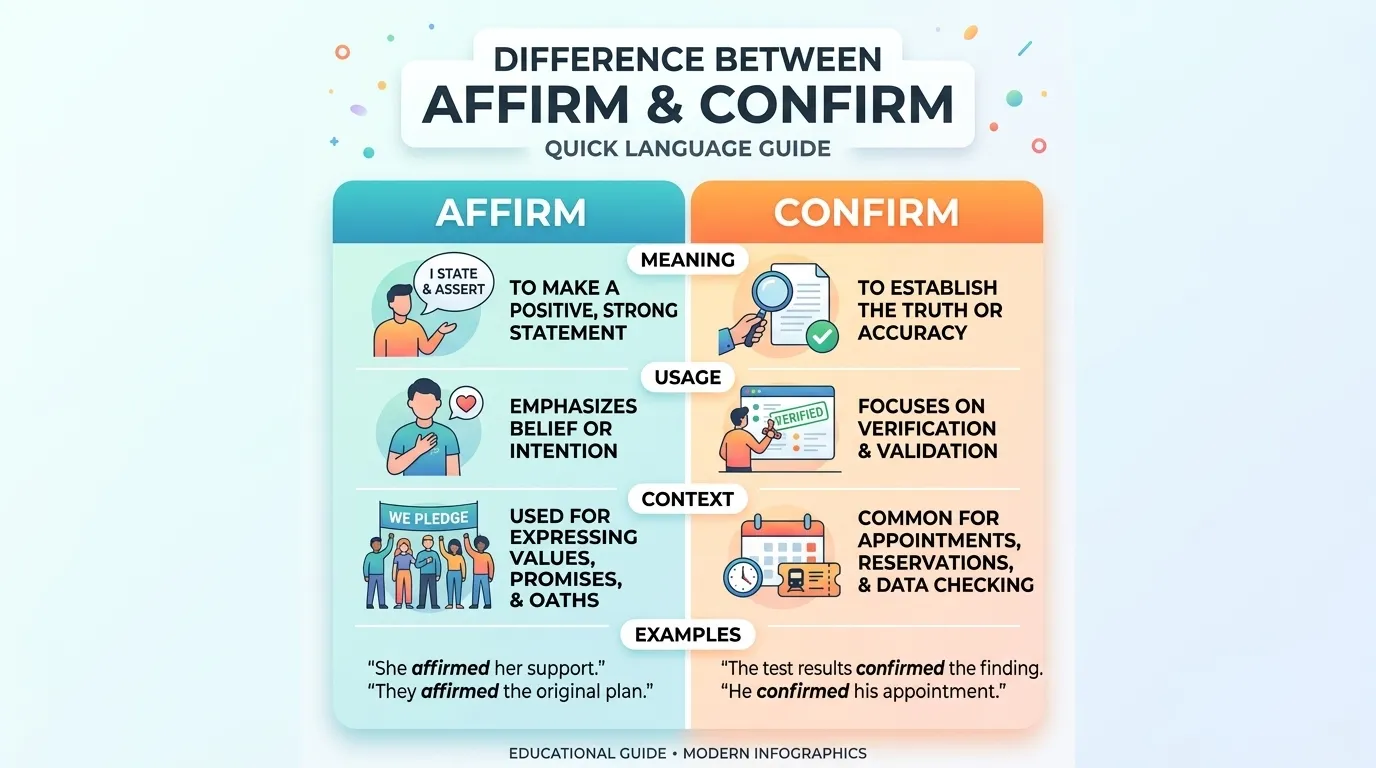
Understanding the difference between affirm and confirm is important because many learners mix them up in writing and speaking. When we study both, we learn that both words deal with truth, but they approach truth in different ways. In simple terms, affirming means strongly declaring something to be true, while confirming means verifying something through proof or evidence.
Learning the affirm vs confirm distinction improves vocabulary, communication skills, and writing clarity. Whether you are a student, teacher, writer, or professional, understanding both helps you to choose the correct word in the right situation.
Key Difference Between the Both
The basic idea behind affirm vs confirm lies in how truth is expressed.
- Affirm means to declare something strongly or state it confidently as true.
- Confirm means to verify or prove that something is true using facts, evidence, or reliable information.
In simple words, when discussing both, affirming focuses on asserting truth, while confirming focuses on proving truth.
Why Is Their Difference Necessary to Know?
Understanding affirm vs confirm is essential for both learners and experts. Language becomes more powerful when people use the correct words in the correct context. In fields such as law, journalism, education, and science, the difference between both can affect how information is interpreted.
For learners, studying the difference between both strengthens vocabulary and improves writing accuracy. For professionals, it ensures clarity in communication and avoids misunderstandings. In society, knowing whether someone is affirming a belief or confirming a fact helps people understand statements correctly.
Pronunciation of Both (US & UK)
| Word | US Pronunciation | UK Pronunciation |
| Affirm | /əˈfɝːm/ | /əˈfɜːm/ |
| Confirm | /kənˈfɝːm/ | /kənˈfɜːm/ |
Difference Between Affirm and Confirm
1. Meaning
Affirm:
Affirm means to state or declare something confidently.
Example 1: The leader affirmed his commitment to peace.
Example 2: She affirmed that she would complete the task.
Confirm:
Confirm means to verify something with proof or evidence.
Example 1: The laboratory confirmed the results of the experiment.
Example 2: The airline confirmed our ticket booking.
2. Source of Truth
Affirm:
Truth comes from belief or personal declaration.
Example 1: The witness affirmed the truth of his words.
Example 2: She affirmed her loyalty to the organization.
Confirm:
Truth comes from verification.
Example 1: The report confirmed the scientist’s theory.
Example 2: The police confirmed the suspect’s identity.
3. Context of Use
Affirm:
Often used in emotional, motivational, or legal contexts.
Example 1: He affirmed his support for the cause.
Example 2: The judge asked the witness to affirm the truth.
Confirm:
Commonly used in factual or administrative situations.
Example 1: The hotel confirmed our reservation.
Example 2: The manager confirmed the meeting time.
4. Emotional Tone
Affirm:
More emotional or personal.
Example 1: She affirmed her love for her family.
Example 2: The speech affirmed people’s hopes.
Confirm:
More factual and objective.
Example 1: The data confirmed the research findings.
Example 2: The test confirmed the disease.
5. Usage in Beliefs
Affirm:
Connected with beliefs and values.
Example 1: The group affirmed their identity.
Example 2: He affirmed his faith.
Confirm:
Connected with facts.
Example 1: Scientists confirmed the discovery of a new star.
Example 2: Doctors confirmed the medical diagnosis.
6. Formality
Affirm:
Used in formal declarations.
Example 1: The constitution affirms equal rights.
Example 2: The leader affirmed national unity.
Confirm:
Used in official communication.
Example 1: The company confirmed the meeting.
Example 2: The office confirmed the appointment.
7. Legal Usage
Affirm:
Used when someone promises to tell the truth without taking an oath.
Example 1: The witness affirmed their testimony.
Example 2: The court allowed him to affirm instead of swearing.
Confirm:
Used when evidence supports a claim.
Example 1: Documents confirmed the agreement.
Example 2: Records confirmed the payment.
8. Role in Communication
Affirm:
Strengthens a statement.
Example 1: The teacher affirmed the importance of honesty.
Example 2: He affirmed his promise.
Confirm:
Verifies information.
Example 1: The message confirmed the meeting time.
Example 2: The email confirmed the booking.
9. Relationship with Evidence
Affirm:
Evidence may not always be required.
Example 1: She affirmed her intention to help.
Example 2: The speaker affirmed his commitment.
Confirm:
Evidence is usually necessary.
Example 1: The results confirmed the hypothesis.
Example 2: The records confirmed the transaction.
10. Result of Action
Affirm:
Creates assurance.
Example 1: The statement affirmed trust among the team.
Example 2: The coach affirmed confidence in players.
Confirm:
Creates certainty through proof.
Example 1: The experiment confirmed the theory.
Example 2: The call confirmed the appointment.
Nature and Behaviour of Both
When discussing both, it becomes clear that both words behave differently in communication.
Affirm is expressive and declarative. It often reflects belief, support, or strong assurance.
Confirm is factual and analytical. It focuses on checking and validating information with evidence.
Why People Are Confused About Their Use?
| Aspect | Affirm | Confirm | Similarity |
| Meaning | Declare truth | Verify truth | Both relate to certainty |
| Evidence | Not always required | Usually required | Both deal with truth |
| Tone | Emotional | Objective | Both strengthen statements |
| Context | Beliefs and declarations | Facts and verification | Both used in formal language |
Which Is Better in What Situation?
Affirm is better when expressing belief, support, or commitment. For example, leaders affirm values, teachers affirm student abilities, and witnesses affirm statements in court.
Confirm is better when verifying facts. Businesses confirm appointments, scientists confirm research results, and doctors confirm medical diagnoses.
How the Affirm and Confirm Are Used in Metaphors and Similes
- “Her smile confirmed his hopes like sunlight after rain.”
- “His promise affirmed trust like a strong pillar supporting a house.”
- “The evidence confirmed the story like a key opening a locked door.”
- “Her actions affirmed her words like a signature on a contract.”
Connotative Meaning
Affirm
Mostly positive or neutral
Examples:
- The teacher affirmed the student’s talent.
- The leader affirmed people’s rights.
Confirm
Mostly neutral
Examples:
- The doctor confirmed the diagnosis.
- The email confirmed the reservation.
Idioms or Proverbs Related to the Words
Trust but verify (related to confirm)
Example: Before accepting the information, trust but verify.
Actions speak louder than words (connected with affirmation)
Example: He promised to help, and his actions spoke louder than words.
Works in Literature
- The Affirmation – Novel, Christopher Priest, 1981
- Affirmation of Life – Essay theme in modern literature
- Confirmation – Themes used in several literary essays and short stories
Movies Related to Affirm and Confirm
- Confirmation – 2016, United States
- The Confirmation – 2016, Canada/USA
Frequently Asked Questions (FAQs)
1. What is the main difference between affirm vs confirm?
Affirm means declaring something strongly, while confirm means verifying it through evidence.
2. Can affirm and confirm be used interchangeably?
Sometimes they appear similar, but they usually serve different purposes.
3. Which word is more related to evidence?
Confirm is more closely related to evidence and verification.
4. Is affirm commonly used in legal language?
Yes, witnesses may affirm statements instead of taking an oath.
5. Why do learners confuse affirm vs confirm?
Because both words relate to truth and certainty.
How Both Are Useful for Surroundings
Both words help people communicate truth clearly. Affirm builds confidence and expresses belief, while confirm ensures accuracy and reliability. Together, they strengthen communication in society.
Final Words for Both
Understanding affirm vs confirm helps speakers and writers choose the right word in the right situation. Each word plays an important role in expressing truth.
Conclusion
The comparison of affirm vs confirm shows that even similar words can have important differences. Affirm focuses on declaring something with confidence, while confirm focuses on verifying something through proof. Both words are valuable in communication, especially in academic, legal, and professional settings. By understanding the difference between affirm and confirm, learners can improve their vocabulary and avoid confusion in writing and speaking.

Sarfraz Ahmad is language researcher and content writer who specializes in explaining the difference between commonly confused English words. Through WordClearify, learners understand subtle word distinctions in a simple, structured, and practical way. My writing focuses on clarity, real-life examples, and easy comparisons for students, bloggers, and professionals worldwide.