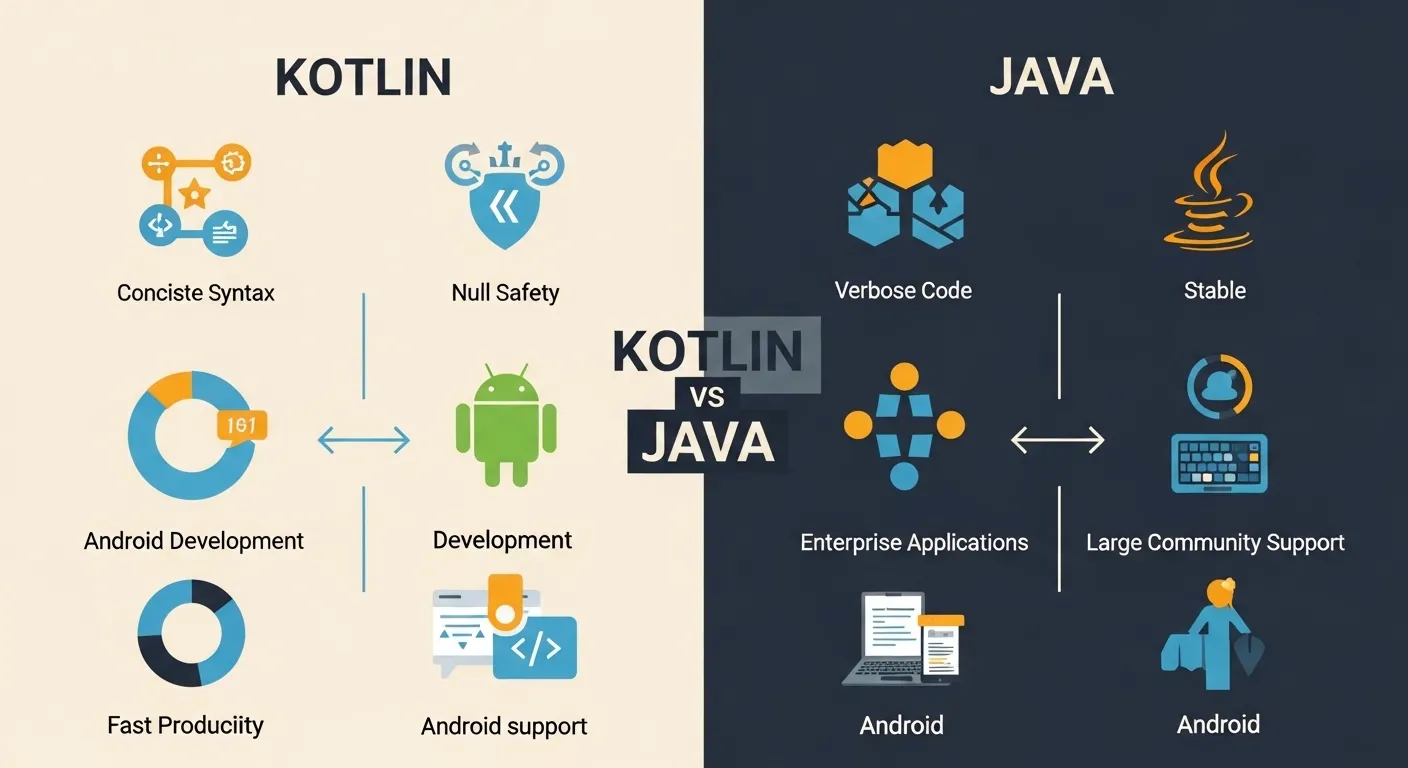
A young developer once started building an Android app using Java, the language that powered Android for years. After struggling with long code and complex syntax, a colleague suggested trying Kotlin, a newer language designed to make coding simpler. Curious, the developer compared both and quickly noticed how Kotlin reduced boilerplate code and improved readability. The difference between Kotlin and Java has become a common discussion among programmers today.
Both languages run on the Java Virtual Machine (JVM), but they differ in syntax, safety features, and developer productivity. When people explore both, they often ask which language is better for Android development or modern software projects.
Understanding the difference between Kotlin vs Java helps learners and professionals choose the right language for their work. In this article, we will clearly explain both, their features, differences, and practical uses in simple language.
Key Difference Between the Both
The main difference between both lies in their design philosophy and coding structure.
- Java is a traditional, widely used programming language known for reliability and stability.
- Kotlin is a modern programming language designed to be concise, safer, and more developer-friendly.
When comparing both, Kotlin focuses on reducing code complexity while maintaining full compatibility with Java.
Why Is Their Difference Necessary to Know for Learners and Experts?
Understanding the difference between both is important because programming languages influence how software is built and maintained.
For learners, knowing both helps them choose a language that matches their learning goals. Java provides a strong foundation in programming concepts, while Kotlin offers a modern approach with simpler syntax.
For experts, the difference between both affects project decisions. Large enterprises may rely on Java due to its maturity, while modern Android development increasingly favors Kotlin.
In society, software drives banking systems, mobile apps, healthcare tools, and education platforms.
Pronunciation of the Both (US & UK)
Kotlin
- US: /ˈkɒt.lɪn/
- UK: /ˈkɒt.lɪn/
Java
- US: /ˈdʒɑː.və/
- UK: /ˈdʒɑː.və/
Both words are easy to pronounce, but their differences become more interesting when we move into how they function in programming.
Difference Between the Kotlin vs Java
1. Syntax Simplicity
Kotlin:
Kotlin has concise syntax that reduces repetitive code.
Example 1:
A simple data class in Kotlin requires only a few lines.
Example 2:
Getter and setter functions are automatically generated.
Java:
Java syntax is more verbose and requires more lines.
Example 1:
Developers must write full getter and setter methods.
Example 2:
Classes often include additional boilerplate code.
2. Null Safety
Kotlin:
Kotlin prevents null pointer errors using built-in null safety.
Example 1:
A variable must be declared nullable using ?.
Example 2:
Safe calls prevent crashes in applications.
Java:
Java allows null values more freely.
Example 1:
A variable may accidentally become null.
Example 2:
NullPointerException is a common runtime error.
3. Code Length
Kotlin:
Requires less code to perform the same task.
Example 1:
Functions are shorter and easier to read.
Example 2:
Lambdas simplify complex operations.
Java:
Usually requires more lines.
Example 1:
Anonymous classes are longer.
Example 2:
Complex operations require additional methods.
4. Learning Curve
Kotlin:
Easier for developers already familiar with Java.
Example 1:
Many concepts are similar.
Example 2:
Simple syntax reduces confusion.
Java:
Better for beginners learning programming fundamentals.
Example 1:
Widely used in universities.
Example 2:
Large learning resources are available.
5. Android Development
Kotlin:
Officially recommended language for Android development.
Example 1:
Supported by Google for Android apps.
Example 2:
Modern Android libraries use Kotlin.
Java:
Still widely used in older Android apps.
Example 1:
Legacy Android projects use Java.
Example 2:
Many tutorials are Java-based.
6. Functional Programming Support
Kotlin:
Supports functional programming features.
Example 1:
Lambda expressions are easier.
Example 2:
Higher-order functions simplify code.
Java:
Functional programming added later.
Example 1:
Java 8 introduced lambdas.
Example 2:
Syntax remains more complex.
7. Interoperability
Kotlin:
Fully compatible with Java.
Example 1:
Kotlin code can call Java libraries.
Example 2:
Projects can mix both languages.
Java:
Also interoperable with Kotlin.
Example 1:
Java can use Kotlin classes.
Example 2:
Developers can migrate gradually.
8. Performance
Kotlin:
Performance is similar to Java.
Example 1:
Runs on JVM.
Example 2:
Optimized for Android.
Java:
Highly optimized for large applications.
Example 1:
Used in enterprise systems.
Example 2:
Stable performance for server applications.
9. Community Support
Kotlin:
Growing community.
Example 1:
Popular among Android developers.
Example 2:
Active open-source contributions.
Java:
Huge global community.
Example 1:
Millions of developers use Java.
Example 2:
Extensive documentation and tutorials.
10. Development Speed
Kotlin:
Faster development due to concise code.
Example 1:
Less time writing repetitive code.
Example 2:
Better productivity for mobile apps.
Java:
Development can be slower.
Example 1:
More code required.
Example 2:
Debugging may take longer.
Nature and Behaviour of Both
Kotlin is modern, expressive, and designed for productivity. It emphasizes safety, readability, and simplicity.
Java is stable, traditional, and widely used. It focuses on reliability, performance, and compatibility across many platforms.
Why People Are Confused About Their Use?
Many people confuse both because both run on the same JVM and share many similar features.
| Feature | Kotlin | Java | Similarity |
| Syntax | Short and concise | Longer and detailed | Both object-oriented |
| Null Safety | Built-in | Manual handling | Both support safe coding |
| Android Support | Officially recommended | Traditionally used | Both used for Android |
| Performance | Similar to Java | Highly optimized | Both run on JVM |
| Community | Growing | Very large | Both have strong developer ecosystems |
Which Is Better in What Situation?
Kotlin is better for modern Android development and rapid application development. Its concise syntax allows developers to write less code while maintaining high safety standards. Many new Android projects now prefer Kotlin because it improves productivity and reduces bugs.
Java, however, remains strong in enterprise environments, large-scale systems, and legacy projects. Many organizations rely on Java because it has decades of stability, extensive libraries, and a massive developer community.
Use in Metaphors and Similes
Even in tech discussions, developers sometimes use both metaphorically.
Examples:
- “Switching from Java to Kotlin felt like upgrading from a bicycle to a sports car.”
- “Java is like a solid old bridge, reliable and strong.”
- “Kotlin works like a shortcut in coding, making development faster.”
Connotative Meaning of Both
Kotlin
Positive:
Modern, efficient, innovative.
Example:
“Using Kotlin made our Android project faster to develop.”
Neutral:
A programming language for JVM.
Example:
“Kotlin and Java both run on the JVM.”
Negative:
Newer language with smaller ecosystem.
Example:
“Some legacy tools still do not fully support Kotlin.”
Java
Positive:
Reliable, powerful, established.
Example:
“Java powers many global enterprise systems.”
Neutral:
A widely used programming language.
Example:
“Java is used for web, mobile, and desktop applications.”
Negative:
Verbose and sometimes complex.
Idioms or Proverbs Related to the Words
Since Kotlin and Java are technical words, they rarely appear in traditional idioms, but programmers often create humorous expressions.
Examples:
- “Write once, run anywhere” (Java philosophy).
- “Less code, fewer bugs” (often used to describe Kotlin).
Example sentence:
“Using Kotlin follows the idea of ‘less code, fewer bugs’ because its syntax is shorter.”
Works in Literature
While these are technical languages rather than literary themes, they appear in programming books.
Kotlin
- Kotlin in Action — Programming guide — Dmitry Jemerov — 2017
- Programming Kotlin — Technology book — Venkat Subramaniam — 2019
Java
- Effective Java — Programming guide — Joshua Bloch — 2008
- Head First Java — Educational programming book — Kathy Sierra — 2005
Movie Names Made on Both
These words are rarely used in movie titles, but they sometimes appear in tech documentaries.
Java
- Java Heat — 2013 — United States / Indonesia
Kotlin
- No major mainstream movies named after Kotlin yet, as it is primarily a programming language.
Frequently Asked Questions
1. What is the main difference between both?
Kotlin is more concise and modern, while Java is more traditional and widely established.
2. Is Kotlin replacing Java?
Kotlin is becoming popular, especially in Android development, but Java is still widely used.
3. Which is easier to learn?
Java is often easier for beginners, while Kotlin is easier for experienced Java developers.
4. Which language is better for Android apps?
Many developers prefer Kotlin because Google officially supports it for Android development.
How Both Are Useful for Surroundings
Programming languages like Kotlin and Java play a major role in everyday technology. Banking systems, mobile applications, education platforms, and online shopping services often rely on Java-based systems.
Kotlin contributes to faster Android app development, which helps companies build modern mobile experiences. Together, Kotlin and Java support the digital tools people use daily.
Final Words for the Both
Kotlin and Java represent two generations of programming design. Java symbolizes reliability and long-term stability, while Kotlin represents innovation and developer productivity.
Conclusion
The difference between Kotlin and Java reflects the evolution of programming languages. Java has been a trusted language for decades, powering enterprise systems, Android applications, and web platforms. Kotlin, on the other hand, introduces modern features that simplify coding and reduce common programming errors.
When comparing both, neither language is universally better; the best choice depends on the project and developer needs. Java remains powerful for large systems, while Kotlin offers efficiency for modern Android development. By understanding their differences, similarities, and practical uses, developers can confidently select the right language and build reliable, efficient software.

Sarfraz Ahmad is language researcher and content writer who specializes in explaining the difference between commonly confused English words. Through WordClearify, learners understand subtle word distinctions in a simple, structured, and practical way. My writing focuses on clarity, real-life examples, and easy comparisons for students, bloggers, and professionals worldwide.