When my friend filled out an international scholarship form, he paused at one question: “Nationality/Ethnicity.” He whispered, “Should I write Asian or Chinese?” That simple confusion reflects a common global misunderstanding. The difference between Asian and Chinese is not just about geography; it is about identity, culture, nationality, and ethnicity.
Many people use these terms interchangeably, but doing so can create confusion. Understanding the difference between both helps avoid stereotypes and improves respectful communication. In today’s interconnected world, knowing the Asian vs Chinese is important for students, professionals, and global citizens.
This article explains the difference between both in simple, clear language so learners and experts alike can understand it correctly.
What is the difference between Asian and Chinese
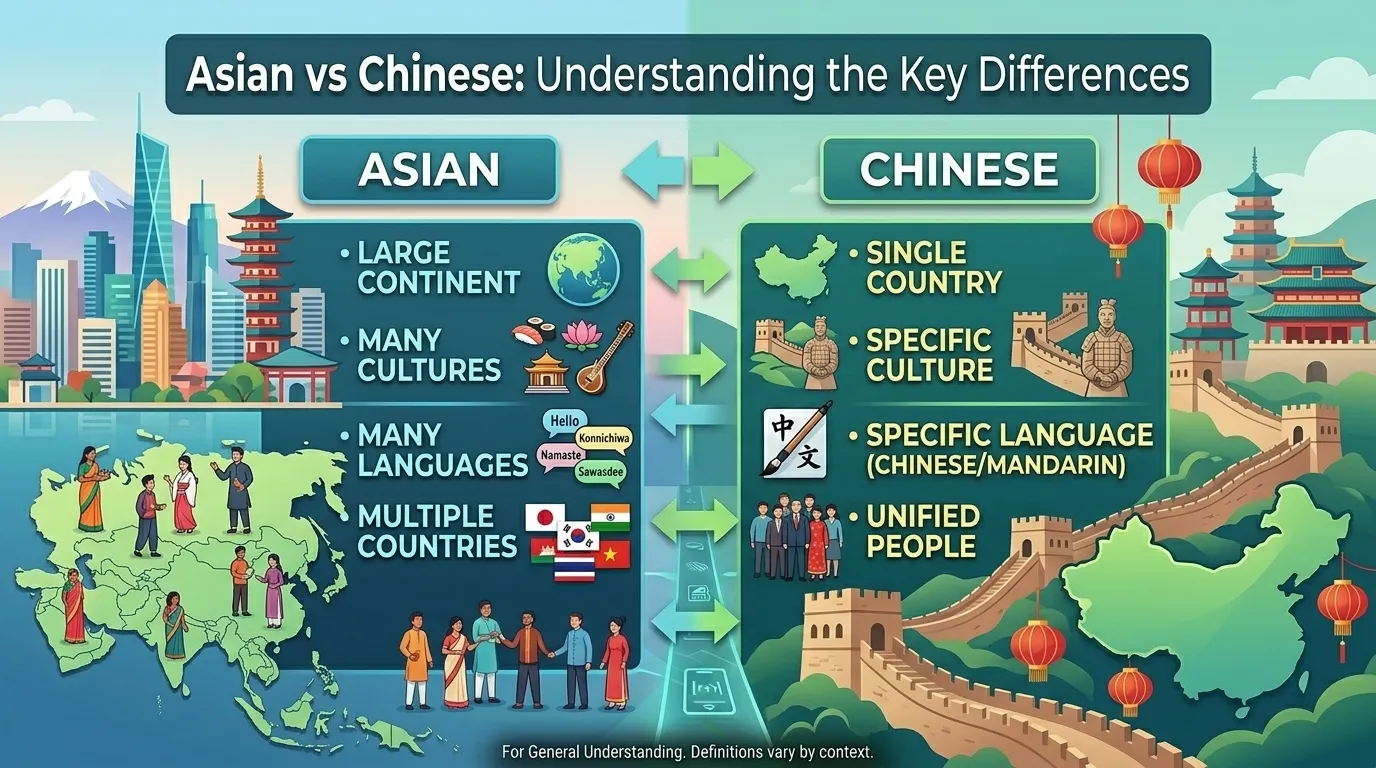
The primary distinction is simple:
- Asian refers to anyone from the continent of Asia.
- Chinese refers specifically to people from the country of China.
Asia is the largest continent in the world, while China is one country within Asia.
Why Is Their Difference Necessary to Know?
Understanding this distinction promotes cultural respect and accuracy. Asia contains more than 40 countries, including China, Japan, India, South Korea, and many others.
If we call every Asian person “Chinese,” we ignore their unique languages, traditions, and identities. For learners, accurate vocabulary improves communication skills. For researchers and professionals, correct terminology ensures clarity in academic, political, and social discussions.
Respectful language builds inclusive societies.
Pronunciation of the Both (US & UK)
Before moving deeper into the difference, let’s clarify pronunciation:
Asian
- US: /ˈeɪʒən/
- UK: /ˈeɪʒən/
Chinese
- US: /ˌtʃaɪˈniːz/
- UK: /ˌtʃaɪˈniːz/
Now that we can pronounce both words confidently, let’s explore their detailed differences.
Difference Between the Asian and Chinese
1. Continent vs Country
Asian relates to a continent.
Chinese relates to one country.
Examples:
- A person from Thailand is Asian but not Chinese.
- A person from China is both Asian and Chinese.
2. Broader vs Specific Identity
Asian is a broad identity.
Chinese is a specific nationality or ethnicity.
Examples:
- An Indian engineer is Asian.
- A Beijing-born artist is Chinese.
3. Geographic Scope
Asia includes East Asia, South Asia, Southeast Asia, Central Asia, and West Asia.
China is located in East Asia.
Examples:
- Saudi Arabia is in West Asia.
- China borders Mongolia and India.
4. Language Diversity
Asia has hundreds of languages.
Chinese mainly refers to Mandarin and other Chinese dialects.
Examples:
- Japanese is spoken in Japan.
- Mandarin is widely spoken in China.
5. Cultural Traditions
Asian cultures vary greatly.
Chinese culture includes Confucian traditions and Chinese New Year celebrations.
Examples:
- Diwali is celebrated in India.
- Lunar New Year is widely celebrated in China.
6. Ethnic Background
Asian includes many ethnic groups.
Chinese often refers to Han Chinese or other ethnic groups within China.
Examples:
- Malays are Asian.
- Han people are Chinese.
7. Government Systems
Asian countries have different political systems.
China has a single-party socialist system.
Examples:
- Japan has a constitutional monarchy.
- China is governed by the Communist Party.
8. Cuisine
Asian food includes sushi, curry, kebabs, and more.
Chinese cuisine includes dumplings, noodles, and Peking duck.
Examples:
- Sushi comes from Japan.
- Dim sum comes from China.
9. Population Diversity
Asia has over 4 billion people.
China has over 1.4 billion people.
Examples:
- Indonesia is highly populated in Southeast Asia.
- China has the largest population in East Asia.
10. Use in Identity Forms
Asian is often used for racial categorization.
Chinese is used for nationality.
Examples:
- A US census may list “Asian” as a race.
- A passport lists “Chinese” as nationality if issued by China.
Nature and Behaviour of the Both Separately
Asian societies are extremely diverse. Some cultures emphasize collectivism, others individualism. Social behavior varies from country to country.
Chinese society traditionally values harmony, respect for elders, and education. Confucian philosophy strongly influences social behavior in China.
Why People Are Confused About Their Use?
Confusion often happens because:
- China is highly visible globally.
- Many overseas Asian communities include Chinese immigrants.
- Media sometimes oversimplifies Asian identity.
Difference and Similarity (Asian vs Chinese)
| Aspect | Asian | Chinese |
| Meaning | Person from Asia | Person from China |
| Scope | Broad | Specific |
| Geography | Continent | Country |
| Languages | Many | Mandarin, Cantonese etc. |
| Similarity | Both relate to Asia | Both relate to Asia |
Which Is Better in What Situation?
Use Asian when referring to someone from the continent generally. For example, in demographic surveys or broad cultural discussions, “Asian” is appropriate.
Use Chinese when discussing nationality, government, language, or culture specific to China. If someone is from Shanghai, calling them Chinese is accurate, while calling them Asian is general but correct.
Neither term is “better.” The correct word depends on context.
Use in Metaphors and Similes
- “He has the patience of an ancient Asian philosopher.”
- “Her discipline is like a traditional Chinese scholar.”
Writers sometimes use “Asian” to suggest diversity and history. “Chinese” may symbolize tradition, wisdom, or resilience.
Connotative Meaning
Asian
- Positive: Diversity, richness, heritage
- Neutral: Geographic identity
- Negative (if misused): Stereotyping all cultures together
Example: “Asian cultures are beautifully diverse.”
Chinese
- Positive: Ancient civilization, innovation
- Neutral: National identity
- Negative (if stereotyped): Economic or political bias
Example: “Chinese history spans thousands of years.”
Idioms or Proverbs Related to Both
There are no direct English idioms using “Asian” or “Chinese,” but cultural references exist.
- “Chinese whispers” (means a message distorted as it passes along).
Example: The rumor spread like Chinese whispers in school.
Works in Literature
- The Good Earth – Pearl S. Buck (Novel, 1931)
- Wild Swans – Jung Chang (Memoir, 1991)
- The Joy Luck Club – Amy Tan (Novel, 1989)
Movies Made on the Both
- The Last Emperor (1987, UK/Italy/China)
- Crouching Tiger, Hidden Dragon (2000, Taiwan/China)
Five Frequently Asked Questions
1. Is every Chinese person Asian?
Yes, because China is in Asia.
2. Is every Asian person Chinese?
No, Asia includes many countries besides China.
3. Can Chinese be an ethnicity?
Yes, such as Han Chinese.
4. Why is Asia so diverse?
Because it is the largest and most populated continent.
5. Is it offensive to mix the terms?
It can be disrespectful if used incorrectly.
6. Is Asian and Chinese the same?
No, they are not the same. Asian refers to people from the whole continent of Asia, while Chinese refers specifically to people from China.
7. What is the difference between Asian and Chinese?
Asian is a broad term for many countries and cultures, whereas Chinese is a specific nationality or ethnicity from China.
8. Asian vs Chinese
Use “Asian” for general reference to Asia, and “Chinese” only when referring to someone from China.
How Both Are Useful for Surroundings
Asian cultures contribute to global cuisine, technology, philosophy, and medicine. Chinese civilization has contributed inventions like paper and gunpowder, influencing the world greatly.
Final Words for the Both
Asian represents continental diversity and unity. Chinese represents a specific national and cultural identity within that vast continent.
Conclusion
Understanding the difference between Asian and Chinese , these terms helps promote respect, accuracy, and global awareness. Asia is a vast continent filled with unique nations, cultures, and languages. China is one powerful and historically rich country within Asia. When we clearly understand the difference between Asian vs Chinese, we communicate more respectfully and intelligently. In academic, professional, and daily conversations, using the correct term strengthens intercultural understanding and avoids confusion.

Sarfraz Ahmad is language researcher and content writer who specializes in explaining the difference between commonly confused English words. Through WordClearify, learners understand subtle word distinctions in a simple, structured, and practical way. My writing focuses on clarity, real-life examples, and easy comparisons for students, bloggers, and professionals worldwide.