Imagine standing on a beach, watching dark clouds roll in, bringing torrential rain. Across the ocean, another storm spirals with ferocious winds, destroying everything in its path. These events remind us of two natural phenomena often misunderstood monsoon and hurricane. These two situations highlight the essence of monsoon vs hurricane.
Understanding the difference between monsoon and hurricane is essential, especially when planning travel, agriculture, or disaster management. Both terms are linked to storms, but they behave differently.
The monsoon vs hurricane debate often confuses even students and weather enthusiasts. In this article, we will explore the difference between monsoon and hurricane, their nature, behavior, and why it’s important for learners and experts alike. By the end, you’ll clearly know when to expect gentle seasonal rains and when to prepare for a fierce storm.
Key Difference Between Monsoon and Hurricane
The main difference lies in their nature:
- A monsoon is a seasonal wind pattern that brings prolonged rainfall.
- A hurricane is a powerful, rotating storm system with intense winds and heavy rain.
Why Is Their Difference Necessary to Know?
Understanding monsoon vs hurricane is crucial for students, researchers, and communities. Monsoons are vital for agriculture, especially in regions like South Asia, where they determine food production. Hurricanes, on the other hand, are hazardous natural disasters requiring early warning systems and emergency planning. Knowing their differences helps meteorologists predict weather accurately, governments prepare disaster management strategies, and citizens respond appropriately. This knowledge also supports climate research and environmental awareness, making societies more resilient.
Pronunciation of Both (US & UK)
- Monsoon
- US: /mɑːnˈsuːn/
- UK: /mɒnˈsuːn/
- Hurricane
- US: /ˈhɜːrɪkeɪn/
- UK: /ˈhʌrɪkən/
Now that you know how to say them correctly, let’s explore their detailed differences.
Monsoon vs Hurricane: What’s the Difference?
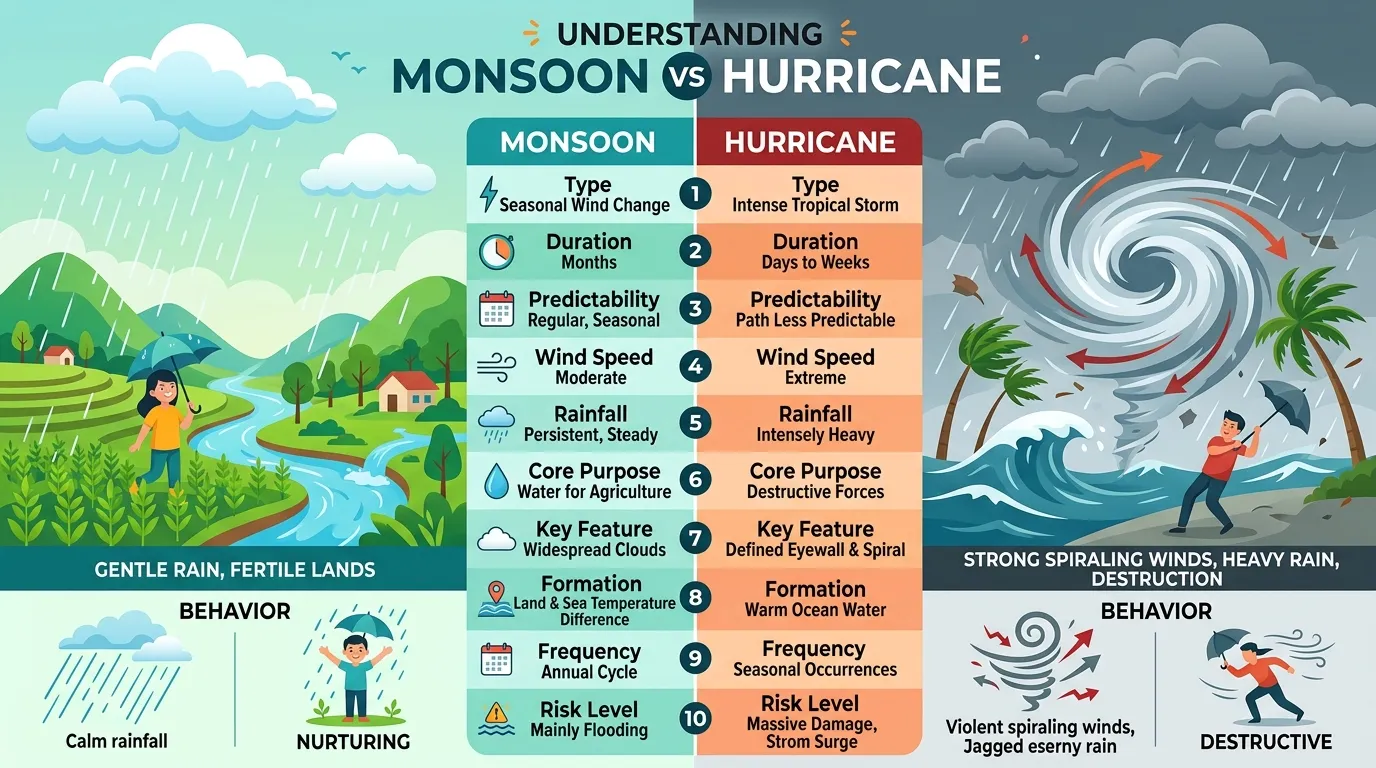
1. Definition
- Monsoon: Seasonal wind system causing rainfall.
- Example 1: Indian monsoon brings summer rains.
- Example 2: African monsoon affects Sahel region.
- Hurricane: A strong tropical cyclone.
- Example 1: Hurricane Katrina caused devastation.
- Example 2: Hurricane Irma hit Caribbean islands.
2. Duration
- Monsoon lasts months.
- Example 1: June to September rains.
- Example 2: Winter monsoon in Southeast Asia.
- Hurricane lasts days or weeks.
- Example 1: Storm dissipates in a week.
- Example 2: Short-lived but intense impact.
3. Formation
- Monsoon forms due to seasonal wind reversal.
- Example 1: Land heats faster than ocean.
- Example 2: Pressure differences cause wind shifts.
- Hurricane forms over warm ocean waters.
- Example 1: Needs 26°C water temperature.
- Example 2: Develops from tropical disturbances.
4. Wind Pattern
- Monsoon: Steady directional winds.
- Example 1: Southwest monsoon winds.
- Example 2: Northeast monsoon winds.
- Hurricane: Circular rotating winds.
- Example 1: Eye of the storm.
- Example 2: Spiral rain bands.
5. Intensity
- Monsoon: Moderate to heavy rainfall.
- Example 1: Flooding due to prolonged rain.
- Example 2: Steady rainfall over days.
- Hurricane: Extremely intense winds and rain.
- Example 1: Wind speeds over 150 mph.
- Example 2: Storm surges.
6. Impact
- Monsoon: Beneficial and harmful.
- Example 1: Helps crops grow.
- Example 2: Causes floods.
- Hurricane: Mostly destructive.
- Example 1: Damages infrastructure.
- Example 2: Causes loss of life.
7. Geographic Location
- Monsoon: South Asia, Africa, Australia.
- Example 1: India.
- Example 2: Bangladesh.
- Hurricane: Atlantic and Pacific Oceans.
- Example 1: USA coast.
- Example 2: Caribbean.
8. Predictability
- Monsoon: Seasonal and predictable.
- Example 1: Arrives annually.
- Example 2: Forecasted months ahead.
- Hurricane: Less predictable.
- Example 1: Sudden formation.
- Example 2: Path changes quickly.
9. Structure
- Monsoon: No defined structure.
- Example 1: Widespread rain.
- Example 2: No central eye.
- Hurricane: Organized system.
- Example 1: Eye and eyewall.
- Example 2: Defined spiral shape.
10. Purpose/Role
- Monsoon: Supports ecosystems.
- Example 1: Replenishes water supplies.
- Example 2: Sustains agriculture.
- Hurricane: Natural but destructive force.
- Example 1: Redistributes heat.
- Example 2: Impacts climate systems.
Nature and Behaviour
Monsoons are seasonal and relatively stable systems that bring continuous rainfall over large regions. Their behavior is gradual and predictable. Hurricanes, however, are violent, fast-developing storms with unpredictable paths and extreme energy, making them far more dangerous in the short term.
Why People Are Confused About Their Use( Monsoon vs Hurricane) ?
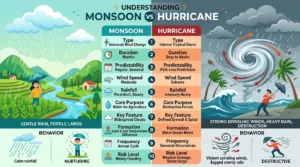
| Feature | Monsoon | Hurricane | Similarity |
|---|---|---|---|
| Type | Seasonal wind system | Tropical storm | Both involve rain |
| Duration | Months | Days | Weather phenomena |
| Impact | Agricultural & flooding | Destructive | Can cause flooding |
| Predictability | High | Low | Studied in meteorology |
Which Is Better in What Situation?
A monsoon is beneficial in agricultural regions where consistent rainfall is needed for crops and water supply. Farmers depend on it for survival and economic stability.
A hurricane is never “better,” but it plays a role in balancing Earth’s climate by redistributing heat. However, in human contexts, it is mostly harmful and requires preparedness.
Use in Metaphors and Similes
- “Her emotions came like a monsoon” (steady and overwhelming).
- “His anger was a hurricane” (sudden and destructive).
Connotative Meaning
- Monsoon
- Positive: Renewal, growth (e.g., “monsoon of blessings”)
- Negative: Flooding, disruption
- Hurricane
- Negative: Chaos, destruction
- Neutral: Powerful force (e.g., “a hurricane of change”)
Idioms or Proverbs
- “Save for a rainy day” (related to monsoon-like conditions)
- “Storm before the calm”
Examples: - “The monsoon taught them to save for a rainy day.”
- “His outburst was the storm before the calm.”
Works in Literature
- Monsoon – Novel, Wilbur Smith, 1999
- The Hurricane – Biography, Rubin Carter, 1974
Movies
- Monsoon Wedding (2001, India)
- The Hurricane (1999, USA)
FAQs
1. What is the main difference in monsoon vs hurricane?
Monsoon is seasonal rainfall, while a hurricane is a short, intense storm.
2. Which is more dangerous?
Hurricanes are generally more dangerous due to high winds.
3. Can monsoons cause disasters?
Yes, they can cause floods and landslides.
4. Where do hurricanes occur?
Mostly in oceans like the Atlantic and Pacific.
5. Are monsoons predictable?
Yes, they follow seasonal patterns.
How Both Are Useful for Surroundings
Monsoons replenish water supplies, support agriculture, and maintain ecosystems. Hurricanes, although destructive, help regulate global temperatures and redistribute ocean heat.
Final Words for the Both
Monsoons and hurricanes are both powerful natural systems, but they serve very different purposes. One sustains life; the other tests resilience.
Conclusion
Understanding monsoon vs hurricane allows us to appreciate the diversity and complexity of Earth’s weather systems. While monsoons bring essential rainfall that supports agriculture and livelihoods, hurricanes represent nature’s raw power and unpredictability. Both phenomena play important roles in the global climate system, yet their impacts on human life differ greatly. By studying monsoon vs hurricane, we not only improve our scientific knowledge but also enhance our ability to prepare for and respond to these events. Awareness and education are key to living safely and sustainably alongside nature’s forces.

Sarfraz Ahmad is language researcher and content writer who specializes in explaining the difference between commonly confused English words. Through WordClearify, learners understand subtle word distinctions in a simple, structured, and practical way. My writing focuses on clarity, real-life examples, and easy comparisons for students, bloggers, and professionals worldwide.