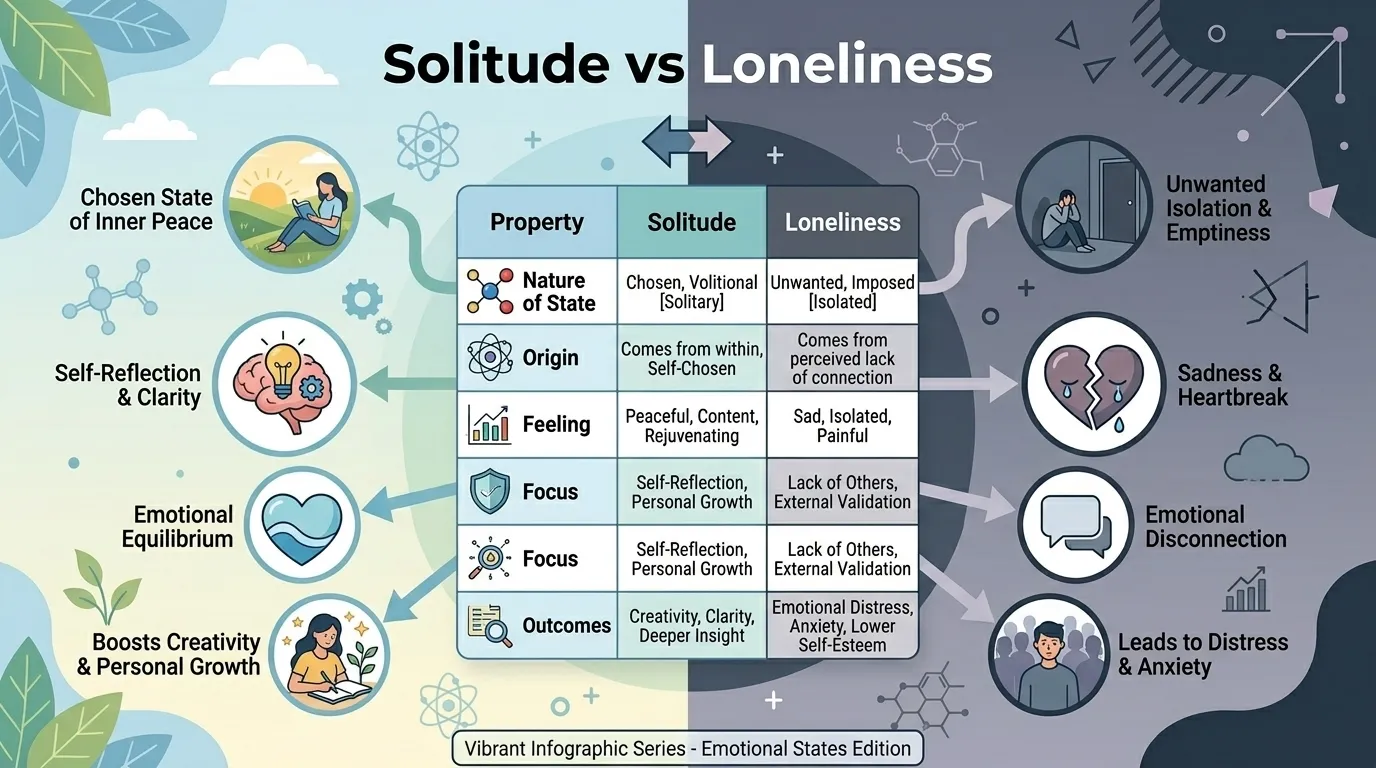
A few months ago, a young professional moved to a new city for work. Every evening, he sat alone in his apartment. At first, the silence felt peaceful he enjoyed reading, reflecting, and growing. But over time, that same silence began to feel heavy and isolating. What changed? This simple story explains the difference between solitude and loneliness.
While both involve being alone, their emotional impact is completely different. In fact, understanding solitude vs loneliness can transform how we view time spent alone. Many people confuse these states, but learning the truth behind helps us improve mental well-being.
Whether you are a student, professional, or researcher, grasping the concept of solitude vs loneliness is essential in today’s fast-paced world.
Key Difference Between Solitude and Loneliness
The core difference is emotional experience. Solitude is a positive and chosen state of being alone, often linked with peace and self-reflection.
Loneliness, on the other hand, is a negative emotional state where a person feels isolated, disconnected, or unwanted even if surrounded by people.
Why Is Their Difference Important for Learners and Experts?
Understanding the difference between solitude and loneliness is essential for both personal growth and professional development.
For learners, solitude can improve focus, creativity, and deep thinking. Students who embrace solitude often perform better academically because they use quiet time for reflection and learning.
For experts, especially psychologists, writers, and leaders, recognizing this difference helps in managing emotional health and guiding others. In society, misunderstanding loneliness as mere solitude can lead to mental health issues being ignored.
In today’s digital age, where people are constantly connected yet emotionally distant, knowing the difference helps build stronger relationships and healthier communities.
Pronunciation of Both (US & UK)
- Solitude
- US: /ˈsɑː.lə.tuːd/
- UK: /ˈsɒl.ɪ.tjuːd/
- Loneliness
- US: /ˈloʊn.li.nəs/
- UK: /ˈləʊn.li.nəs/
Now that you know how to say these words correctly, let’s dive deeper into their actual differences and meanings.
Difference Between Solitude and Loneliness
1. Choice vs Feeling
- Solitude is chosen willingly.
Example 1: A writer sits alone to focus on a novel.
Example 2: A student studies in a quiet room. - Loneliness is an unwanted feeling.
Example 1: Someone feels ignored at a party.
Example 2: A person misses their family deeply.
2. Emotional Impact
- Solitude brings peace.
Example 1: Meditation in silence.
Example 2: Walking alone in nature. - Loneliness brings sadness.
Example 1: Feeling empty at home.
Example 2: Emotional pain after losing a friend.
3. Mental State
- Solitude improves clarity.
Example 1: Thinking clearly during quiet time.
Example 2: Planning goals without distraction. - Loneliness creates confusion.
Example 1: Overthinking negative thoughts.
Example 2: Feeling lost emotionally.
4. Social Connection
- Solitude doesn’t mean lack of relationships.
Example 1: A person enjoys alone time but has friends.
Example 2: Taking a break from social media. - Loneliness reflects lack of connection.
Example 1: No one to talk to.
Example 2: Feeling disconnected in a crowd.
5. Productivity
- Solitude increases productivity.
Example 1: Completing work without distraction.
Example 2: Learning new skills alone. - Loneliness reduces productivity.
Example 1: Lack of motivation.
Example 2: Difficulty concentrating.
6. Emotional Control
- Solitude strengthens emotional control.
Example 1: Self-reflection helps manage stress.
Example 2: Calm thinking during problems. - Loneliness weakens emotional control.
Example 1: Mood swings.
Example 2: Feeling overwhelmed.
7. Duration
- Solitude is temporary and controlled.
Example 1: Spending a weekend alone.
Example 2: Taking a short break. - Loneliness can last long.
Example 1: Long-term isolation.
Example 2: Chronic sadness.
8. Physical vs Emotional
- Solitude is physical aloneness.
Example 1: Sitting alone in a room.
Example 2: Traveling solo. - Loneliness is emotional isolation.
Example 1: Feeling alone in a crowd.
Example 2: Lack of emotional support.
9. Self-Relationship
- Solitude builds self-awareness.
Example 1: Journaling thoughts.
Example 2: Understanding personal goals. - Loneliness harms self-image.
Example 1: Feeling unworthy.
Example 2: Low self-esteem.
10. Outcome
- Solitude leads to growth.
Example 1: Personal development.
Example 2: Creative ideas. - Loneliness leads to distress.
Example 1: Anxiety.
Example 2: Depression.
Nature and Behaviour of Both
Solitude is calm, peaceful, and constructive. It encourages introspection and self-growth. People in solitude often feel satisfied and in control.
Loneliness is painful, stressful, and draining. It creates emotional emptiness and a desire for connection.
Why Are People Confused About Their Use?
People often confuse them because both involve being alone. However, the difference lies in emotional experience.
| Aspect | Solitude | Loneliness |
| Nature | Positive | Negative |
| Choice | Voluntary | Involuntary |
| Emotion | Peaceful | Sad |
| Impact | Growth | Distress |
| Social Need | Balanced | Unfulfilled |
Which Is Better in What Situation?
Solitude is better when you need focus, creativity, or emotional healing. It helps you reconnect with yourself and recharge mentally. For example, writers, students, and thinkers benefit greatly from solitude.
Loneliness, however, is not beneficial. It signals a need for connection. In such situations, reaching out to friends, family, or community is essential. Recognizing loneliness early helps prevent deeper emotional issues.
Use in Metaphors and Similes
- Solitude is like a calm ocean where thoughts settle.
- Loneliness is like a dark room with no windows.
- He embraced solitude like a peaceful retreat.
- She felt loneliness like a heavy shadow.
Connotative Meaning of Both
- Solitude: Positive
Example: She enjoyed solitude while reading books. - Loneliness: Negative
Example: He suffered from loneliness after moving away.
Idioms or Proverbs
- “Better alone than in bad company” (Solitude)
Example: She chose solitude instead of toxic friendships. - “No man is an island” (Loneliness)
Example: Humans need connection to avoid loneliness.
Works in Literature
- “Walden” – Essay, Henry David Thoreau, 1854
- “One Hundred Years of Solitude” – Novel, Gabriel García Márquez, 1967
- “The Lonely City” – Non-fiction, Olivia Laing, 2016
Movies Based on These Themes
- Into the Wild – 2007, USA
- Her – 2013, USA
- Lost in Translation – 2003, USA/Japan
FAQs
1. What is the main difference between solitude and loneliness?
Solitude is a positive choice, while loneliness is a negative emotional state.
2. Can solitude turn into loneliness?
Yes, if prolonged without social connection, solitude may lead to loneliness.
3. Is solitude healthy?
Yes, it promotes self-awareness and mental clarity.
4. Why do people feel lonely in a crowd?
Because loneliness is emotional, not physical.
5. How can loneliness be reduced?
By building meaningful relationships and staying socially connected.
How Both Are Useful for Surroundings
Solitude helps individuals grow, which benefits society through creativity and innovation. Loneliness, although negative, signals the need for social support systems, encouraging communities to become more connected and compassionate.
Final Words for Both
Solitude is a friend that nurtures the soul, while loneliness is a signal that reminds us of our need for connection.
Conclusion
Understanding the difference between solitude and loneliness is essential in modern life. While both involve being alone, their emotional meanings are entirely different. Solitude offers peace, growth, and clarity, making it a powerful tool for personal development. Loneliness, however, highlights emotional disconnection and the need for human interaction. Recognizing this difference allows individuals to use solitude wisely while addressing loneliness effectively. In a world full of noise and distractions, learning to balance both states can lead to a healthier, happier life.

Sarfraz Ahmad is language researcher and content writer who specializes in explaining the difference between commonly confused English words. Through WordClearify, learners understand subtle word distinctions in a simple, structured, and practical way. My writing focuses on clarity, real-life examples, and easy comparisons for students, bloggers, and professionals worldwide.