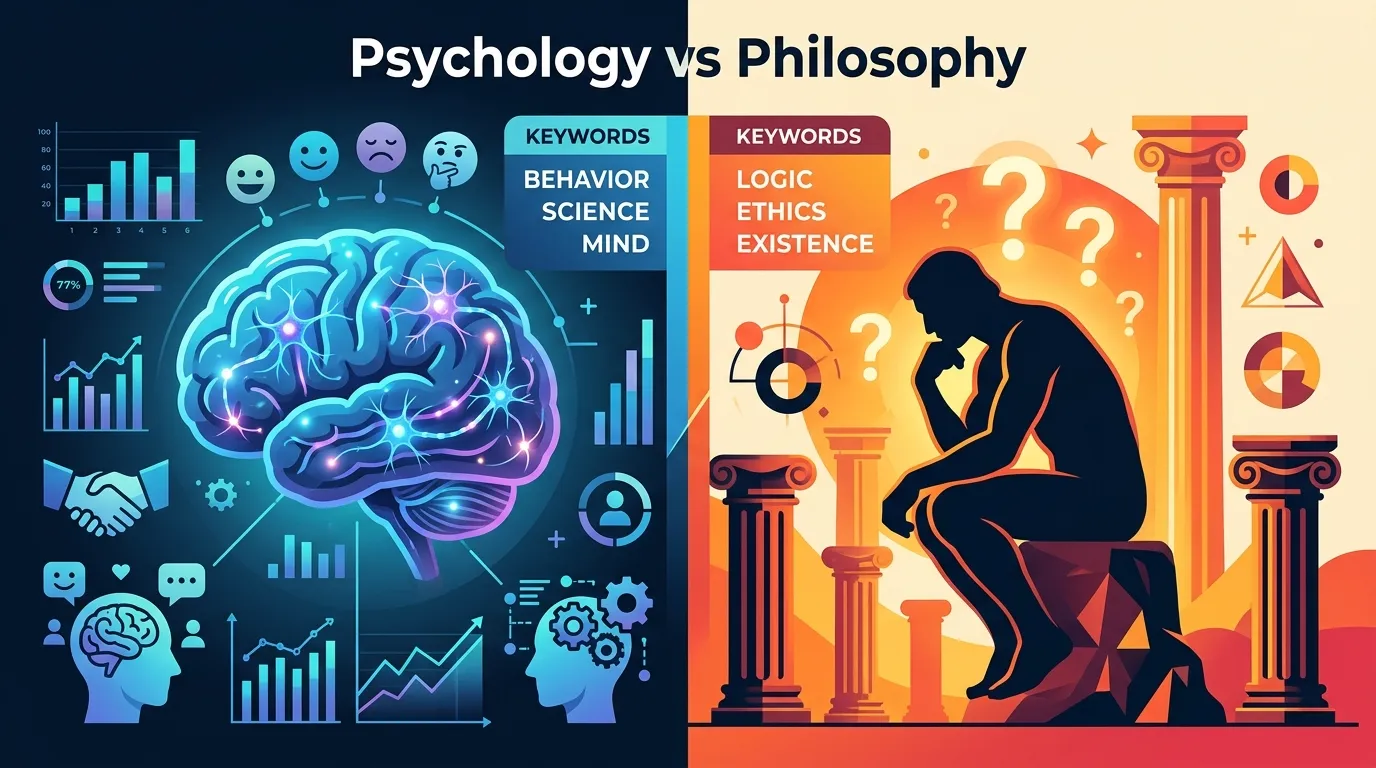
On a quiet evening, a student sits in a café observing people around him. He wonders why a man looks anxious while another seems content. At the same time, deeper questions arise what is happiness, and does it even have a universal meaning? This moment perfectly captures the essence of difference between psychology and philosophy.
While psychology studies human behavior and mental processes scientifically, philosophy explores abstract ideas about existence, truth, and morality. In understanding psychology vs philosophy, we begin to see how one focuses on observable patterns while the other dives into deeper reasoning.
The debate of psychology vs philosophy has shaped education, research, and human understanding for centuries. Whether you are analyzing behavior or questioning reality, both fields offer unique insights into life.
Key Difference Between the Both
The key difference between psychology and philosophy lies in their approach. Psychology is a scientific discipline that studies behavior, emotions, and mental processes using experiments and data. Philosophy, on the other hand, is a theoretical discipline that explores fundamental questions about existence, knowledge, and ethics through reasoning and logic.
Why Is Their Difference Necessary to Know for Learners and Experts?
Understanding the difference between psychology and philosophy is crucial because both fields influence how we interpret the world. For learners, psychology provides practical tools for understanding behavior, improving mental health, and solving real-world problems. Philosophy, however, develops critical thinking, reasoning, and ethical decision-making skills.
For experts, distinguishing between the two ensures clarity in research and application. Psychologists rely on data-driven conclusions, while philosophers engage in logical debates. In society, psychology helps improve relationships and mental well-being, whereas philosophy shapes laws, ethics, and cultural beliefs.
Pronunciation of Both (US & UK)
- Psychology
- US: /saɪˈkɑː.lə.dʒi/
- UK: /saɪˈkɒl.ə.dʒi/
- Philosophy
- US: /fəˈlɑː.sə.fi/
- UK: /fɪˈlɒs.ə.fi/
Now that we understand how these words sound, let’s explore their deeper differences in detail.
Difference between Psychology and Philosophy
1. Definition
Psychology studies human behavior and mental processes scientifically. Philosophy explores fundamental questions about existence and knowledge.
- Example (Psychology): Studying anxiety patterns in teenagers.
- Example (Philosophy): Asking “What is the meaning of life?”
2. Nature
Psychology is empirical and evidence-based. Philosophy is theoretical and conceptual.
- Example (Psychology): Conducting experiments.
- Example (Philosophy): Logical reasoning debates.
3. Methodology
Psychology uses experiments, surveys, and observation. Philosophy uses logic and argumentation.
- Example (Psychology): Lab tests.
- Example (Philosophy): Ethical discussions.
4. Focus Area
Psychology focuses on behavior and mind. Philosophy focuses on truth, existence, and morality.
- Example (Psychology): Studying depression.
- Example (Philosophy): Defining justice.
5. Application
Psychology is applied in therapy and counseling. Philosophy is applied in ethics and reasoning.
- Example (Psychology): Treating mental illness.
- Example (Philosophy): Moral decision-making.
6. Scientific Basis
Psychology is a science. Philosophy is not strictly scientific.
- Example (Psychology): Brain imaging studies.
- Example (Philosophy): Thought experiments.
7. Career Paths
Psychology leads to careers like therapists and researchers. Philosophy leads to teaching, writing, or law.
- Example (Psychology): Clinical psychologist.
- Example (Philosophy): Ethics professor.
8. Historical Roots
Psychology evolved from philosophy but became independent. Philosophy is ancient and foundational.
- Example (Psychology): Modern behavioral science.
- Example (Philosophy): Ancient Greek thought.
9. Objective
Psychology aims to explain and predict behavior. Philosophy aims to understand and question reality.
- Example (Psychology): Predicting stress reactions.
- Example (Philosophy): Questioning truth.
10. Tools Used
Psychology uses tests and statistics. Philosophy uses reasoning and argument.
- Example (Psychology): Personality tests.
- Example (Philosophy): Logical analysis.
Nature and Behaviour of Both
Psychology:
Psychology is practical and scientific. It observes behavior, analyzes patterns, and provides solutions for mental and emotional issues.
Philosophy:
Philosophy is reflective and abstract. It questions assumptions and seeks deeper truths about life and existence.
Why People Are Confused About Their Use?
| Aspect | Psychology | Philosophy | Similarity |
| Origin | Derived from philosophy | Ancient discipline | Both study human thought |
| Approach | Scientific | Theoretical | Both seek understanding |
| Focus | Behavior | Ideas | Both involve thinking |
| Method | Experiments | Logic | Both analyze concepts |
Confusion arises because psychology originally developed from philosophy, and both deal with the mind and human thinking.
Which Is Better in What Situation?
Psychology:
Psychology is better when dealing with real-life problems like stress, anxiety, relationships, or mental health. It provides practical solutions based on research and evidence. For example, therapy and counseling are rooted in psychology.
Philosophy:
Philosophy is better when addressing deep questions about life, ethics, and purpose. It helps in developing critical thinking and making moral decisions. Philosophy is ideal for debates, ethical dilemmas, and intellectual exploration.
Use in Metaphors and Similes
- “Her thoughts were a maze of psychology.”
- “Life felt like a philosophy book full of unanswered questions.”
- “His mind worked like psychology, analyzing everything.”
- “Her ideas flowed like philosophy deep and endless.”
Connotative Meaning of Both
Psychology
- Positive: Insightful, analytical
- Negative: Overanalyzing
- Neutral: Study of behavior
- Example: “He used psychology to understand emotions.”
Philosophy
- Positive: Wise, thoughtful
- Negative: Overly abstract
- Neutral: Love of wisdom
- Example: “Her philosophy of life is inspiring.”
Idioms or Proverbs Related
- “Think before you act” (philosophy)
- “Read between the lines” (psychology)
Examples:
- “Using philosophy, he chose the right path.”
- “With psychology, she understood hidden emotions.”
Works in Literature
- Psychology
- “The Interpretation of Dreams” – Sigmund Freud (1900, Non-fiction)
- “Thinking, Fast and Slow” – Daniel Kahneman (2011, Non-fiction)
- Philosophy
- “The Republic” – Plato (380 BC, Philosophy)
- “Meditations” – Marcus Aurelius (180 AD, Philosophy)
Movies Based on Both
- Psychology
- “A Beautiful Mind” (2001, USA)
- “Black Swan” (2010, USA)
- Philosophy
- “The Matrix” (1999, USA)
- “Inception” (2010, USA)
Frequently Asked Questions
1. What is the main difference between psychology and philosophy?
Psychology is scientific, while philosophy is theoretical.
2. Can psychology exist without philosophy?
No, psychology originated from philosophy.
3. Which is more practical?
Psychology is more practical.
4. Which is older?
Philosophy is much older.
5. Can someone study both?
Yes, both complement each other.
How Both Are Useful for Surroundings
Psychology helps improve mental health, relationships, and workplace productivity. Philosophy shapes ethics, cultural values, and decision-making. Together, they create a balanced society where people think deeply and act wisely.
Final Words for Both
Psychology and philosophy are not rivals but partners. One explains how we think, while the other questions why we think. Together, they offer a complete understanding of human life.
Conclusion
The discussion of difference between psychology and philosophy reveals two powerful disciplines that shape human understanding. While psychology provides scientific insights into behavior and mental processes, philosophy challenges us to think deeply about existence and truth. Understanding both helps learners and professionals apply the right approach in different situations. In the end, psychology vs philosophy is not about choosing one over the other but appreciating how both contribute to knowledge, growth, and society.

Sarfraz Ahmad is language researcher and content writer who specializes in explaining the difference between commonly confused English words. Through WordClearify, learners understand subtle word distinctions in a simple, structured, and practical way. My writing focuses on clarity, real-life examples, and easy comparisons for students, bloggers, and professionals worldwide.