Imagine a small business owner in Pakistan ordering goods from China for the first time. The supplier offers two pricing options: FOB and EXW. At first glance, both seem similar, but choosing the wrong one could lead to unexpected costs, shipping confusion, or even financial loss. This is where understanding the difference between FOB and EXW becomes essential.
The terms FOB (Free on Board) and EXW (Ex Works) are widely used in international trade. They define who is responsible for shipping, risks, and costs during the transportation of goods. For anyone involved in import/export, understanding fob vs exw is not just helpful it’s critical.
In this article, we will explore the difference between them in depth. Whether you are a beginner or an experienced trader, knowing the difference between them can save your money, time, and stress. Let’s dive into this practical and easy-to-understand guide on fob vs exw.
Key Difference Between Both
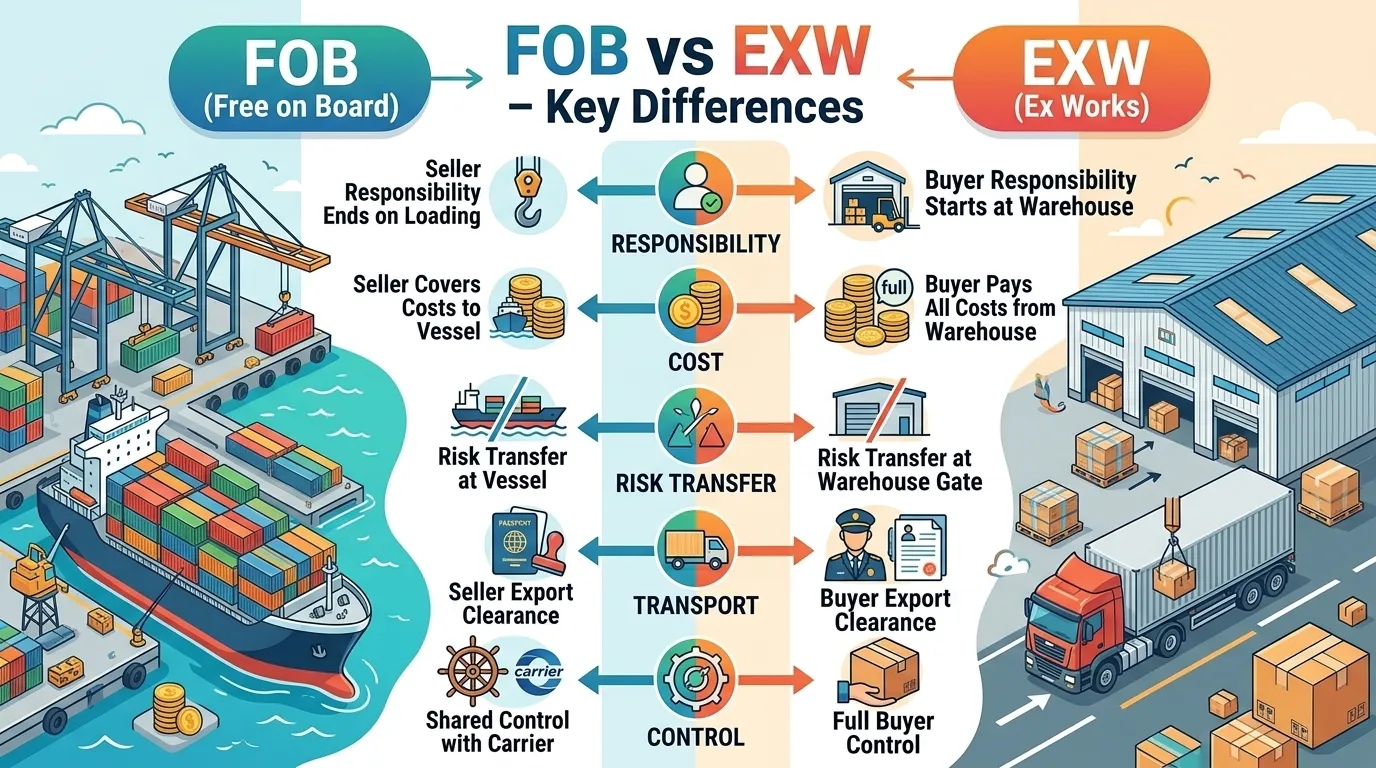
The main difference between both lies in responsibility.
- FOB (Free on Board): The seller handles costs and risks until the goods are loaded onto the ship.
- EXW (Ex Works): The buyer takes full responsibility from the seller’s premises.
In simple terms, FOB gives more responsibility to the seller, while EXW puts almost everything on the buyer.
Why Is Their Difference Necessary to Know?
Understanding the difference between FOB and EXW is essential for both learners and professionals.
For beginners, it helps avoid costly mistakes in international trade. For experts, it improves negotiation skills and ensures smoother transactions. In today’s global economy, where goods travel across countries daily, knowing who is responsible for shipping, customs, and risks is crucial.
Moreover, businesses rely on these terms to build trust and transparency. Without clear knowledge of fob vs exw, disputes can arise, leading to delays and financial losses. Therefore, mastering these terms is not just academic—it has real-world importance.
Pronunciation of Both Terms (US & UK)
- FOB
- US: /ɛf oʊ biː/
- UK: /ɛf əʊ biː/
- EXW
- US: /iː ɛks dʌbəl.juː/
- UK: /iː ɛks dʌbəl.juː/
Now that you know how to pronounce them, let’s move deeper into understanding their differences in detail.
Difference Between FOB and EXW
1. Responsibility for Goods
- FOB: Seller responsible until goods are loaded on ship.
Example 1: Seller loads goods at port safely.
Example 2: Seller pays for port handling. - EXW: Buyer responsible from seller’s warehouse.
Example 1: Buyer arranges pickup truck.
Example 2: Buyer handles loading.
2. Transportation Costs
- FOB: Seller pays local transport to port.
Example 1: Seller hires truck to port.
Example 2: Seller pays export fees. - EXW: Buyer pays all transport costs.
Example 1: Buyer pays pickup charges.
Example 2: Buyer pays freight.
3. Risk Transfer
- FOB: Risk transfers when goods are on board.
Example 1: Damage before loading = seller loss.
Example 2: Damage after loading = buyer loss. - EXW: Risk transfers at seller’s premises.
Example 1: Damage during pickup = buyer loss.
Example 2: Theft during loading = buyer issue.
4. Export Clearance
- FOB: Seller handles export clearance.
Example 1: Seller manages customs paperwork.
Example 2: Seller pays export duties. - EXW: Buyer handles export clearance.
Example 1: Buyer hires customs agent.
Example 2: Buyer submits documents.
5. Control Over Shipment
- FOB: Shared control.
Example 1: Seller controls early stage.
Example 2: Buyer controls shipping stage. - EXW: Full control by buyer.
Example 1: Buyer chooses transport method.
Example 2: Buyer selects shipping company.
6. Complexity
- FOB: Moderate complexity.
Example 1: Balanced responsibilities.
Example 2: Easier for beginners. - EXW: High complexity.
Example 1: Buyer manages everything.
Example 2: Requires experience.
7. Cost Transparency
- FOB: More transparent pricing.
Example 1: Seller includes local costs.
Example 2: Clear shipping stages. - EXW: Less transparent initially.
Example 1: Hidden logistics costs.
Example 2: Extra handling fees.
8. Suitability for Beginners
- FOB: Beginner-friendly.
Example 1: Seller support available.
Example 2: Less stress. - EXW: Not beginner-friendly.
Example 1: Complex logistics.
Example 2: Risk of mistakes.
9. Seller’s Role
- FOB: Active role.
Example 1: Seller arranges transport.
Example 2: Seller ensures loading. - EXW: Minimal role.
Example 1: Seller only provides goods.
Example 2: No shipping involvement.
10. Buyer’s Role
- FOB: Limited role initially.
Example 1: Buyer handles shipping later.
Example 2: Buyer manages import. - EXW: Full role.
Example 1: Buyer manages entire process.
Example 2: Buyer bears all risks.
Nature and Behaviour of Both
- FOB: Balanced, cooperative, and safer for new traders.
- EXW: Independent, risky, and suited for experienced buyers.
Why People Are Confused About Their Use?
People often confuse FOB and EXW because both are shipping terms used in international trade. However, the confusion arises due to unclear responsibility boundaries.
| Feature | FOB | EXW |
| Responsibility | Shared | Buyer only |
| Risk Transfer | At port | At warehouse |
| Export Clearance | Seller | Buyer |
| Complexity | Medium | High |
| Similarity | Both define shipping terms | Both used in global trade |
Which Is Better in What Situation?
FOB:
FOB is better when the buyer is new or wants less responsibility. It allows the seller to handle early logistics, making the process smoother and less stressful.
EXW:
EXW is better for experienced buyers who want full control over shipping and costs. It can reduce costs if managed efficiently but requires expertise.
Use in Metaphors and Similes
- FOB: “Like a guided journey where the seller helps halfway.”
- EXW: “Like starting a race from scratch on your own.”
Connotative Meaning
- FOB: Positive (supportive, balanced)
Example: “FOB made my first import easy.” - EXW: Neutral/Negative (complex, risky)
Example: “EXW gave me full control but more stress.”
Idioms or Proverbs Related
- “Take the wheel” (EXW – full control)
Example: The buyer took the wheel under EXW. - “Meet halfway” (FOB – shared responsibility)
Example: FOB helps both parties meet halfway.
Works in Literature
- International Trade Law – Business/Legal – Various authors – 2000s
- Global Logistics Management – Business – John Mangan – 2016
- Supply Chain Management – Academic – Sunil Chopra – 2019
Movies Related to Trade
- Captain Phillips – 2013 – USA
- The Shipping News – 2001 – USA
- Cargo – 2017 – Australia
Frequently Asked Questions (FAQs)
1. What is the main difference between them?
FOB involves shared responsibility, while EXW puts all responsibility on the buyer.
2. Which is cheaper, FOB or EXW?
EXW can be cheaper initially, but hidden costs may increase total expenses.
3. Is FOB safer than EXW?
Yes, FOB is generally safer for beginners.
4. Who handles customs in EXW?
The buyer handles all customs processes.
5. Can beginners use EXW?
It is not recommended due to complexity.
How Both Are Useful for Surroundings
Both can support global trade by defining clear rules. They help businesses transport goods efficiently, reduce confusion, and ensure smooth international transactions.
Final Words for Both
Both are essential tools in global commerce. Choosing the right one depends on your experience, budget, and control preferences.
Conclusion
Understanding the difference between FOB and EXW is crucial for anyone involved in international trade. While FOB offers a balanced approach with shared responsibility, EXW gives full control to the buyer but comes with higher risks. Choosing between them depends on your experience and logistics capability. For beginners, FOB is often the safer choice, while experienced traders may benefit from EXW. Ultimately, mastering fob vs exw helps you make smarter business decisions, avoid costly mistakes, and build successful global trade relationships.

Sarfraz Ahmad is language researcher and content writer who specializes in explaining the difference between commonly confused English words. Through WordClearify, learners understand subtle word distinctions in a simple, structured, and practical way. My writing focuses on clarity, real-life examples, and easy comparisons for students, bloggers, and professionals worldwide.